The delusion of grace under pressure
Surprise! Fighting looks like…. fighting

This blog post grew from a discussion on RSF, a discussion forum on internal marital arts where I’m a pretty active user. Some members were expressing their displeasure at what they saw as low-level skill displayed in the recent 2012 Olympics Judo contest in London.
I was incredulous, since competing on an international stage in a tough sport like Judo requires the athlete to have levels of skill far beyond those of the mere mortal. Yet phrases like “low level” and “muscling” were being thrown about with abandon. The standard thing the detractors of modern Judo say, while explaining how Judo has entered a state of decline from which it can never possibly recover, is that modern athletes are not as good as the old timers. Then they post a black and white video of Mifune (The “God of Judo”) practicing with his students back in the day.
I have one right here:
As you can see, he’s effortlessly controlling his opponent, and demonstrating what is clearly agreed upon as “high level skills”.
Well, for a start, since Kyuzo Mifune was considered the greatest Judo technician to have ever lived, nobody would compare well to him, but that’s beside the point. Their point is that it looks nothing like Olympic Judo, and of course they’re right! Competition Judo will never look like the Mifune demo, because… (drum roll please) it’s a demo!
It’s exactly the same in every martial art – put a Tai Chi fighter in a sparring contest and inevitably people say “that’s not Tai Chi” because it doesn’t look like the super smooth demonstration their instructor does every Friday night at their class, as he effortlessly repels a doddery middle-aged gentleman who is gently pushing on his arm… Quite simply, competition fights do not look like martial arts demos and never will! I am truly perplexed that people can’t understand this… it’s a sort of collective human delusion. And it’s not just martial artists that have this delusion, it’s seeped into the popular consciousness too because of movies like Enter the Dragon, The Matrix, or James Bond. Most people think that if you “know kung fu” you’ll be able to pull some Jackie Chan moves out of your ass in the middle of a real violent encounter. Nothing could be further from the truth.
There are plenty of clips of martial arts masters under real pressure on YouTube, if you look for them. They all have one thing in common – it stops looking like the perfect martial art demo and starts to look scrappy as soon as they have to deal with real resistance, and not a willing student.
Here’s the thing: We’re confusing the training methods with the end result time after time.
Example:
Here’s Kochi Tohei looking graceful, poised and in control while doing a demonstration of Aikido:
Now here he is working against an opponent offering real resistance:
Totally different, right?
This comment on that last video from YouTube is typical of the collective human delusion I am describing:
“if tohei used aikido techniques against this man,which he is not doing until the last bit of the clip,serious injury to uke could have resulted. this was only an exercise in balance.”
It’s time for people to wake up.
Walking the circle
Another of the Internal Arts of China is Bagua, the core practice of which is walking a circle with various different palm positions. While I don’t really practice Bagua I do have a great circle walking training tool at my local park. Check it out:
As you can see, it’s important to fit your training into your life, and the local park provides many different training opportunities.
As it says in the Tai Chi Classic,
“In motion the whole body should be light and agile,
with all parts of the body linked
as if threaded together.”
Obviously you need to be light and agile to keep your balance while stepping on this childrens’ ride. Lightness and agility are important qualities that need to be trained in Tai Chi, and always practicing on a perfectly flat wooden floor of a dojo, or the flat concrete of a patio won’t help you. I strongly advocate training the form on a variety of surfaces, both even and uneven, sloping, staggered and even moving, as shown here! Also, it never hurts to have a little fun time with your kids 🙂
The problem with push hands

Credit: Image courtesy of http://www.marriedtothesea.com
This blog post is written after reading Scott Phillips’ excellent account of his encounter of pushing hands with another notable Tai Chi blogger… Tabby Cat here.
Interesting post. It reminds me a lot of all the (sometimes depressing) Tai Chi push hands encounters I’ve had with other practitioners. I think the problem is that everybody has a different view of Push hands than everybody else, and these encounters always end up in ‘passive aggressive smiling through gritted teeth’ ideological stand-offs.
My push hands seems to be a lot freer than other people’s. I’m not a fan of this idea that ‘you lose if you move your foot’. As the author says, if your training this as a martial art that’s an absurd conclusion to come to, also moving a foot is yielding, should we not yield now in the art of yielding to force and overcoming it?
But I can also see the value of attribute training.
It comes down to push hands being a useful vehicle for a teacher to use to get across their teaching to a student, but an essentially useless vehicle to test a stranger’s skills out. Sadly it seems to be used for the later all the time!
I don’t know what the solution is. I’m trying to come up with something called GPF Push hands, which is a rule set that will allow for an actual test of skill. (Humorously known as Ground Path Free Push Hands). It’s still a work in progress and the main issue to overcome is ‘what makes this different to wrestling?’
Anyway, you can see a few of my videos of GPF Approved Basic Techniques at:
Elementary school

A field of silk pyjamas
Here’s an interesting quote I read recently:
“Chinese Martial Arts people are looking for 100% perfection, but staying in elementary school all along.” – John Wang
You might expect me to defend Tai Chi Chuan against such a stinging attack, but I actually think the author has a point, and something needs to be done about it.
In Tai Chi Chuan we have the form, which is typically learnt first, then you move onto push hands, possibly a year after starting your training. At this point your form is by no means “finished” – you’ve just started refining it really. Some styles have neikung exercises to learn and then there’s weapons forms, and possibly more hand forms. It’s a big old chunk of learning just getting to the end of the forms in most styles, and remember, if you want to do things traditionally and learn the proper long form, it can take up to half an hour to perform it once!
To reach any kind of standard in Tai Chi Chuan you really need to practice the form every day. It’s a bit like swimming upstream. If you stop paddling the current just takes you back downstream. It requires an awful lot of time to progress, especially when compared to other martial arts. Worse, you risk never actually moving on to learning how to apply your martial arts because you’ve got so much to do just maintaining a standard in all your forms! It’s very easy to slip into the habit of staying in ‘elmentary school’ all your life.
Compare this to somebody learning MMA, Judo or Jiu Jitsu. There are very few (if any) forms, you start with techniques on a partner straight away from day one.
I think the point is to be honest about what you’re training, the level of intensity you’re working at and have a realistic view of what you’re hoping to achieve from it all. Don’t fall into the trap of thinking that because you can unbalance people in push hands you can ‘fight’. if you want to be able to hold your own in those sorts of environments then you need to be training in a way that most Tai Chi purists would dismiss as ‘low level’ or ‘external’.
Tai Chi Chuan (Taijiquan) in Britain

Here’s a great academic essay, by Alexandra Ryan, on the introduction of Tai Chi Chuan (Taijiquan) to Britain. Well worth a read.
Single Whip – ‘Dan Bian’

Yang Cheng Fu performing the Single Whip posture.
Single Whip is one of the most recognisable yet least understood postures in any Tai Chi form. I think the confusion arrises from the name. Hearing “whip” most people think of an Indiana Jones style whip – a strip of leather or cord fastened to a handle. Add to this the phrase “whipping power” that’s often used to describe the type of force used in many Chinese Martial Arts and you get people trying to use the Single Whip posture as a strike that’s like a whip crack. Worse you also see them trying to use the beak-like rear hand to strike with, but more of that later.
Let’s try and solve this mystery.
Personally, I don’t think Tai Chi does use a whipping type of power at all – not in the same way that other Chinese martial arts, like Choy Lee Fut, for example, do. Choy Lee Fut genuinely does use a whipping power – the arms whip out, somewhat wildly, powered by the turning motions of the waist and body, but that’s not the same as Tai Chi movement. When you ‘whip’ the arms out in this manner you give up control of them for a brief moment, so they’re moving independently. In the Tai Chi classic by Wu Yuxian it says:
“Remember, when moving, there is no place that does not move.
When still, there is no place that is not still.”
It’s not possible to stop a whipping motion like this, once it’s started, which means it’s not really Tai Chi Chuan, at least not in my book.
Here’s the deal: The ‘whip’ mentioned in the name of the Tai Chi posture isn’t a flexible whip, as you’d imagine it was – it’s more like a stick. If you think about it not all whips are flexible – take a riding crop, for instance. The posture is called Single Whip because the finishing posture looks like somebody carrying a yoke, but only on one side, hence the “Single”.
The Chinese have used yokes – sticks carried across the shoulders and back – to transport good since ancient times. Buckets are usually hung from the ends of the yoke. Here’s a picture from a historical website of an 1860’s Chinese gold digger, starting for work with his tools suspended from a yoke on his shoulders.
Now take a look at this illustration of a Chinese man carrying a yoke with just one hand on the yoke:
That’s starting to look very like Tai Chi’s Single Whip posture, isn’t it?
The ‘whip’ could also be used as a weapon in Chinese Marital Arts. Again, it was usually referring to a short stick, not a flexible whip. In the excellent “Chinese Martial Arts Training Manuals” by Brian Kennedy and Elizabeth Guo you’ll find a description of a book called “Tiger Tail Whip” by Jiang Rong Qiao published in 1930. It features a “long routine for the metal tiger tail ‘whip’, which is rigid and actually amounts to a type of cane.”

In English the words ‘Single Whip’ cause an understandable confusion. The name is simply an aid to memory for the visual shape of the posture, and it’s not meant to be a clue to how you use it.
And the beak-like hand? It’s simply a stylised version of a grab to the opponents wrist. It’s more elegant to make your finger tips touch your thumb when you perform the form, and it reminds you that this is a wrist grab. A simple application of the Yang style version of Single Whip is to grab one of their wrists and pull it in one direction, while striking them in the face with your other hand. There’s nothing mysterious there, either!
Tucking the tailbone
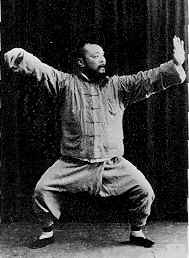
Wu Jianquan of Wu style Tai Chi demonstrating how to centre the coccyx perfectly.
People often get very confused about “tucking the tailbone” in Tai Chi Chuan. It’s a posture requirement that’s mentioned in the Song of the 13 Postures, where it says:
“When the tailbone is centered and straight,
the shen [spirit of vitality] goes through to the headtop.”
The tailbone is what’s more normally known as the coccyx. Notice, there’s no mention of “tucking” here at all, just keeping it centered and straight, which makes me wonder where everybody gets the idea of tucking it from? It’s quite a crucial misunderstanding because the word “tucking” implies bending the hips and tucking under, which results in an unnatural and distorted posture that isn’t comfortable at all. You can’t even stand comfortably like that, let alone fight!
I find that the best way to achieve a centered coccyx is to first bend the knees (you can’t ‘centre’ you coccyx with straight legs) and then relax the lumbar region of your spine. You’re looking for a natural feeling of lengthening. A dropping down. Once you’ve got that feeling then your coccyx will be in the right place. You shouldn’t feel any of the muscles or tendons in the backs of your legs being activated when you do this either, so look out for introducing tension there – it’s usually a sign that you’re starting to “tuck”, rather than lengthen the spine.
Boxing with the legs
I was talking with a practitioner of a so-called ‘external’ style of martial arts today and he said:
“The kwa is very important. Opening and closing the kwa builds energy in all the stances… A weak kwa leads to weak footwork, which leads to a lack of jin in hand techniques.”
Sounds like an ‘internal’ martial art, doesn’t it? I’ve been thinking about what this quote means to Tai Chi. People can mean all sorts of things like the hip or pelvis by “kwa”, but the kwa in this context is referring to the inner thigh (before you Chinese language geeks leap on this, I clarified that this was the area he meant later in the conversation). Obviously as you move through Tai Chi postures the kwa opens and closes. It does this by itself if you let it, you simply need to be aware of it.
After playing around with the form and having this quote in mind I was reminded of something my Tai Chi teacher once said to me. It sounds like a quote from the Tai Chi Classics, but isn’t (I’ve looked for it) – so it must just have been something his teacher said to him once.
“Tai Chi is often called ‘boxing with the legs'”.
At the time it washed over me, but now I think I understand.
You can think of it as being a more pithy and concise version of the earlier quote. What powers the punch in Tai Chi? It’s the legs. How do the legs do it? Through correct posture – the kwa rounded and firm, upper body relaxed and able to channel the power of the ground up through the legs and into the hand. Every time you punch feel that it’s the legs doing the ‘punching’, not the hand or arm – that’s where the source of the power comes from. Put your mind in your feet, not in your head. Do this practice sincerely and you slowly start to feel how the whole body is involved in everything you do – it’s your whole stance and posture that moves into the technique, not segmented bits flailing in an uncoordinated manner. It’s truly a wonderful, wholesome feeling of unity in your self.
Work at it, get it right and you can start to feel how your Tai Chi can become “boxing with the legs”.
To lengthen life and maintain youth
“Think over carefully what the final purpose is:
to lengthen life and maintain youth.”
– Song of the 13 postures.
I’m basing today’s sermon on this often overlooked couplet from the Song of 13 Postures. You see, there’s a lot of talk on online discussion forums asking where it all went wrong for Tai Chi Chuan. How did this deadly pugalistic art of the Chen and Yang families from the bloody 1800s in China become this watered-down, series of sanitised slow-motion movements for old people to do in parks?
As this line from the classic points out, it was never just about fighting anyway. Tai Chi Chuan was always about something more. The argument for staying healthy is a strong one. Even if your main purpose in pursuing the art is to acquire fighting skills what good are they if you’re overweight, ill or have limited movement in your joints? If you’re not healthy then that’s going to seriously inhibit your ability to defend yourself. Yet, do the historical masters of Tai Chi Chuan live up to this ideal? Sadly not. The famous Yang Cheng-Fu was also famously obese and his most famous student, Cheng Man-Ching, was often famously inebriated. Neither of these two unfortunate facts takes anything away from their skill levels in the art.
Is Tai Chi Chuan enough for health? Bear in mind when the words of the Song of 13 Postures were written. Daily life was much more of a grind in 1800s China than it is for us today, with all our fantastic labour (and boredom) saving devices. These days very few of us lift heavy objects, walk very far or move about as much as people used to do on a regular basis. We also eat a lot more, and most of it is high-sugar, high-fat crap.
Quietly, to myself, I often ponder whether the health benefits to be gained by Tai Chi Chuan match up to those that can be gained by, say, going ballroom dancing twice a week. In conclusion, I’d say ballroom dancing is probably the more healthy option, but you can’t go ballroom dancing for those brief 10 minutes in the morning when you’ve got the kitchen to yourself before the kids charge down the stairs and start wrecking the joint. You can’t ballroom dance in that last half hour of the day while the wife is catching up on her soap operas and you slip, unnoticed into the back yard to do a little bit of the form under the stars. And most importantly, for me, you can’t ballroom dance your way out of a violent confrontation.
So, I’m left with Tai Chi Chuan. The great all-rounder. It’s hard to but a label on what it is exactly. It doesn’t specialise in one area too much, but touches on many. Jack of all trades, master of none, or universal panacea? You decide.
 The Tai Chi Notebook