Wisdom from the Pear tree

This is about the fine differences between Tai Chi and Xingyi. Watch this video (some wisdom from the pear tree) first, then carry on reading:

Generally, and as written in the classics, the power comes from the ground up in Tai Chi. I’m not saying you don’t want to start striking until your front foot has hit the floor – that would obviously be ridiculous – but in Tai Chi you do generally move your weight onto the foot in a kind for rolling motion. Just look at any Tai Chi form:

Yang, for example,:

But it’s the same for all of them generally speaking. Moving into a forward posture your weight moves into the technique, which could be a punch, for example, or something else. If it’s not meant to be like this, then all the forms must be wrong and for reasons that are unclear we’re all training to do it wrong so we can do it differently in application? I don’t think so. It’s effective, it works, it’s just different to Xingyi.

Xingyi example showing how stepping is different:

It ties into the strategy of tai chi as well – you train push hands to be good at the ‘in contact’ range, where you can generate power from weight shifts forward and back, without the need to step -e.g. Person punches you, you contact their arm, shift your weight back and turn the waist, deflecting them into emptiness, so you can strike back with ease with a forward weight shift. No stepping even necessary. It’s a good range to work grappling techniques as well.

Generally speaking, and ignoring the animals that like to grapple, Xingyi does not want to be in the ‘in contact’ range as much – you want to be out or in. It’s origin lies in sharp weapons – think about that.

As the classics say, it is rooted in the feet, issued by the legs, controlled by the waist, and expressed in the fingers – some, people might call that ‘all together’ but to me that’s more like a sequence. It can all happen in a microsecond, but it happens from the ground up. Xingyi is different, which is why the footwork is so different. Which is my point in the video. Watch again as I demonstrate it physically – when you use words it’s very open to misinterpretation. Right at the end I do both methods side by side for comparison – they both work, they are just different. Like the way Hyenas and Dogs are different.

Hyenas and dogs – more posts coming.

I’ve written a new training blog, with a video to go with it! It’s on the way, but before it gets here, read this:

http://bjj-australia.blogspot.co.uk/2014/08/a-hyena-is-not-dog.html?m=1

This is one of the reasons I’m writing it – although I’d actually written it before I read that blog post. But I love the point he makes about seeing differences between things that are very similar. Worth pondering.

The eternal cycle of the Lion and the Lamb


Image

Guy trains hard with lions, becomes a lion! Becomes so good he can do it by being soft and using minimum effort. Teaches this soft lamb way to all his students because its obviously superior. None of the new lamb students really get it. The founder dies. The lamb students soon realise that nobody has it and go back to find what the founder did originally to get that good.

It turns out it was to train hard like a lion, with other lions!

Isn’t that the way of all martial arts?

Liquid lightning: The Clear energy of XingYi Quan

Liquid lightning: The Clear energy of XingYi Quan

fists

My friend Scott at the Tabby Cat blog has written a new article on XingYi. Unlike most articles which are concerned with the miniature of detail about how you move the arms and legs, this one is more about what you’re supposed to feel going on inside.

Read it and give it a go!

It’s not the fashion these days to talk about what you should feel in martial arts – as a people we seem more concerned with breaking down which muscle is doing what, or what force vector is going where. So, it’s refreshing to throw that all out and get back to the way Chinese Martial Arts were always taught in the past, which is to get the feel of something, not work it out intellectually.

Enjoy!


As Winter draws to a close here’s a little clip I recorded as the UK was getting battered by storms – some branches had come down in the garden so I used them as improv training tools! Clip is a mix of Choy Lee Fut, Tai Chi and a splash of XingYi.

Hope you enjoy – let me know in the comments!

Winter training

Two sides to the movement coin

There are two sides to the movement coin in Chinese Martial Arts – particularly the so-called internal martial arts. A Yin and a Yang, if you like.


Image

On side a) of the movement coin you’ve got a kind of basic postural advice. Directions we’re all familiar with like – ‘suspend the head from above’, ’round the shoulders’, ‘droop the elbows’, etc. The goal of these directions is to achieve a level of relaxation (‘Sung’) through working with the least level of resistance to gravity. If we can align with gravity it becomes our friend, instead of our enemy in movement. We can discover a sense of lightness and ease in our movements.

On the other side b) of the movement coin there are more subtle instructions to do with things like ‘moving from the dantien’, ‘intent’, ‘wrapping and coiling’, ‘silk reeling force’, ‘open and close’, etc… While these terms are generally unknown to people outside of the Chinese Martial Arts, they are usually familiar to people within them, even if we all understand them in slightly different things, and are willing to go to war over the small details!

Obviously (like Yin and Yang) the two sides form a whole, after progressing beyond a basic beginner level most people assume that they’re ok with a) and spend most of their time working out what the heck b) is supposed to be anyway.

I tend to think that there’s more to a) than we tend to think there is. I’d like to suggest that we put the focus on a) as much as on b), since it’s a) that really has the most impact on how we live our day to day life.

Here’s an article that can help. It’s to do with something called The Alexander Technique, but don’t let that put you off. It’s just great advice for how we ‘use the self’ in everyday life, and it relates directly to part a) of the coin I talked about earlier.

Have a read and see what you think.

http://alexanderviolist.wordpress.com/2014/03/20/understanding-the-primary-directions-which-way-is-up/

Gu Ru Zhang’s book – Taiji Boxing

Finally, a translation of the Gu Ruzhang (Ku Yu Chang) Tai Chi book, Taiji Boxing, by Brennan Translation. This is the style (a version of it, in the same lineage) of Tai Chi that I personally practice. The form in the book is the long form that he learned from Yang Jian Hou, and you should recognise the postures from other Yang forms. It’s not just a book on form movements, there’s a lot of theory here, much of it from the Tai Chi classics, so it’s worth a read for practitioners of any style.

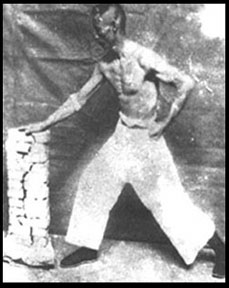
Master Gu Ru Zhang was also known as “King of Iron Palm”, mainly for doing things like this:

guruzhang3B

His approach to martial arts was to take both Internet and External as a whole. He was most known for his Northern Shaolin, but as his Tai Chi book demonstrates, he practiced soft style martial arts as well, including XingYi and Tai Chi. He was an early proponent of the idea of cross training (mixing martial arts). He obviously saw this as beneficial, and trained in many arts, and enjoyed exchanges with different masters.

Find out more about Master Gu.

The big problem with Chinese Marital Arts

hands-touching

This post is something of a follow up to my previous sot on The Delusion of Grace Under Pressure. I’m aware I’m starting to ‘rag’ on Chinese Martial Arts, and don’t want this blog to turn into a negative blog about CMA, since there is much (beyond fighting and including fighting) to be gained by the study of CMA. But the practices are also hobbled by many cultural and out dated modes of training that badly need to be updated, yet are often not due to respect for the ancients, or more likely, the lack of any real need to update them.

If we were living in a war-torn, post apocalyptic future (actually, something like the war-torn Hebei province of old China, in which many of these Chinese martial arts systems first developed) then there would be no debate about this – methods that ‘worked’ would rise to the top naturally and things with no practical value would be abandoned without a second thought. But we do not live in these times, thank goodness, so we are left in a world where we’re all free to carry on doing what we want with no real repercussions. Following tradition, regardless of its application to today’s realities.

Anyway, I’m waffling. The point of this post is about this obsession the Chinese Martial Arts have with starting all engagements from a crossed hands position. Whether its the sticky hands of Wing Chun, the push hands of Tai Chi or the Rou Shou of Bagua (the list goes on) the majority of ‘sparring’ practice is done from a position where you are already touching your opponent.

You can get very skilled in this middle range, and develop an impressive ability to manipulate an opponent. The mistake is assuming that your ability here reflects your ability to fight. In the fight the reality is that you spend hardly any time at this range – you’re either all out, or all in.

This is a Tai Chi blog, so lets use Tai Chi as an example. In push hands we learn to listen and yield to the opponent’s force through the well known push hands exercise. It’s this aspect which is the key to the application of the art in combat. Beginning students are choppy and rough with their pushing and yielding energy, and easily controlled. They lack the flow, balance and smoothness in deflecting incoming pressure that a more experienced Tai Chi exponent can conjure up with ease, often effortlessly deflecting an attacking push to the side without losing the trademark sickly Tai Chi smile on their face.

Yet there is a world of difference between this more civilised practice and the realities of an opponent who is really trying to take your head off.

I think this is the biggest problem with all the Chinese Martial Arts, and the root of their lack of success in ring sports. So much time is spent with doing stuff from hand and arm contact and neglecting the ranges where most of the time is spent in the fight. In actual fights, or free sparring with resistance, it’s very, very hard to get contact with the forearms or hands when shit is going down. It’s even harder to keep somebody there. Why keep training for this almost impossible situation?

Now, I just know somebody is going to chime in with ‘Of course, we train from not touching too, but contact is the starting point for beginners’ – but really, how come 99% of all videos showing CMA applications start from crossing hands?

Western boxing doesn’t start there with its beginners, and it’s got a pretty damn good reputation for teaching people to fight very well with their hands. In fact, it’s the ultimate art for fisticuffs, because that’s all it specialises in (yes, I know ‘old school’ boxing was more like all out brawling with throws and elbows, etc, but I’m talking about ‘modern’ boxing here).

Seriously, I think most CMA has it backwards – doing stuff from contact should be a considered a high level strategy for the very advanced practitioner, not the starting point for the beginner.

I’m not proposing we abandon CMA in favour of boxing, but at least start to practice applications and sparring from ‘not touching’ as the norm, not the exception.

Peng Jin gets talked about all the time in relation to Tai Chi, yet you rarely see anything shown or discussed about its usage and relationship to actual fighting. I wanted to make a video that did that, so here it is!

Tai Chi Chuan, after all, is a martial art, and not just a collection of interesting ways of manipulating ‘force’ in the body for purely health purposes. It’s a martial art that uses Sung Jin, or ‘relaxed force’ in preference to hard strength. One of the reasons why it prefers relaxation over hard strength is that it enables the use of Peng Jin. You simply can’t do Peng Jin unless you are sufficiently relaxed. In terms of martial arts it’s a very useful skill that can be used as shown in the video.

There’s much more to Peng Jin than what I’m showing here – but it would require a much longer video to go into all the intricacies. I don’t, for example, talk about how I’m doing what I’m doing, I just show what the effects are.

Another factor to consider is that Peng Jin should also be a quality that’s always present in the Tai Chi practitioner, rather than something you turn on or off for technique purposes. However it’s the subtle, but powerful, effect of the Peng ‘bounce’ on an opponent that I wanted to demonstrate, so that’s what’s shown here.

The classic “Song of the eight postures” describe Peng Jin as:

“What is the
meaning of
Peng energy?

It is like water
supporting a
moving boat.”

Imagine the way a boat bobs on the water, and that will give you a good insight into Peng.

The (martial) use of Peng Jin in Tai Chi Chuan