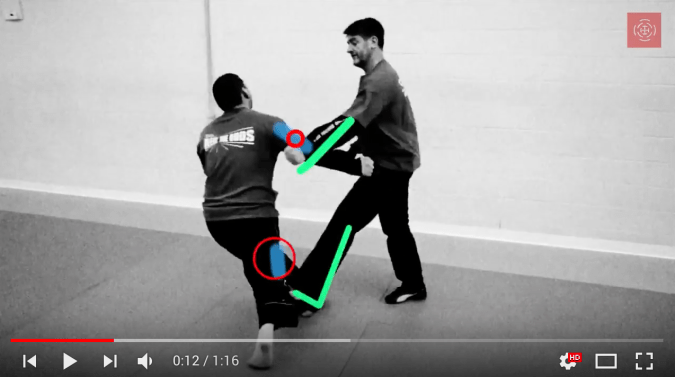
This is a guest post written by Justin Ford of Cup of Kick (cupofkick.wordpress.com) a great martial arts blog you might like to check out.
Close your eyes. Now imagine the best student ever: They are always on time. They always take notes.
They absolutely LOVE learning. They ask really thought provoking questions that lead to even more learning. They work hard, in class and outside of class.
Just keep thinking about how amazing they are. Are you ready to teach them?
Oh, but…I forgot to mention something. They have a couple of flaws: They are arrogant and egotistical.
They are always bragging and showing off. They never show respect. Heck, are their lips staying closed together when somebody else is teaching or talking? They tell lies and are hard to trust because of it. They really couldn’t care less about anybody other than themselves.
Not so perfect now, are they? In the beginning, they sure sounded like an angel that fell from heaven. If their traits ended there, they would learn lots in life, both academically and martially. I mean, who wants to teach an A-hole? Not many people would, happily. Especially not somebody who is teaching because it is sharing a passion of theirs, not so that they can take tuition money.
Most teachers would agree that rather than new knowledge and skills, lesson number ichi would be about respect and proper conduct. Especially if the skills they would be learning are ones they can potentially use to harm another being.
That’s not to say that it would just be the teacher denying them new knowledge though. A bad student stunts their own growth as well. An arrogant mind learns very little.
Let’s turn our eyeballs to feudal Japan and the code of conduct the warriors of that era kept. Bushido.
HEADS UP: Keep in mind that these tenets were never written down and that you will see a different number of them depending on where you look.
If you look at Nitobe Inazo’s famous book published in 1900, Bushido: The Soul of Japan, you will hear about eight tenets of bushido. If you look into other texts that are older, you might only see seven.
A major part of these principles is that they were naturally absorbed into the Samurai class and always expected of them. Therefore they really didn’t need to be written down to remind them of how they were expected to act.
Regardless of the number, each is an important principle that the Samurai were expected to uphold, so let’s take a look at how they lived.
義 (Gi: Righteousness)
The top half is a radical (building blocks for the character) for ram. That might sound like some bull-sheep but rams in China (where the writing character originated) not only represented justice but also frequently represented respect because of the way they often kneel.
The character for ram can also be combined with the character for “big” to mean beautiful. The bottom half of the character means I/me/my and can be used when talking about ourselves, but can also be separated to mean a hand and a spear or a halberd. In a poetic sense, we can picture finding the path of beauty or respect even amongst conflict or struggle.
Even while fighting or arguing, I don’t sweat, I sparkle.
There is even a mythological unicorn-goat in ancient China called Xiezhi that can always tell who is innocent and who is guilty, kicks criminal bootie and – depending on where you hear the legend – even chomps down on the bad guys. Read that sentence again and just let the words sink in.
No matter where we are or what is happening around us, as martial artists we need to uphold our morality and always do what is righteous. Seek justice in the small acts and large acts we perform in our life.

勇気 (Yu Ki: Courage)
The top half of the first character can mean path and the bottom half can mean power. They come together to characterize bravery, or perhaps the path of strength. Understand, that the character for bravery is only a piece of the character for courage or valor.
Bravery is a characteristic of somebody, an attitude. They are willing to be the hero and do what others may be fearful of. Courage is different.
Courage is when somebody is just as afraid as everybody else but accepts what they need to do anyway, whether for personal reasons or for somebody else’s benefit and health.
Did you ever watch the cartoon from the early 2000’s called Courage the cowardly dog? It was about a purple dog that was absolutely afraid of just about everything around it. But when his owners got in trouble, he acted to save them anyway. That’s the kind of courage we are building up to etymologically. That purple dog kind of courage.
The second character can actually be written a couple different ways. The Japanese version is what I listed above. The traditional Chinese version would be 氣 . The character is composed of the radical for uncooked rice and steam.
Stick with me now. I promise I haven’t gone too crazy.
There is a connection between courage and cooking rice. Pinky promise. You see, the two radicals for the last character combine to mean a lot of different things: steam, air, gas, and more. It’s pronounced “ki” in Japanese and “qi” or “chi” in Chinese.
Yep.
The same “mystical” ki us martial artists always make a big deal about. It simply means energy. Not in an “ooooooollld chinese secret!” manner, but rather in a scientific way. The steam rising off of rice. That can be looked upon in a lot of different ways, philosophically and otherwise, but we’ll cover that in a later blog post.
To sum it all up, the two character together can represent the energy to be brave. Being brave while facing down somebody trying to brunoise dice you takes effort. It takes energy. It takes ki.
仁 (Jin: Benevolence)
I love this character! So. Much. If you wanted to describe benevolence, how would you do it? It takes some thinking but it is actually a lot simpler than one might think. There are two parts to this character. The radical on the left which represent man in the general humanity sense. The other radical (the two horizantal lines) means two.
Jin, benevolence, is the connection between two humans beings. It is how we treat the people around us, whether they are a hobo or a Hollywood celebrity. It represents what unites two people living on this planet earth together.
I suppose it should extend to a visiting alien or ghostly spirit as well though…
禮 (Rei: Respect)
“REI!”
Admit it.
You just bowed, didn’t you?
Plenty of martial arts, especially Japanese ones, know rei to mean show respect. Let dive into the meaning a little further though.
The character is composed of two different radicals:
- Abundance or plentiful
- Demonstrate or manifest
Together, they are seen to represent a plentiful sacrifice for a ritual or ceremony. An act done in reverence and respect for somebody or something. An act that has importance. I find it worth noting that the modern simplified character (simplified Chinese came to existence around 1950’s) uses the radical for mysterious/small. The small things we do should be treated as a part of a rite with importance. Respect should be shown in every action we demonstrate and word we speak.
誠 (Makoto: Sincerity)
Half of the character is a radical meaning words or speech (it represents a mouth with a tongue sticking out or sounds coming out). The other half means complete or finished. Together, we get “the complete speech”. Nothing hidden. Nothing left out with ill will.
Every martial artist (as well as decent human) should thoroughly practice integrity in their everyday living. Your students need to be able to trust you. Your classmates should be able to believe you. Your words, actions, and intents should never misalign.
This only becomes more important as the amount of McDojos increase around the world. Remain honest and sincere.
Perhaps most importantly though, you should be able to be honest with yourself.
Don’t pretend your favorite technique is invulnerable. Don’t make up an answer to your student’s question because you don’t know the answer. Admit when you make a mistake. Only then can you begin to really learn and grow.
Learning something new means admitting you didn’t know something before.
There is an unfortunate disease that spreads through any top level athlete or artist: ego. And that ego often leads to a lack of integrity in ourselves.
- “Oh, I didn’t finish Bassai Dai perfectly because I’m just still tired from yesterday’s workout!”
- “I could have beaten that guy in sparring but I wanted to go easy on him.”
- “The other guy won the tournament because of favoritism from the judges!”
Just as we strive to be honest to the people around us, let’s be honest to the person inside us.
名譽 (Meiyo: Honor)
The first character means position or rank/place (in the manner of where you stand among winners. 1st place, 3rd place, etc.) and can be broken down to mean…evening and mouth.
Y’know, it actually kinda makes sense.
I don’t know about you but I’m not getting out of the bed in the middle of the night unless the person calling my name is somebody really important. My dog and my teacher would get very different reactions to calling me and interrupting my beauty sleep.
The second character means praise or reputation. Break it down and you get “the words one carries on their shoulders”.
You can put the two characters together to mean “a position that is praised or carries a reputation” My question is this: Where does your reputation start?
Does your title give you meaning or are you the one giving it worth and weight?
Meditate on this deeply.
忠義 (Chu Gi: Loyalty)
This is another set of characters that can be viewed in a very poetic and beautiful way. The first character has two parts, heart and middle. It means devotion, something your heart is centered on.
The next character means righteousness. Yep. The same character we talked about at the beginning.
Remember? Man-eating justice obsessed unicorn goat? Yeah, we’ll just keep it moving.
Together, they can mean devotion to justice. It is interesting to note that the righteousness character can also mean adopted. We can also view this as staying devoted to the what and who we adopt.
~~~~
What’s important to remember is that being a good person leads to being a good student and a good martial artist because of it (in addition to many other reasons).
If you teach kids classes, then that is one of the most important lessons you can teach. Heck, it applies to grown adults as well.
Martial arts are about living, not just surviving.
I don’t know about you but I don’t have a guy around the corner trying to punch me or stab me every minute of my waking day. I can’t recall but hopefully not in my sleeping nights either.
The part of your martial arts training that you get to use most is the moral and ethical side. Every day, we have to make decisions about how we act and just like most anything else, we can train to improve.
Ethics along with ability is such a universal idea that it is even prominent in other cultures and arts, not just in the east where respect is an inherent part of the country:
- Chinese martial arts have a similar code of conduct called Wu De
- European knights had chivalry
- The pirates of the 17th and 18th century commonly had Articles of Agreement on how to conduct themselves
- The Bible lists the Ten Commandments
- Ancient Rome had the Corpus Juris Civilis Or Body of Civil Law
- The medical field has the Hippocratic Oath
- Modern courts in the US go by Common Law
It doesn’t matter what your “power” is, you have a responsibility to not abuse it.
It is a gift. Not just a powerful weapon.