This video of a lady doing Tai Chi on a balance board popped up in my Instagram feed today and I’ve got to say – not bad at all! Her balance looks fantastic. Obviously, she’s also super flexible ( she looks like she’s adept at modern gymnastic ‘wushu’, not just tai chi, to me), but that has nothing to do with how well she’s balancing.
This balance board device looks like great fun to play with! I’ll have to find one. I like doing things like that that test my balance. My local park has a play area with a strange circular rotating… er… thing?… in it. When my kids were little I used to take them to the park to play on it, and I used to try and do tai chi on it while they jumped on it at the same time:
That thing is very hard to balance on, let alone walk around on while it’s moving. It goes surprisingly fast at times.
I was taught specific body-lightness training as part of my tai chi training, and it really helps with things like this. My teacher’s notes described it as giving you ‘better than normal balance’ and when I read that I thought it was a bit of an exaggeration, but once I got to that part of the training, I realised that this was a perfectly good description of what it gives you. The training involves a chi kung exercise (internal training) as well as doing the form with weights on your ankles (external training) then combing the two. It’s the sort of thing you have to concentrate on to have: Like a switch you can turn it on and off.
Better balance is one of the things I find that people come to tai chi for. The good news is that I think the whole process of learning the form gives you significantly better balance. The specific body-lightness I’m talking about is part of the whole training process and takes time to get to, as well as time to practice before you ‘get it’. Sadly, it’s not something I can just impart to people, because I would if I could. It’s damn useful.
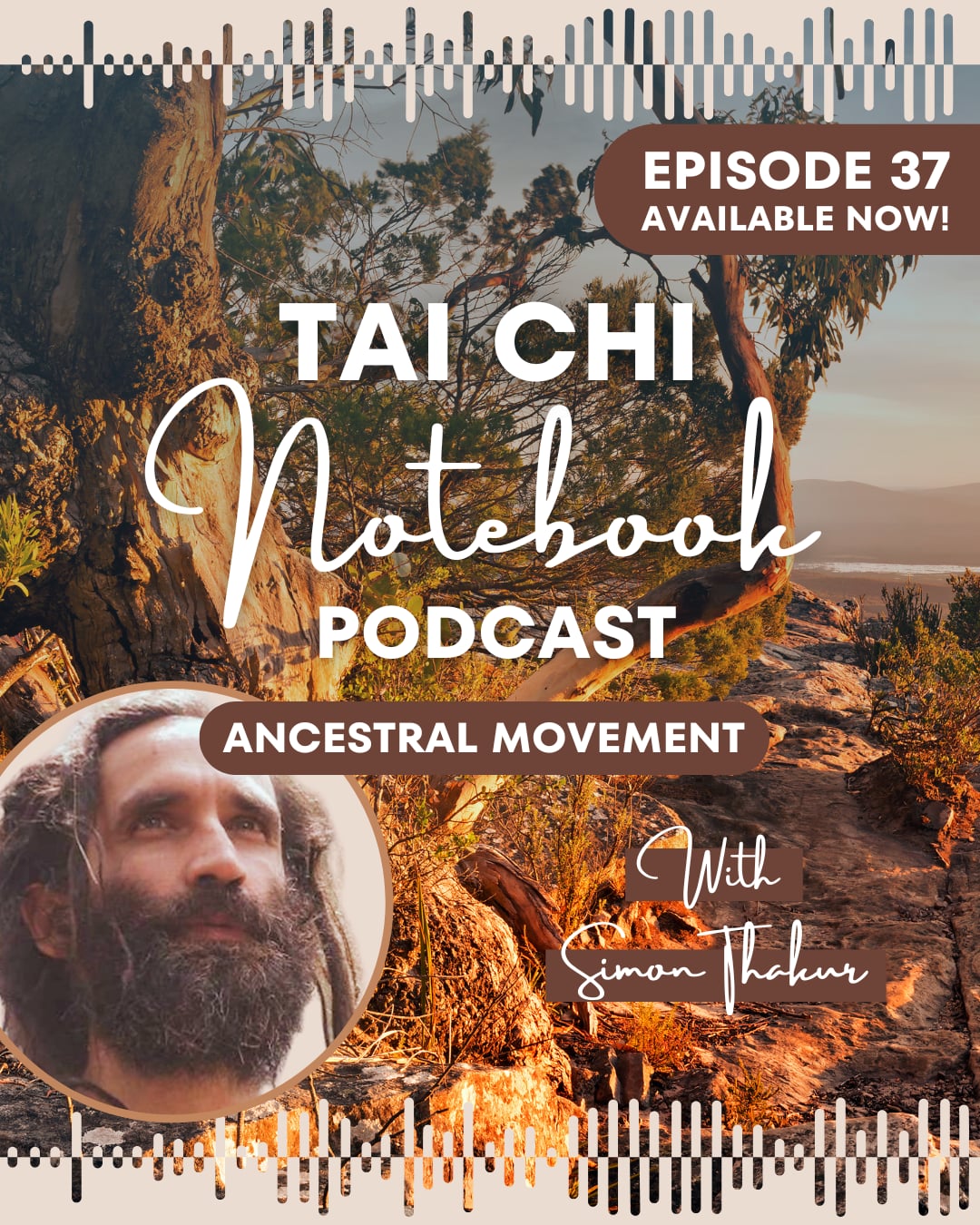
Simon Thakur is the founder of Ancestral Movement, “An ecological approach to movement and mind-body practice, exploring ancient ancestral patterns of movement and awareness built into our bodies, rediscovering the power, grace and ease of natural movement and our bodies’ innate connection to the rest of the living world.”
In this episode we talk about many subjects including Yoga, Chinese Martial Arts, Brazilian Jiu-Jitsu, Tai Chi, Shamanism and more!
Hello! Happy Year of the Snake, dear reader. On an occasion such as this is would normally be customary for a tai chi blog like mine to do a little post about the influence of the snake on tai chi, kung fu and Chinese culture in general.
Snake is, after all, one of the five main Shaolin kung fu animals, one of the 12 main xing yi animals and frequently appears as a menu item in Chinese restaurants, er no, sorry, I mean, appeared in Kung Fu Panda!
But, no! I’m not going to do that; partly because it’s such an obvious thing to do that I’ve done it before, and I hate being predictable, or at least repeating being predictable, but also because I’ve just recorded an excellent conversation for my next podcast with Australian national treasure and sometimes-Chinese-martial-arts-practitioner, Simon Thakur of Ancestral movement about finding your inner, ancestral animal, including, of course, the snake, and I just need to find the time to get on with editing it so I can get it out to you lovely people.
I think that what Simon says about our human connection to snake-style movement is probably more valuable than whatever I’ve got to say on the subject of our slithering cousin. So, I’ll leave the snake talk until the podcast comes out!
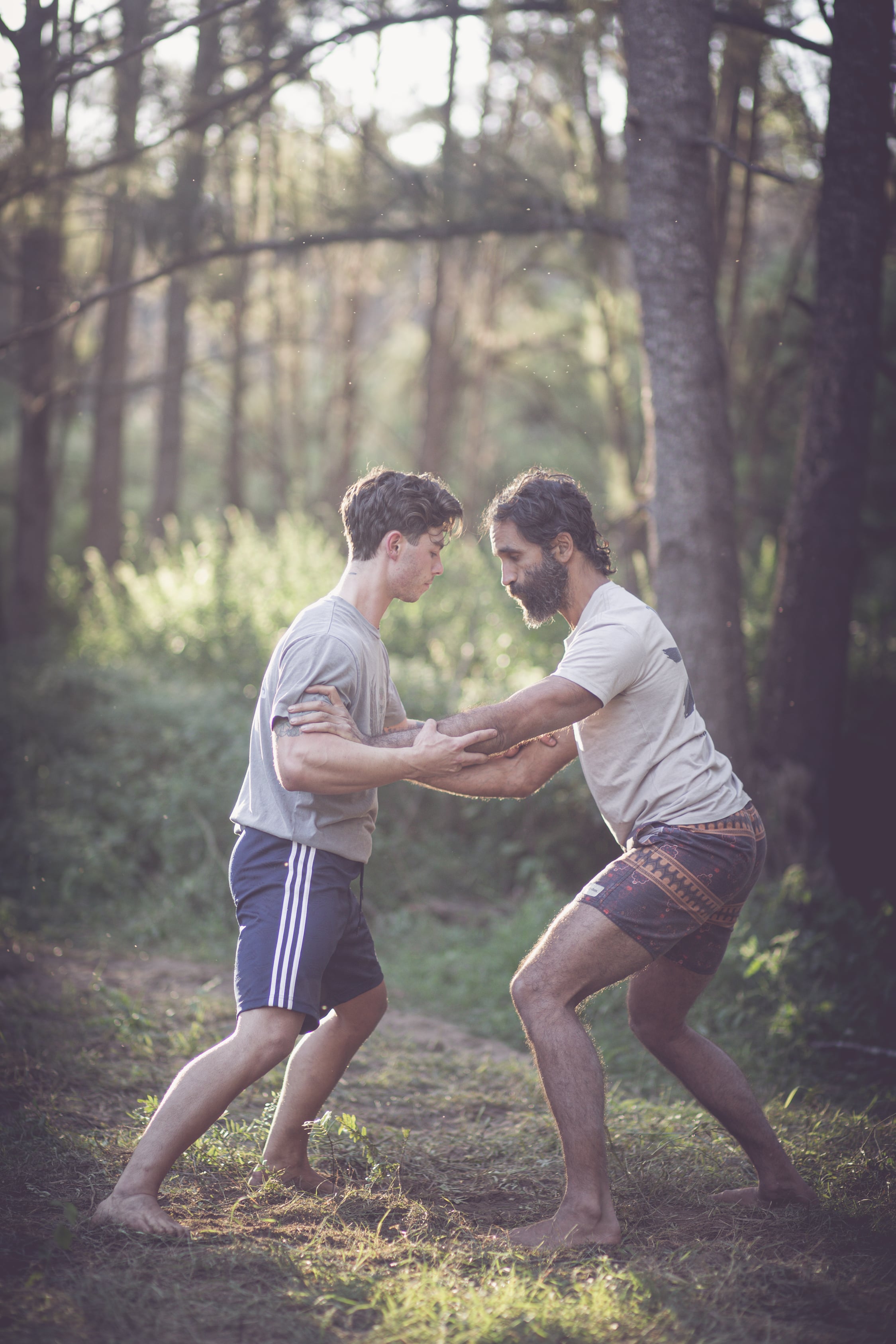
Simon Thakur, trying to locate his inner snake while doing an impromptu bit of Fox Trot in The Bush.
In the meantime, while you wait for that podcast to properly percolate (all the best things take time) I’ll leave you with a thought. “Tai Chi is more than the techniques, it’s the jins that make it interesting”.
If you listened to my last podcast with the esteemed Alan Wycherley of ‘In Defence of the Traditional Arts’, you might be forgiven for thinking that I’m all about training tai chi techniques. Now, while I’ve no objection to practicing a Repulse Monkey or a Part Wild Horse’s Mane (or two), or even a Snake Creeps Down, I definitely agree with the statement that tai chi is more than the moves. In fact, I think we can probably agree that tai chi applications aren’t that great as martial techniques. There are (shock!) other martial arts that have more effective techniques. Hello, Brazilian Jiu-Jitsu, I’m looking at you. Hello, Choy Li Fut. Hello, Western Boxing. Hello, Muay Thai, stop hiding at the back! Yes, all these martial arts have techniques that I would probably put ahead of anything found in a tai chi form, regardless of style. They’re practical and effective. And yet, I practice tai chi. So, why is that?
What tai chi has, and emphasises over techniques, are the eight energies – the jins: Peng, lu, ji, an, etc.. What you are doing when you practice a tai chi form is emphasising energy changes using these eight over technique. Flowing from one to the other a bit like a river flowing along smoothly. Sometimes there are fast bits, sometimes there are slow bits, sometime the river turns one way or another, but its energy flow keeps going.
When I practice other martial arts, my emphasis is more on technique. When I practice tai chi I can relax and get more inside the movement and concentrate on the energy flow.
And of course, in tai chi push hands you get to interact your energy flow with the energy flow of another person in a live situation, and that’s extremely valuable for developing martial ability. Techniques are another thing.
Now, if the analogy of a river doesn’t work for you then think of something else… perhaps, a snake? Snakes can flow along smoothly, they can change direction sharply and they can be incredibly powerful or incredibly quick, as well as slow and suffocating. They’re a great example of energy changes.
Homework
In preparation for my next podcast allow me to recommend a documentary by professional paleontologist and evolutionary biologist Neil Shubin called Your Inner Fish. (He’s written a book of the same name, if you prefer to read about him). Snakes come out to play in episode two. Here you go:
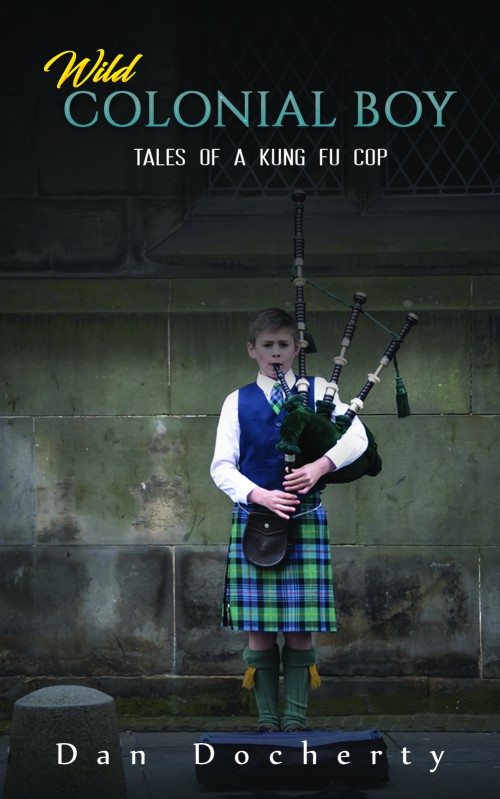
My latest podcast with Alan Wychereley, who was as student of the late UK tai chi legend Dan Docherty inspired my listener/reader Steffan Stringer to track down Dan’s autobiography “Wild Colonial Boy” (I have to admit, I’d heard of this book before, but never read it, and in my mind it was always called “Wild Caledonia Boy”, which, I think, given the Scottish-centric design of the cover would have been a far better title!)
“In 1975, Dan Docherty, a young Scots law graduate and karate black belt, left Glasgow to spend nine years as a Hong Kong police inspector.
As well as serving as a detective and vice squad commander, he also took up Tai Chi and won the 5th Southeast Asian Chinese Full Contact Championships in Malaysia in 1980.
In 1985, he was awarded a postgraduate diploma in Chinese from Ealing College.
He travels extensively teaching Tai Chi and has written four books on the subject.”
When I started Tai Chi in the early 90s everybody had heard of Dan Docherty, and he was something of a big name, not only because of his competition success, but also because of his reputation for unmasking frauds. I remember him gaining a lot of notoriety for pouring a bottle of water over the head of an ethnically Chinese Qigong teacher who was doing seminars on Ling Kong Jin or “Empty force”. Dan’s reasoning was that if he could move people without touching them then he should be able to deflect the bottle without the need for physical contact. It didn’t work. He was also famous for “getting into it” with one of the Yang family representatives in the UK, who ended up leaving the UK after their encounter.
Sadly Dan Docherty died of complications from Parkinson’s disease in 2021. I never met Dan in real life, but his impact on the UK tai chi community continues to be felt long after his death. That’s probably the best legacy a tai chi teacher could hope for.
Greg Souders on the Grappler’s Perspective podcast.
In the last episode of my podcast episode with Alan Wycherley about fantasy vs reality in tai chi we mentioned a subject that might have been unfamiliar to some of you – the ecological approach. This is a training method that is finding a lot of familiarity with BJJ right now, but I believe it has always been a part of tai chi training too, since tai chi contains push hands as a training method, which has the potential to be a free and playful exploration of movement.
Rather than try and explain the ecological approach myself, I thought it would be better to hear directly from the guy who made it famous in BJJ, Greg Souders. As you’ll discover, he’s not afraid to say controversial things about the learning method adopted by most BJJ academies!
So, here he is on a no punches pulled episode of the Grappler’s Perspective podcast. Have a listen and see what you think:
Thanks to everybody who has listened to The Tai Chi Notebook Podcast over the last couple of years! And, if you were wondering, I’ve got a new episode already recorded and coming out in a week or two…
I had a chat with Alan Wycherley from the In Defence of the Traditional Martial Arts YouTube channel for my podcast and the episode is now live. We talk about how Tai Chi can be used as a realistic self-defence system and Alan’s encounters with traditional martial artists from different kung fu systems.
I often wonder what most people’s biggest fear is in Tai Chi. Or what it is that stops them trying it out? Is it looking silly? Is it the fear of other people in the class looking at you as you struggle to get the movements? That you won’t fit into the group?
Believe me, everybody feels the same. You do need some willingness to be open to new experiences if you’re going to try a Tai Chi class for the first time, but just say to yourself, what’s the worse that could happen?
You can learn Tai Chi online these days, but nobody I’ve met in real life who learned online had much of a real practice, as far as I could see anyway.
To learn Tai Chi you need somebody to point out everything you’re doing wrong, because on your own, you won’t see it. Even if you know that your knees aren’t supposed to bend inwards, and are supposed to be in line with your toes, you’ll let your knees collapse in without realising your doing it.
Often those ‘light bulb’ moments in Tai Chi occur when somebody points out what you’re doing wrong without even realising you’re doing it, and for that you need a teacher.
If you’re thinking about starting Tai Chi classes in the new year then dig deep and give it a go. You won’t be the only one who is a bit nervous, and once you realise that everybody else is just as worried as you are you can relax a bit and enjoy it. Believe me, your teacher will simply be pleased to see you. What have you got to lose?
Doing both BJJ and Tai Chi I love seeing moves from one art crop up in the other. Imagine my surprise when I happened across this BJJ seminar clip where the coach seems to be cycling unawares through a variety of Tai Chi moves.
At one point he says that one of the moves looks like “some karate bullshit that looks silly but works”, which is funny because you could describe Tai Chi like that as well 🙂
If you do Tai Chi or Bagua or pretty much any long fist style Chinese martial art, or probably Aikido, you’ll recognise these moves. I’ll give them Tai Chi names:
Breakdown
It starts with a grip break, that is similar to Hidden Hand Punch from Chen style (0.00- 4.00) The first technique from here is like Needle at Sea Bottom (4.17- 6.15) The second is like Diagonal Flying (6.15 – 9.20)
After that it becomes more traditional wrestling/judo takedowns, but it was nice to see some Tai Chi appearing fora minute there.
While the rest of the video is much more of the usual jiu-jitsu fair, the initial positions have a strong similarity to Tai Chi moves, and could definitely help Tai Chi practitioners become more aware to the martial potential of Needle at Sea Bottom and Diagonal Flying.
Now, you can agree or disagree with Rantwo’s opinion on whether the Pak Mei guy can fight or not. Personally I think Rantwo brings up some good points, but I’ve heard other people argue that he’s kind of missing the point – sparring never looks good.
Anyway, I don’t want to get into that. My comment on the video would be that Rantwo is making the classic mistake that a lot of people make when looking at videos of traditional master getting beaten up by average/bad kickboxers and then deciding that martial art XYZ must be no good: It’s always a reflection on the person involved, not the whole style.
I don’t think you can view a couple of videos of Pak Mei guys then decide the whole style is “not for fighting”. I can guarantee you there are Pak Mei guys out there who have no problem throwing down. To just dismiss a whole style like that seems to be incredibly naive.
When it comes to sparring, I don’t think there are styles, there are just individuals. At least that’s the way I look at it.

 The Tai Chi Notebook