New book alert! Chen Taijiquan Illustrated

Thanks to Ken Gullette at Internal Fighting Arts I just caught wind of this new book that’s just come out called Chen Taijiquan Illustrated. I had a quick look on Amazon using the “Look Inside” feature and the illustrations look fantastic. It looks like it’s designed to be halfway between an instruction manual and a comic. It’s a very cool style that’s quite unlike any Tai Chi book I’ve seen before.

Chen Taijiquan Illustrated – available now!

I think that often Tai Chi books, with pages after pages of printed text, can be a bit off putting for people who are learning an art that is all about feel, movement and “doing it”, not “reading about it”. And when they do have photographs in them they are often black and white and a bit dull and lifeless. So, for the visual learners out there, I think the colourful and imaginative approach found in Chen Taijiquan Illustrated will work very well.

Here’s an example:

An extract from Chen Taijiquan Illustrated by David Gaffney and Davidine Siaw-Voon Sim

Here’s another thing: Looking at the contents page, this is the first Tai Chi book I’ve seen that mentions the concept of Man, which translates as Slowness, apart from the book written by my Tai Chi teacher. Man is a concept my teacher talks about a lot, and it’s nice to see it mentioned in another Tai Chi book – I was starting to think that it was a concept that was unknown to the rest of the Tai Chi world!

Tai Chi Chuan a comprehensive training manual by Raymond Rand

Obviously everybody and their dog knows that Tai Chi is done slowly, but Man is more of a mental quality than a reference to the speed of the form. It can be thought of as “not rushing”. The speed you are moving at is irrelevant to the concept of Man, but if you want to acquire the ability of Man then the best way is by slowing the form down and focusing on keeping your mind on what you are doing. Whenever you find your mind wandering off you just stop the form (no matter how far through it you are) and start again. After a few weeks or months you’ll find you are much better at staying focused on your form than you were before. By adopting the qualities of “not rushing” you open up the headspace required to be aware of other things going on, things that you would simply miss otherwise. I’ve written about not rushing before.

At £16 Chen Taijiquan Illustrated is not particularly expensive for a colour book either. And I’d love it if there was a book on Brazilian Jiutjisu that was written and illustrated in the same manner because I think it would also benefit from this approach. Incidentally, there was a good book written about Brazilian Jiujitsu recently, that has colour photos (and very nice ones too) that I still dip into now and again called Nonstop Jiujitsu, by Stephan Kesting and Brandon Mullins. I reviewed it on my blog recently, so check out my review.

Nonstop Jiujitsu by Brandon Mullins and Stephan Kesting

I’ve ordered my copy of Chen Taijiquan Illustrated so will review it at some point in the future.
What’s better in martial arts – Body Methods or Foundational Movements?

I got asked once by a CMA practitioner what the “Shen fa” (body methods) of Brazilian Jiujitsu were and I drew a blank. The only answer I could come up with was “we don’t have any”. What I think we have instead though are foundational movements. Let me explain.

While Chinese martial arts like Tai Chi, Xing Yi and Bagua all have “Shen Fa”, which are “body methods” that need to be internalised before the practitioner can be considered sufficiently proficient in the art, Brazilian Jiujitsu doesn’t have them in the same way. Instead, it has a series of foundational movements that crop up so often in techniques that they are considered the foundations of the art, and are usually done in class as warmups.

I taught an interesting Jiujitsu class this week. (Well, I thought it was interesting – I think you’d have to ask the students themselves what they thought!) I started with the group practicing the basic Technical Stand Up both forward and reversed (which is doing it backwards, so you go fro standing to sitting down), then with variations like a knee or an elbow on the ground instead of a foot or hand.

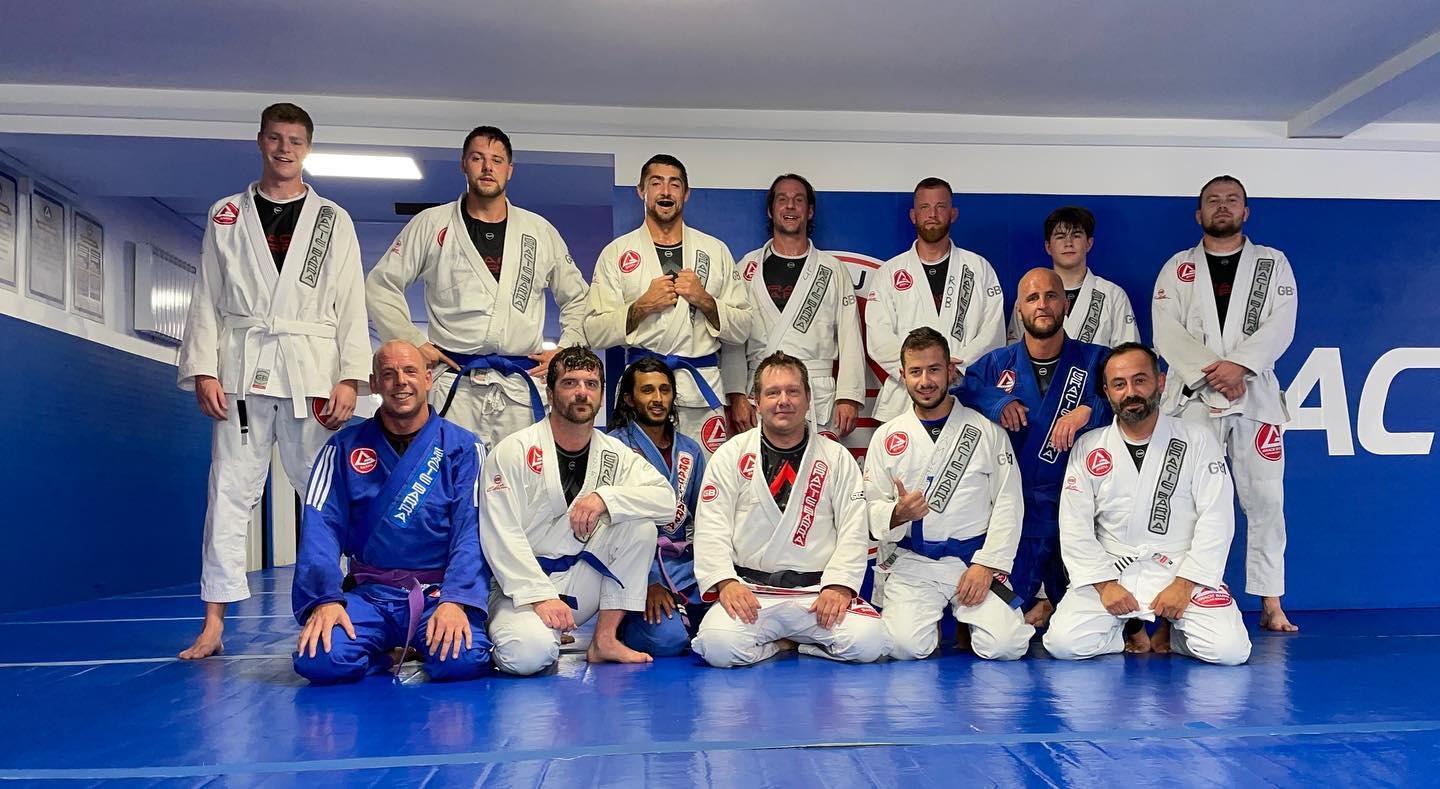
Sweaty work – a fun class!

A Technical Stand Up is a way of going from sitting on the ground to standing up that exposes you to the least risk if you’ve got an aggressive person attacking you. It minimises your chances of getting kicked in the head and also affords you the ability to kick back at the attacker’s knee, possibly hyper extending their leg painfully.

How to do a Technical Stand Up

Once everybody in the class could do a Technical Standup well enough we went on to practice applications that utilised it as part of the technique. A good example is a basic X Guard sweep, or a way of returning to base after completing a tripod sweep. (I’ll not explain what those are here, because I don’t want to get lost in the details of these techniques in this post, because that’s not what this is about.)

Foundational movements in Jiujitsu include the aforementioned Technical Stand Up, but also things like a bridging movement, a hip escape (shrimp), a triangle, a forward (and backwards) roll and an inversion. If you can’t perform these basic movements correctly then your chances of doing any technique correctly are going to be severely limited.

In contrast, Chinese martial arts “body methods” include things like dantien rotation, opening and closing the chest and rounding the kua. These body methods are postural observances and ways of moving that need to be kept in place during all movements.

Why one art should have developed body methods, and the other not even have that concept, is worth thinking about, and I think it relates to the role of form in Chinese martial arts. Practicing solo movement in the shape of a form done in isolation from other people allows the possibility of subtle things like body methods to be developed.

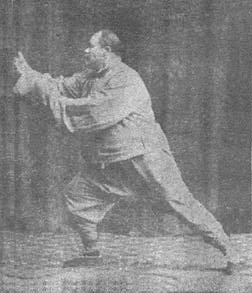
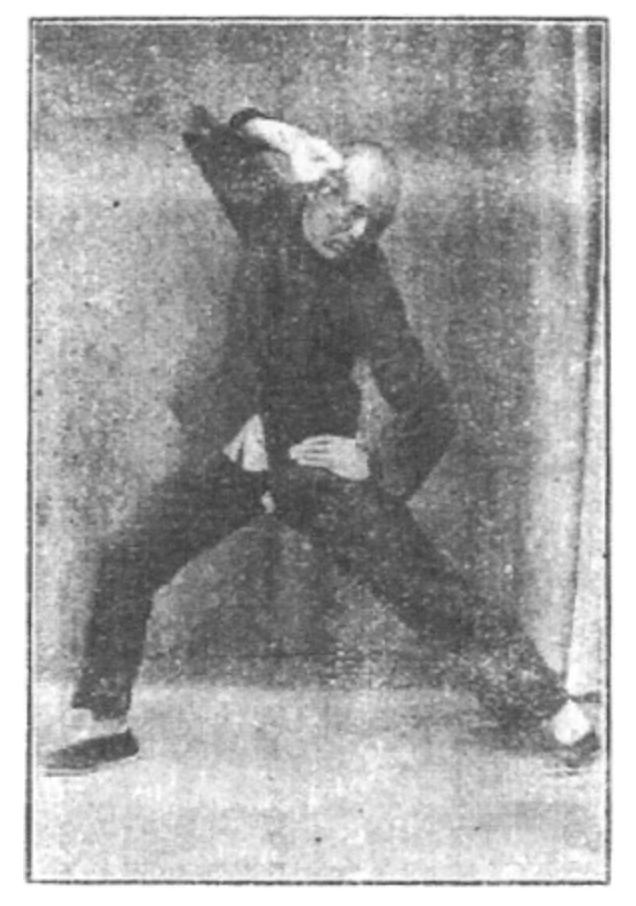
Torso Flung Punch by Chen Zhaopi, 1930,

There are no forms in BJJ. Sure there are solo exercises you can practice to warm up or condition the body, but they don’t have the same function as form (tao lu) does in CMA. BJJ is heavily partner orientated. All the drills and sparring need another person physically there to do it with. To practice BJJ we literally have to get together with other people in nice matted areas and throw down. There is no other way.

These body methods in CMA have resulted from forms, but my suspicion is that this was never planned, rather they have grown out of a situation that happens when you are required to practice forms. Why CMA started practicing forms in the first place is a different question – there are some clues as to why that might be in the video I shared the other day by Simon Cox on the Taoist concept of the Subtle Body.

It’s analogous to the situation in China between Shuai Jiao and Kung Fu (Wu Shu). Shuai Jiao has no extended tao lu (forms), like Kung Fu does, but it has an awful lot of solo conditioning exercises with and without weights and belts. I’m not a Shuai Jiao practitioner, but I think you’d be hard pressed to say that Shuai Jiao has Shen Fa in the same way that the various Kung Fu (Wu Shu) styles do.

Is one approach better than the other? I don’t know. They’re just different and personally I enjoy practicing both.

Why you should know (at least) two different styles of Tai Chi Chuan

Back when I interviewed Michael Babin on my podcast he mentioned that in addition to Yang style he also practiced Sun style on the side. He felt he got quite a lot out of it because Sun style emphasised different things when compared to his main style.

Single whip posture by Sun Jianyun, 1957

I didn’t mention it at the time, but I also have a Tai Chi-style (1) that I do on the side, and I practice it for exactly the same reasons as Michael: I get things out of it that aren’t emphasised to the same extent in my main style.

While my Yang style uses deep, wide stances with obvious circular movement coming from the dantien, my side style has slightly higher, narrower stances and is less obviously centred around the dantien area. Both styles use whole body movement, but with the different physical emphasis there’s more headspace available to focus on other ways of achieving whole body movement – effectively making more use of opening and closing the body. I think that is also exactly how Sun style compliments Yang style, too. By practicing my side style I get to focus more exclusively on the opening and closing of the body, and I can then bring that back into my Yang style practice.

Of course, style purists will find fault with this approach. I’ve nothing against people who only practice one Tai Chi style all their life, or even practice only one martial art all their life. There’s definitely something to be said for ‘don’t fear the man who has practiced 10,000 techniques, but fear the man who has practiced one technique 10,000 times’. And, of course, any Tai Chi style should be enough, on its own, to take you to the highest levels of the art. But I think that if you only practice one style then it’s at least worth dabbling in another, just to get that new perspective on what you already do. In my experience this will make you a better Tai Chi practitioner and a more well-rounded martial artist, if for no other reason than you’ll gain experience of defending attacks from more than just one style.

When we look at well known martial arts masters of the past there’s a pervading view that they only practiced one style, or were only permitted to practice one style by their teachers, but history is full of examples of famous masters who were well known for cross training – Ku Yu Chang, Sun Lu Tang and Wang Xiangzhai, to name but 3.

In terms of biology, nature prefers diversity, if the gene pool of a species starts to become too small you get inbreeding leading to genetic defects. You can see this happen in marital arts styles that become too insular as well. They maintain their purity, but at what cost? They becoming dysfunctional.

I’m all for diversity in my martial arts training and in life.

  1. The side style of Tai Chi I practice is a UK-centric style called Li style. I’ve been doing it since the 90s and while my interest in it can wax and wane it’s been a constant for over 30 years now. The Li style form is a nice, relaxing form to do. It’s slightly controversial because you can’t find the style in China, which is an obvious red flag, but I stopped caring about that a long time ago. I do it because I enjoy it. If I didn’t enjoy it I wouldn’t do it. It doesn’t matter to me if it was “made up” in the 1950s, or not. I mean, at some point everything was “made up” anyway, right? So what matters is if you get something out of it and if you can do it following the Tai Chi principles, which in the case of Li style, you can.

    Li style essentially looks a bit like Wu (Jianquan) stye. The form starts off following (very) roughly the same pattern as Wu Jianqan style, but after White Crane Spreads Wings it splits off into its own sequence, which is nothing like any other Tai Chi style I’ve seen before. It’s a very long form, with no repeated sections, and I’ve never quite been able to get to the end of it and remember all of it satisfactorily, but I can get quite a long way through it. Here’s a video of the Li form being done.

The Taoist subtle body, by Dr Simon Cox

This is a very interesting interview with scholar and practitioner Simon Cox, PhD, whose book on the history of the concept of the subtle body is available on Amazon. Simon lived and trained full time in the Wudang mountains for over five years and has lots to tell…

I’m hoping to have Simon as an upcoming guest on my podcast, so if you can think of any questions you’d like me to ask him about what it’s like training Taoist martial arts in an actual Taoist monastery then put them in the comments. Thanks.

If you’d like to learn more about Simon, see amazing photos from his time in China, and join his mailing list to hear about all the cool stuff he’s offering, check out okanaganvalleywudang.com.

The most successful martial arts movement of the first half of the 20th century, that you’ve probably never heard of

I find I’m getting increasingly fascinated by the concept of ritual, magic, and how it relates to Chinese martial arts. I think I’ve just never been satisfied with the explanation that forms in Chinese martial arts are there for cataloguing techniques. There are many martial arts in the world that do not require forms to catalogue either their techniques or body methods (Shen fa). When something like that so obviously doesn’t add up, I think there has to be something else going on. But what?

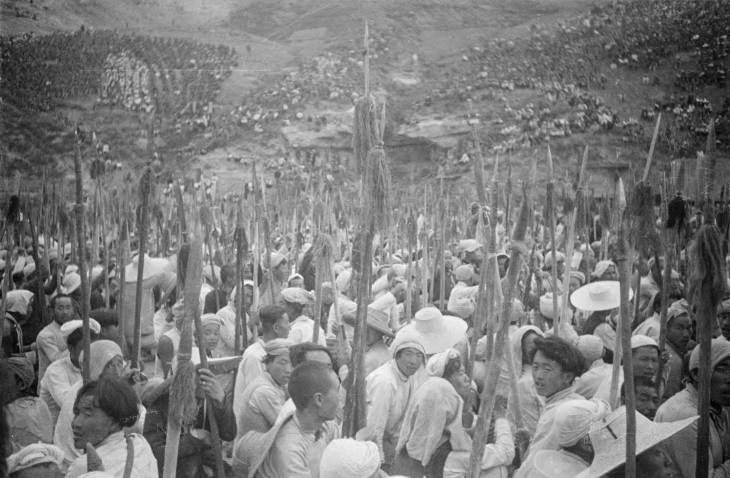
It’s been a long time since I’ve linked to Ben Judkins excellent website Kung Fu Tea, but I’m going to recommend that you give this article a read. It’s about the biggest group of 20th century Chinese ‘martial artists’ that you’ve probably never heard of. They were called The Red Spears. And despite having a membership in the millions (millions!) they tend to get wiped from modern historical accounts of Chinese martial arts. Made up of poor, usually illiterate members, they existed away from the cities and the urban areas, where all the well known marital arts groups like the Jingwu Association and the Koushu Association existed. Urban association tended to write books and leave more newspaper articles as evidence for historians. The Red Spears had the numbers, but they were out in the sticks, and out there, less ‘scientific’, ‘outsider’ and ‘western’ ideas pervaded. There we find war magic, rituals and mystical arts.

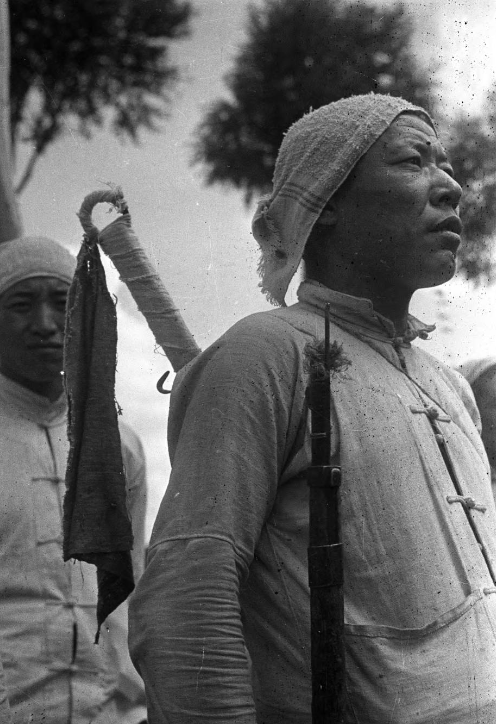
Yanan China Peoples’ Militia member.

The Red Spears, as effective grassroots organisers in local areas seemed to perform something of the same function as elements of the historical Yakuza in Japan, stepping in when local authorities overstep their mark and being effective at “getting things done”.

And despite the name Red Spears, let’s not forget that these militia groups, like all militia groups, carried rifles. Performing magic rituals and being in a secret society did not mean they rejected all modern technology. 

The article contains a report called “Background and Doings of China’s Red Spears By Norman D. Hanwell (Asia Magazine), The China Weekly Review, August 19, 1939. Page 381” which talks about practices that don’t seem a million miles away from what we would call chi kung these days, if you made it more secular and removed the practices we would call superstitious.  

“Through the customs of the Red School probably differ from locality to locality and naturally the secret part of their program is difficult to confirm, since no outsider is permitted to attend, there are descriptions by Chinese in print. In some sectors members of the Red School “got to school” in a temple each evening. Arriving with their red-tasseled spears. Reaching the School Hall they come before the incense altar common to all Chinese Temples, bare their backs and kneel to listen to one their leaders lecture. Following this, each one breaths deeply and beats his breast, ending with the shouting of the slogan “Chi Kung lai yeh!”—a phrase difficult to translate. Perhaps it might be compared to “The gods be with us!” a short incantation from which strength may be obtained. Out of this process some of the Red Spears are convinced of their invincibility in battle and immunity to death therein.

The Type of Training

Certain persons profess to find in this type of training some scientific basis. For example, the regular evening attendance, the listening to lectures and the sitting in meditation are good training, they claim, for the development of the quality of serenity or tranquility.  The practice of holding the breath and beating the breast is excellent for developing the lungs. The crying out of the slogans is declared to be good training for breath control. Whether we accept any of these “scientific” values or not, we must admit that there are psychological advantages to be obtained from these practices. The peasant convinces himself of his own ability to undertake certain tasks, and his conviction inevitably increases his effectiveness.

A recently made investigation of the White Spear Society of Anhwei Province, an area now under Japanese occupation, reports that the superstitious “Chu kung lai yeh!” has been replaced by slogans more appropriate to present activities. Among these are “Kill the Eastern Sea Devils”—that is, the Japanese—and “Kill the Traitors”—that is, those Chinese cooperating with the Japanese.”

As you can see, the report talks about breath control, tranquility training, hitting the body to strengthen it and gain invincibility (The shouting of the slogan “Chi Kung Lai yeh!” may have some relevance, but who knows…? That may simply have been the historical equivalent of “Let’s do this!”)

I’m increasingly wondering how much of modern Chinese martial arts is built on all this long forgotten training from a different time and setting. It’s interesting to ponder.

I wrote about cults in marital arts yesterday. I think its pretty clear that The Red Spears would fit the definition of a cult, but by modern standards they are way more extreme than anything the Tai Chi world can conjure up today. Forget expensive training camps. They actually led their members into armed conflicts, battles and more! That’s also an interesting topic to consider.

Saanxi province China Peoples’ Militia

Tim, tell me you’re in a cult without telling me you’re in a cult.

Tim, tell me you’re in a cult without telling me you’re in a cult:

A comment from “Tim”:

“I’m disappointed in your entire take on internal power, as indicated by your dismissive way of talking about those who actually do possess some genuine internal power as using “tricks”. To be blunt, you’re just ignorant–that is, you have no personal experience with real practitioners and assume everyone showing such power must be a charlatan. Yes, there are many fakers out there and also many brainless critics who are not truly skeptical but just reactionary and dismissive. You haven’t seen this film but you lump everyone doing demos of internal power into one category of fakers using cheap tricks. I suggest you seek out one of the genuine Tai Chi practitioners who possess such power and experience it for yourself. Otherwise, you don’t represent Tai Chi Chuan as your little blog suggests. You just stand for the Tai Chi meditation approach and teaching form, which is OK but very limited and in denial of the original purposes and uses of Tai Chi Chuan. It’s not that difficult to find those who are the real deal. Start with the Martial Man series and see some who have taught at their “camps”–Adam Mizner, Liang de Hua and many others who are authentic practitioners of internal power approaches. Those people are themselves the former students of even higher-level masters whose powers are phenomenal. Tai Chi Chuan is a martial art that can be practiced for health and well-being, but it remains an extremely effective and powerful self-defense system that includes the use of various forms of “jin”–an energy converted to force that can be issued against any opponent. Take a breath, lose the cheap tricks of your dismissal, and try to seek out some contact with those who can show you what you’re missing.

Let’s just go over a few things from this:

  1. Tim (the owner of an anonymous sounding Yahoo email address) has no idea who I am, has never met me, and has certainly not read much of my material beyond my one post about the film “The Power of Chi”, which has got him so upset. That post contained an excellent video by Rob Poyton (who has appeared on my podcast before) showing how those things are done, and that anybody can do them with a bit of training. It’s well worth a watch.
  2. I can do the “internal power” things he’s talking about.
  3. I’ve done the “internal power” things he’s talking about on a stage in front of people.
  4. They are just demonstrations of ways to use power, not divine miracles done by a guy who needs to be paid thousands of dollars while being treated like a master of the universe.
  5. What I object to is the conflation of these things with real fighting skill, not the things themselves.
  6. Tim, you’re in a cult, and you don’t know you’re in a cult. One day you’ll look back and think, wow I was in a cult!
  7. Namaste.

Yang style Tai Chi: The needle in the cotton

My recent podcast with Chen stylist Ken Gullette has led to me thinking a lot about the differences between Yang style and Chen style Tai Chi Chuan. I know the official view is that these two arts are both the same art – “there is only one Tai Chi” – but I’m not really sure I believe that entirely.

Single whip posture by Li Xianwu, 1933.

The issue is confusing because a lot of highly partisan Tai Chi practitioners tend to view one of the arts as being a more ‘watered down’ or ‘less internal’ version of the other – if they’re on the Chen side of the argument then they view Yang style as a “watered down for the masses” version of Chen style, and if they’re on team Yang style then they view Chen style as a more “external and Shaolin” aberration of Tai Chi.

I’ve never been interested in either of those two arguments myself as they betray a kind of small-minded “my style is THE BEST” attitude that seeks to simply put down the other style for no good reason beyond “I don’t like it”. It reminds me of the worst aspects of jingoism that seeks to war with other countries simply because they are not us.

When I say I think Yang style and Chen style are really different beasts I mean it in a positive sense – they’re both good, and share a lot of similarities, and both exist under the banner of “Tai Chi”. But the emphasis is quite different between the two. I find Chen style seems to be more concerned with the body mechanics like silk reeling and opening and closing in different parts of the body, and going from being soft to sudden explosive movements (hard) then back to soft again.

Of course, opening and closing is there in Yang style too, but I don’t really know of any Yang stylists that put as much emphasis on it as Chen stylists do, especially the Chen Yu branch of the art, which goes really deep on it (to my eye at least). And as for silk reeling, that seems to be absent in Yang style.

Yang style, in contrast, has its main emphasis on a kind of “needle in cotton” feel throughout. It’s soft on the outside and hard on the inside and all done at the same speed – drawing silk, rather than reeling silk, like a long river flowing. That’s not to say that Chen style can’t be like that too, but the emphasis on that way of being is greater in Yang style.

Of course, the official view from the Chinese government (and Yang and Chen families) is that Chen style is the ancestor of Yang style. End of story. But like most things in China, I suspect it’s more about political expediency than historical accuracy. For example, there’s a complete lack of evidence that Yang Luchan ever visited Chen village, let alone trained there for years and years. (If you want to get picky, there’s hardly any evidence available anywhere that Yang Luchan actually existed at all!) And the Chen family didn’t get in on the Tai Chi teaching business until 1928, which is very, very late in the day compared to Yang style, since Yang Luchan was reputedly teaching Tai Chi in the Forbidden City from the 1860s onwards. There are a lot of holes in the official story. Now that doesn’t necessarily mean that the official story can’t be true, but there are enough holes in it to make me the journalist in me question it.

But anyway, In Yang Cheng-Fu’s 10 Important Points, we find number 6 – use the mind not force. Cheng-Fu goes on to explain that, “In practicing T’ai Chi Ch’uan the whole body relaxes. Don’t let one ounce of force remain in the blood vessels, bones, and ligaments to tie yourself up. Then you can be agile and able to change. You will be able to turn freely and easily. Doubting this, how can you increase your power?”

I’m willing to bet that this piece of writing is responsible for leading more than a few Tai Chi practitioners down the wrong path, towards wet-noodle Tai Chi. The attitude of being a needle in cotton is the antithesis of this. If you’re going to make the outside soft then the inside of the body has to be hard, otherwise you are just a wet noodle, which sadly a lot of Tai Chi practitioners are. That’s how the Yin/Yang balance is maintained in Yang style.

Importantly, Yang Cheng-Fu goes on to say: “The T’ai Chi Ch’uan Classics say, “when you are extremely soft, you become extremely hard and strong.” Someone who has extremely good T’ai Chi Ch’uan kung fu has arms like iron wrapped with cotton and the weight is very heavy.”

There it is – the needle in the cotton.

If you can imagine a needle (or an iron bar) wrapped in cotton, then just brushing your hand over the cotton we feel like everything was soft. But if you squeezed the cotton you’d feel that hardness at its centre. That is how the whole body should be when practicing Yang style. It’s a kind of presence that can only be acquired by long practice of Tai Chi Chuan, learning to move while relaxing the muscles and letting the flesh hang from the bones, while keeping the skeletal stricture strong. Both light and heavy at the same time.

I also think it’s very hard to get this feel by only practicing Tai Chi Chuan, and that’s one of the reasons that standing practice and Yi Quan has become so popular amongst Tai Chi practitioners. I think standing practice (Zhan Zhuang) provides a kind of shortcut to the kind of power required to be a needle in the cotton, but that’s a story for another day.

Tai Chi Notebook Podcast Episode 15 – Centre the Dragon: Tai Chi Talk with Ken Gullette and Graham Barlow

In this episode of the Tai Chi Notebook podcast I’m teaming up with Ken Gullette, to answer the kind of questions that Tai Chi teachers get asked all the time.

YouTube version for people who, er, like YouTube?

Ken is an all-round good guy and owner of the Internal Fighting Arts website where he teaches the arts of Xing Yi, Bagua and Tai Chi at a very reasonable monthly cost. Check him out at www.internalfightingarts.com

Ken is a Chen style guy, and I’m a Yang style guy so it’s no surprise we have slightly different views on a lot of different topics, but that’s part of the fun of it all.

And if you’d like to help out my podcast then you can now become a friend of the Tai Chi Notebook on Patreon. Head over to Patreon.com/taichinotebook and you’ll be able to get a downloadable version of the podcast as well as support my work and get exclusive articles.

If you’ve got any comments on what we say then send them in – we’d love to hear from you!

How do I raise the spirit of vitality?

“Could you tell me if there is a specific exercise to raise the spirit of vitality?
Or could this be just any exercise at all rather than a specific one?
I have been learning tai chi and it talks about Spirit/Shen and its importance,
but I haven’t a clue exactly what it means. I know to feel full of spirit means you feel on top of the world and ready for life- this is what I would like to feel.”

Well, that’s a tricky one to answer. You have to ask what is meant by “spirit”. In the Mongol language, for example, there are a whole plethora of words that in English would translate in “spirit” and they all mean something slightly different. The Chinese word “shen”, I think, could be translated into several different English words depending on context. In English we have to add more words to a sentence containing “spirit” to add context. For example, “spirit of vitality” – this would be the sense of feeling full of energy and ready to face the world that you talk about. But there are other words that we translate as “sprit” that have all sorts of meanings, from the mundane to the profound – and all slightly related. For example to “raise the spirit” can mean something as mundane as keeping the posture upright with the head up, or as profound as the creative realm of the tree of life.

This idea of being upright (physically, mentally and spiritually) is a big thing in Tai Chi – we are told to “let a light and intangible energy raise to the head top” in Yang Cheng-Fu’s 10 Important Points.

Yang Cheng-Fu

So, to get to the other part of your question – how to do it. There is no specific exercise for raising the spirit of vitality. Rather, it is a part of the postural requirements of Tai Chi, so it should apply in all exercise orientated towards Tai Chi practice. You want to feel as if your head if being pulled up by a thread from the crown point (between the tops of the ears). The result should be that the back of your neck gently lengthens and the chin tucks in. As always, you don’t want to achieve this posture with force, so don’t push your head into it. You should find that if you stand, focus on your breathing, generate that lightweight observation of self that is required in Tai Chi, your head and neck posture should naturally want to assume this posture.

Everything in Tai Chi works together. If you are breathing well, then it will encourage your posture to be upright and strong, which in turn will encourage you to ‘raise the head top’. If you can remove stress and tension from the body then the weight will sink down simultaneously, so you should feel strongly rooted into the ground and drawn up from the crown at the same time. These two pulls in opposite directions provide balance. You are separating yin and yang in the body – again, another part of the Tai Chi process.

I hope that helps.

Did Taoist cultivation exercises really influence Western gymnastics?

I was watching a video recently about the origins of Swedish Gymnastics, the exercise system created (or codified) by Dr. Pehr Henrik Ling in the 18th Century. Swedish Gymnastics was part of the “Physical Culture Movement”, which began in Europe during the 19th century, spreading to England, the United States and can still be found today in the form of Gymnastics, Body Building and modern massage.

(Discussion of Swedish Gymnastics is usual centered around the fact that they contain more of the content of a modern Yoga class than you find in anything from ancient India. This information usually comes as a shock to most people, but postures like Downward Dog or Table Top are straight from Swedish Gymnastics and have little to do with ancient Indian Yogis on a path to enlightenment. You can find out more about that in the book Yoga Body by Dr Mark Singleton, or his Yoga Journal article.)

But today we are not interested in Yoga. We’re interested in the connection between Swedish Gymnastics and Taoist health exercises. It’s always been been assumed that Ling was, at least, inspired, by the Chinese/Taoist breathing, gymnastic and alchemical systems (what we would call Qigong today) when he created his gymnastic system, if not actually copying them, but the following video by Physical Culture Historians makes the case that there was no Chinese connection for Ling’s work at all. Have a watch:

It’s quite a persuasive video. I mean, it doesn’t matter much these days – nobody except cultural historians really practices the old style of Swedish gymnastics anymore, as far as I can see, and millions of people practice yoga and Chinese Qigong, but it did start me thinking about the whole question.

From watching the video it appears that the commonly quoted idea that Ling traveled to China at some point is bogus. Which leaves the idea that he might have been exposed to a book on Taoist gymnastic exercises. Everything traces back to the 1779 article by Jesuit priest Cibot “Notice du Cong-fou [Kung-fu] des Bonzes Tao-see Tao shih” which you could translate as “Kung Fu xercises of the Taoist Priests”. The video above calls these the “old form of the popular Baduanjin exercises” – however, I’m not convinced that’s what they are, but anyway… I agree with the point the video is making, which is that these seated exercises don’t seem to have much in common with Ling’s exercises, which are all done standing.

The video makes no reference to Joseph Needham’s Science and Civilisation in China, Vol 5, which is the work that, I think for most modern scholars, adds the most credence to the idea that Ling’s exercises were based on Chinese Taoist gymnastics. But Needham is also using Cibot as his source. Needham says:

Our little digression, if such it was, on Chinese calisthenics, has brought us to the time when the Jesuit P. M. Cibot (3) presented Europeans with a short but celebrated paper on the strictly macrobiotic exercises of the physiological alchemists.a His ‘Notice du Cong-fou [Kung-fu] des Bonzes Tao-see [Tao shihJ’ of + 1779 was intended to present the physicists and physicians of Europe with a sketch of a system of medical gymnastics which they might like to adopt-or if they found it at fault they might be stimulated to invent something better. This work has long been regarded as of cardinal importance in the history of physiotherapyb because it almost certainly influenced the Swedish founder of the modem phase of the art, Per Hendrik Ling. Cibot studied at least one Chinese book, but also got much from a Christian neophyte who had become expert in the subject before his conversion. Cibot did not care much for the Taoist philosophy, but believed that kungfu and its medical theory was an ‘estimable system’ which had really worked many cures and relieved many infirmities.

Did this work really influence Ling? Maybe he read it, who can say, but I think the idea that Ling’s exercises are in any way copies of these Taoist exercises seems to be stretching things a bit. In any case, there were already plenty of existing exercises systems in Europe that are the most likely source of Ling’s influence, not to mention that Ling got a lot of his stuff from fencing, which he was very familiar with.

I think we also have to address the issue of whether anybody can truly create something new, or not, as well. Every new Kung Fu style, for instance, is not really new, it’s a blend of things that have come before with some new ideas added.

So, I have to say, it is looking like Needham is wrong here and that Ling wasn’t influenced by Chinese sources, but equally, I don’t think Ling created all these exercises himself out of thin air. Every great innovator stands on the shoulders of giants. Either way, Ling’s system remains a fascinating snapshot of exercise methods that started to sweep Europe, and US, paving the way for the things that would follow.