I’ve always liked the turtle position in BJJ. It’s supposed to be a position that you don’t go to voluntarily, however, I’m quite happy there and I find there are good opportunities for sweeping your opponent. This is one particular sweep I’ve always liked doing.
It’s off the opponent’s attempted toreando pass. They grab your gi pants at the knee, ready to toreando. You hold both sleeves, so you can adapt to whichever side they go to. Once they move a side is chosen, you turn away from them and stiff arm the sleeve that’s now your top arm. Your bottom arm starts building a base from elbow to hand and gets you into turtle right underneath them. You then wrap the stiff arm around your body and execute a shoulder throw from your hands and knees. In most cases it’s a pretty easy sweep and they go head over heels and land on their back. If the armbar is available then take it, otherwise side control is there for the taking.
A couple of months ago I put my Sacroiliac joint out doing Jiujitsu. Typical symptoms are pain walking, standing in one spot and generally everything involving being alive. I didn’t know it was out initially so carried on training for a couple of days, but the pain steadily increased until I sought help from a sports therapist who diagnosed me, followed by a painful massage which felt good afterwards, not during!
This video shows where the Sacroiliac joint (SI joint) is located (it’s the meeting of the sacrum and the iliac.) The pelvis is not one bone, it’s three bones and the SI joints are what connects them together. The presenters are a bit crazy, but I kind of like them:
As you can see, there’s not much movement in the joint at all, and when it gets jolted it can move out of alignment and that’s when you get all the problems I had. Naturally, your other muscles and tendons have to compensate for the joint being out, and they object, strongly! In my case my piriformis was particularly unhappy about the situation and wanted to let me know by inflaming. Ouch!
Now the video above shows various ways to pop your SI joint back in the right place, but I did it using the baduanjin exercise I was taught as part of Chinese Qigong, so I thought it was worth talking about here.
After a sports massage to relax the tendons I did the usual Baduajin routine I do regularly as part of my morning routine, and during one particular exercise I felt the SI joint pop back in place straight away.
Baduanjin 八段錦 (translates as ‘8 silk force’ or ‘8 pieces of brocade’) are a set of Chinese exercises that could be up to a thousand years old. Simon Cox has a great history of the baduanjin (including a video of them being done) on his website here.
The version of baduanjin I do is way simpler than Simon’s version from Wudang mountain. Here’s a video of my version done by Sifu Kerr of the Spinning Dragon Tao Youtube channel (whose videos are worth checking out as well):
At 6.48 he does “Stretch and Glare to the Horizon” which is the exercise that immediately popped my SI joint back in. I prefer to do that one with my hands in fists rather than the “sword fingers” Sifu Kerr is using, I don’t think it would make any difference to what’s happening to your SI joint either way.
In the Okanagan Valley Wading video that exercises is called “7. 攒拳怒目增力气 Make a fist and with glaring eyes increase your power and qi,”:
But they do it with the fist vertical and very much as a hard punch. The variation I prefer myself is doing it as a slower stretch and I keep my fists horizontal, and a bit bent downwards, so effectively out of alignment for a punch, but with an increased stretch across the yang channels on the outside of the forearm. With the slower stretch version you can really feel the counter rotation on the spine as one arm is stretching forward, the other is simultaneously stretching backwards and you are doing your best to not let your pelvis move – just keep it facing 100% forward and level in a horse stance… And that’s what did it – pop! I felt my SI pain immediately go and the joint felt normal again. Relief!
Clench the Fists and Glare Fiercely, circled in red, was the exercise that did it for me.
As you can see, there are many variations on the baduanjin, (just look at how many you can find on YouTube!). So, I’d suggest sticking with whatever version your teacher gives you. The important thing is these exercises put my SI joint back in place, and for that I’m very thankful, as is my piriformis, which took a couple of weeks to quieten down, but hasn’t bothered me since.
If you ever put your SI joint out, it’s good to know how to put it back, so try the above. I’d recommend a sports massage as well, to deal with the inflamed tendons caused by it being out of place.
Almost by accident I watched Onama vs Landwher from UFC: Marlon Vera vs Dominick Cruz this morning and heavens above, that was one hell of a fight! Possibly the fight of the year. I’ve no idea how you’d score it. Landwher won by decision, but it was possibly the MMA fight of the year. Wild exchanges throughout with both fighters being so tired they could hardly stand up, but somehow kept going. It looked like they both had almost beyond the levels of human endurance, going from looking so tired they could barley move to pulling off flashy 3 move combinations.
You could almost see their spirit rising within to propel them on. It reminded me of all the phrases about the internal harmonies (san nei he) that we use in the Internet arts. The Xin (heart) leads the Yi (intention/mind), the Yi leads the Qi (energy to work) and the Qi leads the Li (physical movement). Initially this seems rather simplistic, say if you want to do something like make a cup of tea then you first have a desire to do it (heart) that travels to the brain (yi) that decides and then it ends up in a physical movement (li) and you find your feet moving you towards the kettle.
But that process happens automatically in humans and all animals, so why do we need to make a big deal of it and describe all the parts that build up to making an automatic process happen?
It’s often explained as putting the intention and will (the brains and heart) behind the movement. You can do things with a sense of purpose, or you can do them absent mindedly. In the internal arts, like Xing Yi, Bagua and Tai Chi, your actions need to have a sense of purpose. Your mind needs to be on the job, not half engaged. That’s one reason, but I think there’s more to these internal harmonies than just this.
I remember in BJJ training sometimes being so exhausted it was like my mind left my body and I became somewhat detached from my surroundings. It’s at moments like that that you start to be able to feel your “spirit” or mind as an identifiable thing. Through a sheer act of will you can force your mind to not give up and get back to the job and it can give you the energy you need to carry on fighting. That’s what I saw happening in Obama vs Landwher. A sheer force of will was being used to make them continue – their internal was leading the external.
Frankly, most people training only internal arts without hard sparring pay a lot of lip service to the internal co-ordinations, but do they ever reach an intensity of training where they can actually feel these things as tangible elements?
I’m not saying that you need to get an an MMA cage to experience your internal state under extreme physical stress before you have any idea what it is, but you can experience it in a safer way through things like Jiujitsu. Maybe Systema, too. Just some food for thought, and another reason why I think all Tai Chi instructors who re physically able should try and get a blue belt in BJJ if they are teaching the art beyond the health aspects.
There’s a risk, when reading this that people might think that using your Yi, or Xin in Tai Chi technique simply means to furrow you brow, put on a mean face, stare hard at something, get really tense and act like you really mean it, man. Because that’s not it either. That’s not what using “martial intent” or Yi means in internal arts at all. If I see people practicing internal arts like that I think it’s just bad karate. Not that there’s anything wrong with karate, of course.
Your internal state can be serious, but come from a place of calm. It’s a strange contrast between being expansive, yet laser focused, like the eyes of an eagle who is high up in the sky looking for prey. He’s taking in all his surroundings, but can pinpoint down on a single point when required. That’s using the 3 internal harmonies properly.
I think this is a Kite, not an Eagle, but you get the idea. Photo by Flo Maderebner on Pexels.com
The Tai Chi classics say:
To fajin, sink, relax completely, and aim in one direction!
There it is – the (sung) relaxed body is the first requirements, once you have it you can ‘point your mind’ in the direction you want your power to go, so that the internal movement matches the external movement. When the inner and outer harmonise together, then you have internal power.
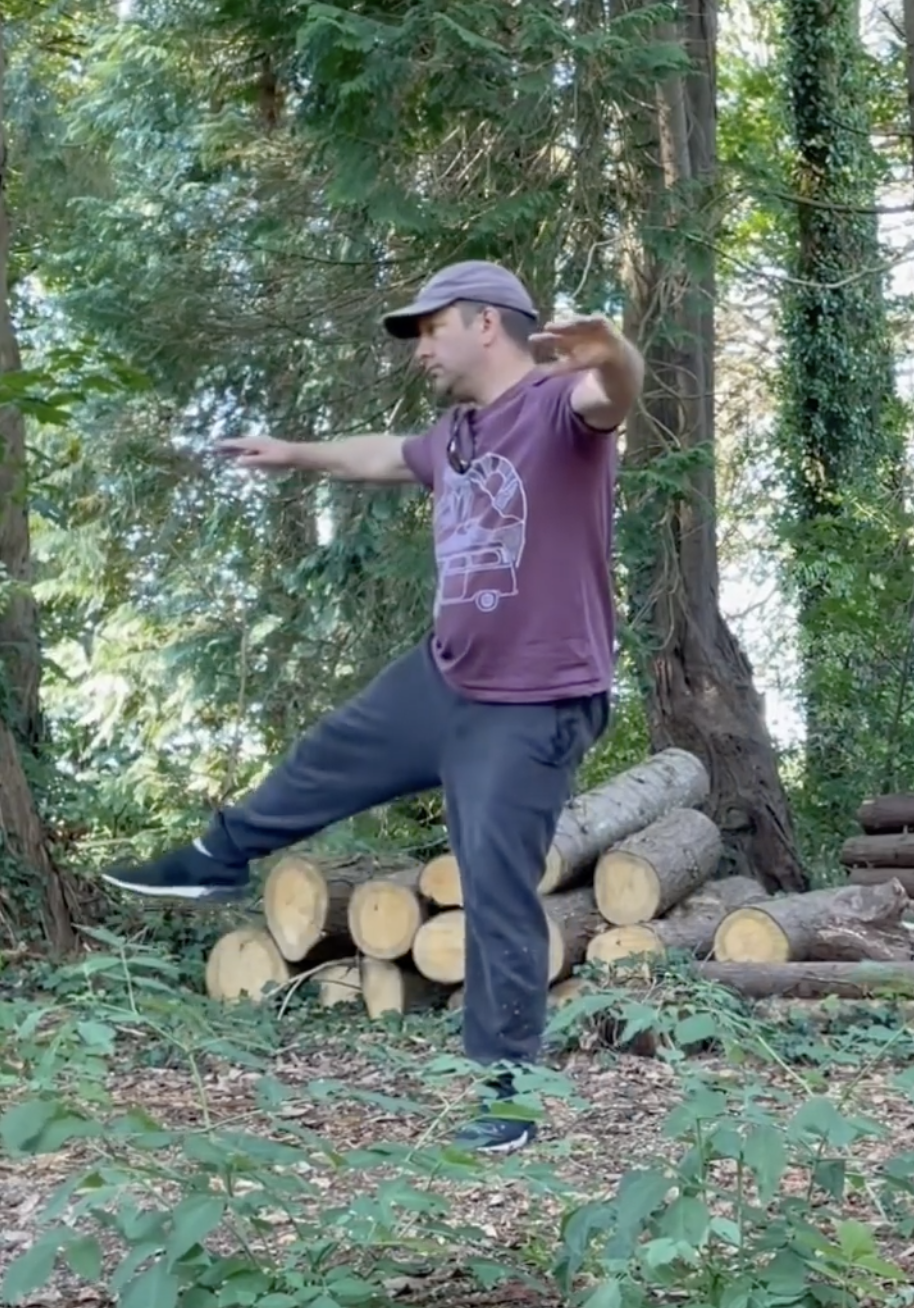
Tai Chi kicks are a great way of testing your balance. Due to the circular nature of Tai Chi technique the sections of the forms where you are kicking often involve turning the body to the left or right while you are standing on one leg. It’s more challenging than a simple one direction kick and is a great training for your balance.
I shot this during this morning’s Tai Chi practice. It’s the kicking section of the short form that we practice in the Yongquan Tai Chi Chuan Association:
You’ll notice that the kicks are done lower than you see in a lot of modern Tai Chi forms. That’s because we’re aiming at the knee. The classical technique for these moves is to block their knee with your foot and pull their arm in the opposite direction to get a takedown. Effectively using the foot as a kind of brace, not really as a kick.
But it’s the training these techniques offer in balance that is their real value I think – a lot of people end up very wobbly on the standing leg when performing these techniques. The key to making it silky smooth is not to think about sinking down into the ground as you raise the leg, but to ‘raise the back’ as you lift the leg. That upward ‘pull’ holds you in place securely so you can deliver a smooth kick.
So often we have to practice Tai Chi in our front rooms, back gardens or patios because of time pressures. Or maybe we only get to practice at a class in a village hall, gym or community centre. Either way, our surroundings are often far from natural.
Being able to practice Tai Chi in an environment where there were no other people, no human sounds and no interruptions was a blessing. It was possible to really sink into the environment for once, and not just my legs!
It’s a process one of my teachers calls “being a teabag in the ocean”. If you want to take in the good stuff from the natural world around you then you need to adopt the attitude of being like a teabag in the ocean – i.e. let nature move through you as well as around you, so that you don’t feel like something separate to it. Absorb it, soak it in. I’d say most people practice Tai Chi as if they are a teabag that’s sealed inside a plastic bag then dropped in the ocean. They can be doing great Tai Chi, but they are perfectly contained within themselves and not interacting with the environment. Often there’s not much environment to interact with, as mentioned previously, but if you get the chance to practice Tai Chi out in the woods, you should take it and take the opportunity to get out of that plastic bag.
Before you practice the form, stand for a few moments and try to let the barriers between you and your surroundings break down. Your mind should be focused on the moment and on your breathing, after all, that is as much a part of nature as anything else. Stand like that for a while before doing the form and just experience it, don’t think about experiencing it.
Then as you go through the movements of the form, you’ll start to feel like you are moving with the natural patterns around you. Don’t worry if your form takes on a subtly different quality than normal. It’s all part of the process.
I find that I don’t have as much free time for this in my normal life as I do when I’m on holiday, but I’m going to try and make an effort to get out to a secluded place now and again and practice my Tai Chi out there because the effort is well worth it.
Multiple time BJJ world champion Leandro Lo died a couple of days ago in a nightclub in Brazil. He was shot twice in the head in an altercation over essentially nothing by an undercover cop carrying a gun. The tragedy is a waste of his life and talent.
It reminded me of some self defence sayings that are worth remembering:
Don’t ever start a fight over something that isn’t worth dying over.
If you do end up in an altercation then win.
and:
It takes a stronger man to walk away from a fight than to start one.
Rest in power Leandro Lo. Let’s remind ourselves of what it was that made you great thanks to the BJJ Scout breakdowns of his matches, which inspired so many of us back in the day:
“Training the form helps one to learn the core substance of Taijiquan. Practicing the various push hands methods trains how to apply its inherent potential.”
The function and reason for forms (tao lu) in Chinese martial arts continues to fascinate me. Were they planned to be like this all along, or is the usage of tao lu a happy accident born out of ancient religious ritual festival celebrations and the hiding of marital arts in theatrical traditions? The answer is probably a bit of both, and more of the “wrong” answer than you’d like to admit, no matter which of the two views you take.
I think all Tai Chi practitioners, beyond the mindless followers practicing in parks, 12 rows deep from the front, have a basic understanding that the Tai Chi form contains martial applications which can be brought out in push hands. But it’s the wording of the quote above that caught me: “the inherent potential” of the form.
That’s exactly it – the form isn’t explicitly martial. Certain compromises are necessarily made to maintain an aesthetic and flow to the movements. If it wasn’t then Tai Chi would look more like more practical Shuai Jiao solo drills or jiujitsu kata. And I think that’s what bugs a lot of people who laugh at the idea that Tai Chi can be used as a martial art. The martial essence is there in the movements, but it’s not on the surface. It’s buried, inherent potential that you’ll need to mine if you want to discover it.
Except for that tiny minority of ambidextrous people, most human beings have a dexterous hand and a non-dexterous hand. We use our dexterous hand for things that require precision, like writing and the non-dexterous hand for holding and framing. I’m sure we’ve all tried to write with our non-dexterous hand before and found it almost impossible, but here’s another thing to try…
Put your non-dexterous hand behind your back and try to write as normal with your dexterous hand. You’ll find it’s hard because you use your non-dexterous hand more than you think, in this case, to steady the paper you’re writing on and stop it moving. Both hands are actually involved in writing, but both have different jobs. If you wanted to get all “Tai Chi” about it we could call it a Yin and Yang split between the hands, which work together as a whole, and talk about the sword hand, but layering a bit more philosophy on the concept is probably not necessary, I prefer the phrases dexterous and non-dexterous hands.
Large-Scale Postures Boxing Set by Huang Hanxun 1959
It’s the same in martial arts. I’m sure we’re all used to doing a technique quite competently on one side, then swapping it to the other side and feeling like a complete beginner. For this reason I’m quite against the idea that we should be able to do everything equally on both sides. Learning to do a technique on your non-dexterous side will be arduous, time-consuming and you’ll never be able to do it with the same flair, so why invest all that time in a pointless campaign?
If you look at the Tai Chi form (I’m thinking of Yang style, here since it’s the one I’m most familiar with) then you’ll see that some techniques are done equally on both side (brush knee, for example) but some techniques are only done on one side (all the grasp bird’s tails, for example go to the right, while all the single whips end to the left). I believe this is because the creators of these movements were well aware of the difference between our dexterous and non-dexterous hands.
In stand up arts of punching you see the same thing – people generally poke a jab with their non-dexterous hand to set up the big overhand from the dexterous side. I find if I put my dexterous side forward (southpaw) it results in a jab I can hit harder with but a cross that is less accurate.
But how do you choose which techniques to do on one side and which to do equally? The answer is simply to feel what works. And for this you’re going to need to do a lot of practice on another human, not solo form.
For example, in jiujitsu I have developed this one-sided approach through countless hours of practice. It’s most noticeable in my guard passing, but it also applies to my guard playing, although I’m not sure the idea extends to the legs – they both seem equally non-dexterous when compared to our arm! But in guard passing I notice that I naturally do some passes to my left and different passing to my right. For example, I knee cut with my right knee on both sides of the opponent’s body, so if I’m going left, I lead with my right knee and if I’m going to the right I also lead with my right knee – this naturally leads to two different techniques being used.
So, the answer is to feel, and don’t try to force yourself to do techniques that feel awkward because they are on the “wrong side” – look to see if there is something else you can do in that situation that fits better.
My copy of Chen Taijiquan Illustrated arrived, and I’ve almost finished it. It’s an easy read since the word count isn’t very high – it’s essentially a series of high quality training notes, illustrated, which I think really helps to convey the message in a way that text alone cannot. I’m not going to do a full review for a while, I’m going to let the book sink in first, but I might do a series of posts on ideas it has sparked in me.
Here’s the first one.
The thing I wanted to talk about today was how similar Chen style (as described in this book) is to Yang style. I think a Yang stylist would get almost as much out of this book as a Chen stylist. While the content and methods described in the book all clearly derive from Chen style, as do the illustrations, I’d say 90% (or more) of what’s described here is exactly the same as Yang style.
So what’s different? Bits and bobs on silk reeling, some stepping methods and stance details and the bits on fajin. But even then, they’re not something alien to a Yang stylist, and would be easily within reach of anybody who wanted to take their practice in that direction.
What’s the same? The emphasis on posture is really good here – how to round the back, contain the chest, round the kua, the eight energies, the 5 steps, push hands strategy and training methods, quotes from the classics, being centred and upright, rooting, the dantien, martial applications, etc.
What was I surprised not to find more of? Opening and closing using the 5 bows, and empty and solid. Perhaps more on using the force from the ground… There are mentions of these things throughout, but the book never really goes deeply into them. Perhaps it was too complex for the illustrated book-based approach? There’s only so much you can fit in one book, and there’s plenty of content here.
However, the emphasis on the body requirements of Tai Chi, and explanation of why these things are done, is excellent and transfers effortlessly across Tai Chi styles. It’s reminded me a lot how similar Yang style and Chen style are ‘under the hood’, so to speak. I wrote a post recently where I talked about them being similar but different. I still kind of think that. My view is that at some point Chen style incorporated the ideas contained in “Taijiquan” wholesale from Yang Luchan’s lucrative teaching business in Beijing into its larger, pre-existing, village style (which was more militia fighting and weapons-based) – it absorbed it whole – a bit like a whale swallowing a smaller fish. It was easy because all Chinese styles are similar to some extent. But of course, this means that the Yang style is still there inside Chen, and it’s impossible not to see how ‘almost the same’ they are when reading this book. (I think the spiraling and silk reeling stuff was from the pre-existing Chen style). Your opinion may be different. Food for thought!
Thanks to Ken Gullette at Internal Fighting Arts I just caught wind of this new book that’s just come out called Chen Taijiquan Illustrated. I had a quick look on Amazon using the “Look Inside” feature and the illustrations look fantastic. It looks like it’s designed to be halfway between an instruction manual and a comic. It’s a very cool style that’s quite unlike any Tai Chi book I’ve seen before.
Chen Taijiquan Illustrated – available now!
I think that often Tai Chi books, with pages after pages of printed text, can be a bit off putting for people who are learning an art that is all about feel, movement and “doing it”, not “reading about it”. And when they do have photographs in them they are often black and white and a bit dull and lifeless. So, for the visual learners out there, I think the colourful and imaginative approach found in Chen Taijiquan Illustrated will work very well.
Here’s an example:
An extract from Chen Taijiquan Illustrated by David Gaffney and Davidine Siaw-Voon Sim
Here’s another thing: Looking at the contents page, this is the first Tai Chi book I’ve seen that mentions the concept of Man, which translates as Slowness, apart from the book written by my Tai Chi teacher. Man is a concept my teacher talks about a lot, and it’s nice to see it mentioned in another Tai Chi book – I was starting to think that it was a concept that was unknown to the rest of the Tai Chi world!
Tai Chi Chuan a comprehensive training manual by Raymond Rand
Obviously everybody and their dog knows that Tai Chi is done slowly, but Man is more of a mental quality than a reference to the speed of the form. It can be thought of as “not rushing”. The speed you are moving at is irrelevant to the concept of Man, but if you want to acquire the ability of Man then the best way is by slowing the form down and focusing on keeping your mind on what you are doing. Whenever you find your mind wandering off you just stop the form (no matter how far through it you are) and start again. After a few weeks or months you’ll find you are much better at staying focused on your form than you were before. By adopting the qualities of “not rushing” you open up the headspace required to be aware of other things going on, things that you would simply miss otherwise. I’ve written about not rushing before.
At £16 Chen Taijiquan Illustrated is not particularly expensive for a colour book either. And I’d love it if there was a book on Brazilian Jiutjisu that was written and illustrated in the same manner because I think it would also benefit from this approach. Incidentally, there was a good book written about Brazilian Jiujitsu recently, that has colour photos (and very nice ones too) that I still dip into now and again called Nonstop Jiujitsu, by Stephan Kesting and Brandon Mullins. I reviewed it on my blog recently, so check out my review.
Nonstop Jiujitsu by Brandon Mullins and Stephan Kesting
I’ve ordered my copy of Chen Taijiquan Illustrated so will review it at some point in the future.





 The Tai Chi Notebook