Now, you can agree or disagree with Rantwo’s opinion on whether the Pak Mei guy can fight or not. Personally I think Rantwo brings up some good points, but I’ve heard other people argue that he’s kind of missing the point – sparring never looks good.
Anyway, I don’t want to get into that. My comment on the video would be that Rantwo is making the classic mistake that a lot of people make when looking at videos of traditional master getting beaten up by average/bad kickboxers and then deciding that martial art XYZ must be no good: It’s always a reflection on the person involved, not the whole style.
I don’t think you can view a couple of videos of Pak Mei guys then decide the whole style is “not for fighting”. I can guarantee you there are Pak Mei guys out there who have no problem throwing down. To just dismiss a whole style like that seems to be incredibly naive.
When it comes to sparring, I don’t think there are styles, there are just individuals. At least that’s the way I look at it.
Do you want to find out what traditional martial arts are practiced in Vietnam? Do you want to know what Tai Chi is like in Vietnam? And what Ho Chi Minh had to do with the development of the 24-step Tai Chi form? You do? Well, you’re in luck!
This episode of the Tai Chi Notebook Podcast features martial artist and author Augustus John Roe who lives and works in Vietnam. Enjoy!
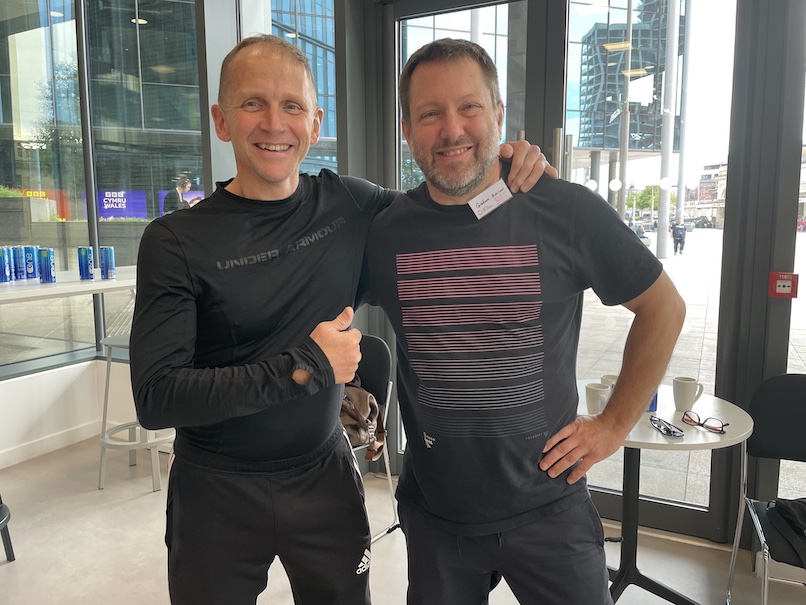
At the recent 2024 Martial Arts Studies conference in Wales I had the good fortune to meet Randy Brown of Mantis Boxing and Brazilian JiuJitsu in Massachusetts, USA. We had a blast at the conference discussing martial history, theory and even demonstrating a few techniques on each other into the small hours in a pub in Cardiff city center! Not only is Randy highly skilled in mantis boxing, but he’s also a black belt in Brazilian Jiujitsu, so we had a lot in common.
When I was exchanging techniques with Randy he noticed that the Choy Li Fut I was showing was identical to moves from a form he knew called gong li quan, which translates as “power-building boxing”. It was a form he had learned that was used as foundational training for various Ching dynasty martial arts, like long fist, eagle claw boxing and praying mantis boxing.
Gōng Lì Quán, or Power Building Boxing, is a unique boxing set from northern China, and is included as a training routine amongst a variety of boxing styles in the north to include: long fist, eagle claw boxing, and praying mantis boxing. This form likely intermixed with the latter two styles when it was included as part of the Jīngwǔ Athletic Association’s fundamental wu shu curriculum. At Jīngwǔ, gōng lì quán was one of the mandatory six empty hand and four weapons sets taught to kung fu practitioners. These ten sets were required as a prerequisite to the study of: xingyiquan, bagua, taijiquan, eagle claw, or mantis boxing; considered by Jīngwǔ founders to be more ‘advanced’ styles.
Our meeting seems to have sparked a desire in Randy to delve further into gong li quan and resurrect this old form he’d forgotten about and try to bring the movement to life with grappling applications. He’s been kind enough to share video of his research.
3 Rings Trap the Moon
This was the original move we discussed in Cardiff, 3 Rings Trap the Moon, which in Choy Li Fut would be a gwa choy (back fist) followed by a sau choy (sweeping fist) followed by a biu choy (an outward forearm strike). Randy shows the original move from gong li quan, then his grappling applications. It’s pretty cool!
Twining Silk Legs
Randy has been updating his blog post with new applications as he goes, so keep checking back. One of his latest is the move Twining Silk Legs:
Twining Silk Legs is two upper cuts followed by two kicks. Again, Randy shows the move and then his grappling interpretation of the applications. What’s really interesting to me is that, once again, there’s a parallel in Choy Li Fut with this move. If you look at the move starting at 1.22 in the following Choy Li Fut video you’ll see what is essentially the same move as Twining Silk Legs – two upwards strikes followed by a kick. (Ok, just the one kick here, not two, but still…)
You could look at this as further proof that gong li quan and Choy Li Fut share a common ancestor back in the mists of time, but since I’d be willing to bet that other Chinese martial arts practitioners would also recognise these moves from their own systems, I’d venture to say that is is further evidence for Randy’s theory that the explosion of different martial styles during the end of the Ching dynasty (which is where we get Choy Li Fut, mantis, Wing Chun and the other well-known styles) was more about branding the martial arts, for commercial reasons, and that they actually shared a common pool of knowledge.
“A question needs to be asked, did ‘Chinese boxing’ of the era, have a similar common pool of knowledge? Qī Jì guāng’s manual would hint at such. Within ‘Chinese Boxing’, attributes, feats, or skills defining one fighter over another became definitive styles of their own right due to events of the time”.
(The Qi Ji Guang he’s referring to is the Ming dynasty general who fought off Japanese pirates and because a hero to the people. He wrote a famous manual which documented the martial arts of the time. The techniques in the manual seem to crop up in all sorts of Ching dynasty martial arts.)
You can learn more about the the tumultuous events of the Ching dynasty and the explosion of martial arts styles that happened during it in Randy’s video of his presentation from the 2019 Martial Arts Studies Conference:
2025 Martial Arts Studies Conference
Today I heard the exciting news that next year’s 2025 Martial Arts Studies Conference will also be held in Cardiff, Wales. This will be the 10th anniversary of the original 2015 conference, which was held on the 10th-12th June in Cardiff, and will be held on exactly the same dates. It’s almost too perfect. See you there?
The Martial Arts Studies Network has also released a new (and free as always) issue 15 – check it out, it’s full of top-quality articles on martial arts. Oh, and don’t forget, I also recorded a podcast with Randy while we were at the conference – here it is:
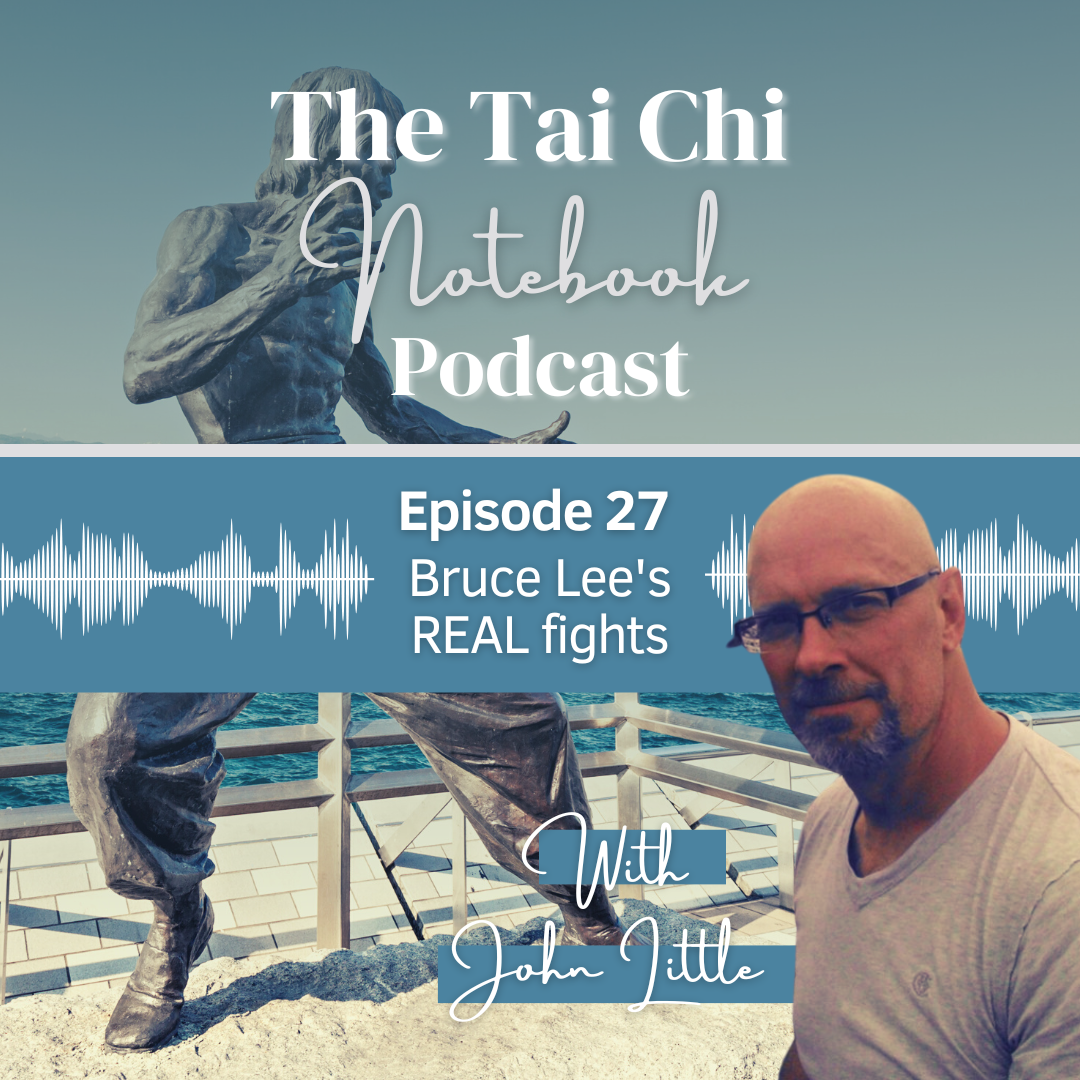
I have a new podcast out! Bruce Lee will be no stranger to anybody listening to The Tai Chi Notebook Podcast – even 50 years after his death he remains the most famous martial artist in the world.
But could he actually fight?
World Champions in karate competition have gone on record to point out that he never once competed in tournaments. So, were his martial abilities simply a trick of the camera?
My guest for this episode is Bruce Lee authority and bestselling author John Little.
To get these first hand accounts John has tracked down over 30 witnesses to the real fights of Bruce Lee as well as those who were present at his many sparring sessions. There are over 30 years of research in this book that took him thousands of miles around the globe.
One observation I have on ‘internal’ martial arts is that there there is often very little focus on the ‘internal’ qualities to a human being. Or if they do address them then it is, not directly and often in passing.
I’m not talking about things to do with forces, or the body, like Qi, Xin and Jin. Yes, the Yi (intent or mind) is mentioned all the time in the Tai Chi Classics, but it’s always in relation to fighting, or releasing and accepting forces on the body. “Quelle surprise”, you might say, since Tai Chi is a marital art, but if I contrast ‘internal’ martial arts with ‘external’ martial arts for a moment, the discussion there is often on the internal qualities of a human that internal martial arts, ironically, neglect.
I’m talking about things like self-control (temperance), endurance and patience.
The goal of improving these internal qualities has been the goal of practical philosophers since man first decided to ponder his/her existence. I could quote from LaoTzu here, but I find it more explicitly written by the Greek philosophers, particularity the Stoics.
In Chapter 10 of the Greek classic of Stoicism, The Enchiridion, we find:
“On the occasion of every accident (event) that befalls you, remember to turn to yourself and inquire what power you have for turning it to use. If you see a fair man or a fair woman, you will find that the power to resist is temperance (continence). If labour (pain) be presented to you, you will find that it is endurance. If it be abusive words, you will find it to be patience. And if you have been thus formed to the (proper) habit, the appearances will not carry you along with them.”
Epictetus, The Enchiridion
Sure, these internal qualities can certainly be learnt from any martial art, however I find it is the external martial arts that really emphasise them. Many Taekwondo schools use the goal of improving your inner qualities as the main sell in their marketing approach. For example, I just did a Google search for Taekwondo clubs in the local area, clicked on Tiger martial arts, and what do I find written on their website, in all caps, so you can’t miss it?
“WE BELIEVE MARTIAL ARTS IS ABOUT MORE THAN JUST KICKING AND PUNCHING”.
This is followed up with “We give students the focus and confidence to achieve in all areas of their lives. Yes, you can learn to take care of yourself in dangerous situations, but really it’s about learning to use your mind and body like a martial artist – learn how to control your body and your mind, and you will be set up for life.”
It’s the same with Karate. I did another random search on Karate clubs and found Bristol Karate Academy whose motto is “virtue in industry” from “Virtute et industria” — or by virtue and industry — from the city of Bristol, which dates back to at least 1569. They explain how that relates to the values of their club on their About us page:
“So what does that mean for us?
Virtue (美徳): We have integrity, in our commitment to traditional, effective Karate and integrity in the way that we treat others. We are respectful, fair and aim for high moral standards. We build character, strive for excellence and show courage in the face of challenges.
Industry (勉励): We work hard to reach our goals. We’re diligent and determined to get better at every single training session. We are rigorous in our approach to improvement and dedicated to our own and each other’s development.
Through hard, honest training we become our best possible selves”
Again, while I’m sure they can kick-ass with their karate, the emphasis in their motto is on the internal qualities of a human being. It’s about becoming your best possible self.
I know what you’re thinking – “perhaps it’s about teaching children?” Things like Karate and Taekwondo can be very orientated towards teaching children, and you obviously don’t want to be raising a hoard of little ninjas who have no idea about the moral implications of using their marital arts. However, it’s not just non-Chinese marital arts that have a heavy emphasis on building moral character. Similar ‘external’ Chinese martial arts do too, and those tend to have as much emphasis on adults as children. Also the moral aspects were there right from the beginning in the Southern arts.
For the history of Southern Chinese martial arts I’d recommend Ben Judkin’s excellent book “The Creation of Wing Chun”. Its tag line is “A social history of the Southern Chinese Martial Arts” because it covers all of them, not just Wing Chun, and particularly Choy Li Fut. When the first professional Choy Li Fut school opened in 1836 a moral education was seen as part of the ethos of the school. The school had 10 rules that had to be followed at all times:
Ten Points 1 Seek the approval of your master in all things relative to the school. 2 Practice hard daily. 3 Fight to win (but do not fight by choice). 4 Be moderate in sexual behavior. 5 Eat healthily. 6 Develop strength through endurance (to build a foundation and the ability to jump). 7 Never back down from an enemy. 8 Practice breathing exercises. 9 Make the sounds (“Yik” for punches, “Wah” for tiger claws, “Tik” for kicks). 10 Through practice you cannot be bullied.
While some of the rules are to do with body use, like making sounds on punches, others are more moral, like being moderate in sexual behaviour. And also eating healthy is a rule! Can you imagine going to a Tai Chi class or a Xing Yi class today and being told that healthy eating is now a rule, and if you don’t follow it, you’re out? In fact, I’d go as far to say that many internal martial arts teachers were renowned for hard drinking and over eating!
(It should be noted that Bak Mei tended to not have this moral emphasis. Reasons for this are explored in the book.)
Moving forward in time and changing locations to Brazil… Carlos Gracie also created a set of rules called the 12 Commandments when he started Brazilian Jiujitsu as an offshoot of Judo.
1 Be so strong that nothing can disturb the peace of your mind. 2 Talk to all people about happiness, health, and prosperity. 3 Give to all your friends the feeling of being valued. 4 Look at things by the enlightened point of view and update your optimism on reality. 5 Think only about the best, work only for the best, and always expect the best. 6 Be as just and enthusiastic about others victories as you are with yours. 7 Forget about past mistakes and focus your energy on the victories of tomorrow. 8 Always make those around you happy and keep a smile to all people who talk to you. 9 Apply the largest amount of your time on self-improvement and no time in criticizing others. 10 Be big enough so you can feel unsatisfied, be noble enough so you can feel anger, be strong enough so you can feel fear, and be happy enough so you can feel frustrations. 11 Hold a good opinion about your self and communicate that to the world, but not through dissonant words but through good works. 12 Believe strongly that the world is in your side, as long as you stay loyal to the best of yourself.
Carlos Gracie
These are mainly forgotten about these days and I’ve noted before that a lot of them were borrowed from somewhere else but they are almost exclusively about internal qualities of a human being.
If you contrast these sorts of rules to what you find in “internal” marital arts schools, well first of all, there are usually no set rules like this at all! Secondly, we tend to look to the classics for our ancient sayings, and finding moral instruction in them is like finding a needle in a haystack. Instead you find simile – for example, “be still like a mountain and move like a great river” from the Tai Chi classics, or philosophy from the Xing Yi classics like The 10 Theses of Yue Fei:
“From the beginning, that which is discrete must have its unification. The divided must be combined. Therefore, between heaven and earth, all that is disordered hasits abode, all the thousand branches and the confusion of then thousand endings, all have their origin. This is because one root divides into ten thousand branches, and ten thousand branches all belong to one root. These events are natural“.
– The Thesis of Integrity
Or you find descriptions of body use and strategy.
The jin should be rooted in the feet, generated from the legs, controlled by the waist, and expressed through the fingers.
What you don’t find a lot of is moral instruction or a reflection on the internal qualities of a martial artist that you find emphasised right up front in external schools.
So, why is this? Good question. One possible answer could be that ‘external’ arts historically coming from the Shaolin Temple (in the usual origin myth, at least) always had a Buddhist religious and therefore moral aspect to them. The internal arts in contrast tended to evolve out of the (violent and bloody) countryside, or they evolved from a Taoist approach to life, which was less prescriptive.
I don’t know – what do you think? What explains the internal/external difference? Let me know in the comments.
Had another great Wing Chun lesson from Bear this week. This time we seemed to look at more and more principles that I would call “internal”, which again calls into question if these terms are really useful for describing martial arts…
I mentioned last time that he calls the Wing Chun straight punch a “sun punch” because the fist looks like the character Ri for Sun. Today we looked at two exercises for helping with chaining punches together. For the first one you use a towel. Hold both ends, and punch so it makes a kind of cracking sound. I’ve seen videos of “belt cracking” before, usually associated with Chinese Wrestling, but I have also seen videos of it used in Wing Chun before as well. The emphasis is on being relaxed and getting a nice sharp, crisp movement. And here’s the key – the pull back of the other hand is the important bit, not the punching hand.
In the second exercise you hold a rope around something vertical and solid, (we used a wooden drumstick from the drum kit in the lockup) and you punch holding the ends of the rope. The key to this one is that your rope should not pull on the object it is around, so you’re keeping everything inside a very fixed space. Again, the pull back hand is the initiator of the action, and if you focus on that you get a more relaxed, faster, punch.
While the first exercise was all in front of you, this one involves a muscle/tendon chain going up your arm and around your back and into the other arm. I’ve seen this described before as “tongbei” or “though the back” power. I’m sure I heard Bear say “Bu Bei” which means back or rear, so I’m going to assume we’re talking about the same thing.
He does these punches very, very fast and explosively. Faster than the eye can see. He points out that it’s all about being relaxed, so the power can be “all though the arm” not just in the fist, which it is if you are tense. And the initiator of the punch is the non-punching hand moving backwards.
At one point he says “arrow punch”, and looks at me. I say “Beng Chuan?” And he says “yes!”. He seems to be saying that this is the same as Xing Yi’s Beng Chuan, just without the footwork. That’s something to think about.
When he punches he seems to also emphasise the root in the foot, so the power is coming up from the ground (sound familiar?) and he uses all the joints of the body, in a chain, ending in the fist.
I asked him why, when he punches, he uses his whole body in a very expressive way, with this ‘through the back’ kind of power and dynamic footwork, the “Little idea” form is different? When we train “Little idea” the requirements are very strict – the body stays still and the arm just punches on its own. I think (through translation) the answer was that you are learning to release tension in “Little idea” and not expressing power, so think of it as a conditioning exercise to give you the sort of body that can be used later for more expressive Wing Chun punches and kicks.
So, it appears that once you look beyond the surface-level things about Wing Chun, I’m finding principles that fit right in with Tai Chi and Xing Yi. I look forward to whatever we learn next.
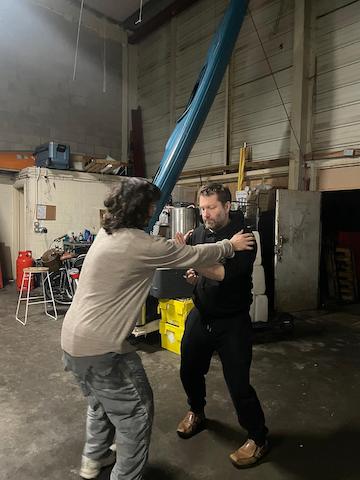
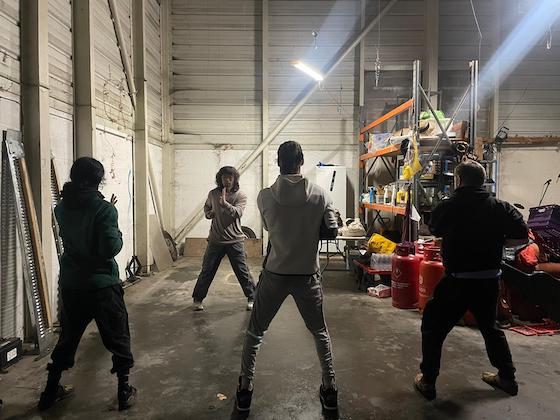
Due to a series of fortuitous events, this week I ended up learning Wing Chun for a couple of hours from a teacher from Hong Kong in a cold, damp, lockup somewhere off the beaten track in an industrial estate. As we ran through the opening sequence of the “little idea” form, (Siu Lim Tao), the glare of the electric light bulb cast our stationary shadows out through the open door into the dark, rainy yard outside and I remember thinking that this really felt like the real thing. I could feel the magic of Kung Fu here.
We are learning from “Bear”, a nickname we have created from his family name (Xiong). Bear has long hair and glasses and has a kind of laid back vibe. He seems more interested in being friendly and making friends than fighting. He speaks very little English, but YaYa his girlfriend does and acts as his translator. I’d say about 60% of it gets through, the rest I can hopefully work out thanks to my previous martial training.
He’s built a bit like a bear too – he takes his top off so we can see his arms – his tendons and muscles are clearly very conditioned and big, yet his arms feel soft to the touch. He used to train “5 hours a day when I was reading”, which I think means when he was a student.
He doesn’t have an ego at all. He demonstrates his speed all the time, but without hitting us, just stopping short – but at the same time his instruction is incredibly precise and demanding. Parts of the body have to move and other parts must stay still. He touches my arm and says “Ooooh! Very sung”, which I’ll take as a compliment 🙂
The concrete floor is damp and slippy, but luckily we are not doing footwork yet. We have to bend our legs all the time, as if sitting on a stool and grip with our inner thighs as if riding a horse. The night air is cool and the breeze blows in through the open door as we go through the opening movements of Siu Lim Tao, over and over.
I’m used to bending my wrist back so the fingers are vertical to form “praying hand”, and sitting down into my stance as if riding a horse, thanks to years of training other styles, but my companions are not, so there is a lot of stretching out aching legs and talk about how to condition tendons so wrists can be bent back further.
The three of us have ended up here after a chance meeting, and a lot of mistranslation. I was initially told that my friend had met Bruce Lee’s nephew who was going to teach us Wing Chun. OK, I thought, it was unlikely but theoretically possible that he could be Bruce Lee’s nephew, but the “nephew” bit turned out to be a mistranslation based on the word “Sifu” meaning both father and teacher. So, he’s a “marital nephew”, but not a family nephew. But who cares, we are all here now learning together and we’re having a great time, so I’m going with it. You can learn from any good teacher, and the chance to learn a new martial art is always a great opportunity.
Bear pulls out a book, which looks like a hand-written training notes, and starts to tell us the story of the creation of Wing Chun, which YaYa translates. It was, we are told, created from “the observation of a snake and a goose fighting”. (I suspect he really means crane). The goose(!) uses its wings in a kind of sideways swiping action, like Wing Chun’s Bong Sau. The key feature of the snake, Bear emphasises, is that it doesn’t retreat to strike, it just strikes from where it’s at. Bear pulls out his phone and shows us this clip from ‘Enter the Dragon’ where Bruce fights O’Hara to demonstrate:
I’d thought of Wing Chun as being more based on lots of relaxed arm trapping, but Bear seems much more interested in striking as quickly and explosively as he can, with minimal movement, which I think he was trying to tell us was the point of training the “little idea” form, very much like Bruce in this clip. Not big movement – minimal movement. There seems to be a snap on the end of everything, too, and he says the words “fa jin”, which Tai Chi people should be familiar with, quite often.
Having read all these snake and crane origin stories for years, not to mention hearing stories of many of my own British teachers having to work out what their Chinese teacher was actually saying through the limitations of translation, I’m finding this experience of living the tradition quite magical.
Towards the end he starts showing us some kicks and these are fast, low and look very cool. He wants us to fix some tires on the wall to practice kicks on. He seems to pendulum his upper body backwards as his legs flash forward, as if avoiding a head strike and countering low. The impression I get is that whatever we are learning it’s not designed for a long protracted engagement. It’s quick, to the point and you get it over with then move on. I’m looking forward to learning more next week.
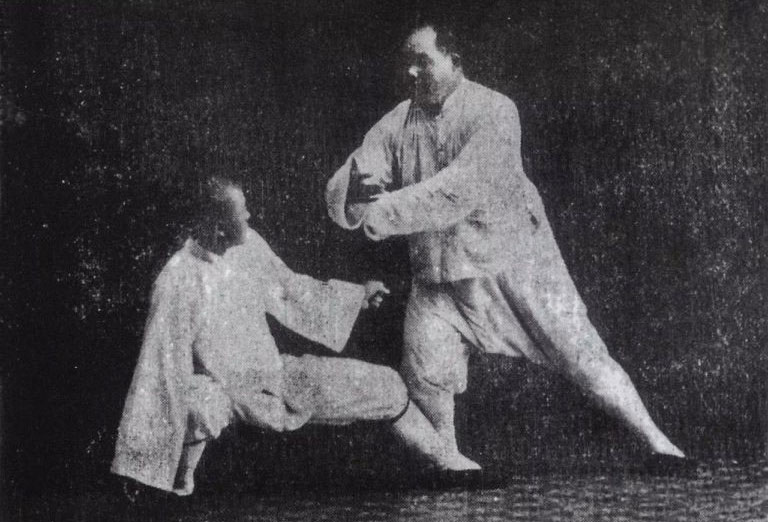
Yang Cheng-Fu showing Tai Chi applications from his book.
In the comments section Richard asked a good question in response to my last post. I wrote a brief reply in the comments, but I thought I’d flesh it out a bit as a blog post, because it’s an interesting topic.
The question is, ‘what’s the point of Tai Chi applications?’ Actually, to be fair, he was talking specifically about the one application video in my last post, not about Tai Chi in general. But personally I think you can extrapolate the question to include the wider Tai Chi universe, and that would be where I’d look for my answer.
There are plenty of videos of respected masters of various styles of Tai Chi running though the applications of their form movements and producing a series of very questionable applications that would require a perfect storm of events to happen for them to work. I don’t want to post them here because I think it would distract from the point I’m making, but look up ‘Name of famous master’ and ‘applications’ on YouTube and you’ll find them.
I really like the phrase “a perfect storm” to describe Tai Chi applications because as far as I can see, most (if not all) Tai Chi applications one would require a ‘perfect storm’ of attacker, positioning and timing for the application work. Therefore the one application video I posted previously is not particularly different to any other Tai Chi application video, at least to me.
That might not be a popular opinion, but I think it’s true.
Contrast this with a martial art like Choy Li Fut. I’ll choose CLF because it’s a kind of a typical Chinese Kung Fu style. It’s has some key techniques like Sao Choy – sweeping fist and Charp Choy – leopard fist and Pao Choy, a kind of big uppercut, Gwa Choy, a backlist, for example.
Here’s 10 of the ‘basic’ techniques that you find in CLF:
I wonder – does the man in the mirror ever punch him back?
If you watch a Choy Li Fut form then you’ll see these 10 techniques crop up again and again, but each form enables you to practice them in different combinations:
A great title for a video “Killer Choy Li Fut form!” It’s actually a great performance, especially with the drumming in the background.
Or check out the famous first form of Wing Chun – Siu Lim Tao, it’s a series of techniques performed very, very accurately so you can refine and practice them:
Now when you do those techniques in a form, you are performing a technique that would work exactly as shown. The only thing you need for success is to actually contact with an opponent and do the move correctly at the right time.
Tai Chi as a marital art just doesn’t work in the same way. We don’t have a toolbag of techniques designed to be pull out and used ‘as is’. Ward off is not a fundamental technique of Tai Chi – instead Peng, the ‘energy’ you use in performing ward-off, is the important thing. And I think this leads to a lot of confusion about what Tai Chi forms are.
So, if we don’t have techniques that exist in the same way as other marital arts, how are you supposed to fight with Tai Chi?
Tai Chi is a set of principles and a strategy that together make it a martial art. In a nutshell the strategy part can be summed up with the 5 keywords of push hands – listen, stick, yield, neutralise and attack. The principles cover how the body is used, resulting natural power derived from relaxation, ground force and a series of openings and closings expressed in the 8 energies. When the principles of Tai Chi are properly internalised you become something like a sphere, which can redirect force applied to you with ease and respond as appropriate. All these things are elucidated in the Tai Chi Classics.
Now that short description probably leaves a lot out, of what Tai Chi is, but at least it’s a starting point.
If that’s your goal, then putting emphasis on individual techniques doesn’t make much sense. Everything you do now exists in relation to an opponent, rather than existing on its own terms. The Tai Chi form then becomes a series of examples of how you might respond to specific attacks. In essence, it is a series of perfect storms, one after the other, put in a sequence that is long enough that you start to internalise the principles of movement and energy use. And obviously the strategy part requires a partner, hence why push hands exists.
I think that’s also the reason why Tai Chi forms are so long and slow, btw, so you internalise things.
As a final note, I’d say the jury is still out as to whether the Tai Chi way is the best approach to teaching people to fight. It’s interesting to note that a lot of martial arts innovators tend towards this same nebulous ‘technique-free’ style of training the further they get into their research into martial arts. Bruce Lee for example, was moving towards freedom and the technique of no technique in his later years – see his 1971 manifesto ‘Liberate yourself from Classical Karate’ for example. Then there’s Wang Xiang Zhai who created Yi Quan by removing fixed forms and routines from Xing Yi Quan and mixing it with whatever else he had studied. See his criticisms of other Kung Fu styles in his 1940 interview, for example.
In contrast a lot of the martial arts that have actually proven effective in modern combat events have turned out to be very, very technique based. Brazilian Jiujitsu, for example, is taught through very specific techniques. So is MMA. Karate, for all of Bruce Lee’s criticisms often does very well in competition against other more esoteric styles because it contains some no nonsense techniques.
Another factor to think of is that while Tai Chi may have those lofty goals of producing a formless fighter in its classical writing, it often isn’t taught like that in reality. One of the martial arts that Wang Xiang Zhai is criticising as having lost its way and become a parody of itself in that 1940 essay linked to above, is, in fact, Tai Chi Chuan!
So, as ever with marital arts, I think the answer is: it’s complicated.
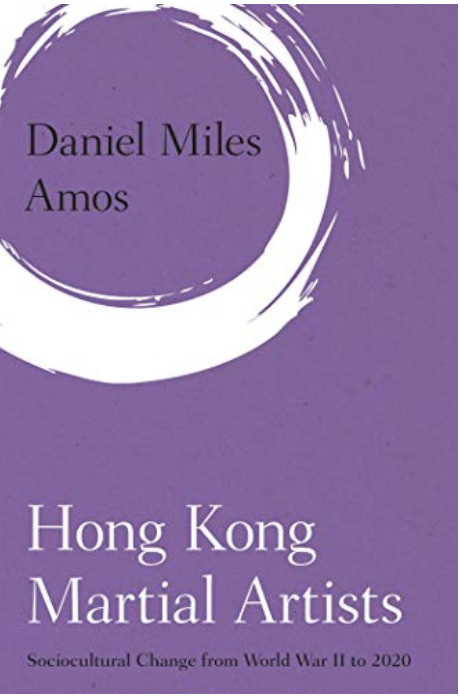
There’s a great book review by Ben Judkins over on Kung Fu Tea of Daniel Miles Amos’ 2021 book Hong Kong Martial Artists: Sociocultural Change from World War II to 2020.
The book sounds excellent and offers first hand experience of the changes in the Hong Kong martial arts scene has gone through over an extended period of years, and as such really pins down the economic and social challenges that traditional Chinese martial arts face in the modern world.
I really liked the opening of the review, because it somehow sums up the message of the whole book in one easy to follow exchange:
“Some years ago, one of my younger brothers married into a Hakka family after moving to Hong Kong to teach. My sister-in-law finds my interest in the Chinese martial arts fascinating and even admirable. And she insists that her children should have an opportunity to practice martial arts as well. Yet she did not enroll them in a local Wing Chun class, despite the media buzz around the art. Nor did she seek out one of the traditional Hakka styles from her family’s home village. Like so many other parents, she placed them in one of the city’s many thriving Tae Kwon Do schools.
I asked her about this once while we were discussing martial arts films and her answer was both blunt and revealing. “Why would I turn my kids over to some sketchy alcoholic! Besides, after ten years in Tae Kwon Do you get a black belt and something to put on your resume when applying for University. What did they give you after 10 years of Wing Chun?”
Jesse Kenkamp (AKA The Karate Nerd) has done another great video on tracing the roots of Karate. Here he is with White Crane practitioner Martin Watts in Yongchun, birthplace of White Crane, which is usually considered an ancestor style to Karate.
What I liked about this video is Martin’s no-nonsense teaching of what are generally thought of as internals in Chinese martial arts and shrouded in mystery (usually by westerners using Orientalism to sell books 😉 )
My point in posting this is that Martin covers “sinking the qi to the dantien” at 4.00 – what it is and, most importantly how what it is not is just as important.
I appreciate Martin’s simple, down to earth explanation.



 The Tai Chi Notebook