I’m pleased to announce I’m partnering with XMartial for BJJ and general gym-wear clothing. I’ve gone with XMartial because they have a genuinely fun range of designs, and also their website is full of people I actually recognise from the world of BJJ, like John Danaher, Jordan Preisinger from Jordan Teaches Jiujitsu, and B-Mac. Plus, its Reddit customer reviews for quality and shipping to the UK are good and the customer service is highly rated.
Shipping in the US is free, but there is a small $9.50 for shipping to the UK. There are lots of different designs, and XMartial sell gis and hoodies too. So, if you’re looking for new, high quality, BJJ wear and you want to support The Tai Chi Notebook then head over there and have a look at what they’ve got. Thanks!
I always find the labels ‘traditional’ and ‘modern’ misleading because something that’s current and popular, like Brazilian Jiujitsu, is actually quite old in comparison to some of the martial arts we would call traditional, like Aikido or Taekwondo. But even recently created martial arts are built on older traditions, so where do we start dating a martial art from? From the day it was named, or from the arts the proceeded it? If it’s the later then all martial arts are the same age and have existed (potentially) forever.
Another way of differentiating between traditional and modern is using the self defence vs sporting dichotomy, however so many martial arts exist in a grey area between the two – take Muay Thai for example, that I don’t think that’s a good way to do it either.
“For me, one of the best, i.e. concise and precisely written and kind of encompassing scholarly starts on traditional martial arts was and is the following by Moenig & Kim (orig. 2018; republished as a book chapter 2021):
“[T]he expression ‘traditional martial arts’, which has become very fashionable, is one of the most misrepresented and misused terms in the general discourse. ‘Traditional’ projects an image of a long history and of continuity throughout history, without change. In reality, most modern Asian martial arts are only a few hundred years old or are an evolutionary product of the twentieth century. On the other hand, some western combat sports, such as boxing and wrestling, actually have traditions as long as, or longer than, most modern, popular Asian martial arts, and nobody would ever classify them as ‘traditional martial arts’. The term ‘traditional’ seems wholly reserved as a reference to Asian martial arts. However, to the contrary, many present-day East Asian martial arts developed only recently, and are not ‘traditional’ by most definitions. Most traditional martial art proponents do not consider sports as having any philosophical aspects, as being mostly irrelevant, and as ‘merely’ a physical activity without any spiritual merits. Surveying the available literature on martial arts reveals that leaders and practitioners of traditional martial arts have often monopolized the discussion about philosophy, educational values, and realism in martial arts training; labelling the sports aspect inferior regarding educational benefits in addition to being unrealistic for real combat“ (Moenig & Kim in: Hong & Li, 2022: 43). Original reference Book reprint/republishing
You might also like to listen to the lecture, Inventing Traditional Martial Arts a lecture by Prof. Peter Lorge from one of the Martial Arts Studies conferences.
FYI:Owls can rotate their necks up to 270 degrees!
To some Tai Chi people it’s important to know where the eyes are looking when doing a Tai Chi form for slightly esoteric reasons: “your eyes lead your intention and your intention leads your chi.” But I think we can come up with reasons for using the eyes in Tai Chi that require no mention of intention (yi) or chi.
Try this: Sit comfortably. Turn your head slowly to the side, back to the middle then the other side. It’s a typical neck stretching exercise that you’ll find done at the start of your typical Kung Fu, Tai Chi, or Yoga class. It’s good for your neck, but there’s nothing particularly special about it.
Now try this: Instead of just turning your head to the side, actively look to the side. Lead the movement with your eyes looking to the side. Now compare the feeling of doing that to the feeling of just turning your head to the side.
If you’re anything like me you’ll find the experience quite different. When you are looking to the side for a reason your whole body co-ordinates better, not to mention, I think you can turn your head a bit further too. I’m sure there is a scientific word for this purpose driven movement, but I don’t know it.
Think of an owl, when it turns its head to look at something interesting that might potentially be prey – the eyes are always locked in.
When doing the Tai Chi form, try actively looking with your eyes and turning your head in the direction you are going. Hopefully you’ll notice the different in the quality and coordination of your overall movement.
One observation I have on ‘internal’ martial arts is that there there is often very little focus on the ‘internal’ qualities to a human being. Or if they do address them then it is, not directly and often in passing.
I’m not talking about things to do with forces, or the body, like Qi, Xin and Jin. Yes, the Yi (intent or mind) is mentioned all the time in the Tai Chi Classics, but it’s always in relation to fighting, or releasing and accepting forces on the body. “Quelle surprise”, you might say, since Tai Chi is a marital art, but if I contrast ‘internal’ martial arts with ‘external’ martial arts for a moment, the discussion there is often on the internal qualities of a human that internal martial arts, ironically, neglect.
I’m talking about things like self-control (temperance), endurance and patience.
The goal of improving these internal qualities has been the goal of practical philosophers since man first decided to ponder his/her existence. I could quote from LaoTzu here, but I find it more explicitly written by the Greek philosophers, particularity the Stoics.
In Chapter 10 of the Greek classic of Stoicism, The Enchiridion, we find:
“On the occasion of every accident (event) that befalls you, remember to turn to yourself and inquire what power you have for turning it to use. If you see a fair man or a fair woman, you will find that the power to resist is temperance (continence). If labour (pain) be presented to you, you will find that it is endurance. If it be abusive words, you will find it to be patience. And if you have been thus formed to the (proper) habit, the appearances will not carry you along with them.”
Epictetus, The Enchiridion
Sure, these internal qualities can certainly be learnt from any martial art, however I find it is the external martial arts that really emphasise them. Many Taekwondo schools use the goal of improving your inner qualities as the main sell in their marketing approach. For example, I just did a Google search for Taekwondo clubs in the local area, clicked on Tiger martial arts, and what do I find written on their website, in all caps, so you can’t miss it?
“WE BELIEVE MARTIAL ARTS IS ABOUT MORE THAN JUST KICKING AND PUNCHING”.
This is followed up with “We give students the focus and confidence to achieve in all areas of their lives. Yes, you can learn to take care of yourself in dangerous situations, but really it’s about learning to use your mind and body like a martial artist – learn how to control your body and your mind, and you will be set up for life.”
It’s the same with Karate. I did another random search on Karate clubs and found Bristol Karate Academy whose motto is “virtue in industry” from “Virtute et industria” — or by virtue and industry — from the city of Bristol, which dates back to at least 1569. They explain how that relates to the values of their club on their About us page:
“So what does that mean for us?
Virtue (美徳): We have integrity, in our commitment to traditional, effective Karate and integrity in the way that we treat others. We are respectful, fair and aim for high moral standards. We build character, strive for excellence and show courage in the face of challenges.
Industry (勉励): We work hard to reach our goals. We’re diligent and determined to get better at every single training session. We are rigorous in our approach to improvement and dedicated to our own and each other’s development.
Through hard, honest training we become our best possible selves”
Again, while I’m sure they can kick-ass with their karate, the emphasis in their motto is on the internal qualities of a human being. It’s about becoming your best possible self.
I know what you’re thinking – “perhaps it’s about teaching children?” Things like Karate and Taekwondo can be very orientated towards teaching children, and you obviously don’t want to be raising a hoard of little ninjas who have no idea about the moral implications of using their marital arts. However, it’s not just non-Chinese marital arts that have a heavy emphasis on building moral character. Similar ‘external’ Chinese martial arts do too, and those tend to have as much emphasis on adults as children. Also the moral aspects were there right from the beginning in the Southern arts.
For the history of Southern Chinese martial arts I’d recommend Ben Judkin’s excellent book “The Creation of Wing Chun”. Its tag line is “A social history of the Southern Chinese Martial Arts” because it covers all of them, not just Wing Chun, and particularly Choy Li Fut. When the first professional Choy Li Fut school opened in 1836 a moral education was seen as part of the ethos of the school. The school had 10 rules that had to be followed at all times:
Ten Points 1 Seek the approval of your master in all things relative to the school. 2 Practice hard daily. 3 Fight to win (but do not fight by choice). 4 Be moderate in sexual behavior. 5 Eat healthily. 6 Develop strength through endurance (to build a foundation and the ability to jump). 7 Never back down from an enemy. 8 Practice breathing exercises. 9 Make the sounds (“Yik” for punches, “Wah” for tiger claws, “Tik” for kicks). 10 Through practice you cannot be bullied.
While some of the rules are to do with body use, like making sounds on punches, others are more moral, like being moderate in sexual behaviour. And also eating healthy is a rule! Can you imagine going to a Tai Chi class or a Xing Yi class today and being told that healthy eating is now a rule, and if you don’t follow it, you’re out? In fact, I’d go as far to say that many internal martial arts teachers were renowned for hard drinking and over eating!
(It should be noted that Bak Mei tended to not have this moral emphasis. Reasons for this are explored in the book.)
Moving forward in time and changing locations to Brazil… Carlos Gracie also created a set of rules called the 12 Commandments when he started Brazilian Jiujitsu as an offshoot of Judo.
1 Be so strong that nothing can disturb the peace of your mind. 2 Talk to all people about happiness, health, and prosperity. 3 Give to all your friends the feeling of being valued. 4 Look at things by the enlightened point of view and update your optimism on reality. 5 Think only about the best, work only for the best, and always expect the best. 6 Be as just and enthusiastic about others victories as you are with yours. 7 Forget about past mistakes and focus your energy on the victories of tomorrow. 8 Always make those around you happy and keep a smile to all people who talk to you. 9 Apply the largest amount of your time on self-improvement and no time in criticizing others. 10 Be big enough so you can feel unsatisfied, be noble enough so you can feel anger, be strong enough so you can feel fear, and be happy enough so you can feel frustrations. 11 Hold a good opinion about your self and communicate that to the world, but not through dissonant words but through good works. 12 Believe strongly that the world is in your side, as long as you stay loyal to the best of yourself.
Carlos Gracie
These are mainly forgotten about these days and I’ve noted before that a lot of them were borrowed from somewhere else but they are almost exclusively about internal qualities of a human being.
If you contrast these sorts of rules to what you find in “internal” marital arts schools, well first of all, there are usually no set rules like this at all! Secondly, we tend to look to the classics for our ancient sayings, and finding moral instruction in them is like finding a needle in a haystack. Instead you find simile – for example, “be still like a mountain and move like a great river” from the Tai Chi classics, or philosophy from the Xing Yi classics like The 10 Theses of Yue Fei:
“From the beginning, that which is discrete must have its unification. The divided must be combined. Therefore, between heaven and earth, all that is disordered hasits abode, all the thousand branches and the confusion of then thousand endings, all have their origin. This is because one root divides into ten thousand branches, and ten thousand branches all belong to one root. These events are natural“.
– The Thesis of Integrity
Or you find descriptions of body use and strategy.
The jin should be rooted in the feet, generated from the legs, controlled by the waist, and expressed through the fingers.
What you don’t find a lot of is moral instruction or a reflection on the internal qualities of a martial artist that you find emphasised right up front in external schools.
So, why is this? Good question. One possible answer could be that ‘external’ arts historically coming from the Shaolin Temple (in the usual origin myth, at least) always had a Buddhist religious and therefore moral aspect to them. The internal arts in contrast tended to evolve out of the (violent and bloody) countryside, or they evolved from a Taoist approach to life, which was less prescriptive.
I don’t know – what do you think? What explains the internal/external difference? Let me know in the comments.
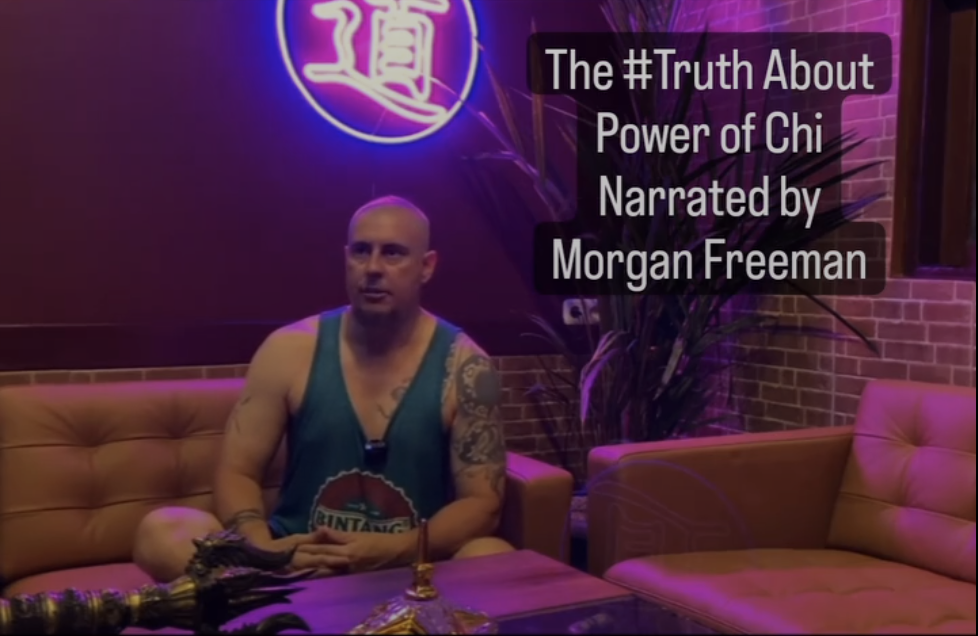
Notable Tai Chi teacher, Damo Mitchell, just released a new video with Adam Mizner where he addresses some of the controversy over The Power of Chi documentary that is worth watching, if you care about these sorts of things.
Damo Mitchell and Adam Mizner are a couple of the most well-known modern Tai Chi teachers on the seminar circuit, both of whom have a lot of followers on social media, and large organisations of students behind them. The Power of Chi was a movie where Adam Mziner demonstrated his chi/qi on a number of athletes from various sports. The movie has since mysteriously disappeared from the Internet, as far as I can tell, but the trailer is still on YouTube:
You can see from the start of the clip where Damo’s thinking is at (around the 4 minute mark) – the reason people criticise the movie, or himself and Adam, is because they are jealousof how well he and Adam are doing and that the people who criticise them have less followers so are below them and it’s therefore wrong to “punch down” by replying to them. These low level people also “are not in a good space mentally”’. His other point is that the movie was not made by Adam, he was just a paid performer in it, therefore everybody’s criticism is misplaced.
Well, talk about missing the point entirely!
At no point does he address the central issue I and many others had with the movie – that all this “chi” stuff is nothing to do with chi/qi!
Now, I’m not egotistical enough to think that Damo is addressing this video specifically to me, but my original post about the documentary is still there for everybody to read. As you can see, I said I thought the whole thing was a bit silly. That’s about the worst of it!
You can decide for yourself if that means I am racked with jealousy about how many students Adam and Damo have, and how great their lives are… I really am not even playing in the same league as Adam and Damo – they are professional Tai Chi teachers making a living off this, I’m not. I have a real job, and just run this blog in my spare time for fun. It’s the same with my podcast. But that doesn’t mean I’m not serious about my practice.
The other thing I did in my original post was link to my friend Rob Poyton’s video response to the trailer showing how all the supposed Chi feats in the trailer were really done – which I thought was quite cool, but seems to have really put the cat amongst the pigeons. I mean part of the attraction of seeing a stage magician is working out how the magic is really done, right?
Rob Poyton explaining how to do the feats seen in The Power of Chi movie.
Now that video by Rob seemed to raise the ire of many of Adam’s followers (who posted in the comments section of my blog, which are still there and you can read) who replied with such gems as this:
“I’m disappointed in your entire take on internal power, as indicated by your dismissive way of talking about those who actually do possess some genuine internal power as using “tricks”. To be blunt, you’re just ignorant–that is, you have no personal experience with real practitioners and assume everyone showing such power must be a charlatan. “
“Why do you have a website about Taiji (that’s the correct pinyin spelling btw) when you’ve never met any of the top taiji practitioners – and refuse to meet them before publishing negative theories about the limits of the art? So the best explanation to you is that the top practitioners in the world who have trained thousands of students are merely liars with fake reviews from professional athletes and professional teachers?”
“So you did not see the move, or met anyone in the movie to experience this skill/ attribute first hand. Kind of strange to have such strong opinions on something you have no experience in….”
You can see from the comments that the followers of Adam and Damo really do believe that the feats presented in the movie, The Power of Chi, are real demonstrations of chi power, (or Qi power.) Again, that’s my issue with all this stuff, not that they’re making a good living off teaching Tai Chi.
As a complete co-incidence Rob just released another clip in the last few days, this time about the subject of Empty Force, that’s also worth a watch, and will undoubtedly upset all these same people all over again, for exactly the same reasons:
There’s a long history of the Tai Chi magician. Empty Force is something that the Tai Chi Magicians of the world engage in regularly, and once again, I think it’s cool that Rob is posting a video showing how it works.
As for Damo and Adam, I hope they keep enjoying their cocktails and cigars – they seem to be having a great time, hidden away in all that smoke, being Tai Chi Gurus. I’m not jealous that we have very different lives at all. I wouldn’t trade mine for anything. Spending a month on a retreat in Thailand training Tai Chi full time, (let alone a year!), sounds like absolute hell to me. I’m sure it would send me potty! I’d rather be with my family, friends and pets, thanks.
It looks like Adam and Damo have some real skills in Tai Chi push hands – I’m not doubting that. After all, they’ve had years training full time to get good at this stuff, so they better have something by now. But as with everything in the internal arts – it pays to keep your feet firmly on the ground.
For me the latest video from Damo and Adam is just another fascinating glimpse into how the mind of a Tai Chi Guru works.
I had the good fortune to guide a group of people through some Xing Yi Monkey recently, which made me focus on it more and practice it a bit harder in the run up, which was a good thing. (I’m also available for children’s parties and Hen parties too, btw). Anyway, I wrote some notes about it, which I’ve typed up below.
A unique animal
When it comes to the animals in the natural world that we can look at for inspiration for martial methods the most obvious place to start is with one of our closes cousins, the primates. Like us, monkeys can stand upright, if only for short periods in some cases, they have hands that can grip and even a bit of limited tool usage. However, monkey is not a good place to start your journey into the 12 animals of Xing Yi.
The first thing to realise about monkey is that it breaks a lot of the ‘rules’ of Xing Yi Quan, which is one of the reason why it’s often taught last amongst the 12 animals. My teacher taught the animals as almost self-contained mini martial arts – each one had a different strategy and techniques, but Monkey wins the award for being the most unique amongst them. It really does stand up on its own as a complete martial art.
Almost all of the rest of Xing Yi Quan can be performed in formation, standing in a line with other people, since you generally move forward and backwards along a straight line (except for the turns, obviously). Whether this really harks back to an ancient heritage of soldiers moving in formation is speculation of course, but it should be noted that a row of people holding a spear and standing side by side can perform the 5 elements and most of the first 11 animal links while all facing in the same direction without impending each other, provided they all turn at the same time. That’s possibly one reason why Xing Yi is so obsessed with keeping the elbows near the ribs.
But Monkey doesn’t follow these rules – it’s breaks the line. Or more accurately, it’s what you do when the line has been broken. Attacks in monkey are reacted to and defended at diagonal angles – there’s footwork you don’t find in the rest of Xing Yi and there are changes in tempo, bursts of speed and jumping. It’s as if your nice orderly line of soldiers has been broken up and the battle has become more of a melee situation.
All the different types of monkey have similar movement, but the monkey native to China that Xing Yi is probably using for inspiration is the Golden Monkey. And thanks to the BBC there are plenty of Golden Monkey clips available to watch – this one of two tribes coming together and fighting over resources is particularly good:
And here’s an interesting clip of a group of wild monkeys who have learned to trust humans for food:
Both clips are a gold mine of information about how these animals move.
Monkey Pi
Pi (splitting) is the main energy from the 5 elements that is used in monkey, but while in Pi Quan the arm uses the elbow joint as a pivot point for delivering the downward chopping strike (a bit like the swing of an axe), in monkey it’s the wrist that is the pivot point. The monkey Pi is more like a slap, but don’t think that makes it ineffectual. A relaxed and loose slap delivered using good body mechanics to the head can easily result in concussions.
Monkey also tends to eschew single strikes – everything is done in quick flurries of 3. This is called a triple palm. Often the first strike is to open up their guard, or intercept a strike, the second is to hit the head, and the third can be done as a grab and pull on their limb or head, leading to your own head butt or knee strike – an action called ‘wrapping’. The back of the hand can also be used as an upward deflection to the opponents arms, for when the monkey wants to enter deep.
Range
Talking of entering deep, Monkey wants to either be too far away for you to hit (beyond kicking range), or right in at what would normally be called grappling range, (i.e. too close for what is generally called striking range) but the use of close body palm strikes delivered by turning the body sharply and the cross stepping opens it up as a striking range too.
Take a look at this video of a monkey antagonising a Tiger cub (I don’t think he’d be brave enough to try this on a fully grown tiger!) to get the idea of range:
As you can see, monkey is something of a trickster engaged in a war of attrition. A tiger generally wants to finish the prey in one big action, monkey will keep attacking, wearing it down over time. Often the monkey’s goal is simply to drive the opponent away out of its territory.
Agility, but with stability
Obviously to close the distance from outside kicking range to inside punching range you need tremendous agility to play monkey, however, agility without stability is a recipe for disaster, which is another reason for teaching monkey last – it requires a very solid understanding of the footwork methods of Xing Yi Quan. It uses a cross step frequently, and also spins and jumps.
Monkey requires you to be agile, but rooted when you step. Without that combination the movements of monkey can become just a dance. The stability also relates to being relaxed in your movements. Because monkey movements tend to be done fast the tendency is to get tighter and more tense as you do them. I find consciously trying to relax while doing monkey is required more so than in other Xing Yi animals.
Tea cups exercise
The arm methods of money require more utilisation of the joints of the wrist, elbow and shoulder than the other methods of Xing Yi. Techniques like “Reach around the back of the helmet” require significant mobility of the arm joints. The best way to achieve this is to become adept at the famous tea cups exercise. You should practice this is with actual tea cups full of tea (or water) and try not to spill any. This is incredibly difficult!
Here’s a basic instructional on the tea cups exercise:
Yin and Yang
Finally, we do a Yin and a Yang monkey in our Xing Yi – the Yang monkey is the bright, lively, younger monkey, while the Yin monkey is the more older experienced monkey who uses heavier techniques. Almost all the video you see of Xing Yi money on the Internet are showing the Yang version. The most famous move from Yang monkey is the upward ‘flying’ knee strike. Here’s a good example:
To be honest, I haven’t seen any other Xing Yi group do a Yin monkey like we do, but here’s a little clip of me doing some Yin monkey so you can see what I mean:
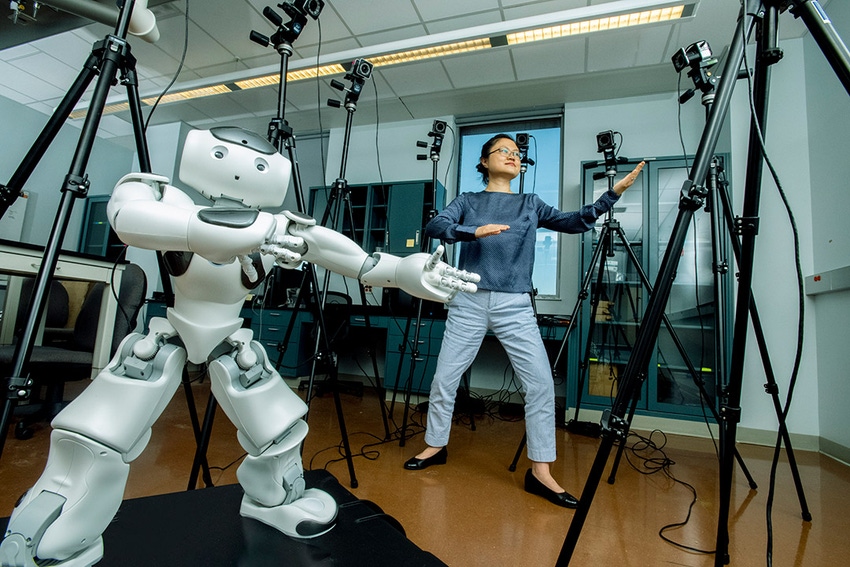
So, a heads up about a couple of new books on the way, a robot teaching Tai Chi and a seminar write up that’s worth a mention. This post actually makes me think, should I be doing a newsletter? What do you think? Do you want one? Would you read it? Let me know!
XING YI NEWS
Dragon Body, Tiger Spirit
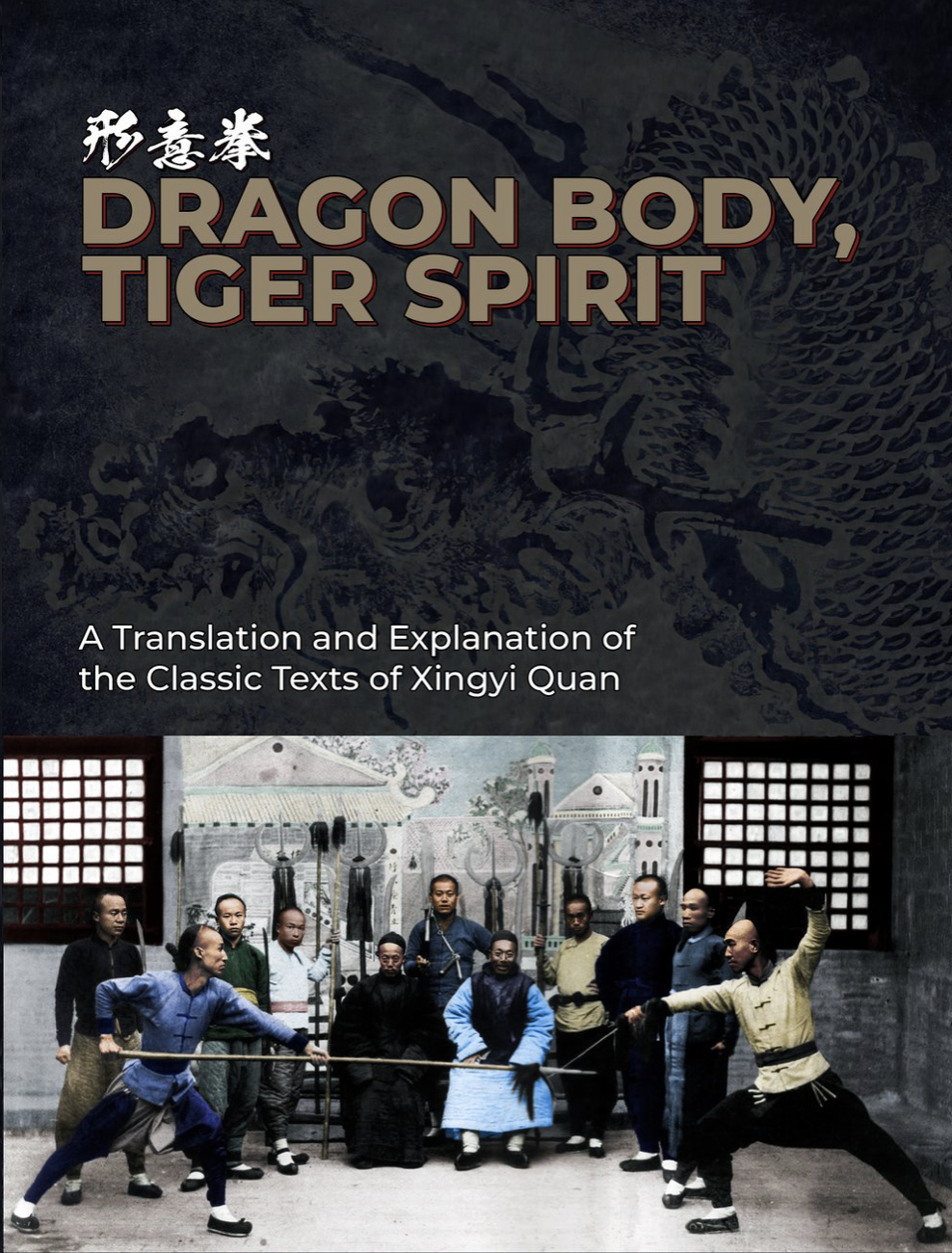
Byron Jacob has a new translation of the Xing Yi Classics, Dragon Body, Tiger Spirit, coming out, which looks like it will include a chapter on the history of Xing Yi written by Jarek Szymanski who you may know from his popular website China from inside.
This is looking like it’s going to be good. The title is a nice play on “Crouching Tiger, Hidden Dragon” and it refers to things mentioned in the Xing Yi Classics. The cover also features a nicely-colourised version of the only photo we have of the famous Xing Yi master Guo Yun Shen, which has been very nicely done. (Master Guo is the guy seated centre right, and wearing the light blue tunic, next to Master Che.)
There have been many books that contain the Xing Yi classics translated, of course, but I’m hoping that Byron’s commentary will be the thing that makes this one different.
Byron says: “Dragon Body, Tiger Spirit will be available in hardcover, softcover as well as digital versions. To be notified of release visit mushinmartialculture.com and sign up to the newsletter.”
I’ll do a review once I get my hands on a copy.
TAI CHI NEWS
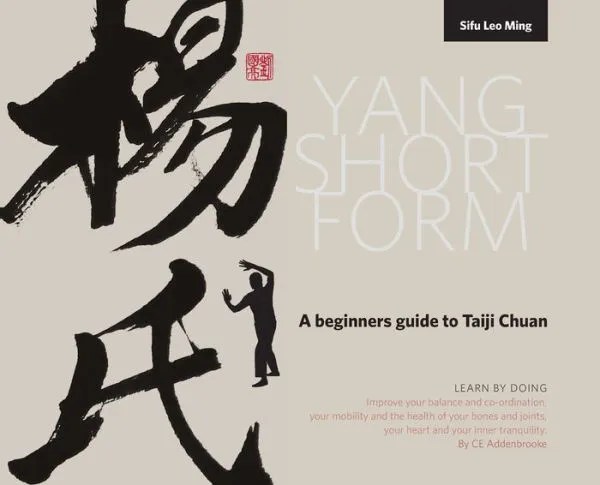
Yang Style Short Form
Another nicely presented book on my horizon is Yang Style Short Form by Sifu Leo Ming and Caroline Addenbrooke. The short form in question is the Cheng Man-Ching Tai Chi form, and calling it the “Yang Short Form” is a bit of a liberty, since it is not the official Yang Short Form. But names aside, it looks like it’s going to be interesting.
“A beginners guide to Taiji Chuan is a comprehensive training guide for all students of Taiji who are serious about mastering the art of Taiji. It is unique in that it details each of the forty four postures that make up the complete Yang Style Short Form, and it does so in a way that the student can experience the smallest nuance of each movement, from the opening sequence to the closing posture.”
It sounds interesting, especially since it goes on to say it will teach you how to breathe correctly during your practice and how the “Tan Tien drives all movement, opening the meridians so that the universal llife [sic] force can flow through you. “
A spelling mistake in the description of the book on the website (“llife”) is a bit of a red flag, but that could be Barnes & Nobles fault, and nothing to do with the book. However, I’m curious about the use of “Taiji Chuan” as a Romanisation on the cover though, since it seems to mix both Pinyin and Wade-Giles Romanisation systems. I have genuinely never seen anybody mix the two quite like this before. It’s usually either “Tai Chi Chuan” or “Taijiquan”. This will upset some people, I’m sure, but I don’t mind.
Image Credit: Credit: Rochester Institute of Technology
Depending on how it works (there’s no video!) this looks quite impressive, however, I’m left with one burning question – why? I don’t know how many thousands or millions of dollars it took to create this robot, but economically I’m pretty sure that paying Bob, your local Tai Chi teacher $50 to teach Tai Chi to the people in the old folks home once a week is a business model that is going to be hard for a multi-million dollar robot to beat. This looks like a solution in search of a problem to me.
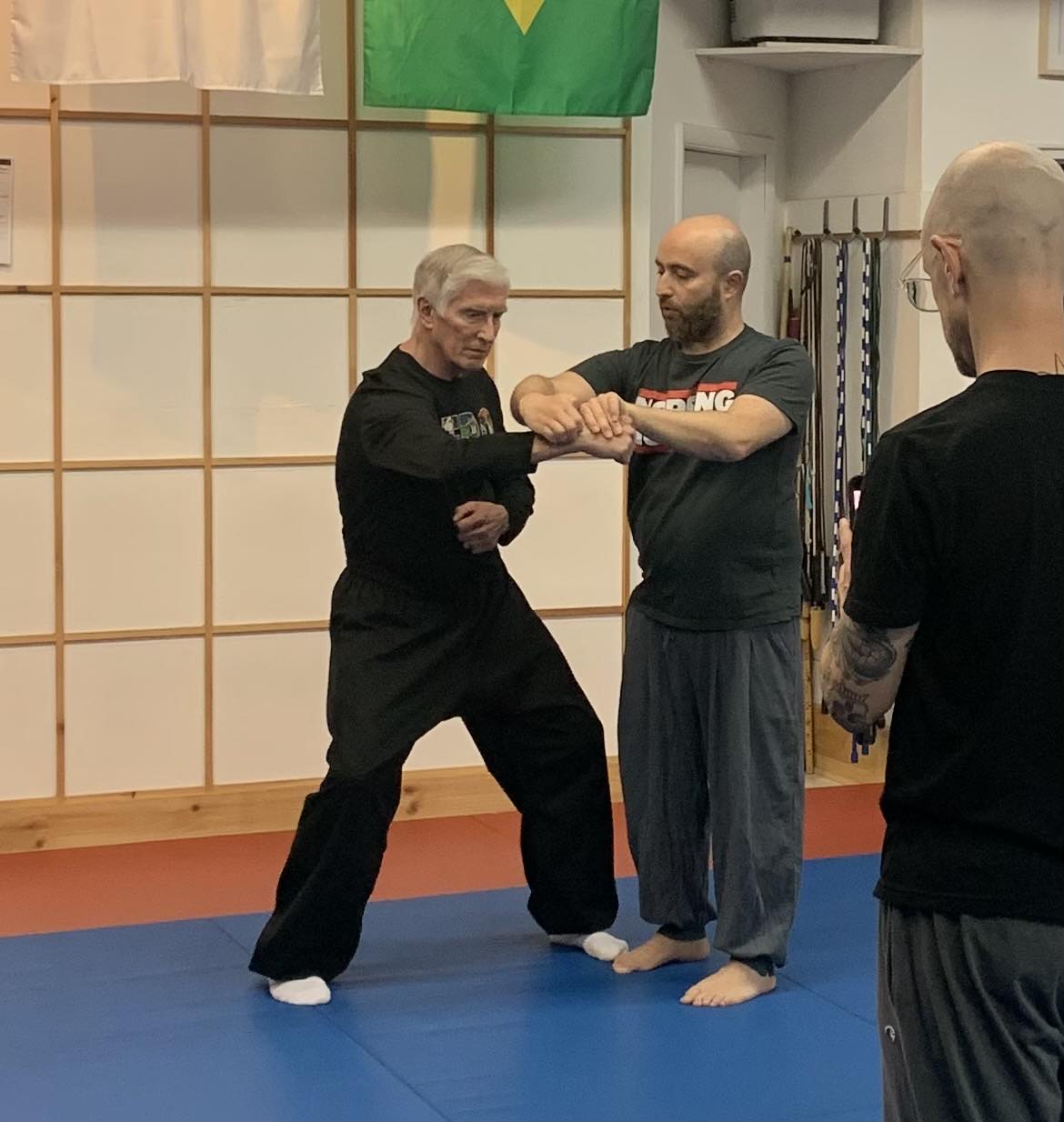
“What impressed me most about Nabil’s teaching was the level of detail. And there were differences — in the shorter stances where feet are parallel most of the time, in the shifting of weight, in the awareness of different jin in each movement, the fullness of the dan t’ien and the coordination of the mingmen, the opening and closing of the chest and back, the folding of the chest and stomach, the closing power in the legs, the grounding from the heels, the stability of the knees and the spiraling through the feet, and connecting it all in each movement; and peng — always maintaining peng, which I have worked on for over two decades but still learn new aspects.”
Image Credit: Ken Gullette
Nabil teaches Tai Chi in the Chen Yu lineage, and to my eye seems by far the best of the teachers available if you want to follow that particular line of Chen style. Plus, you can learn with him online at the Chen Style Taijiquan Network
If you want to get a quick glimpse of his style of Tai Chi then check out this Instagram page.
MORE LINKS
Recent Tai Chi Notebook posts
Here are 3 things I wrote this week that you should read:
I came across this video recently of Henry Akins explaining the concept of connection in BJJ, as taught to him by Rickson Gracie, and it doesn’t half remind me of Tai Chi…
This blog is about a weird quirk of the Xing Yi world. There’s a surprisingly large amount of online debate in Xing Yi circles about where the elbow should be when performing Xing Yi.
If you haven’t checked The Tai Chi Notebook out on Facebook then please do, and why not give our Instagram page a look too, and our YouTube channel?
The Tai Chi Notebook Facebook page has finally got far enough over the 1,000 followers milestone that I feel confident in shouting about it a little bit! So, here we go – 1,000 followers!
Thanks to everybody who has liked, subscribed and commented on The Tai Chi Notebook over the years – it’s all very much appreciated!
Also, I’ve changed the sidebar on the blog over to the right —-> It now shows the most popular posts on the page by views and likes, so if you’re looking for something interesting to read about martial arts and Tai Chi, then look here to find something.
Today’s blog is about a weird quirk of the Xing Yi world. There’s a surprisingly large amount of online debate in Xing Yi circles about where the elbow should be when performing Xing Yi. I mean, a surprisingly large amount of debate. Especially for a matter that might, forgive me for saying this, be seen as trivial by people actively engaged in combat sports that actually spar with resistance.
Obviously, if you have some sort of two person free practice in your Xing Yi system that you actually engage in regularly, I’m not talking to you. I think the real reason why all these debates happen is simple – too much forms and not enough fighting.
But, ok, there are other reasons. For example, details do matter in internal arts. Quite often we’re being asked to look in detail at our movements and micro movements to get the most perfectly coordinated and natural human movement possible. But without keeping one foot on the ground, (and grounded in the reality that sparring provides), the theoretical arguments start taking over and the art disappears up its own bum. A martial art that is predominantly forms-first is always going to be theoretical at best. To take the well worn analogy – you don’t learn to swim by practicing on dry land.
The problem stems from the fact that there’s a line in the Xing Yi classics that translates as:
“The hands do not leave the heart and the elbows do not leave the ribs”.
But it’s how literally you take these words seems to be the crux of the matter. Now, I’ve seen videos of respected Xing Yi masters quoting this passage while demonstrating and their elbows are clearly leaving the ribs, if not in the horizontal axis, at least in the vertical axis.
The reasoning behind keeping the elbows tight is sound – in boxing, kickboxing and MMA it’s generally considered best practice to keep your shoulders high and elbows tucked in close to the body to help protect the ribs. But boxers don’t tend to get hung up on this – as their individual style develops they don’t feel like they have to conform to the same ‘rules’ that the novice has to. They are free to develop their own personal style through experimentation and testing in the ring. I’m sure Prince Naseem was taught the same basics as Mike Tyson, but look how differently their boxing styles turned out in the end.
So, (and I know, dear reader, that you are just dying the hear this), what’s my take on where the elbow should be in Xing Yi?
Well, I’m glad you asked. Rather than getting hung up on words in an old writing (that may or may not be old at all) I prefer to get hung up on history. I mean, you have to get hung up on something, right?
Xing Yi is generally considered to be descended from military spear fighting. If you hold a heavy spear it becomes readily apparent that your best chance of wielding it with power is to keep it in front of the body, not out to the sides. It’s the same when you hold any heavy object – you are stronger when your arms are in front of you holding it than when they are at your side holding it. This is the truth I feel these words are aiming towards, and generally the postures and techniques of Xing Yi all comply with this idea of keeping the elbows in and the arms in front of the body, not to the sides. There are exceptions though. For example, Xing Yi Bear has a much rounder posture, with gaps under the elbows, more like the Yi Quan standing postures.
Some postures in our Xing Yi dragon and chicken links are for hitting with the elbows and we hold them out to the side when doing so, but in these cases you are normally (but not always) standing side-on to the opponent, so the elbow tip is pointing at the opponent, so in that sense it is not ‘out to the side’.
A good example is this famous Liang Yi Zhuang posture from Baji, which is similar to the chicken posture I was talking about. (Baji is another Northern Chinese martial arts, that is a bit similar to Xing Yi).
I mean, we could decide that viewed from the opponent’s position the elbow is in line with the body, therefore it is not leaving the ribs, but the hands are not in front of the heart. No way. Are we therefore going to decide that this posture, taken out of context on its own, is wrong because it doesn’t correspond literally to some ancient writing that may, or may not, have been referring to a specific context?
Here’s another theory: I think what the whole thing is quite possibly about how soldiers work in formation on a battlefield. If Xing Yi does have military roots then a line of soldiers on a battlefield would all be orientated towards the enemy, standing side by side in a line. That’s another good reason to stick the elbows to the ribs. Any bladed weapons going towards your sides would definitely not be welcomed by your brothers in arms.
Ultimately, I don’t expect this post to have really made a difference to the debate. I feel like this one is just going to run and run forever. So long as there are mainly theoretical practitioners of the art there will be always be many theoretical debates about how what somebody is doing is right or wrong in relation to some ancient writing.
I just think people’s efforts would be better put to trying moves out on other people and getting feedback that way. As one of my teachers used to say often:
“There is no such thing as correct technique, there is only appropriate technique.”
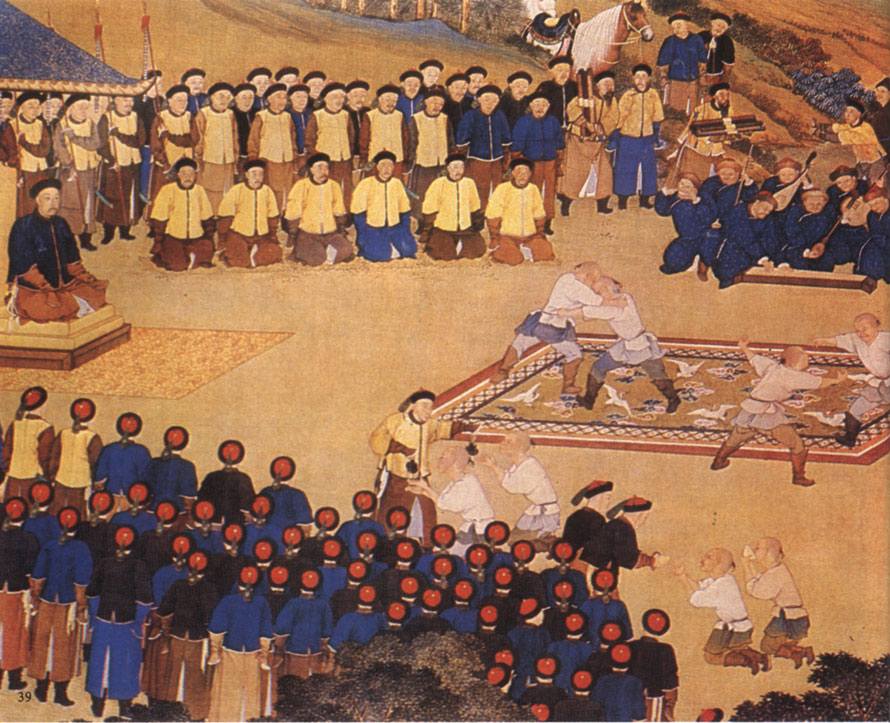
I’ve written quite a lot on this blog (and upset plenty of people in the process!) about the deep connections between performance, ritual, religion, theatre, entertainment and martial arts, particularly in the Chinese martial arts traditions. But it’s not only the Chinese martial arts that function as this one-size-fits-all container for self defence techniques, self development techniques, pugilism and good old-fashioned raucous entertainment. There are strong traditions of wrestling-based entertainment in almost all cultures. Whether it was the gladiators of Ancient Rome or the Jujitsu mania that swept early 1900s Victorian England and America alike, or the recent ADCC 2022 grappling championship with a 14,000-strong audience, for as long as men (or women) have wrestled, sparred or boxed there have been other men working out ways of getting people to pay to watch it.
A section of Qing Dynasty (1644-1912) court painter Lang Shining’s painting depicting a wrestling contest in the royal court, performed as entertainment for the emperor.
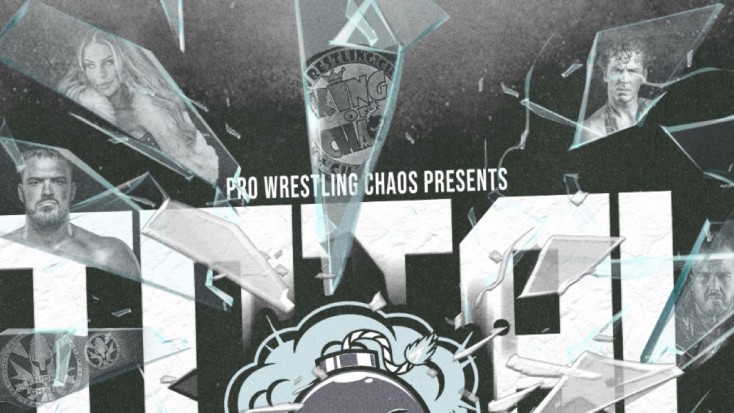
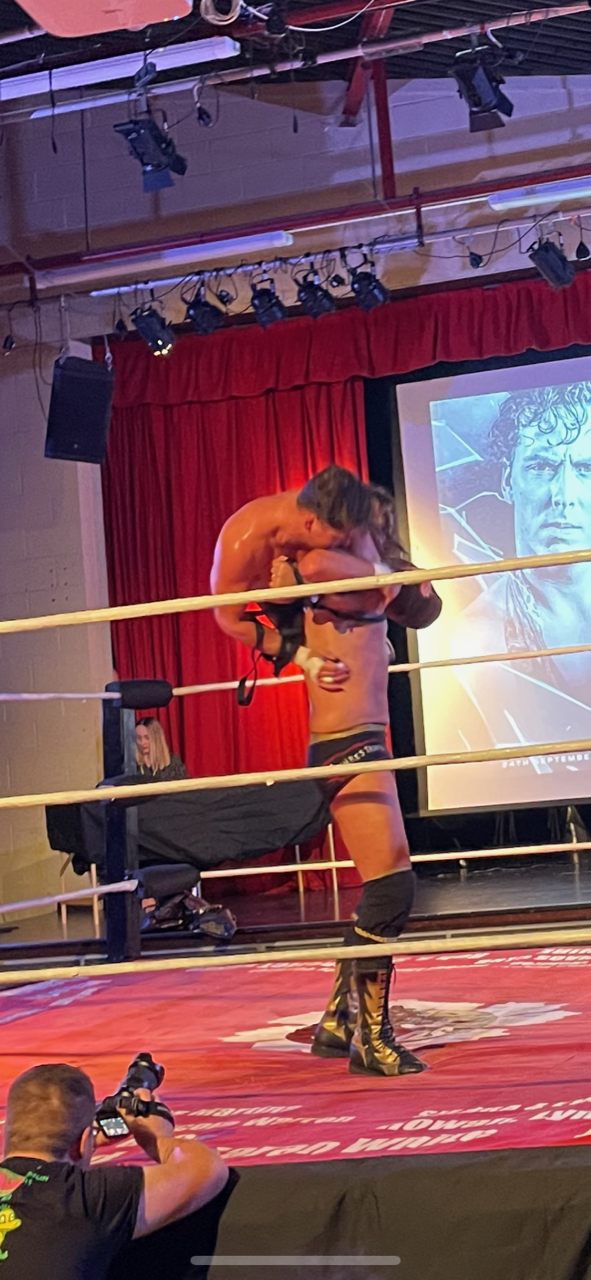
England is no different, and so I find myself at Total Chaos, in Kings Oak Academy, a secondary school in Bristol, England, for my first visit to a real life Pro Wrestling event. I’m here ostensibly because of my 13-year old son and his obsession with WWE, which he watches almost every day, but I can’t deny I’m curious to see what all the fuss is about myself; to see what martial arts looks like when the performance elements aren’t hidden, disguised or denied, but brought to the fore and celebrated.
It begins: the first match is between the heel – the obvious bad guy – Tate Mayfairs – and the face, the obvious good guy, Joseph Connors. In terms of audience participation knowing who you need to boo for and who you need to cheer for takes a lot of the mental load off you, and you can just relax and enjoy it going along with the various chants that spontaneously break out amongst the crowd. In that way it’s a lot less stressful to watch than MMA, and a lot more family friendly and less bloody.
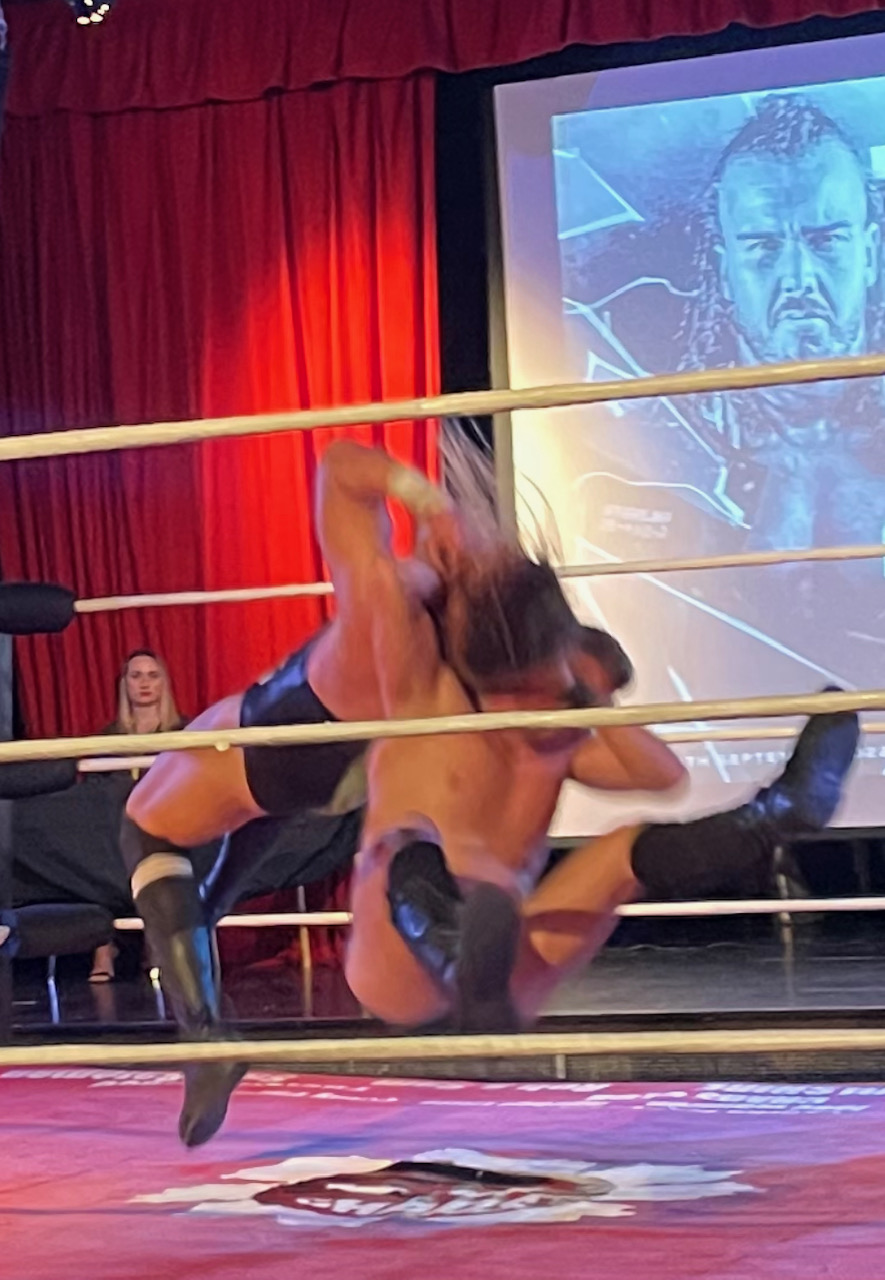
Tate Mayfairs about to be thrown by Joseph Connors
And the skill level is really impressive. Mayfairs and Connors are engaged in a ‘strap match’, in which they are tied together with a strap at the wrist which they both utilise in very technical ways that reminded me of the rope dart techniques found in Chinese marital arts.
As a child I used to watch wrestling religiously on World of Sport every Saturday morning in the 70s and early 80s, when it was on one of the only 3 TV channels you could watch in the UK. That was the era of Giant Haystacks, Mick McManus, Catweazle and Bid Daddy.
Things have come on a long way since then. Joseph Connors really looks the part of a modern day WWE wrestler: he’s lean, strong and his hair is long. Although Chris Hemsworth-lookalike Charlie Sterling who comes on next has even more hair, and even tighter pants.
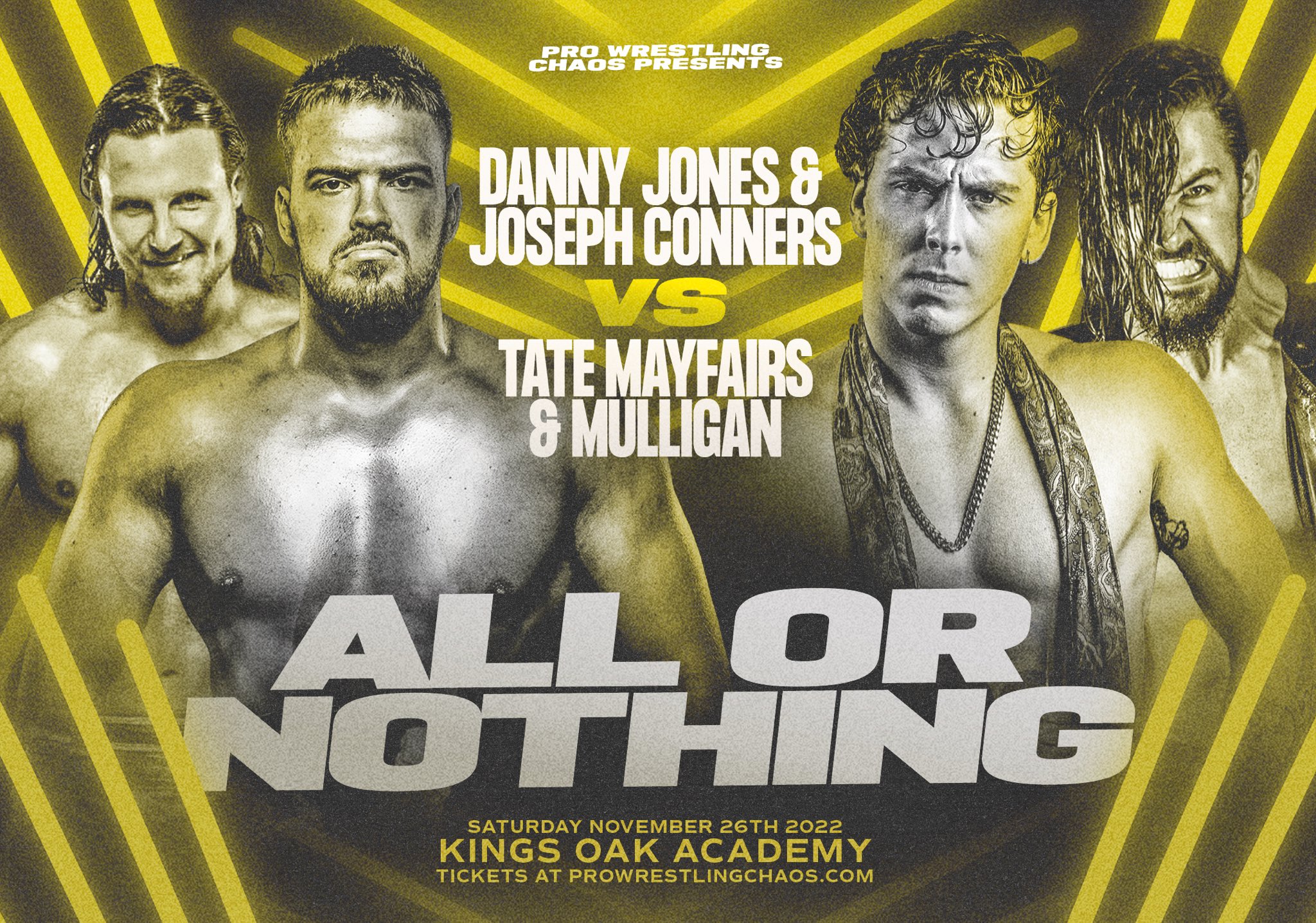
There are surprises throughout the night. The central conceit of Total Chaos is that you don’t know who is coming on next, you have to see who the Chaos Generator throws out – we get to see current King of Chaos champion Danny Jones vs Mulligan (who was a properly nasty heel) in a match to be decided by who got smashed through a table first, and then there is the surprise inclusion of “Jack from the bar” a comparatively skinny teen who had been serving drinks all evening from a small hatch in the foyer. Jack gets thrown into the show to make his Chaos debut in a male vs female match against the formidable Ava White, which was great fun. The poor boy didn’t stand a chance, but what a way to go.
The Total Chaos Generator throws JACK FROM THE BAR into his Chaos Debut and the Chaos Fans are here for it!!! pic.twitter.com/Mb7x8nmQYq
There was an all-female match up with Kanji vs Rayne “Make it rain!” Leverkusen, a tag-team event featuring the DEAD SAD BOYS and, surprisingly, 3 other wrestlers, (whose names, I apologise, I forget) and then a surprise final bout – Wait! It’s not over! – as “All Wales Champion” Brendan ‘Bronco’ White storms the stage to take on Eddie Dennis. These guys really brought the house down with incredible back flips from the top ropes.
Verdict: The athleticism and skill is real and it’s fantastic entertainment. There are moments of comedy, danger, tragedy, heroism and the wrestlers put it all on the line. Throughout the show the plot line of two rival wrestling factions, personified initially by Mayfairs and Connors, is weaved and developed into a feud, building to a grudge match tag team event bringing in Danny Jones and Mulligan, that will be decided in November at the next Total Chaos event: All or Nothing. I can’t wait! I just hope my 13-year old son still wants to go, or I’m going to have to go on my own…
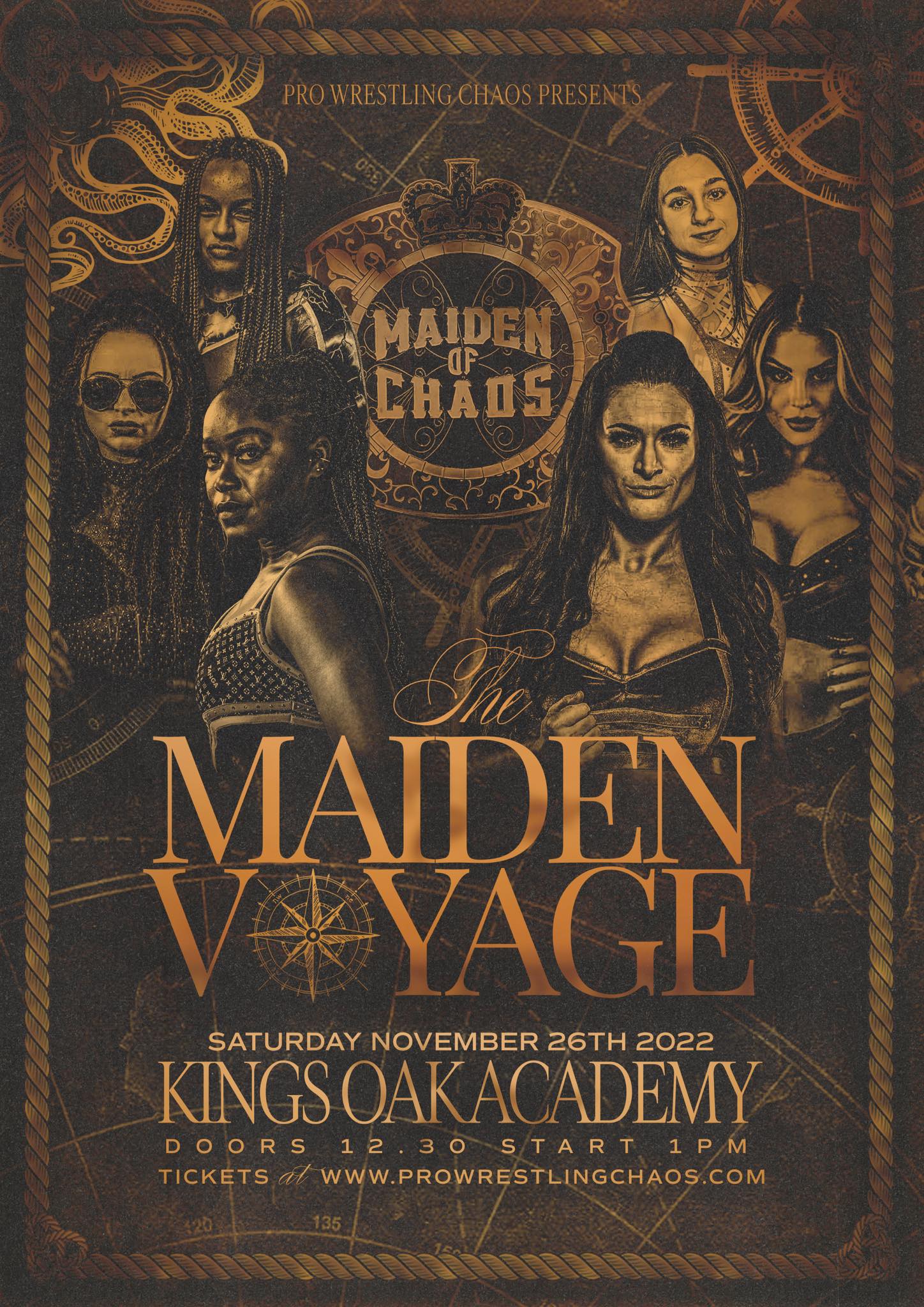
But that’s not all – there are two shows that day with the first being to decide the new Maiden of Chaos Champion. Don’t miss it!






 The Tai Chi Notebook