Tai Chi contains advancing and retreating movements, combined with circling left and circling right. Of course, in Tai Chi all movements need to be powered by the dantien. That’s easy to say, but on a practical level, how does this work?
One way I like to think about this is that as you retreat you can think about the arm movements being pulled by the dantien and as you advance they are pushed by the dantien. You can think of ‘rollback’ and ‘press’ from the Yang Tai Chi form as being a good example of this. As you shift the weight backwards in rollback you can imagine ropes attached from your dantien to your hands that are gently pulling them as the dantien moves. Rollback is usually performed with a turn of the waist to the side as you do it, so rather than being pulled completely in towards you, the pulling makes the hands go past you and ready to circle into the next movement… which is ‘press’. At this point you can imagine the ropes snap hard and become ‘rods’, which push the hands away, so the ‘press’ is powered by a pushing from the dantien into the hands. It looks like this:
In all of this your shoulder joint is moving, and power is going through it, but the key thing is that it is not the source of the power. The power source is the triangle formed by the two feet, legs, kua and dantien. The power goes through the shoulder to get to the hands, and if you tense the shoulders then you stop the flow.
Of course, these ropes and rods I’m talking about don’t actually exist, but they do give you the idea of a kind of pressure that is either pulling or pushing your arms and hands, which I think is useful. Once you use reverse breathing to pressurise your body you can start to feel this push and pull in the arms and hands. This isn’t imaginary, it’s a genuine feeling.
If you stand in a relaxed stance you can feel the pressurisation that reverse breathing gives you. Pick the classic ‘hold the ball’ Zhuan Zhang position, then stand for a few minutes while doing reverse breathing*.
You need to feel a connection all the way to the fingers and toes that’s connected to the breathing. It should feel like a slight pressure. Then try to get the feeling of pulling that connection in towards the dantien on an in breath and pushing out towards the fingers on an out breath.
The usual disclaimers apply to any type of work with pressure in the body – don’t do anything crazy with the pressure – you don’t want to tear anything in the body, and don’t direct it into your head. That way lies madness, or at least a pretty decent headache 🙂
(* All breathing in Tai Chi is done lower in the body than normal, so that the diaphragm extends downwards when you breath in, as opposed to the chest expanding. In ‘normal’ Tai Chi breathing the abdomen expands as you breathe in, in reverse breathing you change this around so that you contract your abdomen as you breathe in – this creates a kind of pressure in the body, that you can then use to power movement.)
Once you have a handle on the feeling of being pushed and pulled you might like to experiment with a basic arm wave silk reeling exercise – as the arm moves away from you it’s the ‘push’ from the dantien, and as the arm circles back towards you, you are looking for a basic ‘pull’ from the dantien. You need to maintain the pressurised connection at all times.
Here’s Chen Xiao Wang showing some silk reeling exercises – he starts with the basic single arm wave. Unlike me, he’s an actual expert, so pay close attention.
Of course, there’s more going on than this in Tai Chi, but as a basic fundamental it’s a good place to get started. Going back to the example of rollback and press – it’s a good section of the form to work with as both hands move in the same direction. Other Tai Chi movements, like Repulse Monkey for example, are more complex, with one hand going towards you, – a ‘pull’ – and the other going away from you – a ‘push’. Of course, it’s easy to mimic the movement on a surface level, but you need to be doing it from the inside. For now I’ll leave it up to you to think about how Repulse Monkey might work when it’s powered from the dantien.
This could change the way you do martial arts forever
Now, this is interesting. Esther Gokhale has created a method of sitting and walking that she claims will restore your “primal posture”. As you’d expect there’s a book, a DVD, a six-lesson course you can go on, and associated paraphernalia (like cushions) that you can spend more money on, etc, but you can actually get the core of the information for free by watching talks she’s given, like this one at TEDx. If you watch the following video you’ll get the background to what she’s talking about, plus she shows you how to sit in a chair using the method.
I’ve tried it, and I have to say, it makes sitting in a chair way more comfortable than usual for me. I find I can also stay there. Using her ‘sitstretch’ method I lose the urge to fidget around that I normally get when correcting my posture. The slight stretch on your lower back that the method gives you is actually kind of like having a hot bath – very relaxing and restorative.
There are lots of other videos on YouTube for different aspects of the method – like lying and walking. The method is based on observation of tribal people and how they don’t tend to have back pain, and move with a natural grace that we lose as soon as we become ‘civilised’ and live in larger groups in cities.
One idea is the ‘J spine’ – that the spine should be relatively straight, without a large lumbar curve that was associate with an ‘S’ shape.
The J spine in ancient Greek statue.
One tip she gives for keeping this spinal alignement throughout activities is to imagine you have a tail behind you, and you want to keep it behind you and pointing ‘up’. From an evolutionary point of view, this makes sense. Human foetuses actually have a tail, until at some point in our development in the womb it shrinks back into the body.
It’s interesting to apply this idea to Tai Chi, which has long been associated with ‘tucking the tailbone’. I’ve always thought of it as ‘centre’ the tailbone myself, which means that you basically relax the lower back. In fact, the Internet is full of people who have suffered health problems due to excess tucking of the tailbone in Tai Chi practice. There are a lot of people who seem to think that ideally you should form some sort of ‘c’ shape with your spine when doing Tai Chi. I’m of the opinion this is a misunderstanding.
From the classics:
When the tailbone is centered and straight,
the shen [spirit of vitality] goes through to the headtop.
The spine on the right is from an older medical textbook, before the idea of the ‘S’ shape.
Static stretching vs dynamic stretching – which is best?
I’ll be the first to admit that stretching isn’t the most exciting topic for most people, but it’s kind of important, so I should cover it. Plus, I’ve recently found a video by Ryan Hall that gives some extra insights into common stretches we do before BJJ:
Ryan gives some really valuable little tips on how to do each stretch correctly. Since you generally learn these stretches by just following along in class, with little to no additional information, it’s all too easy to miss the little details. For example, the first stretches he shows are the shoulder stretches you do by pulling the arm across the body (see 9.08 in the video). These are really common stretches used in all sorts of sports, yet the little detail he gives that you should be taking the shoulder down and back while pushing the chest out as you do them makes all the difference. Now you’re actually working the shoulder joint, which is the point of the stretch. Just yanking the arm across the body on its own won’t do squat.
Look at the ‘sprinters stretch’ at 24.26 – everybody I know will reach for that foot (including myself) but as Ryan points out, the point of the stretch is to get really comfortable getting your head to your leg – that’s where the focus needs to be.
What’s also nice about the video, is that Ryan puts each stretch in context – so you can see where it fits into BJJ as a whole. So, he’ll show you why it’s useful to be flexible.
And yet, he’s doing it all wrong. We all are. Or are we? You need to decide this for yourself after reading the latest research into dynamic vs static stretching, which I’ll point you towards here.
Ryan is showing what are called ‘static’ stretches, where you move into position then hold for 10 seconds. The current thinking is that ‘dynamic stretches’ are a better way to warm up. Dynamic stretches don’t involve holding the position at all, you simply take the joint through a range of motion, without holding the position at any point.
The reason of why dynamic stretching is better for you as a warm-up (than static stretching) seems to come down to two things. Firstly, the purpose of a warm-up is to warm the muscles and tendons, ready for the work that’s about to be done. In martial arts the work that is about to be done doesn’t usually involve holding stretched positions in extended periods (although if you’re getting stacked in your guard in BJJ, then it might!) Generally though, we’re about to use our muscles in an explosive way while putting our joints through their full range of motion. This is very different to the experience of a static stretch.
The second part is to do with the Golgi tendon receptor. This is a nerve which is found inside every tendon, and tells the muscle to relax and switch off to avoid it getting injured. So, if your bicep is under load and at full contraction for more than 5 seconds, the Golgi tendon receptor will make it relax, so you don’t tear anything. It’s this nerve which gets activated in a static stretch lasting more than, say, 5 seconds, essentially tricking it into relaxed the muscle further than normal, which means you can stretch further, but it also means the muscle can lack up to 20% of the power it had before it did the extra stretch (because you need tension to create power).
There have also been various studies performed which show that static stretching as a warm-up does nothing to help athletic performance, and in some cases actually diminishes it.
I think it all comes down to how you view the warm-up. If it’s simply to prepare your body for the work to be done, then dynamic stretching makes sense. However, you’re not going to dramatically increase your flexibility with dynamic stretching. So, in an ideal world you’d have both – the dynamic stretch before the activity, as a warm-up, then the static stretch as a cool-down afterwards.
A good source of information on stretching for athletic performance is sports coach Brian Mac, who has a website packed full of articles, like these ones, which contain the following quotes:
“Contained in the tendon of each muscle is the Golgi tendon receptor. This receptor is sensitive to the build up of tension when a muscle is either stretched or contracted. The receptor has a tension threshold that causes the tension to be released when it gets to high. As the Biceps contracts and the threshold is exceeded then a signal is sent to the Biceps causing it to relax. This mechanism prevents damage being done to the Biceps should the weight be to heavy or the movement is to fast.”
Conditioning: How does static stretching affect an athletes performance?
“In conclusion, in most cases static stretching before exercise reduces an athlete’s power and strength. If the athlete participates in power or strength exercises acute stretching may not be recommended. “
“This suggests that dynamic stretches, slow controlled movements through the full range of motion are the most appropriate exercises for warming up. By contrast, static stretches are more appropriate at the end of a workout to help relax the muscles and facilitate an improvement in maximum range of motion.”
We’re in a strange situation where the vast majority of people who “do Tai Chi” are performing some kind of elegant, slow-motion movement ritual, but without the required ‘internal’ body movement. There’s not necessarily anything wrong with this, as most of the benefits Tai Chi can give you – like relaxation, better breathing, suppleness, improved general health and flexibility – don’t really require ‘proper Tai Chi movement’. If you’re up and you’re moving then you’re doing your body more good than everybody left on the sofa. This is particularly important for the elderly.
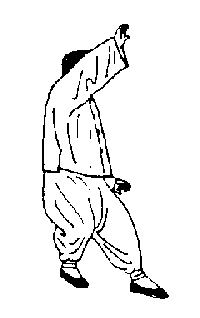
But what do I mean by ‘required internal body movement’? Well, I’m talking about how your body forms the posture of Tai Chi – the movement you use to get into the various postures and flow between them. By default everybody uses a kind of normal human movement – the sort you use when you reach for something in the cupboard, or when you are tidying up a room. You don’t think about it, you just do it. And it’s the same with performing a Tai Chi form. If you’re going to do White Crane Spreads Wings then one hand has to circle up, ending above your head, and the other hand has to circle down, ending near your hip. Like this:
The question is, how did the hands get there?
With ‘normal movement’ we just do it – our brain tells the muscles what to do and they do their thing, in the order and manner they’ve been working in since we were babies.
In Tai Chi we need to repattern the way our body moves to adopt the ‘internal’ model of movement. This involves creating a sense of connection from the toes to the fingers (like you’re wearing a suit), along which you can feel a slight stretch, and then keeping this stretch as you move, while powering and controlling the movement from the dantien and legs, not from the shoulders. In fact, the shoulders shouldn’t be actively doing much at all – they should act as conduits for power, not generators. There are other additives that are used to generate movement, but those are the basics.
It’s a lot easier to practice this sort of movement in a simple controlled way than it is to jump in at the deep end with a Tai Chi form and all the variation it offers. To help you do this, people have created are what have become known as “Silk reeling exercises”.
There are a ton of these on the Internet to watch and follow along with, but like most things of that nature, it’s not the exercise that’s the important thing, it’s how you do the exercise. Luckily, Mike Sigman has recently produced a couple of new videos that not only show the exercise, but also show how you are supposed to do them.
Take a watch, try them out, then see if you can repattern the way you are moving in your Tai Chi form.
Unfortunately, it’s hard to talk about Silk Reeling without getting into some of the style wars within Tai Chi. Silk Reeling is often though of as the preserve of Chen style Tai Chi, and that in other styles of Tai Chi they do something else. You can do you own research on the matter, but the conclusion I’ve come to is that all the various ‘tricks’ that you learn in Tai Chi (like bows, or rotation or sinking and rooting) are all different facets of silk reeling, and you can therefore save yourself a lot of time by just adopting the model wholeheartedly.
Here’s a link to an article on the Yang Family website extolling the virtues of silk reeling and why it’s so useful. I’ll leave you to draw your own conclusions about why it’s up there.
As it says in the article:
“We need to understand the requirement to ‘link everything together’. Not only does moving energy require going through all the joints, it also needs to be sent through the muscles and sinews above and below the joints. This is the function of spiralling silk reeling.”
So, to return to the aforementioned Crane Spreading its Wings – this is how you get your hands to circle up and circle down. Now you just need to go and practice it.
A discussion of the similarities between BJJ and Tai Chi
So, finally, here’s my much delayed look at the similarities between BJJ and Tai Chi. This is probably an impossible topic to give justice to fully, but I’ve given it a go and hopefully my perspective will be useful to others. I’ve already attempted to define Tai Chi in a previous post, so the next logical question is, ‘what is Brazilian JiuJitsu?’ Well, explaining what the art is, how it evolved and where it came from is not a simple job but luckily a lot of people have made a lot of (very long) documentaries that explain the whole story of the Gracie family, the in-fighting, the out-fighting and everything else in-between, so you’re better off watching those than having me explain it all again here. If you don’t fancy watching them all then the (very) short version is “it’s an off-shoot of Judo that has more emphasis on ground fighting”.
Try these for size:
The Gracie Brothers and the birth of Vale Tudo in Brazil:
If you want to find out how the art evolved once it entered the United States, and how it compliments other grapplings arts, then check out Chris Haueter’s incredibly entertaining speech at BJJ Globetrotters USA camp:
And finally, don’t miss the excellent Roll documentary on the spread of BJJ in California:
Fighting fire with water
But my concern here is not really the history of the art. I’m more interested in the technical similarities between Tai Chi and BJJ. I’ve heard Brazilian JiuJitsu described as being “like Tai Chi, but on the ground”. I understand where people coming from with that sentiment, but I can’t quite go down that route myself, or rather, I’d settle for saying that it is like Tai Chi, but also explicitly not the same. The one central idea that both BJJ and Tai Chi share is that it’s smarter to not oppose force with force, and instead “yield to overcome” (from a Tai Chi perspective) or “use leverage”, from a JiuJitsu perspective.
As it says in the Tai Chi classic “Treaste on Tai Chi Chuan”:
“There are many boxing arts.
Although they use different forms,
for the most part they don’t go beyond
the strong dominating the weak,
and the slow resigning to the swift.
The strong defeating the weak
and the slow hands ceding to the swift hands
are all the results of natural abilities
and not of well-trained techniques.
From the sentence “A force of four ounces deflects a thousand pounds”
we know that the technique is not accomplished with strength.
The spectacle of an old person defeating a group of young people,
how can it be due to swiftness?”
I’d disagree with the classic on one important point though – most of the traditional martial arts in fact do go beyond the strong dominating the weak, because without that key principle there is not much of an art left in the martial art at all. And I don’t know about the idea of defeating a “group” of young people either (that would be a tall order for any martial art, or martial artists), but to me the classic is suggesting that skill and technique can supersede the natural advantages of youth, such as speed and strength. And when it comes down to it, it’s hard to find an art that can deliver on this promise as well as BJJ can.
BJJ is one of the few martial arts where an older man (or woman) can be expected to regularly beat a younger man (or woman) by having more skill and technique, in a fully resisting scenario, thanks to techniques that manage the distance (a critical self defence skill) and use leverage and technique to overcome brute strength. That’s not to say that no strength is required, but you don’t necessarily need more strength than your opponent to make it work.
Rickson Gracie
To me, the BJJ practitioner that best exemplifies a similarity between Tai Chi and JiuJitsu is the legendary Rickson Gracie. He’s generally agreed to be the best of the Gracies. Compared to the acrobatic extravagances of today’s sport JiuJitsu champions, who favour inverted guards and bermibolos, Rickson’s style of Jiujitsu seems surprisingly simple, yet effective. There are no flashy moves, just basics done at a very high level.
The Rickson documentary “Choke”, which shows his training for a Vale Tudo fight in Japan, is essential viewing if you haven’t seen it before:
In the documentary you can see a young Rickson doing Yoga on the beach. Rumour has it that he also said he studied Tai Chi in a magazine interview, although I’ve not been able to find a transcribed version online to confirm this. Either way, it’s clear that he’s not averse to stepping outside of “pure jiujitsu” to add elements to his exercise, martial and health regimen. The cost of upholding the reputation of JiuJitsu and the Gracie family has been heavy though, and he has several herniated discs in his back, but he’s still on the mats teaching his family art, cornering his son Kron in his MMA fights and giving instruction through his JiuJitsu Global Federation. He also spends a lot of time surfing these days, instead of fighting.
If you read a Rickson seminar review, like this one, you can see that he keeps returning to two common themes – “connection” and “invisible jiujitsu”. The invisible part refers to what you can’t see happening; you can’t see where he is putting his weight and making his connection to his opponent, but you can feel it when he does it. He has detailed ways of making a connection in each position in BJJ.
This sort of teaching from Rickson, to me, is where I find the crossover between Tai Chi and BJJ to be strongest. In Tai Chi Push Hands, for example, we constantly seek to make a connection to the other person, through touch, so its a very familiar concept.
Here’s me doing some push hands:
Forget about the thing I’m trying to teach in the video, just look at the Push Hands routine we’re doing. As you can see, Push Hands very concerned with ‘feeling where the other person is’ and ‘yielding to their force without opposing it’ to neautralise the opponent. From this perspecitve, Push Hands starts to sound a lot like what Rickson is talking about in his seminars, but in a different format.
But the similarities don’t end there. When employing standing techniques Rickson also utilises some of the postural work found in Tai Chi and makes makes subtle nods towards the ‘internal’ method of body movement favoured by Tai Chi. He talks about making a connection to the ground through the feet. I’m not suggesting his ‘body mechanics’ ideas fully embrace everything you’d find in Tai Chi, but I can see the foundations of it being built.
For example, in a Rolled Up episode (3/4) from last year Rickson shows Budo Jake how to use some basic body mechanics to create a better root to the floor when meeting an incoming force while standing. He’s talking about transferring the force applied to the arm down to his foot and into the ground, then back up to move the opponent backwards. This is basic Tai Chi 101.
See here, from the beginning:
At.4.26 he starts to talk about ‘invisible jiujitsu’, specifically at 5.55 about ‘putting the weight in the hands’.
I was taught a very similar drill in Tai Chi – a kind of wrestling game, where you had to stand square on to the opponent and try to unbalance them with a push as they did the same to you. The key to doing it is to ‘put your weight into your hands’, so that when you push, it’s coming from the foot, not the shoulder. And when they push you root the push into the ground, instead of letting it push you over.
Here’s a video of me doing it from a few years ago. The camera is on the ground and not straight, so it looks like I’m leaning forward, but I’m not really:
I’m not an expert at it, and use too much arm strength, but hopefully you can see the similarity between this and what Rickson is talking about in the Rolled Up video.
Of course, Tai Chi takes this idea of creating a path from the foot to the hand to further levels of detail – first the idea of ‘pulling silk’ where you create a stretch from the fingertips (and toes) to the dantien and maintain that connection while moving, so it remains unbroken. Incidentally, the silk analogy refers to the way silk weavers pulled raw silk thread from a cocoon – you had to pull with an even pressure or the thread would break.
The next stage after ‘pulling silk’ in Tai Chi is to create windings on the muscle-tendon channels in the body, controlled from the dantien – the famous ‘silk reeling’ of Tai Chi. I think you can view this as the point where BJJ and Tai Chi diverge and head off along different paths – Tai Chi becomes highly specialised in this type of movement, while BJJ becomes more interested in the practicalities of actual fighting, and taking the fight to the ground (or just dealing with the fight on the ground) where it enters a whole new arena.
Realistically, and practically, there is no need for the type of highly specialised and, frankly, difficult, method of moving the body that Tai Chi employs for actual fighting, and also it’s questionable whether you can actually do ‘silk reeling’ type movement when on the ground, since it relies on using the power of the ground to push up from via the legs. Does that mean one art is better than the other? Well, they both are what they are, and they’re good for different things. I’ll probably leave it at that.
Conclusion
Interestingly, when I started BJJ (almost 5 years ago now) I found that my all years of experience in Tai Chi meant nothing at all on the mat when rolling against an experienced practitioner – even if they were a smaller, weaker person. Fighting on the ground is a completely different animal compared to stand-up. I was submitted as regularly as the next white belt, but I did find that my previous experience in Tai Chi meant I could learn quicker than average (I got my blue belt in a year). It let me see the concepts and principles hidden within the techniques of jiujitsu. And it helped me relax under pressure, which is a huge part of getting better at BJJ. Also, doing the Tai Chi form helped me recover quicker from the physical wear and tear which is characteristic of your first 6 months of BJJ, while your soft, squidgy body is still toughening up.
Unlike Tai Chi, which has, in a sense, become set in stone in terms of its evolution, BJJ is a constantly fluid and evolving art. Thanks to the highly competitive environment of the BJJ competition circuit, new techniques are always being created and being discarded. It’s becoming highly specialised towards what works in the most common competitive rule sets. Where I see the connection to Tai Chi is in the older, ‘original’ BJJ that was more self-defence orientated, as exemplified by Rickson Gracie. Where BJJ is headed next is anybody’s guess. Quite possibly it will evolve in several directions all at once, and it will be interesting to see if the legacy started by Rickson Gracie and his ‘invisible JiuJitsu’ lives on, or even gets expanded upon.
How to build a Tai Chi practice that lasts a lifetime
If you know some Tai Chi moves and you want to practice at home you probably have some questions, like where, when and how?
Firstly, the when. The best answer is ‘whenever’! There’s an old saying that the best time to plan a tree is 20 years ago. The second best time is right now. Just get on an do your Tai Chi practice whenever you have time. While there are some good reasons to practice first thing in the morning (it’s quiet, your brain hasn’t started to worry about the 20 things you have to do that day yet, etc) there’s no medical reason why practice in the early morning is better than midday, for example.
Secondly where should you practice? The traditional way is outside. I like this idea as we don’t spend enough time outside these days feeling the wind, or the sun, on our faces. Time in the elements and away from unnatural lighting and computer screens is actually very important to our health. Just ask Katy Bowman. If you’re going to practice Tai Chi then why not make use of that time to kill two birds with one stone and get some fresh air as well? If it’s cold outside just put on a coat and some gloves. And practicing Tai Chi in the snow is very cool- just ask that Panda in the picture!
Finally, let’s look at how you should practice, if you want to progress, that is. My teacher always advised doing the Tai Chi form a minimum of 3 times. Once to get it out of your system, then a few times (just once or as many times as you like) to work on something, then finally, once through again just to enjoy it. One of my students described this routine as “Once to notice the mistakes, then the next time to work on them”, which is a good way of looking at it. The ‘working on them’ bit can be frustrating, so the final ‘just enjoy it’ rendition is essential if you want to make this a life-long practice. Remember why you wanted to do Tai Chi in the first place – to enjoy it! Performing slow movements in the peace and quiet (or with relaxing music on) is very calming, so just enjoy yourself in movement. In the last run through you should try to be completely uncritical of your performance. It might be helpful to imagine that you have already attained mastery of the art!
I like this approach because ‘3 times minimum’ is something you can realistically fit into a morning routine and it encourages you to practice daily. Because, guess what? It turns out that you need to practice Tai Chi every day to get anywhere. Yes, sadly, daily practice is essential. Tai Chi is weird like that. I remember when I learned the Beng Chuan punch of XingYiQuan it was very hard, almost impossible, to get it right in terms of delivering structure and power together with perfect timing. But once I got it I realised I would never forget how I did it. To me it was like riding a bike. Sure, you can get rusty if you haven’t practiced for a while, but you don’t every really forget.
Tai Chi is different. At least to me it is, anyway. I feel like every time I do the Tai Chi form I’m learning to ride a bike again from scratch. After 3 run-throughs I’m pretty much back on the bike and riding, but it seems to wear off pretty quick, and by tomorrow you need to learn all over again.
According to Seneca, “He who studies with a philosopher should take away with him one good thing every day: he should daily return home a sounder man, or on the way to become sounder.”
I feel the same way about students of Tai Chi teachers. I feel like if I don’t impart that one vital thing each lesson then it’s not been a good day.
This Alexander Technique article on staying upright brought back some thoughts I have on Tai Chi, and being upright, that I thought I’d share.
Being balanced is a big deal in Tai Chi. I mean, if you’re going to move that slowly through a set of movements, you might as well make sure you are on balance while you do it, right? But what exactly is ‘balanced’ in a Tai Chi sense? The Tai Chi classics famously advise: “Stand like a perfectly balanced scale and move like a turning wheel” whilst also “Don’t lean in any direction; suddenly appear, suddenly disappear.” Of course, what is meant by those words is open to interpretation.
Being ‘upright’ is a bit of a contentious subject in Tai Chi as some styles advocate an active ‘lean’ in their forward postures, yet because there’s a staight line between foot and head they see it as still being balanced.
In terms of fighting, it’s hard to do a jab without a bit of a lean, so unless you want to start off your sparring career by fighting like a robot with your chin up, ready to be knocked out, I’d advise going with the protection that a slightly-leaning fighter’s stance offers:
Bruce Lee showing his lead straight.
Bruce Lee showing his straight jab
…. that is, until you are really comfortable with it. Then you can make it your own. For instance, take a look at the stance of current interim Featherweight UFC champion Connor McGreggor.
Beautiful counter punching from McGreggor.
See how ‘upright’ he is? It enables him to move fluidly and counterpunch very effectively. He knows when to lean, and when not to. In fact, I’d say he’s perfectly embodying the words “Stand like a perfectly balanced scale and move like a turning wheel” and “Don’t lean in any direction; suddenly appear, suddenly disappear.”
Was this what the authors meant when they wrote the Tai Chi classics? Who knows. They were written in another time and another place, by gentlemen who may have had no connection with what would be known as ‘prize fighters’ in their day. They might, even, have looked down on them as mere pugilists, existing on a lower strata of society. It’s impossible to say, but if you look at what remains inside the family lineages of Tai Chi – the Yangs, the Chens – then it seems to have no connection to two men duelling with gloves on. Only some branches of the Wu style seems to have branched off in this direction. But this is another topic, for another time.
Either way you look at it, a head that’s directed upwards (and by which I mean, suspended as if by a thread from your crown, not by looking upwards) offers you the most options in terms of mobility because the body is free to move. You are aligned with gravity.
Watch Systema expert Vladimir Vasiliev move and you can see the same thing.
He ducks his head when he needs to, but notice how ‘upright’ he is most of the time?
To go back to that article I kicked off with for a second:
“We tend to be overly forward oriented just because of the fact that most of what we do all day is in front of us. Then there is the tendency to be future focused on all the things that have to get done instead of being present with what you are doing as you are doing it. With these two things in mind, you can easily understand how you can lose a sense of the back of yourself as you get pulled forward.”
I notice this. I work at a computer all day, and occasionally notice that my head is always being pulled forwards into the work I do (writing). It takes a bit of mental effort to bring myself back into the present and my posture back to being directed ‘up’ as I sit, not slouching or drawn forward.
When you sit in a meditation posture long enough you start to notice your habitual tendency to lean forward. It’s subtle. When you sit ‘back’ into your hips and align your head over your hips you really notice how you can rest in your structure with less effort. The whole body can relax into the present moment.
I notice it in my Tai Chi, too. It takes strong awareness to be able to stay ‘upright’ doing the form. My habit is to slump. My challenge is to stay upright.
This great video is worth coming back to again and again. Obviously, there has been some manipulation – the sequence of each player is paused or slowed down at key moments so that they stay in sync, but it shows how Chen style and Yang style, which initially look quite different, are in fact, variations of the same form.
Yesterday I taught the ‘Grasp Bird’s Tail’ sequence in the form. I don’t know why, but I drifted into talking about trigrams as I was teaching it. Trigrams are the series of three broken or unbroken lines that make up the Bagua and are usually associated with the ancient book of Chinese wisdom, the I-Ching, or “classic of changes”, which contains 64 hexagrams (two trigrams on top of each other).
This diversion into ancient philosophy is somewhat unusual for me, but not unheard of, as I usually don’t like to get sidetracked into theoretical discussions too much when I teach. I think theory has its place, but I’ve seen too many Tai Chi teachers who seem to need a whiteboard and marker pen to teach you how to throw a punch. The thing is, the trigrams aren’t purely theoretical to me, and they do have relevance to teaching and practical application, as I will explain.
The four fundamental forces used in Tai Chi are Pung, Lu, Ji and An, (usually translated as Ward off, Rollback, Press and Push) and are most clearly expressed in Yang style-derived Tai Chi forms in the section known as Grasp Bird’s Tail. Each of the energies has a trigram related to it for a specific reason.
Peng is three unbroken, or yang, lines: “heaven”
Lu is three broken, or yin, lines: “earth”
Ji is one solid, yang, line surrounded by two yin lines: “water”
An is “fire”, a yin line surrounded by Yang lines.”fire”
Heaven, earth, water and fire – four fundamental elemental forces.
Because of their symbolic makeup, the trigrams can help you understand what’s ‘inside’ the postures, and what makes them different to each other – what makes a Peng a Peng, for instance, and not a Lu? And how is that different again to a Ji? And how is An different again?
It’s about the feel of each movement.
For example: Peng is represented by three yang lines – this is maximum yang at its fullness. In this posture you should feel internally inflated – a positive, outward expression of energy at its maximum. That doesn’t mean it is “hard” – it is actually more like a large rubber ball – a springy kind of energy on contact.
Lu is represented by three yin lines. This is the most empty a posture can be, but again, it’s not lacking or depleted, it’s just empty. There’s still a structure, like the way a vase is empty in the middle. You are guiding force past you, without adding in your own force, but also without losing your own stability.
Then you get Ji and An, which mix both yin and yang lines. Ji is a solid yang line between two broken yin lines – the needle in the cotton. This is how the energy should be expressed in Ji – soft, but with a hard centre. Push is the opposite – it appears to be hard, but is open and empty inside, giving the push a warmer fire-like feel.
Again, we are talking about how each posture feels here, so words will always be inadequate, which is why the trigrams can be a useful visual symbol to represent the feeling of each energy and help you distinguish them.
The use of trigrams is not limited to Grasp Bird’s Tail. (There are another four in use in Tai Chi, which are further mixtures of yin and yang balances, but I often feel like the theory is being shoehorned slightly into Tai Chi to accomodate them into a nice neat number 8, as there’s no real reason to go as far as 8, and you could also go further.).
Once you can understand the feeling of the four energies in Grasp Bird’s Tail you can see how it applies in other areas of the form. For example – what energy do you want to express at the very end of Brush Knee Twist Step? Is it a Ji or an An with the projecting hand?
Well, the interesting thing is, you could do it either way, so long as you know what you’re doing and why you’re doing it.
Addendum: One of the joys of symbols is that you can interpret them in different ways. If what I’ve written goes directly against what your teacher has told you, then that’s fine – you can interpret these things in different ways. This is just the way I do it.






 The Tai Chi Notebook