Religion, Theatre, and the Chinese Martial Arts, by Daniel Mroz
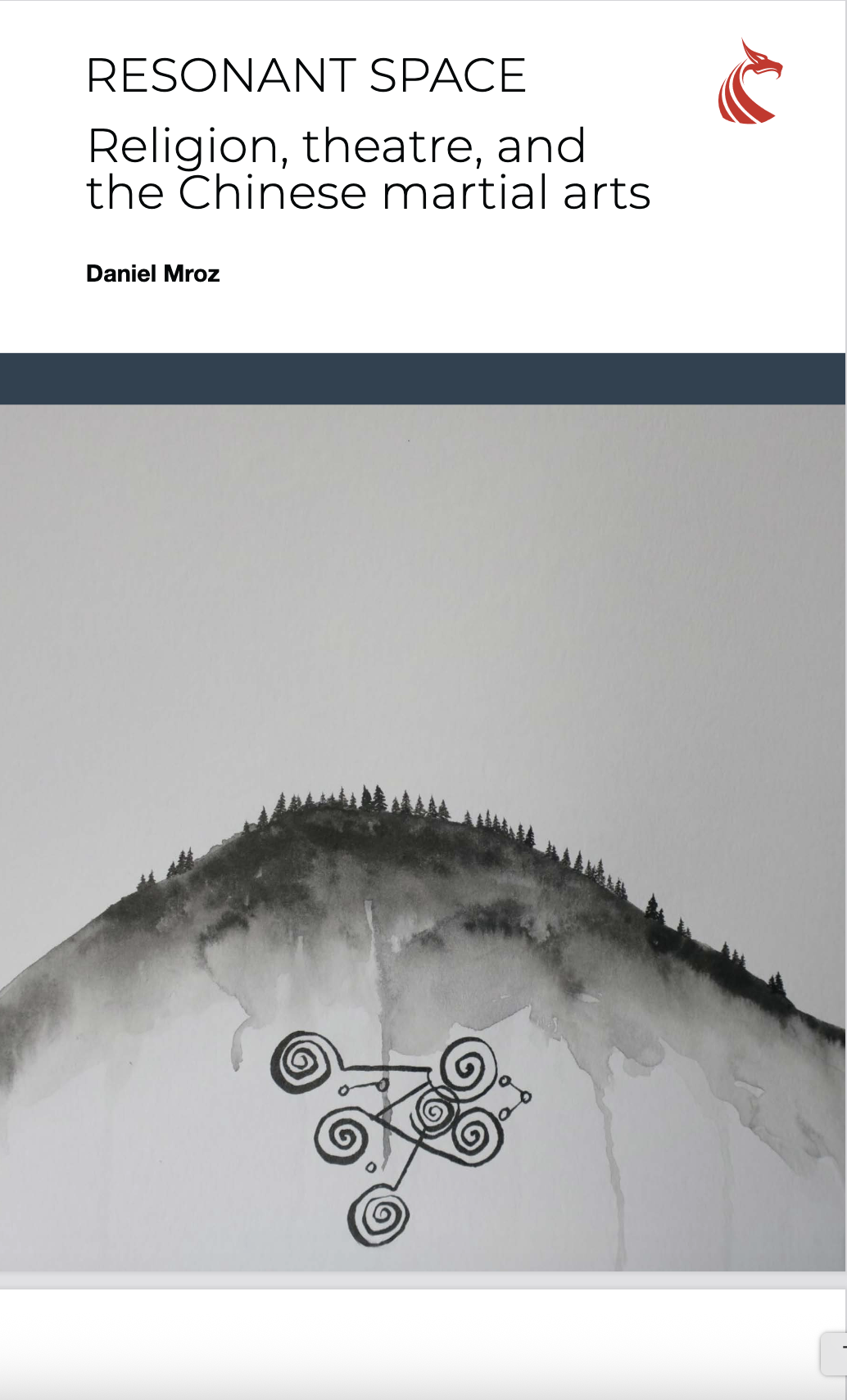
My good friend Daniel Mroz’s new book Resonant Space is out now! Daniel was the first guest on my podcast — back when I had no idea what I was doing with recording and editing audio, so it sounds pretty bad compared to my more recent efforts. However, what he talked about remains as insightful and up to date now as it did then. This book takes his ideas even further.
Here’s the blurb:
“Resonant Space constellates the martial, ritual, and theatrical elements of the Chinese martial arts with the practice of contemporary theatre and dance. This interdisciplinary approach blends the embodied experiences of the author, a lifelong student of the Chinese martial arts and a theatre director and dance dramaturg, with the study of Chinese cultural history. This is a work for scholars and practitioners of the Chinese martial arts, of contemporary dance and theatre, and for scholars of Chinese religion and cultural history.”
If you are at all interested in the intersection of Chinese martial arts, magic, theatre, military methods, violence, dance, self defence and religion, then you can’t miss this. I have read bits of this book already (it’s excellent), but I haven’t read it all yet, so I’m yet to appreciate it as a whole, and to see how he makes all the pieces fit together. I’m very excited to finally get to read the complete thing.
If you’re a practitioner of Chinese marital arts, then I can guarantee that this book will make you think. In good ways. There’s almost an embarrassment of riches packed into every page. So, rather than attempt to describe it, I thought I’d just throw three random quotes at you from the first chapter of the book, without context. Hopefully they’ll make you want to find out more.
“In the Chinese martial arts and in military strategy more generally, excellence in fighting is secondary to trickery and wisdom.”
“Perhaps the most famous failure of war magic was experienced by the Yìhéquán 義和拳 fighters of the Boxer Rebellion of 1899, who discovered they were not impervious to the bullets of Western colonial powers.”
“Given its spectacular nature and emphasis on dramatic fights, it comes as no surprise that Chinese theatre, or xìqǔ 戲曲, employs many training methods that are virtually identical to those used in martial arts.”
Again, you can read the whole book for FREE from Cardiff University Press as a PDF, or you can buy a printed copy for a reasonable price. Don’t miss this!
Something I read today was, “training material in my personal practice only includes the methods which have always consistently produced observable benefits and skills. Anything which hasn’t done so in a trial period of regular practice is eliminated and abandoned. I don’t have time for anything which doesn’t give a good return on the investment of time and effort to practice.”
That’s an interesting point of view, and seems logical and rational. It seems very in-line with modern efficiency-based exercise or martial arts thinking. I just don’t think it’s a realistic approach to studying the internal arts or qigong in any depth.
I remember talking to Simon Cox who trained for years at Wudang mountain in one of my podcasts and (I’m going by my failing memory here) he said something like his teacher asking them to do meditation for a few years, with barely minimal instructions, then just leaving them to it. Forget “a good return on investment”, you were just expected to do it, without any hope of a result.
I’ve often heard people say things like, “A year is not a long time in qigong practice”.
And from my own experience, I can say with confidence that you do need to practice without “observable benefits and skills” for a long, long time.
Most people simply stop, and therefore never get anywhere. They stay scratching the surface, thinking that they are deep into their practice.
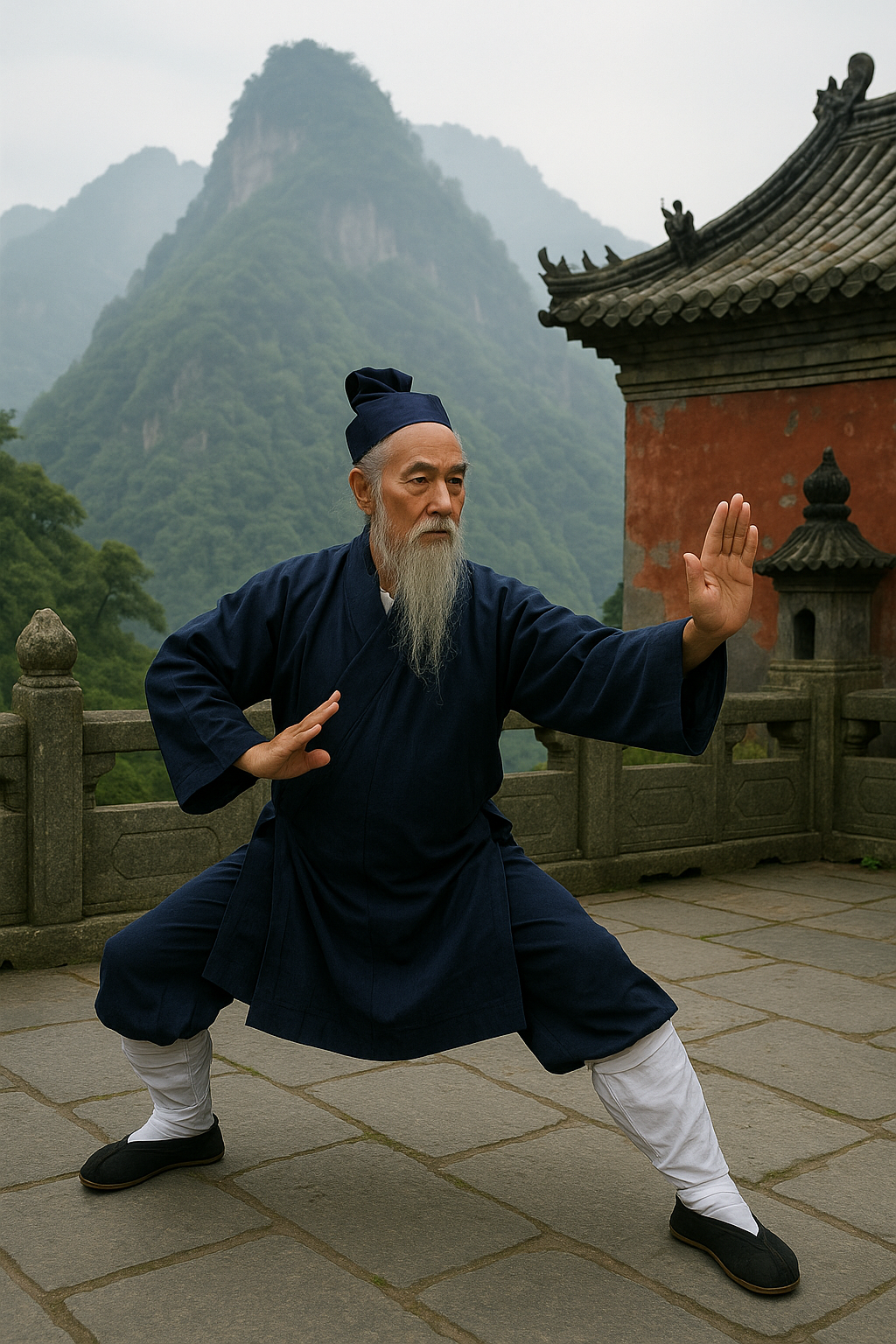
(FYI AI-generated image of a monk practicing martial arts at Wudang).
This is an excellent article called The Sacred Cash Cow: Wudang Mountain’s Martial Arts Tourism Empire by The_Neidan_Master on the massive amount of commercialisation of the martial arts in Wudang, which has really leaned into its claims as the birthplace of tai chi.
I don’t think it’s worth debating the authenticity of these claims again, I’ve done a couple of podcasts with people who have lived at Wudang and trained there, one with Simon Cox, and the other with George Thompson – both very different experiences, which reflects the diversity over such a wide area, since Wudang is a vast collection of mountains and temples/schools, rather than a single place – and I don’t know what more is gained by going over that ground, but I think it’s better to simply accept that there is a growing cultural force that is pushing Wudang, a traditional home of Taoist studies, as one of the centers of modern tai chi training.
If your goal is to train tai chi at Wudang then its worth reading the article to get a balanced view of the place before going there.
Here’s a great quote:
“For travelers seeking authentic martial arts experiences at Wudang, awareness of these commercial realities provides crucial context. Understanding that most schools are modern businesses rather than ancient temples allows for more informed decisions about where and how to invest time and money.”
I think we have to accept that for ancient traditions to exist and continue in the modern age there needs to be some soft of commercial aspect, but that means that you need to approach these traditions with eyes wide open.
And why you shouldn’t train with weights when developing your qi
Mike Sigman has sent me an article to publish on this blog. I don’t normally publish other people’s work, or agree to their requests, but I’ll make an exception because it will hopefully generate some discussion. Regardless of how you feel about him, there’s is always a real depth to Mike’s writings and ideas that you can get a lot from, that you don’t really find anywhere else.
The article is primarily about one of the trickiest subjects in Chinese martial arts – qi (or chi).
I have a few thoughts about it:
1) The article starts by trying to “separate the skin-related qi, which includes the subconscious mind’s involvement, from the theoretical qi of traditional Chinese medicine”.
To some, particularly those people who relish Chinese history and the evolution of the concept of qi as it appears in Taoist thought, or medicine, that just won’t be acceptable, but I think this works for me. It moves the discussion into the realm of the physical and practical. It becomes a feeling and a doing thing.
2) It appears to be written partly as a reaction to a recent trend of mixing, or doing, Chinese martial arts conditioning through the medium of kettle bell or weights training. The question is, is that a waste of time if you want to get to the root of the subject, which is what the Chinese martial artists call qi?
Look, I don’t think there’s anything wrong with making yourself physically stronger at all. In fact, it’s obviously advantageous if you’re learning martial arts… But the article states that to master the internal movement, “the body must be completely retrained to learn to move with the qi, jin, and dantian”, and using weights will not help you in that respect. If you have retrained the body, then you could probably add them.
3) As I’ve said, nobody else really talks about this stuff, or if they do it’s watered down with a lot of other guff. If the article is correct on qi then what exactly are all the big names in modern tai chi seminar circuit and online courses out there actually teaching? Because they talk about qi a lot… but they don’t approach it in the same way as this article does, at least as far as I can see.
4) The article describes internal movement, quite simply and quite succinctly: “Ultimately, you develop a form of movement that uses the solidity of the ground as the focus of all forces to and from the body, while the qi covering of the body is manipulated by the lower-body and the middle to bring power to the arms and upper body.”
I find it hard to disagree with that definition, probably because it’s pretty broad. Sure, we can argue over what the “middle” is, or what the “lower-body” means,etc.. but as a succinct definition, it’s not half bad.
Now, let’s move on to how you do it…
The article talks about breathing exercises as a starting point: “Breathing techniques that stretch the surface of the skin and the involuntary muscle layers are the usual start of the progression.”
Now, I have personally trained in some of the methods that Mr Sigman uses (there’s a link to a video at the end of the article), and experienced what he’s talking about, and I’d agree that I can feel what he’s talking about. But I wouldn’t count myself as an expert in it, or knowledgeable about anything to do with it beyond the initial foot in the door stages, however, I have found that alone to be incredibly valuable and shone a light on some of the other things I was already doing. Even getting a foot in the door took a lot of work and a lot of time.
Anyway, I’ll leave you to read the article now and feel free to comment with your thoughts below.
Graham
Practical Development of Qi
And why you shouldn’t train with weights when developing your qi
by Mike Sigman, March 2025
Discussing qi is difficult because the definition of qi has become a bird’s nest of related topics. Let’s try to narrow the discussion and then describe an approach to practical development.
Most of the skills related to qi, in the physical body, have to do with an area near the skin of the body that is referred to as the “protective qi” or “wei qi”. While the protective qi is often referred to as an “energy”, it is actually a physical set of tissues that is controlled via the autonomic nervous system … but when you learn to control it via the subconscious mind, it does indeed feel sort of like an “energy” because it is apart from the topical sensations of the somatic nervous system, and the qi indeed feels odd, like an energy.
So, let’s separate the skin-related qi, which includes the subconscious mind’s involvement, from the theoretical qi of traditional Chinese medicine: that’s where most of the confusion lies. The skin-related qi and the subconscious mind are the artifacts which give us heightened toughness of the skin, odd sensations of qi, added strength by supplemental our muscle-bone strength, and dantian control of the body as whole connected by skin-related qi, among other things. Jin forces, the manipulation of the solidity of the ground and/or downward forces of gravity, are also the product of the skin-related qi: jin is defined as “the physical manifestation of qi” in many Chinese sources.
The qi of traditional medicine theory is/was an effort to explain the workings of strength, including the strength of our involuntary systems. We don’t need to know all the theories about meridians, putative different types of qi, etc., in order to develop the qi. Breathing exercises and focused physical and mental exercises are more important than complex qi-paradigm explanations.
The skin-area wei qi is initially controlled by respiration and “breathing exercises” are our initial approach to control and development of the qi tissues. During inspiration, if we are slightly extended or stretched out, we can feel a slight inward pulling of the tissues of the fingers and hand. Other areas of the body, upon being slightly stretched taut, can also be felt during the inhale, but many tissues in other areas of the body can’t be felt. They must be developed over time by breathing exercises before we can feel them respond to our breathing and before we can develop them further.
Some Chinese texts mention the fact that this superficial qi is something that animals still use (think of a horse quivering its flanks, for example), but which has atrophied in humans over the course of evolution. In order to regain our qi, we must use deliberate exercises of breathing, mental imagery, and posture manipulation.
Training the Qi in General Movement
Jin force-manipulation is a product of the qi tissues applying stressors within the body’s frame. That’s why jin is defined as “the physical manifestation of the qi”, among other things. We use jin unconsciously in our everyday movements, so another common definition of jin is as an “intrinsic strength”. The full-blown traditional movement methodology that permeates the Chinese (and related) martial arts involves both qi and qi’s subset, jin. Qi and jin. Jin forces are the mind-directed forces from the ground and gravity; qi can be thought of, in a simplified sense, as a superficial muscular layer that connects the whole body.
The basic idea of movement with qi and jin is that the power from the ground and lower body is used as the power source for the upper body. The qi and the jin work from the lower body (including the middle/dantian), so what we have with “internal” movement is a system where the arms and hands are controlled and powered by the lower body and the middle.
The general admonition is that muscle and power are used in the lower body, as needed, while the upper body is moved without the use of local muscle. I.e., a person has to learn to control his/her upper body via manipulation of the lower body and the middle. The person who thinks the internal arts would be best supplemented with typical weight workouts at the gym has lost the plot and is giving away a total lack of understanding about how the “internal” martial arts work.
Developing the Qi
Jin skills are actually fairly easy to learn, although it generally takes a few knowledgeable pointers and some personal, hands-on demonstrations to get someone started. There are a number of written attempts at jin explanations on the internet, particularly through the 6H forum.
Qi is difficult to develop because it takes time and the feelings we need to focus our attention are tenuous at first. Breathing techniques that stretch the surface of the skin and the involuntary muscle layers are the usual start of the progression. Many traditional Chinese martial arts talk about “100 Days” of breathing exercises to develop the qi to a usable status.
Movement of the involves directing all forces upward from the solidity of the ground (so you must “sink your qi”) or use the weight of the body as a basis for downward movement.
Ultimately, you develop a form of movement that uses the solidity of the ground as the focus of all forces to and from the body, while the qi covering of the body is manipulated by the lower-body and the middle to bring power to the arms and upper body.
All Asian martial arts that are labelled as “internal” martial arts, formal calligraphy, qigongs, traditional dance, etc., use this combination of qi and jin for movements. Learning the external choreography and appearance of a martial art, a qigong, etc., no matter how much it resembles the movements of an expert, will not be correct until the system of movement is changed over to the qi, jin, and dantian type of movement.
Almost all of the movements we so often see in western semblances of “Tai Chi”, Aikido, Xingyiquan, Baguazhang, etc., are based from normal movement parameters, rather than qi and jin mechanics and it will take effort to re-learn these arts with the correct movement basis. There is an old saying to that effect: “Taijiquan is easy to learn, but difficult to correct”. So, if your goal is to learn Taijiquan, Aikido, or related arts, remember that all the talk about “relaxation”, “don’t use weights”, etc., is because the body must be completely retrained to learn to move with the qi, jin, and dantian.
Here’s a video of Chen Zhaosen, with translation by John Prince, teaching basic movement drills for the Chen-style Taijiquan. Notice his comment about no strength in the upper body, but whatever strength you need in the lower body. https://vimeo.com/141009942
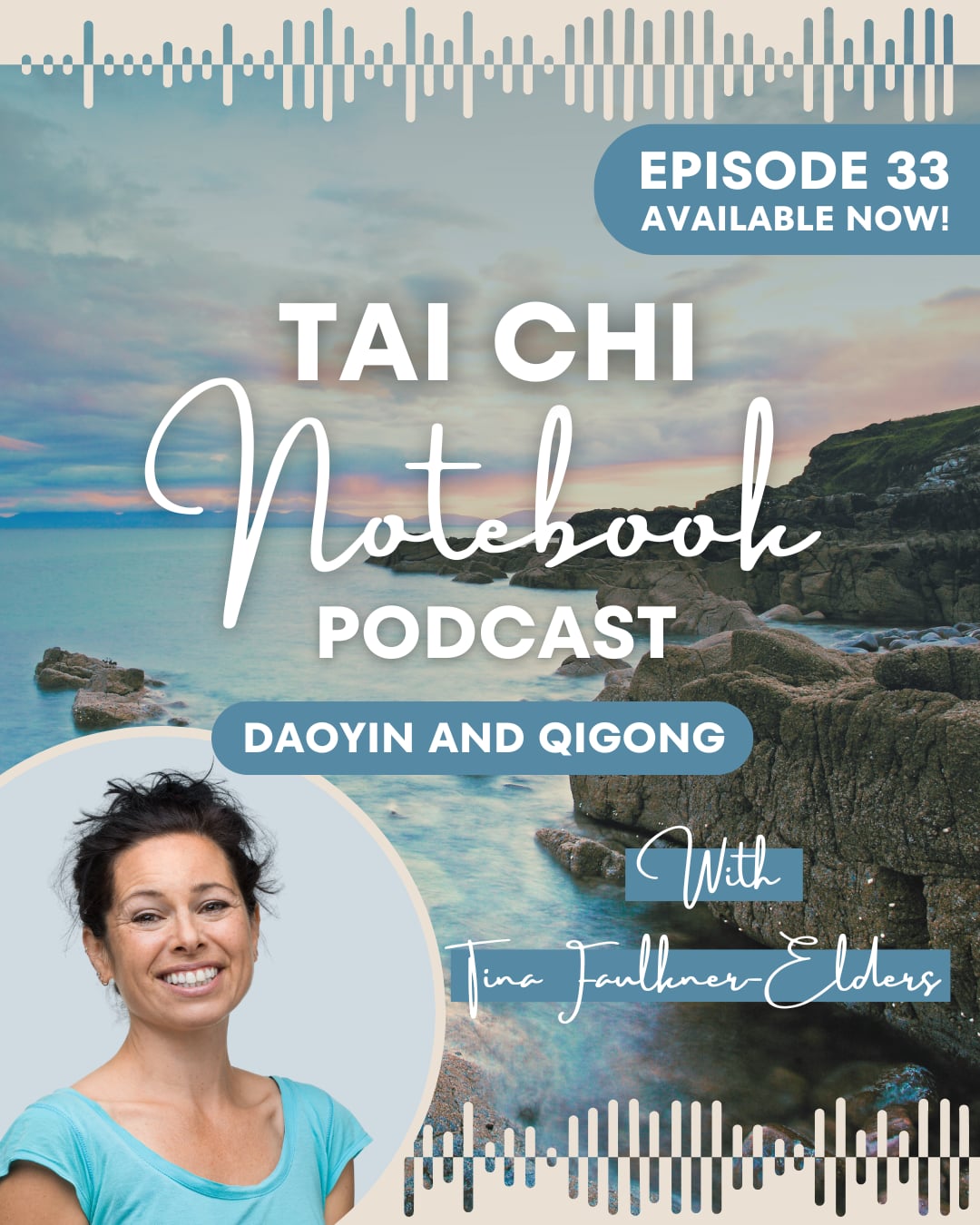
My guest for the latest episode of The Tai Chi Notebook Podcast is Tina Faulkner Elders, chief instructor of the RuYi School of Taijiquan and Qigong in Aberdeenshire. We talk about Tina’s training in qigong, first with her father, then in Beijing, China, and then on Wudang mountain itself, the legendary home of Taoism.
Change from being ‘stuck’ in your form to smooth, effortless movements.
People often say that Tai Chi is a moving meditation. But what does that really mean?
I can think of two distinctively different ways of mediating (there are others, too). One is to focus on an object exclusively. This is a type of concentration-based meditation. Your goal is to keep that object in your mind so that other thoughts can’t intrude. The other is an awareness-based meditation. Instead of focusing on one object, you have an overview of everything going on: you, what you are doing, and the space you are in, and you try and maintain that open awareness without getting distracted. If something comes up you notice it and let it go, returning to the awareness.
An awareness mind, reflected in nature.Photo by Noelle Otto on Pexels.com
In Tai Chi we want the second type of practice. When you’re are a beginner, learning the movements, you are akin to somebody learning to drive – it feels like there’s too much to do at once. Your mind is completely occupied by what you are doing and there’s no room for anything else. The more experienced Tai Chi player knows the choreography of the form, they know what’s coming next, and they don’t need to be in the movement so much. They can afford to step back and take a more general view of the activity.
If you’re in the more experienced camp on your Tai Chi journey, then try this the next time you do your form: imagine that ‘you’ are in your head, watching yourself do the form. You can be aware of yourself, your movements, your breathing and the space around you simultaneously, without getting ‘stuck’ in any one of those things. You’re just watching them happen.
I went to see an Alexander Technique teacher for lessons once and she told me to imagine a stage, with every element that’s happening to you and around you is on that stage. In normal every day life we have a spotlight on the one thing we are doing. In Alexander Technique, she said, we allow everything to be in the light. For me that made immediate sense. Maybe it will for you? It’s the same with Tai Chi. When doing the form, we need to expand our awareness to include everything that’s going on with us right now, and not get stuck in the one thing we are doing. It’s a bigger, more expansive feeling that leads to smoother, effortless movements.
In my training my Tai Chi teacher described something very similar to this as ‘man’ in Chinese, which translates as “slowness”, which is misleading since it wasn’t about moving slowly, it was about hanging in the moment without rushing. Rushing is often the thing that takes us out of the moment.
So, slow down, stop rushing, and when you’re doing the form allow yourself to mentally step back a little so you can be aware of everything that’s happening on your stage. For me the results of doing this are profound and immediate. It’s like a light bulb going on. It also feels like the release of a lot of mental tension you didn’t even know you were carrying. And it doesn’t need to be limited to the times you are doing the Tai Chi form. You can do it when you’re sitting down and having a cup of tea, watching TV, playing with the kids, or even ‘meditating’.
Some comments from Lao Tzu, in the Tao Te Ching come to mind:
“Do you have the patience to wait Till your mud settles and the water is clear? Can you remain unmoving Till the right action arises by itself?”
― Lao tzu
Thank you for supporting The Tai Chi Notebook. If you are reading this on a website that isn’t thetaichinotebook.com, then it’s highly likely it’s been stolen. Please let me know so I can issue their webhost a DMCA takedown notice for copyright breach. Thanks.
“The origin of internal arts” is probably what I’d have called this really interesting podcast with Peter Lorge about the history of internal martial arts, however Kung Fu Genius decided to name it “Chinese Martial Arts History is Mostly FAKE” because, well, it probably generates more clicks, or something. Anyway, Lorge turns over a few sacred cows here, and I also liked what he had to say about BJJ.
Have a listen:
I think Peter makes a great point about all these different ‘internal’ things throughout Chinese history all definitely existing, but all being completely separate and unconnected until the 1920s Guoshu Institute needed to create the category of “internal” to exist in opposition to shaolin and external, so it brought them all together. (The gentleman whose name he forgets when talking about this is obviously Sun Lu Tang.)
I do wonder if instead of looking back for mentions of “internal” throughout Chinese history a look back for the phrase Liu He “six harmonies” would make a better connection between the dots of Chinese martial arts history. While the term “Neijia” may not appear very often pre-1920s, Liu He definitely did. If we’re looking at how we got where we are today, then that’s probably a better bet.
I remember reading in a Zen book that I enjoyed that you should not practice for yourself, but just practice for the sake of practice. I like that. There’s a kind of grim realism to it but it raises the issue of how exactly are you supposed to approach these sort of goaless activities, like Tai Chi and Zen? The sort of activities where even having a goal can become a problem because it interferes with the activity itself, because it needs to be about being open and aware in the moment, not thinking about things far off in the future. By definition, if you have a goal you cannot be ‘living in the moment’.
Watching that Bagua Boy documentary that I linked to in my last post I was struck by how much Mr Rogers had practiced over his lifetime. He said he spent a lot of years practicing for hours a day. It’s impressive, but it also sounds very lonely, and even if most people had the free time to do that, they wouldn’t. You need to have some sort of drive deep within you to practice anything that much.
Lots of people in the Tai Chi world practice for hours a day. Some people meditate for an hour a day. Some people stand in Zhan Zhuan for an hour.
Today I read an article by Sam Pyrah in The Guardian that asks the question, at what point does a fitness activity become a ball and chain around your neck? At some point she realised that her life long addiction to running had left her very healthy, but with a very narrow life, and at the end of the day, what was the point?
People start Tai Chi for all sorts of reasons and the reasons for doing it change over a lifetime. Since I discovered Tai Chi I’ve always practiced, but I tend to do my personal practice in little pockets of time scattered throughout the day, not in big chunks of hours at a time. Maybe when I’m too old to work I’ll do a lot more Tai Chi than I ever did before? Everything has a cost, and I wonder if the people who practice for hours a day sometimes sit down and smell the flowers and wonder if it was all worth it… Like the Bear of Little Brain, I’ve always valued doing nothing as a worthwhile activity.
Practicing a bit is good, practicing a lot is better, but sometimes you can practice too much.
Things have not worked out well for the author of the book that got me started with Tai Chi…
The reason I got interested in Tai Chi in the first place was a combination of watching Kung Fu, the classic TV series starting David Carradine, in my early childhood, which primed to be receptive towards “Kung Fu” (whatever I thought that was at the time), and Star Wars with its emphasis on Eastern-influenced spiritual warriors with special powers that could be trained with a rigorous martial arts-like training programme, and then reading The Tao of Pooh by Benjamin Hoff when I was about 20.
This was the version of the book I had, The Tao of Pooh, by Benjamin Hoff.
This simple book combined a nostalgic look back at the Winnie the Pooh books by A.A.Milne from my childhood, which I loved, together with the basics of Eastern philosophy. And somewhere in the pages there was a single mention of a martial art that embodied the best of both, called “T’ai chi ch’uan” (as it was always written back then). That lead me to my first Tai Chi class, and I was hooked from the first minute I tried it. There was no Internet back then – you had to discover martial arts classes by looking at notice boards, that were usually found in health food shops. I remember I got a wobbly 2nd-hand VHS copy of the teachers in my first class doing their form, and I must have worn it out playing it over and over to copy the moves. What we would have given to have had YouTube back then!
The nature of politics and human affairs
Today I wondered what had happened to Benjamin Hoff, and if he was still alive, so I went off to have a look. It turns out he is still alive, but a visit to his website doesn’t reveal the comfortable life of a well respected author, sitting back on his laurels and reaping the benefits that writing one of the most popular books on Pooh and Tao should surely bring you. Instead there’s mention of vicious legal battles with publishers that has lead to a deep depression and a lack of funds. It all sounds rather sad. It’s an unfortunate and desperate station for somebody who has brought so much pleasure to people in the world, not to mention uncharacteristic for somebody who also authored a book about, “how to stay happy and calm under all circumstances”.
In addition to The Tao of Pooh, Hoff also wrote The Té of Piglet, which is also very good, and (I’ve just discovered) he wrote his own Tao Te Ching translation:
“Hoff was awarded the American Book Award in 1988 for The Singing Creek Where the Willows Grow. The Tao of Pooh was an international bestseller and spent 49 weeks on The New York Times’ bestseller list. The Te of Piglet also became an international bestseller and spent 59 weeks on The New York Times’ bestseller list.
In 2006, Hoff published an essay on his website titled “Farewell to Authorship”, in which he denounced the publishing industry and announced his resignation from book-writing.”
If you want a summation of Benjam’s problems with the publishing industry then I’d recommend reading this essay “Farewell to Authorship” – it is very well written. It seems to have been removed from his website, but you can find it on an Internet archive page.
They say that every great career ends in failure but it’s sad to see that the author who inspired me (and presumably many others) all those years ago to start Tai Chi has ended up in this situation, but perhaps all human lives end in some kind of failure. It’s inevitable, it’s just the nature of the Tao. His books, however, remain great.
If you’ve been doing Tai Chi, meditation or yoga for any length of time you’ll have heard the old adage to ‘put your tongue behind the two front teeth‘. The explanation given for this is usually that it “connects the two meridians that go up the back and down the front of the body called the Ren and Du meridians, creating the micro-cosmic orbit”.
Micro cosmic orbit connected… man. Photo by Elina Fairytale on Pexels.com
Personally, I have my doubts about the whole idea of ‘energy’ or Qi ‘flowing’ around the body. I often think it’s really an ancient aberration of the simple idea of forces moving inside the body. In Chinese martial arts there’s a phrase you often hear – rise, drill, overturn, fall, which matches this circuit in the body with a martial technique. The best example of which is Pi Quan from Xing Yi, during which forces in the body (jin) rise up and then come crashing down into a strike.
Strength and balance
However, it’s not just Chinese medicine that recommends this tongue position. I’ve recently discovered that there are a lot of Western sources advocating the same tongue position. For example, Colgate toothpaste has an article about correct tongue position on its website that recommends the exact same thing – the tongue resting on the upper palette behind the two front teeth. The article links to a study in Radiology and Oncology called “Three-dimensional Ultrasound Evaluation of Tongue Posture and Its Impact on Articulation Disorders in Preschool Children with Anterior Open Bite“, which notes that “children with poor tongue posture were reported to have a higher incidence of anterior open bite, a type of malocclusion where the front teeth don’t touch when the mouth is shut. This may be because the tongue puts pressure on the teeth which can shift their position over time.” (Colgate).
In this article from Healthline, Dr. Ron Baise, dentist of 92 Dental in London explains “Your tongue should be touching the roof of your mouth when resting… It should not be touching the bottom of your mouth. The front tip of your tongue should be about half an inch higher than your front teeth.“
While dentists may be aware of the benefits of good tongue position for your teeth and preventing problems with your speech, or mouth breathing from occurring, some exercise enthusiasts are going further and claiming that proper tongue position actually increases your strength and balance, something that is undoubtedly important for martial arts, like Xing Yi.
Pi Quan is said to be like the swinging of an axe. (Photo by Ivan Samkov on Pexels.com)
Now, I’m as aware as the next Tai Chi blogger that cherry picking studies that confirm your beliefs (and presumably ignoring everything that doesn’t) is a bit of a red flag. However, the idea that your tongue position effects strength and balance makes more sense to me than imaginary energy channels (Du/Ren) that may, or may not, exist in real life.
Apparently, good tongue placement can give you superpowers!
I remain slightly skeptical about the whole issue, however, my tongue does naturally rest behind my two front teeth on the upper pallet of my mouth… I can feel it there now as I write this. Was it always there? Or have I turned this into my natural position thanks to starting Tai Chi in my 20s?… I don’t know. All I can say is that it feels comfortable, and if my Ren and Du channels are connecting because of it, and my strength and vision is better because of it then…. so much the better.





 The Tai Chi Notebook