For clarity, his assertion is that the “dantien” is something that doesn’t exist by default, the way, say, your shoulder exists, but that it is formed by the simultaneous actions of other parts of the body. In this case, the hips, back, spine, breathing and more.
I’ve written here before that this is somewhat similar to the idea of the lap in English. The lap is formed by taking a seated position, and when you stand up it disappears.
So, when you form Tai Chi postures, you are also forming a dantien. Or at least you should be.
You can think of this as being an incredibly complicated prospect, but I don’t think you need to. There is also an implied simplicity to the idea. The problem is that when you start out the feeling of ‘strength’ in that area of the body is inherently weak, but correct practice of Tai Chi should be the training you require to start to build that dantien so that it’s a much stronger feeling.
Correct practice on a daily basis is what you need.
Of course, if you talk to Chinese medical practitioners, to them the dantien is as real as any other part of the Chinese medical system, and doesn’t require ‘work’ to exist. But I think that when talking about Tai Chi things, it’s safer to assume that this is not the dantien being talked about.
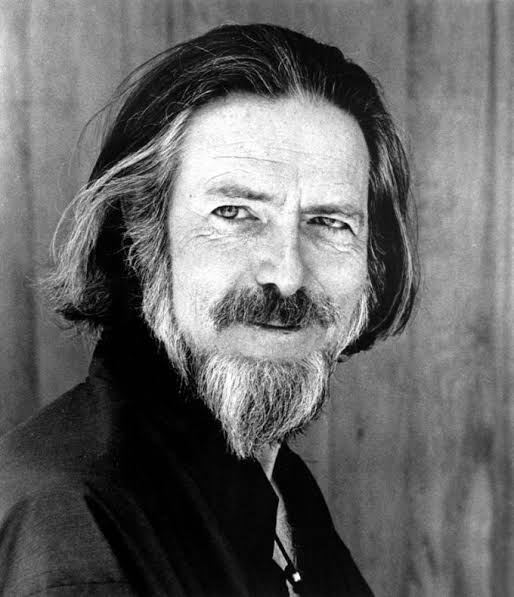
Alan Watts – what a guy! As the public philosopher entertainer de jour he spearheaded the Eastern spirituality movement of the 60s that took America by storm and forever gave Tai Ch its hippy associations. The lectures on Eastern religions, particularly Zen, he did for a local radio station in California have provided endless motivational video fodder for advertising-packed YouTube videos, and they’re all very good. For example:
He had such a good speaking voice, and could articulate mystical ideas, particularly the idea that existence was simply consciousness playing an eternal game of hide and seek with itself, in ways that Westerners could understand. Of course, the downside of that after you die your words get used to advertise all sorts of things you may or may not have been in favour of. For example, he’s currently doing a voice over for a company selling cruises on UK TV at the moment. I’m not sure what the old guy would have thought of that, but there you go. That’s life! It’s never what you expect it to be.
I’ve heard people say that Alan Watts was a good communicator, but a poor example of the Taoist ideas he espoused. This is mainly because he was an alcoholic who died at the relatively young age of 58 due to related health complications. However, if I look at the 60’s popular philosopher entertainers like Alan Watts and Joseph Campbell, they’re so much more interesting and interested in their ideas than today’s sorry crop of pitiful, grifting, sophists like Joe Rogan, Scott Adams and Jordan Peterson. All of them are usually trying to convince you of some terrible conspiracy theory with one hand while selling you something with the other. At least Alan Watts had enough self respect to be dead before he started trying to sell me cruises!
I saw one of Alan Watts’ videos on YouTube recently, that sparked a few ideas in me. It was to do with the Taoist idea of Wu Wei. It’s called “Alan Watts – The Principle of Not Forcing”
“Not forcing” is Alan’s translation of the Taoist idea of Wu Wei, which is usually translated as “not doing”, or “doing nothing”, however Alan’s translation is much better for martial application. In martial arts, like Tai Chi, it is forcing things that is bad. Alan even mentions Judo in his explanation above.
In English, the idea of doing nothing sounds too passive. Tai Chi isn’t passive. You can’t do a marital art by doing nothing, so I much prefer the translation of “not forcing”. It’s what we aspire to in Jiujitsu as well as Tai Chi. If you feel like you have to force techniques to work in Jiujitsu then it’s not the right way. It might be required in a time-limited competition, but the Gracie family were always famous for not wanting time limits on their matches, mainly because, with their hyper-efficient style of Jiujitsu, they knew they could survive longer than their opponent, exhausting them in the process. When you are forcing things to work you are burning energy, and wearing yourself out.
I think different styles of Tai Chi might look at this situation differently though. Yang style, and its derivatives tend to effortlessly breeze through the form. The emphasis is on efficient, continuous movement and relaxation. And while it may look effortless, you feel it in the legs, even if you are not visibly out of breath. Chen style seems to want to work a little harder. The stances are lower, there are occasional expressions of speed, power and jumping kicks. But there is still that emphasis on being like a swan moving through the water – graceful up top, but the legs doing all the hard work below the surface.
But regardless of style, all Tai Chi forms follow the same principle: Wu Wei.
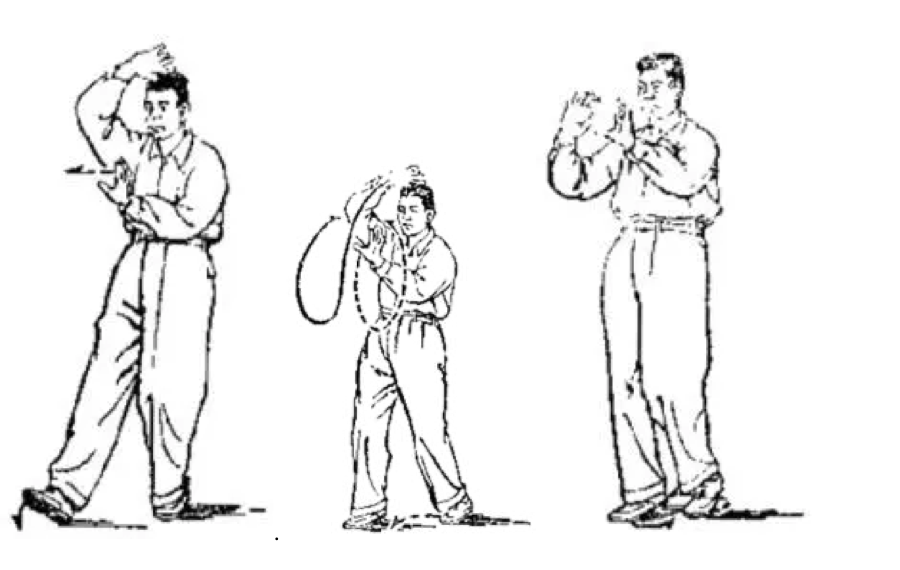
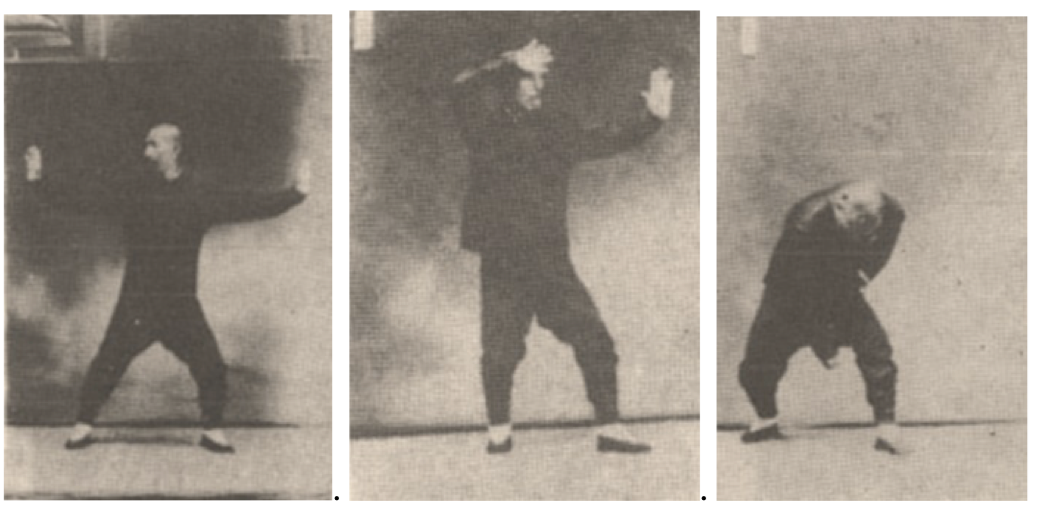
I’ve always been curious about the postures in martial arts forms where both feet are together, because these postures don’t look very martial at all. In fact, it’s hard to imagine why you would want to use a stance like that in a fight, and yet we find them in a lot of Tai Chi forms:
Here’s an example of the posture in application in Taiji performed by my teacher Sifu Raymond Rand:
Sifu Rang, Brush Knee, Twist Step.
It seems to be mainly Taiji lineages that have some influence from Sun Lu Tang that do this the most. A lot of people attribute the distinctive ‘feet together’ postures he used to his prior training in Xing Yi, and there could be some truth to this. Xing Yi does have ‘feet together’ postures quite a lot.
Of course, the root of Xing Yi is spear fighting, but the modern interpretation of the art is heavily biased towards bare hand training, and this creates a misleading impression. Think about it – if you were at at least one spear length away from your opponent the risk of being tackled to the ground because your feet are together would be greatly reduced. You’re now free to use the power generation advantages that can be gained by letting both feet come together, which is handy when you are holding a heavy object, like a spear.
If you watch this excellent video of Xing Yi spear technique by Byron Jacobs you’ll see that he doesn’t hang out with his feet together all the time, but occasionally he uses the feet together moments for power generation (and of course, also standing on one leg for range advantage and manoeuvrability in a way that makes sense with weapons).
In Xing Yi the most famous example of the ‘feet together’ posture is the Half-Step Beng Quan. Here the back foot stepping up to meet the front foot in place creates a powerful closing action of the body, kind of like a door slamming.
So, is this the origin of ‘feet together’ postures in Taiji forms? Quite possibly. However, there is one more thing to consider. After first learning Xing Yi, Sun Lu Tang learned his Taiji from Hao Weizhen 1849–1920, who learned from Li Yiyu 1832–1892, who learned from one of the Wu brothers, Wu Yuxiang 1812–1880 who had learned directly from Yang Luchan 1799–1872 and also sought out Chen Qingping 1795–1868 who he learned from in Zhaoboa village.
It’s often thought that the distinctive stepping seen in Sun style Taiji, where the back foot is often lifted and brought up close to the front foot, is a consequence of Sun’s prior Xing Yi training. This makes sense as part of the narrative created as part of the Sun Style Taiji brand, which is that he incorporated his earlier Xing Yi and Bagua training into his Taiji style. However, if you look at the Wu (Hou) style he learned, it already had this distinctive stepping in it.
While the feet don’t go completely together as much, if at all, in Wu(Hao) style, they are very close together for a lot of the time. Watch this video for an example of the form in action:
I think you can see that influence extending into Sun Lu Tang’s Taiji, which makes sense since he learned from this lineage.
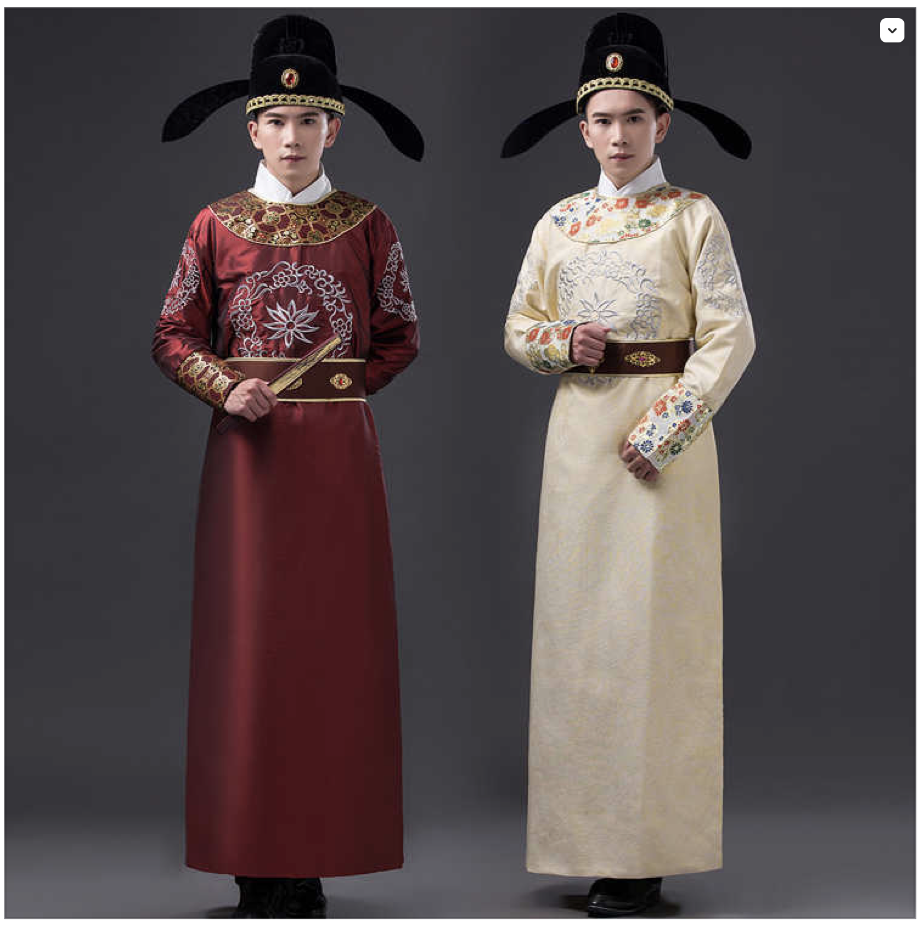
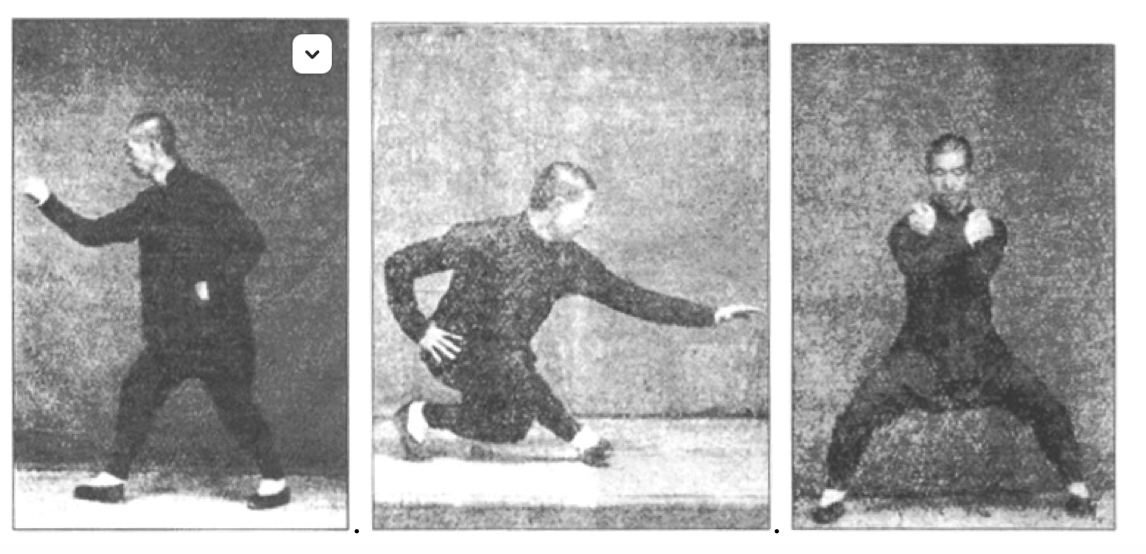
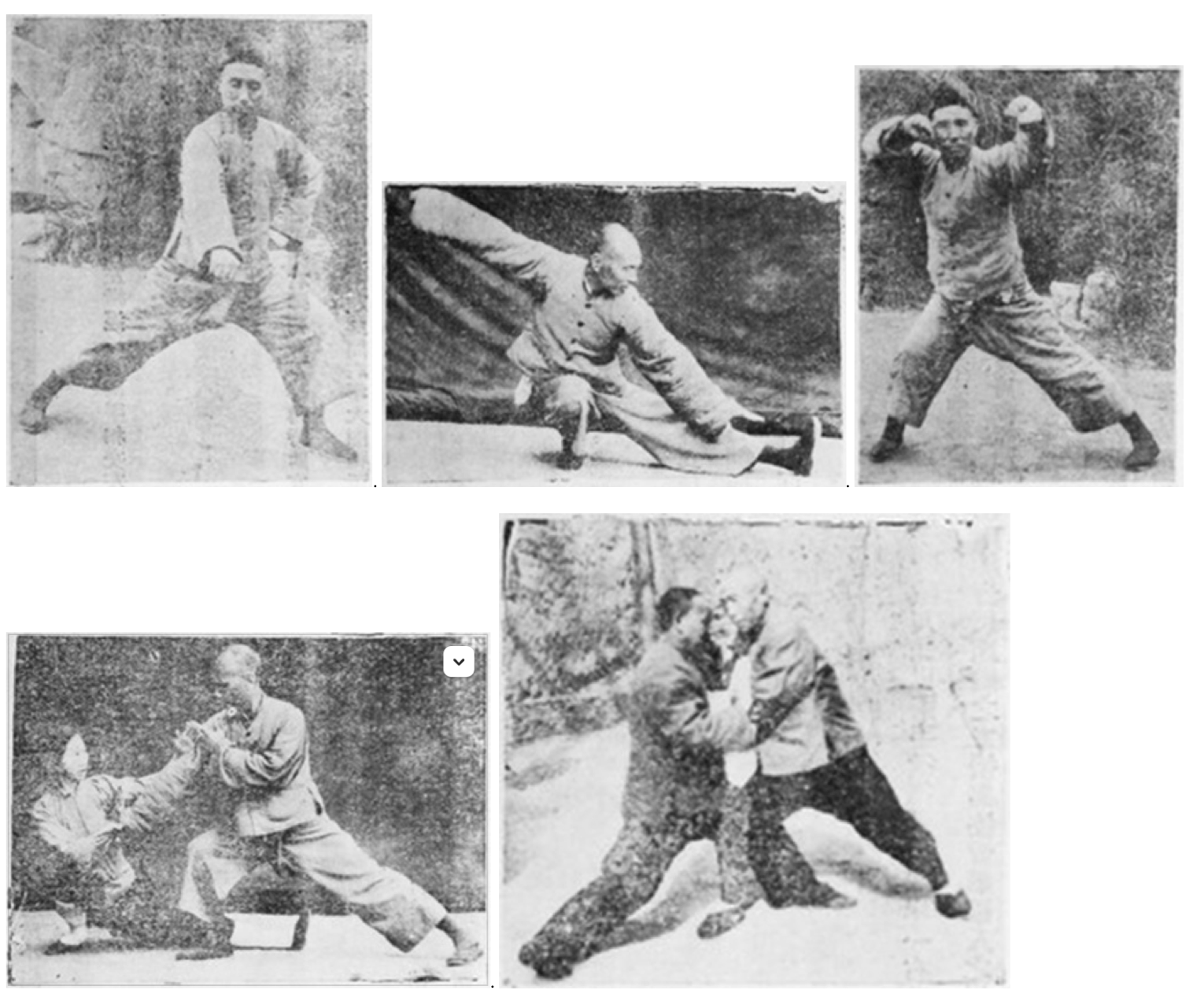
Finally, I should note that thought this post I don’t want to create the impression that all the steps in either Xing Yi or Taiji performed by Sun Lu Tang are small or restricted. He also had plenty of wider postures in his arts too, for example.
Xing Yi:
Taiji:
However, compare it to postures found in other styles of Taiji whose practitioners didn’t have to wear court dress:
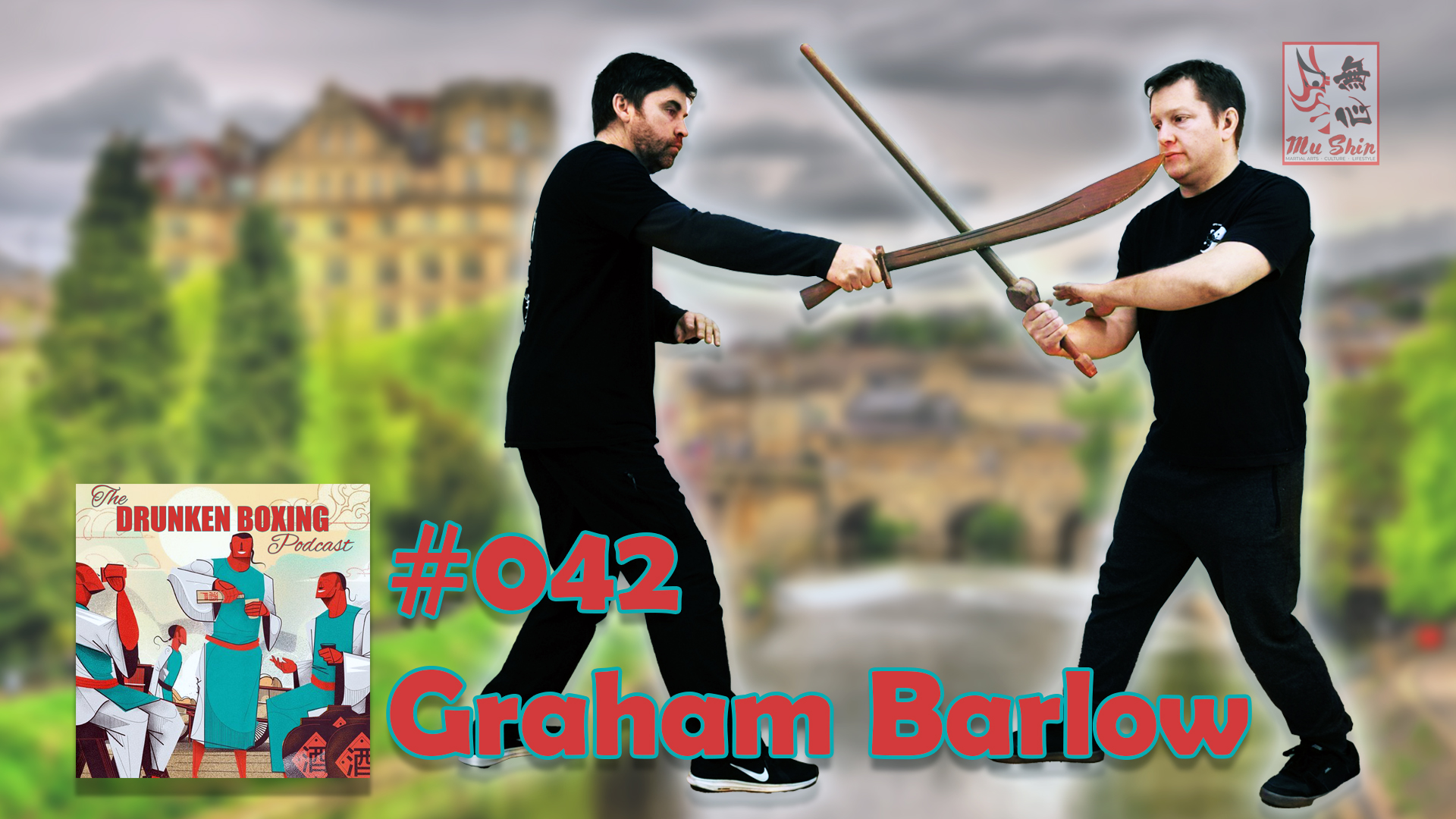
I appeared on the Drunken Boxing podcast run by my friend Byron Jacobs yesterday where we dived into the story behind all the martial arts I practice, who my teachers are and how I discovered them.
I’m usually the one interviewing other people on my podcast (I interviewed Byron back in episode 2) so this was a bit different. To be honest it feels a bit cringe listening to yourself talk about yourself, but hopefully there’s some interesting stories here to entertain people.
Drunken Boxing #042 Graham Barlow
Here’s a few links to some of the many and varied things I talk about:
Master Lam and Sifu Raymond Rand on the cover of Fighters magazine 1983:
Sifu Raymond Rand, Tai Chi Chuan applications 2022:
Stand Still Be Fit, Day 1: Master Lam Kam Chuen’s original Channel 4 TV series.
Graham in a BJJ sub-only competition 2013, blue belt
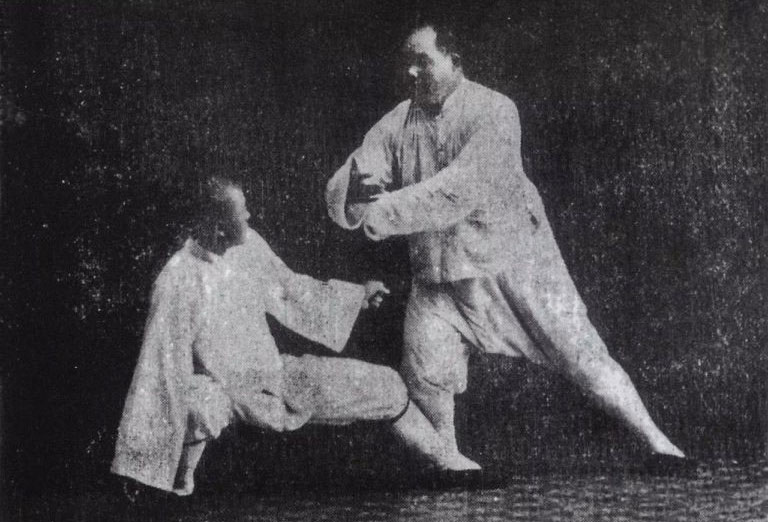
Yang Cheng-Fu showing Tai Chi applications from his book.
In the comments section Richard asked a good question in response to my last post. I wrote a brief reply in the comments, but I thought I’d flesh it out a bit as a blog post, because it’s an interesting topic.
The question is, ‘what’s the point of Tai Chi applications?’ Actually, to be fair, he was talking specifically about the one application video in my last post, not about Tai Chi in general. But personally I think you can extrapolate the question to include the wider Tai Chi universe, and that would be where I’d look for my answer.
There are plenty of videos of respected masters of various styles of Tai Chi running though the applications of their form movements and producing a series of very questionable applications that would require a perfect storm of events to happen for them to work. I don’t want to post them here because I think it would distract from the point I’m making, but look up ‘Name of famous master’ and ‘applications’ on YouTube and you’ll find them.
I really like the phrase “a perfect storm” to describe Tai Chi applications because as far as I can see, most (if not all) Tai Chi applications one would require a ‘perfect storm’ of attacker, positioning and timing for the application work. Therefore the one application video I posted previously is not particularly different to any other Tai Chi application video, at least to me.
That might not be a popular opinion, but I think it’s true.
Contrast this with a martial art like Choy Li Fut. I’ll choose CLF because it’s a kind of a typical Chinese Kung Fu style. It’s has some key techniques like Sao Choy – sweeping fist and Charp Choy – leopard fist and Pao Choy, a kind of big uppercut, Gwa Choy, a backlist, for example.
Here’s 10 of the ‘basic’ techniques that you find in CLF:
I wonder – does the man in the mirror ever punch him back?
If you watch a Choy Li Fut form then you’ll see these 10 techniques crop up again and again, but each form enables you to practice them in different combinations:
A great title for a video “Killer Choy Li Fut form!” It’s actually a great performance, especially with the drumming in the background.
Or check out the famous first form of Wing Chun – Siu Lim Tao, it’s a series of techniques performed very, very accurately so you can refine and practice them:
Now when you do those techniques in a form, you are performing a technique that would work exactly as shown. The only thing you need for success is to actually contact with an opponent and do the move correctly at the right time.
Tai Chi as a marital art just doesn’t work in the same way. We don’t have a toolbag of techniques designed to be pull out and used ‘as is’. Ward off is not a fundamental technique of Tai Chi – instead Peng, the ‘energy’ you use in performing ward-off, is the important thing. And I think this leads to a lot of confusion about what Tai Chi forms are.
So, if we don’t have techniques that exist in the same way as other marital arts, how are you supposed to fight with Tai Chi?
Tai Chi is a set of principles and a strategy that together make it a martial art. In a nutshell the strategy part can be summed up with the 5 keywords of push hands – listen, stick, yield, neutralise and attack. The principles cover how the body is used, resulting natural power derived from relaxation, ground force and a series of openings and closings expressed in the 8 energies. When the principles of Tai Chi are properly internalised you become something like a sphere, which can redirect force applied to you with ease and respond as appropriate. All these things are elucidated in the Tai Chi Classics.
Now that short description probably leaves a lot out, of what Tai Chi is, but at least it’s a starting point.
If that’s your goal, then putting emphasis on individual techniques doesn’t make much sense. Everything you do now exists in relation to an opponent, rather than existing on its own terms. The Tai Chi form then becomes a series of examples of how you might respond to specific attacks. In essence, it is a series of perfect storms, one after the other, put in a sequence that is long enough that you start to internalise the principles of movement and energy use. And obviously the strategy part requires a partner, hence why push hands exists.
I think that’s also the reason why Tai Chi forms are so long and slow, btw, so you internalise things.
As a final note, I’d say the jury is still out as to whether the Tai Chi way is the best approach to teaching people to fight. It’s interesting to note that a lot of martial arts innovators tend towards this same nebulous ‘technique-free’ style of training the further they get into their research into martial arts. Bruce Lee for example, was moving towards freedom and the technique of no technique in his later years – see his 1971 manifesto ‘Liberate yourself from Classical Karate’ for example. Then there’s Wang Xiang Zhai who created Yi Quan by removing fixed forms and routines from Xing Yi Quan and mixing it with whatever else he had studied. See his criticisms of other Kung Fu styles in his 1940 interview, for example.
In contrast a lot of the martial arts that have actually proven effective in modern combat events have turned out to be very, very technique based. Brazilian Jiujitsu, for example, is taught through very specific techniques. So is MMA. Karate, for all of Bruce Lee’s criticisms often does very well in competition against other more esoteric styles because it contains some no nonsense techniques.
Another factor to think of is that while Tai Chi may have those lofty goals of producing a formless fighter in its classical writing, it often isn’t taught like that in reality. One of the martial arts that Wang Xiang Zhai is criticising as having lost its way and become a parody of itself in that 1940 essay linked to above, is, in fact, Tai Chi Chuan!
So, as ever with marital arts, I think the answer is: it’s complicated.
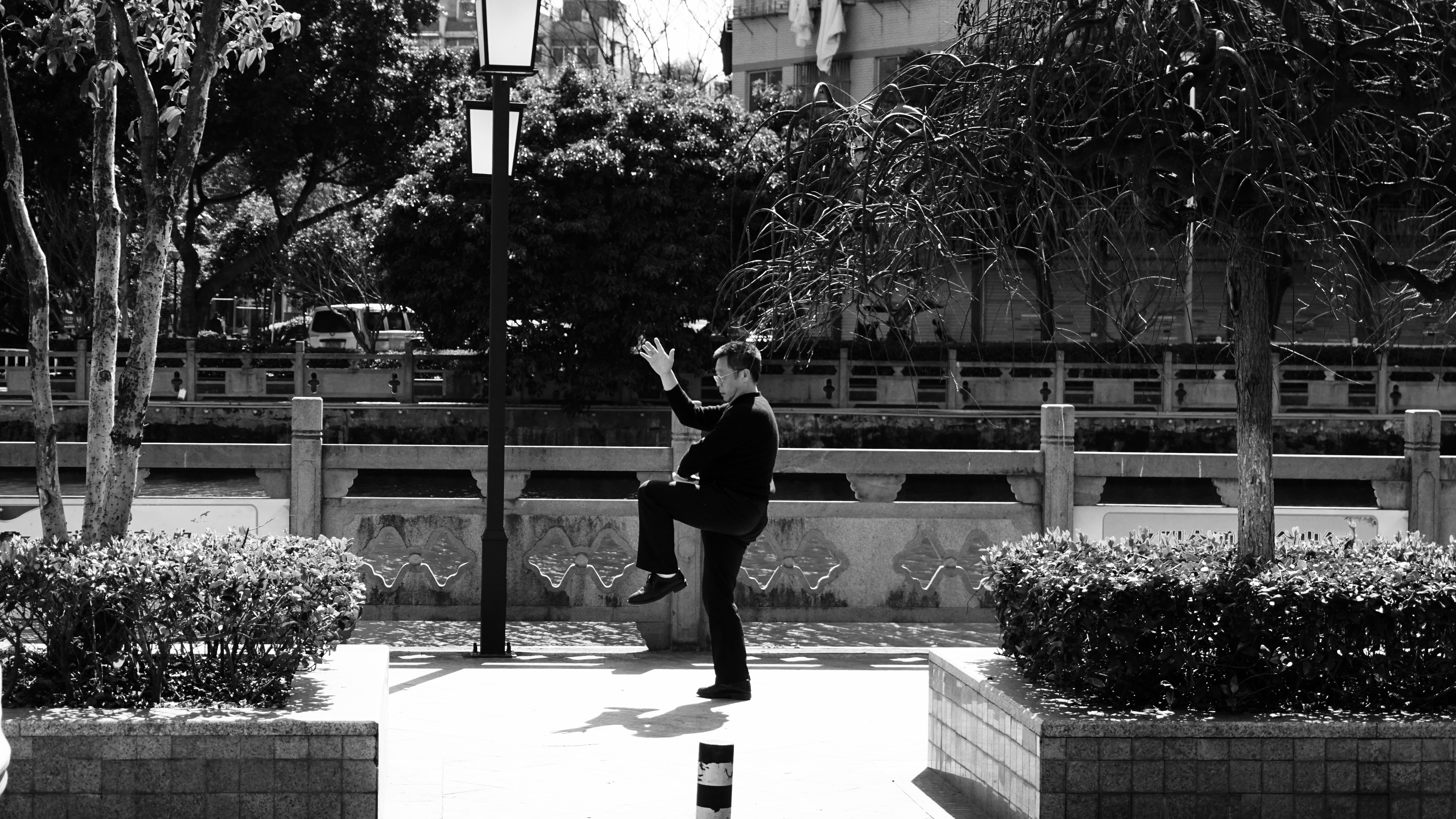
I live in the suburbs of Bristol. While Bristol itself is one of the most culturally diverse cities in the UK the suburbs tend towards leafy suburbia where you can feel the crushing weight of normality on your shoulders. So, while seeing somebody in a central Bristol park doing Tai Chi on their own wouldn’t be unusual, it’s almost unheard of in my local parks. I’ve done Tai Chi in my local park of course – usually when training with somebody else and it’s not something I do solo, since I can just imagine the amount of funny looks it would generate around here.
Imagine my surprise then when I saw somebody else doing Tai Chi in my local park this morning. I looked to my right as I entered the park on the way back from the supermarket and facing towards me in the Push posture, just a couple of meters away was a man doing Tai Chi. One glance was all I need to identify that he was doing Yang style, or possibly the Beijing 24-step, which is based on Yang style. He had that large frame posture and super slow movement speed.
He was an older man with striking white hair, brushed back and John Lennon-style glasses, but tinted, so you couldn’t see his eyes. It was that moment where you see something that you recognise but it’s in the wrong place at the wrong time, so your brain takes a moment to process it and you freeze like a rabbit in the headlights. The Germans probably have a word for it.
After over 20 years of living in an area where it would be considered odd, even weird, to do Tai Chi in a local park, it had finally happened. I’d seen somebody doing Tai Chi in the park! And do you know what my first thought was on seeing him?
‘Gee, what a weirdo!’
I just walked off without saying a word and he just carried on, his attention rapt up in his movements.
Have you ever been in a situation where you suddenly felt a subtle change in your body? Maybe your body is feeling a bit weaker, sluggish, or even a tad stiffer than usual? Maybe you’ve put on a bit of weight, and your body decided to send you a little message. It is interesting how you always have the sense that you need to move, as if your body is trying to tell you something.
Your mind is a powerful instrument. It knows exactly when you need a push and how much push you should be giving your body. One great way to harness your mind’s capability is to channel it through Tai Chi. Tai Chi requires a type of resilience that no other exercise can provide – it requires you to develop the resilience to work slowly and methodically even when your mind is telling you that it would rather do something much more intense. During high-intensity workouts, you can easily tune out and smash your way through them as you blast out tunes to keep you going. Tai Chi requires that you stop and reconnect with your breath before you go through your routine. You are then expected to keep your mind present and engaged throughout. The mental fortitude you develop while doing Tai Chi – which even the British Heart Foundation points out is required for a healthy lifestyle – will better serve you as you face more daunting tasks, like losing weight.
Here are a few beginner-friendly routines to get you started in Tai Chi, if you haven’t started already:
Exercise #1: Tai Chi Walking
As you go through this routine, concentrate on shifting your weight smoothly and without wobbling. Pay particular attention whilst you’re shifting forward onto the turned-out foot as you are twisting your torso. Complete beginners will often find this challenging, so don’t feel frustrated if you have a hard time. Your body will get used to this movement the more often you practice. To make sure you are getting the most out of the workout, try to keep your centre of gravity levelled. Be aware of how much you bend your legs and keep your body from moving up and down as you shift weight.
Exercise #2: Wild Horse Parting Mane
The key to this Tai Chi exercise is to try to combine the weight transfer, torso twisting, and arm separation and perform them in a flowing motion. Be mindful that your legs should be driving the pelvis forward. Feel your spine being in charge of rotating your shoulders as your shoulders propel your arms.
Exercise #3: Cloud Hands
As much as you are able to, draw circles with your arms in a smooth, continuous motion and keep your speed uniform all throughout the routine. With constant practice, you will begin to notice the overhand arm pulling while the underhand arm pushes/stabs. This movement activates the posterior chain on one side of the body while simultaneously engaging the anterior chain on the other.
Committing to a regular exercise routine, like Tai Chi, helps bring you closer to your ideal weight. Moreso, small lifestyle changes like being aware of what you put in your body will also help you tremendously. WeightWatchers notes that the best weight loss programmes work optimally when their main goal is to help you find movement you enjoy. This way, your decision to move becomes a healthy habit that sticks.
If you are still not convinced of the weight loss potential you can get from Tai Chi, you might be surprised to find out that the calm, rhythmic flow of Tai Chi works equally as well as cardiovascular exercise and strength training. The results from Tai Chi are comparable to the mentioned exercises in terms of reducing waist size and cholesterol improvement. A trial published by the Annals of Internal Medicine showed that three 1-hour weekly sessions of this low-impact practice helped the participants lower their level of triglyceride (a type of fat found in the blood). This eventually led to greater drops in body weight.
When it all boils down to it, the best way for you to lose weight is to find an activity that you enjoy, and that makes you feel good. If you are looking for a workout that would help you strengthen your mind as you strengthen your body (and lose weight in the process), give Tai Chi a try.
Opening and closing are in every movement of Tai Chi. But what does it mean to close?
To me the closing movements in the form feel like a squeeze. Closing in Tai Chi doesn’t mean shutting off. I think of the movement of Taijiquan as being like a garden hose that’s always on – the water (or if you want to get all mystical about it, the qi) is flowing regardless, and all you are doing with the closing movements is compressing the mouth of the hose a little, or putting your thumb over the lip, to increase the pressure, so the velocity of the water increases.
Quite often the closing part of the movement is when you form the end of a posture – the finish position of Single Whip, the end of Ward off, for example. When the body closes it’s like the pressure increases and the velocity of the water becomes higher, then as you open again the mouth of the hose opens allowing more water comes out but at a lower velocity. That’s opening and closing.
I will understand if you don’t have time for this or are unable to give a meaningful answer. I bumped into your website about a year ago, and since your writing seems to make sense to me, I thought I’ll ask.
I’d been exposed to Tai Chi some years back, and have continued trying to learn a bit more about it on and off since then, but given I’m an inlander in Australia I don’t have any practitioners nearby (nearest is ~over 300 mi away) it’s proving to be a slow process of breaking down videos and trying to assess myself against these.
Which is sort of the ignorant leading the ignorant. I’m making progress, but it’s slow.
I’ve spent a bit of time this weekend watching one of the classes that happens “close” to me, and looking at patterns that are the same but different, so that was my first in person exposure to differences between schools.
Given the distances involved in this, and my general reluctance to travel that much, I’m wondering about how well the online courses work? But that also leads onto a more basic question, of how do you pick a teacher in the first place? (I have worked out that at least one of the groups near to me attach to the “lineage” responsible for “Tim” being in a cult so I’m counting that one out.)
Is it just a case of pick one and go until it stops making sense?
Thank you for your time, and the blog posts.
Regards, Henry.”
Hi Henry,
Firstly, greetings to a reader from down under! What an amazing thing it is that I can write these blog posts here in the UK and on the other side of the world somebody is reading them. That really does make me think my time isn’t entirely being wasted.
Now, to the question of “how do I choose a Tai Chi teacher?” That is indeed a weighty one. A teacher/student relationship can be a big influence on your life, mainly because you will spend a lot of time practicing with them and people tend to rub off on you, so you should be careful of who you spend your time with. I also don’t want to advise you wrongly, and be responsible for you wasting years on the wrong track, or equally missing out on some great possibilities because the teacher didn’t quite live up to some standard I’ve set. People are human, fallible and weak, and they all make mistakes. Even mighty Tai Chi masters.
Members of a group that we might initially write off as a cult, could still be worth checking out. Just keep your wits about you. At the end of the day there are very few individuals who are good enough at Tai Chi to actually teach it, and your chances of finding one of those, especially one who isn’t charging an arm and a leg, is minimal, so we have to work with what is.
I think what we’d all like is to stumble across our very own Mr Miyagi, in a situation where we somehow befriend the keeper of an ancient family martial style who is happy to divulge his secrets to us if we do a bit of fence painting for him. If you manage to stumble across your very own Mr Miyagi then consider yourself to be incredibly lucky, because it’s not very likely to happen. However, we have the Internet these days, and while Mr Miyagis may be in short supply, there are an increasing number of Daniel-sans out there who may, or may not, be able to band together and form a practice group around a similar set of goals or perhaps an online teacher. You see, as well as a teacher to tell you what to train, you are mainly going to need a group of training partners of the same level to practice this stuff with when the teacher isn’t around. The majority of that work will look ugly, be full of mistakes and be unpaid, but it’s essential. That’s what nobody tells you.
Anyway, my top tips when meeting a new teacher are to trust your gut, ask questions and try and get hands on. Ask politely to try and feel what they’re doing. If they won’t let you or start making excuses, there’s your red flag. How do the other students act? Do they behave in an overly obedient way that makes you question what’s being presented? And what about their history? They should be able to answer basic questions about who they learned from and where they trained.
Of course, on the other side of the coin, it’s quite possible that you have entirely unrealistic expectations about what a Tai Chi teacher should be. Just remember: There’s no point checking everybody in the room if you don’t check yourself. Are you sure you’re not letting a good learning situation go by just because the teacher in question only has 3 of the 5 specialist Tai Chi skills you are looking for? A rule of thumb I used to use was “can this guy do something I can’t do and do it well enough that I want to learn it?” If they could then that was a good reason to learn from them. You can learn something from pretty much anybody.
And be clear with yourself what you actually want to learn. Some teachers are better at the fighty stuff than others, but if you don’t want the fighty stuff, then you can save a lot of time by not training it.
But what if the worse should happen and you get taught “wrong”? Well, that’s always a risk, but is it as bad as you think? It could be that you need to be taught wrong a few times, just so you can appreciate what’s right. Think of it as the price of an education.
The big thing I’ve learned over the years is that in the end it matters more how we treat each other, than what special knowledge somebody has access to. At one period in my life I trained with a Tai Chi teacher who was very good at what he did, but was also a complete asshole. I could tell he was an asshole, and the frequent bust ups he had with long term students were a constant reminder, but I wanted to get what he had, so I put up with him. I turned a blind eye to his various escapades into what would be called “bullshido” these days. But in the end I just couldn’t take it anymore and I left. It turned out to be the best thing I could have done. It was like a weight had been lifted, and I realised it was that weight that had been holding me back the whole time, I just couldn’t see it.
Anyway, I hope that helps.
Here are some typical Australians, about to be murdered by sharks. Photo by Belle Co on Pexels.com
I was reading through my latest purchase, Chen Style Illustrated, again recently and I got to something that piqued my interest – it’s the section where they are describing the 8 energies and we get to Press (Ji)
“When in contact the aim of this gradual rolling move is is to unsettle the balance of he opponent.”
It’s not a bad description at all, but I don’t resonate with the word “gradual” there. The most common application you tend to see for Press is of a kind of “bump” that puts the person off balance, but my experience of Ji has been that there’s nothing particularly gradual about it. That bump can be applied in a hard sharp way. Jin done in a forward direction (which is Press) can often be quite jolting and it hurts inside.
The 8 energies are:
掤 peng, 捋 lu, 挤 ji, 按 an, 採 cai, 挒 lie, 肘 zhou, 靠 kao
Google translates 挤 as “press” or “crowd in”. (I’m not sure that another translation you often see of “squeeze” is helpful. I’ve read people writing about squeezing the hands together – that’s not it at all. ) From that you get the sense of a situation where you are already in contact with the person and, perceiving a point of weakness in their defence you press them further on the point. It reminds me a lot of the strategy of Horse in Xing Yi, which is to attack a point of defence that is already defended but has a weakness you can exploit.
Cheng Man Ching doing Press
In the Tai Chi form Ji is usually done with the back of the hand in the typical Grasp Bird’s Tail sequence (presumably because it the easiest way to capitalise on a good position you’ve already achieved), but there’s nothing about the energy you’re using that means it has to be done with the back of the hand. It can be done with a fist or palm too.
And this is where the Tai Chi waters get a bit murky. There is the martial technique Press, which is to do with pressing further forward into an opponent you are already contacted with, and then there is the abstract concept of “jin in a forward direction”. Anytime you express jin (strength derived from the ground through a relaxed body) in a forward direction you could be said to be doing 挤, but when you put it into a Tai Chi context it takes on this quality of crowding in and pressing that attack.




 The Tai Chi Notebook