Thoughts on Chen Taijiquan Illustrated #1 – Yang style vs Chen style

The newest addition to my collection!

My copy of Chen Taijiquan Illustrated arrived, and I’ve almost finished it. It’s an easy read since the word count isn’t very high – it’s essentially a series of high quality training notes, illustrated, which I think really helps to convey the message in a way that text alone cannot. I’m not going to do a full review for a while, I’m going to let the book sink in first, but I might do a series of posts on ideas it has sparked in me.

Here’s the first one.

The thing I wanted to talk about today was how similar Chen style (as described in this book) is to Yang style. I think a Yang stylist would get almost as much out of this book as a Chen stylist. While the content and methods described in the book all clearly derive from Chen style, as do the illustrations, I’d say 90% (or more) of what’s described here is exactly the same as Yang style.

So what’s different? Bits and bobs on silk reeling, some stepping methods and stance details and the bits on fajin. But even then, they’re not something alien to a Yang stylist, and would be easily within reach of anybody who wanted to take their practice in that direction.

What’s the same? The emphasis on posture is really good here – how to round the back, contain the chest, round the kua, the eight energies, the 5 steps, push hands strategy and training methods, quotes from the classics, being centred and upright, rooting, the dantien, martial applications, etc.

What was I surprised not to find more of? Opening and closing using the 5 bows, and empty and solid. Perhaps more on using the force from the ground… There are mentions of these things throughout, but the book never really goes deeply into them. Perhaps it was too complex for the illustrated book-based approach? There’s only so much you can fit in one book, and there’s plenty of content here.

However, the emphasis on the body requirements of Tai Chi, and explanation of why these things are done, is excellent and transfers effortlessly across Tai Chi styles. It’s reminded me a lot how similar Yang style and Chen style are ‘under the hood’, so to speak. I wrote a post recently where I talked about them being similar but different. I still kind of think that. My view is that at some point Chen style incorporated the ideas contained in “Taijiquan” wholesale from Yang Luchan’s lucrative teaching business in Beijing into its larger, pre-existing, village style (which was more militia fighting and weapons-based) – it absorbed it whole – a bit like a whale swallowing a smaller fish. It was easy because all Chinese styles are similar to some extent. But of course, this means that the Yang style is still there inside Chen, and it’s impossible not to see how ‘almost the same’ they are when reading this book. (I think the spiraling and silk reeling stuff was from the pre-existing Chen style). Your opinion may be different. Food for thought!

New book alert! Chen Taijiquan Illustrated

Thanks to Ken Gullette at Internal Fighting Arts I just caught wind of this new book that’s just come out called Chen Taijiquan Illustrated. I had a quick look on Amazon using the “Look Inside” feature and the illustrations look fantastic. It looks like it’s designed to be halfway between an instruction manual and a comic. It’s a very cool style that’s quite unlike any Tai Chi book I’ve seen before.

Chen Taijiquan Illustrated – available now!

I think that often Tai Chi books, with pages after pages of printed text, can be a bit off putting for people who are learning an art that is all about feel, movement and “doing it”, not “reading about it”. And when they do have photographs in them they are often black and white and a bit dull and lifeless. So, for the visual learners out there, I think the colourful and imaginative approach found in Chen Taijiquan Illustrated will work very well.

Here’s an example:

An extract from Chen Taijiquan Illustrated by David Gaffney and Davidine Siaw-Voon Sim

Here’s another thing: Looking at the contents page, this is the first Tai Chi book I’ve seen that mentions the concept of Man, which translates as Slowness, apart from the book written by my Tai Chi teacher. Man is a concept my teacher talks about a lot, and it’s nice to see it mentioned in another Tai Chi book – I was starting to think that it was a concept that was unknown to the rest of the Tai Chi world!

Tai Chi Chuan a comprehensive training manual by Raymond Rand

Obviously everybody and their dog knows that Tai Chi is done slowly, but Man is more of a mental quality than a reference to the speed of the form. It can be thought of as “not rushing”. The speed you are moving at is irrelevant to the concept of Man, but if you want to acquire the ability of Man then the best way is by slowing the form down and focusing on keeping your mind on what you are doing. Whenever you find your mind wandering off you just stop the form (no matter how far through it you are) and start again. After a few weeks or months you’ll find you are much better at staying focused on your form than you were before. By adopting the qualities of “not rushing” you open up the headspace required to be aware of other things going on, things that you would simply miss otherwise. I’ve written about not rushing before.

At £16 Chen Taijiquan Illustrated is not particularly expensive for a colour book either. And I’d love it if there was a book on Brazilian Jiutjisu that was written and illustrated in the same manner because I think it would also benefit from this approach. Incidentally, there was a good book written about Brazilian Jiujitsu recently, that has colour photos (and very nice ones too) that I still dip into now and again called Nonstop Jiujitsu, by Stephan Kesting and Brandon Mullins. I reviewed it on my blog recently, so check out my review.

Nonstop Jiujitsu by Brandon Mullins and Stephan Kesting

I’ve ordered my copy of Chen Taijiquan Illustrated so will review it at some point in the future.

What’s better in martial arts – Body Methods or Foundational Movements?

I got asked once by a CMA practitioner what the “Shen fa” (body methods) of Brazilian Jiujitsu were and I drew a blank. The only answer I could come up with was “we don’t have any”. What I think we have instead though are foundational movements. Let me explain.

While Chinese martial arts like Tai Chi, Xing Yi and Bagua all have “Shen Fa”, which are “body methods” that need to be internalised before the practitioner can be considered sufficiently proficient in the art, Brazilian Jiujitsu doesn’t have them in the same way. Instead, it has a series of foundational movements that crop up so often in techniques that they are considered the foundations of the art, and are usually done in class as warmups.

I taught an interesting Jiujitsu class this week. (Well, I thought it was interesting – I think you’d have to ask the students themselves what they thought!) I started with the group practicing the basic Technical Stand Up both forward and reversed (which is doing it backwards, so you go fro standing to sitting down), then with variations like a knee or an elbow on the ground instead of a foot or hand.

Sweaty work – a fun class!

A Technical Stand Up is a way of going from sitting on the ground to standing up that exposes you to the least risk if you’ve got an aggressive person attacking you. It minimises your chances of getting kicked in the head and also affords you the ability to kick back at the attacker’s knee, possibly hyper extending their leg painfully.

How to do a Technical Stand Up

Once everybody in the class could do a Technical Standup well enough we went on to practice applications that utilised it as part of the technique. A good example is a basic X Guard sweep, or a way of returning to base after completing a tripod sweep. (I’ll not explain what those are here, because I don’t want to get lost in the details of these techniques in this post, because that’s not what this is about.)

Foundational movements in Jiujitsu include the aforementioned Technical Stand Up, but also things like a bridging movement, a hip escape (shrimp), a triangle, a forward (and backwards) roll and an inversion. If you can’t perform these basic movements correctly then your chances of doing any technique correctly are going to be severely limited.

In contrast, Chinese martial arts “body methods” include things like dantien rotation, opening and closing the chest and rounding the kua. These body methods are postural observances and ways of moving that need to be kept in place during all movements.

Why one art should have developed body methods, and the other not even have that concept, is worth thinking about, and I think it relates to the role of form in Chinese martial arts. Practicing solo movement in the shape of a form done in isolation from other people allows the possibility of subtle things like body methods to be developed.

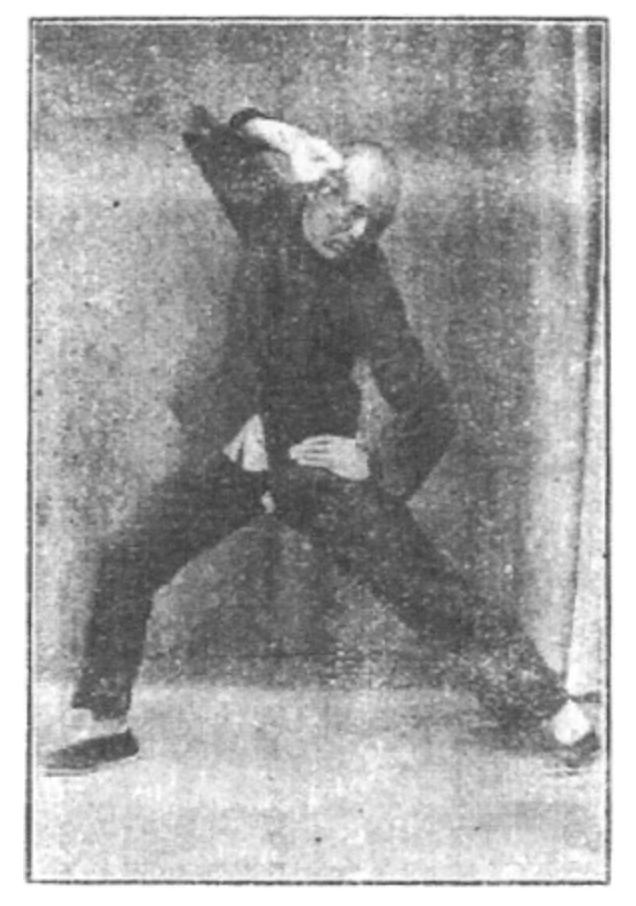
Torso Flung Punch by Chen Zhaopi, 1930,

There are no forms in BJJ. Sure there are solo exercises you can practice to warm up or condition the body, but they don’t have the same function as form (tao lu) does in CMA. BJJ is heavily partner orientated. All the drills and sparring need another person physically there to do it with. To practice BJJ we literally have to get together with other people in nice matted areas and throw down. There is no other way.

These body methods in CMA have resulted from forms, but my suspicion is that this was never planned, rather they have grown out of a situation that happens when you are required to practice forms. Why CMA started practicing forms in the first place is a different question – there are some clues as to why that might be in the video I shared the other day by Simon Cox on the Taoist concept of the Subtle Body.

It’s analogous to the situation in China between Shuai Jiao and Kung Fu (Wu Shu). Shuai Jiao has no extended tao lu (forms), like Kung Fu does, but it has an awful lot of solo conditioning exercises with and without weights and belts. I’m not a Shuai Jiao practitioner, but I think you’d be hard pressed to say that Shuai Jiao has Shen Fa in the same way that the various Kung Fu (Wu Shu) styles do.

Is one approach better than the other? I don’t know. They’re just different and personally I enjoy practicing both.

Why you should know (at least) two different styles of Tai Chi Chuan

Back when I interviewed Michael Babin on my podcast he mentioned that in addition to Yang style he also practiced Sun style on the side. He felt he got quite a lot out of it because Sun style emphasised different things when compared to his main style.

Single whip posture by Sun Jianyun, 1957

I didn’t mention it at the time, but I also have a Tai Chi-style (1) that I do on the side, and I practice it for exactly the same reasons as Michael: I get things out of it that aren’t emphasised to the same extent in my main style.

While my Yang style uses deep, wide stances with obvious circular movement coming from the dantien, my side style has slightly higher, narrower stances and is less obviously centred around the dantien area. Both styles use whole body movement, but with the different physical emphasis there’s more headspace available to focus on other ways of achieving whole body movement – effectively making more use of opening and closing the body. I think that is also exactly how Sun style compliments Yang style, too. By practicing my side style I get to focus more exclusively on the opening and closing of the body, and I can then bring that back into my Yang style practice.

Of course, style purists will find fault with this approach. I’ve nothing against people who only practice one Tai Chi style all their life, or even practice only one martial art all their life. There’s definitely something to be said for ‘don’t fear the man who has practiced 10,000 techniques, but fear the man who has practiced one technique 10,000 times’. And, of course, any Tai Chi style should be enough, on its own, to take you to the highest levels of the art. But I think that if you only practice one style then it’s at least worth dabbling in another, just to get that new perspective on what you already do. In my experience this will make you a better Tai Chi practitioner and a more well-rounded martial artist, if for no other reason than you’ll gain experience of defending attacks from more than just one style.

When we look at well known martial arts masters of the past there’s a pervading view that they only practiced one style, or were only permitted to practice one style by their teachers, but history is full of examples of famous masters who were well known for cross training – Ku Yu Chang, Sun Lu Tang and Wang Xiangzhai, to name but 3.

In terms of biology, nature prefers diversity, if the gene pool of a species starts to become too small you get inbreeding leading to genetic defects. You can see this happen in marital arts styles that become too insular as well. They maintain their purity, but at what cost? They becoming dysfunctional.

I’m all for diversity in my martial arts training and in life.

  1. The side style of Tai Chi I practice is a UK-centric style called Li style. I’ve been doing it since the 90s and while my interest in it can wax and wane it’s been a constant for over 30 years now. The Li style form is a nice, relaxing form to do. It’s slightly controversial because you can’t find the style in China, which is an obvious red flag, but I stopped caring about that a long time ago. I do it because I enjoy it. If I didn’t enjoy it I wouldn’t do it. It doesn’t matter to me if it was “made up” in the 1950s, or not. I mean, at some point everything was “made up” anyway, right? So what matters is if you get something out of it and if you can do it following the Tai Chi principles, which in the case of Li style, you can.

    Li style essentially looks a bit like Wu (Jianquan) stye. The form starts off following (very) roughly the same pattern as Wu Jianqan style, but after White Crane Spreads Wings it splits off into its own sequence, which is nothing like any other Tai Chi style I’ve seen before. It’s a very long form, with no repeated sections, and I’ve never quite been able to get to the end of it and remember all of it satisfactorily, but I can get quite a long way through it. Here’s a video of the Li form being done.

Tim, tell me you’re in a cult without telling me you’re in a cult.

Tim, tell me you’re in a cult without telling me you’re in a cult:

A comment from “Tim”:

“I’m disappointed in your entire take on internal power, as indicated by your dismissive way of talking about those who actually do possess some genuine internal power as using “tricks”. To be blunt, you’re just ignorant–that is, you have no personal experience with real practitioners and assume everyone showing such power must be a charlatan. Yes, there are many fakers out there and also many brainless critics who are not truly skeptical but just reactionary and dismissive. You haven’t seen this film but you lump everyone doing demos of internal power into one category of fakers using cheap tricks. I suggest you seek out one of the genuine Tai Chi practitioners who possess such power and experience it for yourself. Otherwise, you don’t represent Tai Chi Chuan as your little blog suggests. You just stand for the Tai Chi meditation approach and teaching form, which is OK but very limited and in denial of the original purposes and uses of Tai Chi Chuan. It’s not that difficult to find those who are the real deal. Start with the Martial Man series and see some who have taught at their “camps”–Adam Mizner, Liang de Hua and many others who are authentic practitioners of internal power approaches. Those people are themselves the former students of even higher-level masters whose powers are phenomenal. Tai Chi Chuan is a martial art that can be practiced for health and well-being, but it remains an extremely effective and powerful self-defense system that includes the use of various forms of “jin”–an energy converted to force that can be issued against any opponent. Take a breath, lose the cheap tricks of your dismissal, and try to seek out some contact with those who can show you what you’re missing.

Let’s just go over a few things from this:

  1. Tim (the owner of an anonymous sounding Yahoo email address) has no idea who I am, has never met me, and has certainly not read much of my material beyond my one post about the film “The Power of Chi”, which has got him so upset. That post contained an excellent video by Rob Poyton (who has appeared on my podcast before) showing how those things are done, and that anybody can do them with a bit of training. It’s well worth a watch.
  2. I can do the “internal power” things he’s talking about.
  3. I’ve done the “internal power” things he’s talking about on a stage in front of people.
  4. They are just demonstrations of ways to use power, not divine miracles done by a guy who needs to be paid thousands of dollars while being treated like a master of the universe.
  5. What I object to is the conflation of these things with real fighting skill, not the things themselves.
  6. Tim, you’re in a cult, and you don’t know you’re in a cult. One day you’ll look back and think, wow I was in a cult!
  7. Namaste.

Tai Chi Notebook Podcast Episode 15 – Centre the Dragon: Tai Chi Talk with Ken Gullette and Graham Barlow

In this episode of the Tai Chi Notebook podcast I’m teaming up with Ken Gullette, to answer the kind of questions that Tai Chi teachers get asked all the time.

YouTube version for people who, er, like YouTube?

Ken is an all-round good guy and owner of the Internal Fighting Arts website where he teaches the arts of Xing Yi, Bagua and Tai Chi at a very reasonable monthly cost. Check him out at www.internalfightingarts.com

Ken is a Chen style guy, and I’m a Yang style guy so it’s no surprise we have slightly different views on a lot of different topics, but that’s part of the fun of it all.

And if you’d like to help out my podcast then you can now become a friend of the Tai Chi Notebook on Patreon. Head over to Patreon.com/taichinotebook and you’ll be able to get a downloadable version of the podcast as well as support my work and get exclusive articles.

If you’ve got any comments on what we say then send them in – we’d love to hear from you!

How do I raise the spirit of vitality?

“Could you tell me if there is a specific exercise to raise the spirit of vitality?
Or could this be just any exercise at all rather than a specific one?
I have been learning tai chi and it talks about Spirit/Shen and its importance,
but I haven’t a clue exactly what it means. I know to feel full of spirit means you feel on top of the world and ready for life- this is what I would like to feel.”

Well, that’s a tricky one to answer. You have to ask what is meant by “spirit”. In the Mongol language, for example, there are a whole plethora of words that in English would translate in “spirit” and they all mean something slightly different. The Chinese word “shen”, I think, could be translated into several different English words depending on context. In English we have to add more words to a sentence containing “spirit” to add context. For example, “spirit of vitality” – this would be the sense of feeling full of energy and ready to face the world that you talk about. But there are other words that we translate as “sprit” that have all sorts of meanings, from the mundane to the profound – and all slightly related. For example to “raise the spirit” can mean something as mundane as keeping the posture upright with the head up, or as profound as the creative realm of the tree of life.

This idea of being upright (physically, mentally and spiritually) is a big thing in Tai Chi – we are told to “let a light and intangible energy raise to the head top” in Yang Cheng-Fu’s 10 Important Points.

Yang Cheng-Fu

So, to get to the other part of your question – how to do it. There is no specific exercise for raising the spirit of vitality. Rather, it is a part of the postural requirements of Tai Chi, so it should apply in all exercise orientated towards Tai Chi practice. You want to feel as if your head if being pulled up by a thread from the crown point (between the tops of the ears). The result should be that the back of your neck gently lengthens and the chin tucks in. As always, you don’t want to achieve this posture with force, so don’t push your head into it. You should find that if you stand, focus on your breathing, generate that lightweight observation of self that is required in Tai Chi, your head and neck posture should naturally want to assume this posture.

Everything in Tai Chi works together. If you are breathing well, then it will encourage your posture to be upright and strong, which in turn will encourage you to ‘raise the head top’. If you can remove stress and tension from the body then the weight will sink down simultaneously, so you should feel strongly rooted into the ground and drawn up from the crown at the same time. These two pulls in opposite directions provide balance. You are separating yin and yang in the body – again, another part of the Tai Chi process.

I hope that helps.

The restorative effects of Tai Chi practice

Sun Lu Tang

I’ve just finished recording my next podcast with the mighty Seymour Yang whose martial arts clothing range goes under the name Meerkatsu. It will be out soon. At one point he asked me how Tai Chi practice fits into my life after I started BJJ and I replied that when you wake up the morning after a hard training session you inevitably feel a bit stiff. I run through my Tai Chi form a few times and pretty soon I feel good again and able to train BJJ later. That’s a great benefit in my view.

Sun Lu Tang put it like this:

“Those of you who are weak, suffering from fatigue, injury or illness, or who have weakened your Qi from practicing other martial arts to the point that you no longer have the strength to train, all of you can practice Tai Ji Quan. With practice, qi will quickly return to a balanced state and become strong, while the spirit returns to a state of wholeness.”

– Sun Lu-Tang, A Study of Taijiquan, 1924

To me that sounds like the same thing, except there’s no need to mention Qi these days. As Notebook reader Richard commented on a recent post:

“When a Chinese traditional teacher answered, How is this done? with the answer, “qi.” He was essentially saying biomechanics, or physics, or motor control, or sports psychology, or some other subject he couldn’t fully explain. Or more specifically, by qi, he was saying, “I can’t explain the details of why, but it falls in the category of qi.”

A valuable Tai Chi documentary from the 1950s

I think this is one of the best historical videos of Tai Ch you’ll find. I’ve seen this film before, but the quality wasn’t great. This version of the Tai Chi documentary however seems to have been edited to make it smoother and sharper:

In the video you’ll find the most famous masters teaching Tai Chi in Beijing in the 1950s. It’s a good cross section of the different styles being taught. The masters are (and I think I’ve got the order correct):  Li Yaochen, Li Bingqi, Chen Zhaokui (the youngest son of the famous Chen style patriarch, Chen Fake), Yang Yunting, who learned from Quan Yu, who was a direct student of Yang Lu Chan. Sun Jianyun (daughter of the famous Sun Lu Tang). Wang Yongquan, who performs the Yang long form and was a student of Yang Jianhou and Yang Shouhou. And finally Li Jing Wu, who was a student of Wu style and Chen style, but here is performing the Beijing 24 step form.