How do I raise the spirit of vitality?

“Could you tell me if there is a specific exercise to raise the spirit of vitality?
Or could this be just any exercise at all rather than a specific one?
I have been learning tai chi and it talks about Spirit/Shen and its importance,
but I haven’t a clue exactly what it means. I know to feel full of spirit means you feel on top of the world and ready for life- this is what I would like to feel.”

Well, that’s a tricky one to answer. You have to ask what is meant by “spirit”. In the Mongol language, for example, there are a whole plethora of words that in English would translate in “spirit” and they all mean something slightly different. The Chinese word “shen”, I think, could be translated into several different English words depending on context. In English we have to add more words to a sentence containing “spirit” to add context. For example, “spirit of vitality” – this would be the sense of feeling full of energy and ready to face the world that you talk about. But there are other words that we translate as “sprit” that have all sorts of meanings, from the mundane to the profound – and all slightly related. For example to “raise the spirit” can mean something as mundane as keeping the posture upright with the head up, or as profound as the creative realm of the tree of life.

This idea of being upright (physically, mentally and spiritually) is a big thing in Tai Chi – we are told to “let a light and intangible energy raise to the head top” in Yang Cheng-Fu’s 10 Important Points.
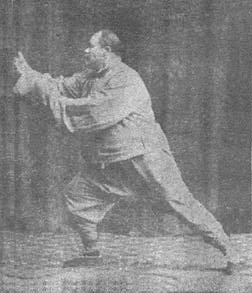
Yang Cheng-Fu

So, to get to the other part of your question – how to do it. There is no specific exercise for raising the spirit of vitality. Rather, it is a part of the postural requirements of Tai Chi, so it should apply in all exercise orientated towards Tai Chi practice. You want to feel as if your head if being pulled up by a thread from the crown point (between the tops of the ears). The result should be that the back of your neck gently lengthens and the chin tucks in. As always, you don’t want to achieve this posture with force, so don’t push your head into it. You should find that if you stand, focus on your breathing, generate that lightweight observation of self that is required in Tai Chi, your head and neck posture should naturally want to assume this posture.

Everything in Tai Chi works together. If you are breathing well, then it will encourage your posture to be upright and strong, which in turn will encourage you to ‘raise the head top’. If you can remove stress and tension from the body then the weight will sink down simultaneously, so you should feel strongly rooted into the ground and drawn up from the crown at the same time. These two pulls in opposite directions provide balance. You are separating yin and yang in the body – again, another part of the Tai Chi process.

I hope that helps.
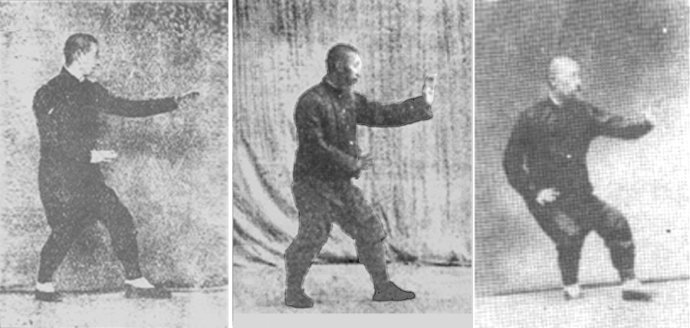
The restorative effects of Tai Chi practice

Sun Lu Tang

I’ve just finished recording my next podcast with the mighty Seymour Yang whose martial arts clothing range goes under the name Meerkatsu. It will be out soon. At one point he asked me how Tai Chi practice fits into my life after I started BJJ and I replied that when you wake up the morning after a hard training session you inevitably feel a bit stiff. I run through my Tai Chi form a few times and pretty soon I feel good again and able to train BJJ later. That’s a great benefit in my view.

Sun Lu Tang put it like this:

“Those of you who are weak, suffering from fatigue, injury or illness, or who have weakened your Qi from practicing other martial arts to the point that you no longer have the strength to train, all of you can practice Tai Ji Quan. With practice, qi will quickly return to a balanced state and become strong, while the spirit returns to a state of wholeness.”

– Sun Lu-Tang, A Study of Taijiquan, 1924

To me that sounds like the same thing, except there’s no need to mention Qi these days. As Notebook reader Richard commented on a recent post:

“When a Chinese traditional teacher answered, How is this done? with the answer, “qi.” He was essentially saying biomechanics, or physics, or motor control, or sports psychology, or some other subject he couldn’t fully explain. Or more specifically, by qi, he was saying, “I can’t explain the details of why, but it falls in the category of qi.”

A valuable Tai Chi documentary from the 1950s

I think this is one of the best historical videos of Tai Ch you’ll find. I’ve seen this film before, but the quality wasn’t great. This version of the Tai Chi documentary however seems to have been edited to make it smoother and sharper:

In the video you’ll find the most famous masters teaching Tai Chi in Beijing in the 1950s. It’s a good cross section of the different styles being taught. The masters are (and I think I’ve got the order correct):  Li Yaochen, Li Bingqi, Chen Zhaokui (the youngest son of the famous Chen style patriarch, Chen Fake), Yang Yunting, who learned from Quan Yu, who was a direct student of Yang Lu Chan. Sun Jianyun (daughter of the famous Sun Lu Tang). Wang Yongquan, who performs the Yang long form and was a student of Yang Jianhou and Yang Shouhou. And finally Li Jing Wu, who was a student of Wu style and Chen style, but here is performing the Beijing 24 step form.

The Power of Chi, the movie, and a response

A new YouTube video landed a day or so ago that has caused something of a sensation. It’s a trailer for a movie called The Power of Chi and has some well known UFC fighters and professional athletes in it, all experiencing the power of a Tai Chi master’s “chi”. And there’s a voice over by Morgan Freeman. I kid you not! Yes, the Morgan Freeman!

From the trailer, this mysterious chi is presented as a force that can be produced by the master and defies all explanation. To be honest, this tai chi master has been producing very similar YouTube videos for years now, but he’s usually demonstrating on no-name seminar attendees, this time however it’s a big budget production with well known fighters like Fabricio Werdum and Lyoto Machida being demonstrated on.

You can see the trailer here:

Now I haven’t seen the full film, and frankly, I’m not going to pay to download it, but colour me unimpressed with that. It all seems a bit silly to me.

Friend of the Notebook, Rob Poyton (who I recorded a podcast with recently) has produced his own video response to the trailer and I think it’s hard to argue with his conclusions, but feel free to make your own mind up:

I like Rob’s point at the end, that if you’re going to demonstrate things like this, then what are the functional uses of it? That’s what you should be demonstrating.

Tai Chi Feet, Kung Fu Toes

I came up with the title of this blog post by bastardising the old Chinese martial arts saying, “Southern Hands, Northern Legs”, but I don’t really have Kung Fu Toes (the mind boggles!) but what I really want to talk about today is your feet.

In Tai Chi we talk a lot about the waist and the joints, the spine and the kua, but we rarely give the feet a mention. Every part of your body is important, but your feet are especially so. You can think of your feet as the gateway to movement. If they are injured in some way, or have foot pain, you are immediately impaired in pretty much everything you do.

Lots of Tai Chi styles pay special attention to which parts of the sole are in contact with the floor. One style of Tai Chi I did instead that the foot had to be in contact with the ground in nine, (yes, nine!) places at all times for you to be ‘on balance’. It was perhaps an excessive number of point to realistically pay attention to. Other styles of Tai Chi talk about a more manageable 3 points of contact with the ground through the foot, and other styles don’t really place that much importance on what points of the foot are in contact with the floor, just that some of it is.

In general in Tai Chi I think it’s pretty safe to say that you don’t want to be rolling the weight of your body onto the edges of your feet. Why? Because it misaligns the ankle and therefore puts you at risk from injury not to mention ruins your body structure and posture, which is so important to Tai Chi. 

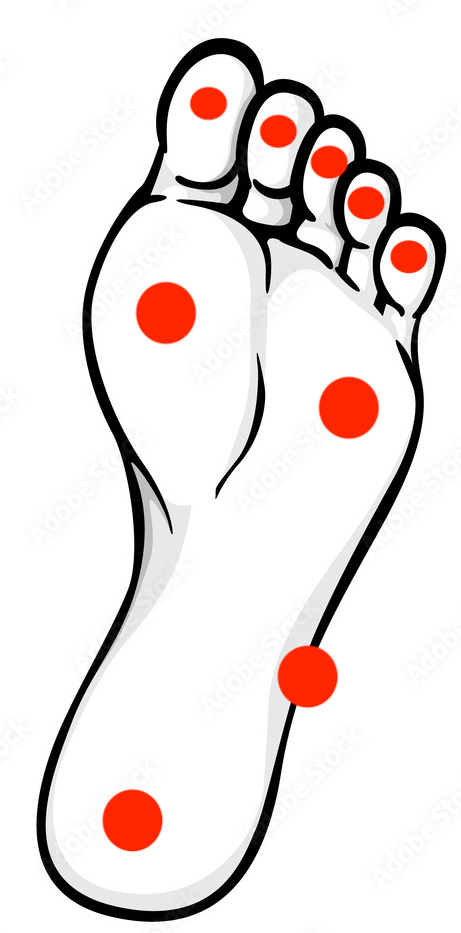
Remember that style I said that talked about 9 points? Let’s go back to that because it was a pretty thorough guide to keeping your foot aligned. Here are the 9 points:

The 9 points are the 5 toes, the outside edge, the two ‘pads’ and the heel.

However, before you start to shift you weight around on your feet to get all nine points touching, let’s just remember the position of the foot is maintained by the muscles of the hips. That’s a key point. If you are having trouble keeping these 9 points (or 3 in a simplified model) on the ground when you stand, or do Tai Chi, the problem could be that your lateral hip, hamstring, gluteal, and adductor (or inner thigh) muscle strength is weak. You may need to take these areas through fuller ranges of motion than a Tai Chi form allows to enable them to losen up. Tight hips are definitely going to be limiting to your foot function. You might want to look into some form of stretchy Qi Gong or Yoga to open up your hips if you want to get your feet to be flatter.

It’s also worth considering what you’re wearing on your feet when doing Tai Chi. Have you ever done Tai Chi barefoot? Do you wear chunky trainers, or (heaven forbid!) shoes with a heel, to do Tai Chi in? 

It’s quite possible that the muscles in your feet have atrophied from years of under use. In our shoe-wearing, chair-bound society we aren’t given the chance to give or feet the workout they require from daily use. 

Wearing minimal shoes while doing Tai Chi is probably the best option. But remember, we wear shoes these days to protect us from our overly-rigid environment. Training on stone flagstones or hard flooring will come as a shock to your feet, especially if they have been used to being continually protected from these environments, so you may need to take things slowly if you’re doing barefoot Tai Chi for the first time. Don’t push your atrophied foot muscles too far too soon!

Here’s an exercise you can do to help you feel where your weight is on your feet:

Exercise 1:

Stand as you would at the beginning of the Tai Chi form. Toes pointing forward, knees off lock and weight distributed evenly between your feet. 

Now ‘think forward’ and feel what happens to the weight in your feet. Think to the right, feel again, think to the left, and behind and repeat. You may notice a subtle shift in your body weight towards the direction you are thinking. This shows you how important your mental focus is when doing a Tai Chi form.

Exercise 2:

Now let your weight move around in an anti-clockwise circle. Forward first then around to the left. After a few circles you can change direction. You should notice that as your weight shifts the distribution of it over the 9 points (and therefore down to the floor through your feet) changes. As you move more to the left the right hand edge of your foot loses some contact with the ground. 

Now try and centre yourself over your feet so that all 9 points are equally weight baring. That’s your point of balance.

Now do your Tai Chi form and just pay attention to these 9 points of the feet. When do they feel light and when do they feel heavy? Is the weight equally distributed? This might give you something to think about as you do the form.

If you need some additional listening/reading about your feet I’d recommend this podcast/article by Katy Bowman on wearing minimal shoes to go hiking in and how to strengthen you foot muscles.

Whole body movement

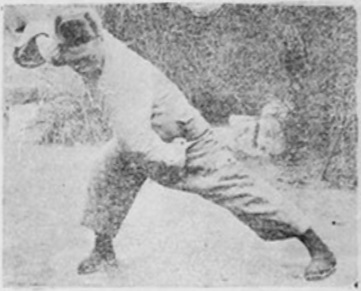
Chen Ziming demonstrating whole body coordination.

What makes Tai Chi, Tai Chi? One of the things you often hear said is that whole body movement, or whole-body coordination, is what makes Tai Chi different to other kung fu styles. How this is interpreted in Tai Chi Chuan, however, seems to vary slightly, moderately or even hugely depending on the style of Tai Chi you’re watching or doing.

I was scrolling through the excellent 1932 book by Chen Ziming (I’ve discussed this book before) on Chen style small frame called “The inherited Chen family boxing art”. I did a search of the text for “whole-body coordination” and it appeared 34 times! That gives a good sort of indication on how important he thought it was to his Tai Chi Chuan. In fact, the phrase “The entire movement must have whole-body coordination.”, appears in almost every single description of a move in his form.

Earlier in the book he lists the key points of Tai Chi boxing and says:

[8] WHOLE-BODY COORDINATION

四肢百骸協同動作此之謂周身相隨故太極拳一動無有不動一靜無有不靜
Your four limbs and hundreds of bones are to be moving cooperatively. This is called “whole-body coordination”. Hence in Taiji Boxing: “When one part moves, every part moves, and when one part is still, every part is still.”

Chen Ziming

He’s quoting “When one part moves…” from the Tai Chi Classics there. But what does he mean?

In some styles of Tai Chi the footwork is lively and continually moving. Wu (Hou) style springs to mind as a good example. In others, there are moments where the practitioner seems to almost stop in a semi-static posture for a moment or two – Chen style springs to mind. It’s therefore no surprise then that people’s definition of what “whole body movement” actually is can vary considerable. 

It clearly doesn’t mean that the feet have to be moving all the time. My belief is that it’s more to do with engaging the whole body in a movement – think of the difference of lifting a heavy weight with just your arms, or getting your whole posterior muscle chain involved with the movement, all the way down to the feet. A Judo hip throw is a good martial example. When picking up a heavy object (like a spear) it’s more obvious when you are engaging the whole body and when you’re not. With a solo bare-hand form it requires an extra level of awareness to discern if you are engaging your whole body, or not, in a movement. You can essentially cheat because with no weight to carry, there are no consequences to using local movement. This is one of the advantages of practicing archaic weapons forms, even in the modern age – they give you direct feedback on your whole-body coordination.  

On a more subtle (esoteric?) level, whole-body movement can refer to dantien controlled movement, as often exhibited in silk reeling exercises. This is where you’re controlling the extremities (the limbs) by subtle movements from your dantien. This is a step beyond simply activating the posterior muscle chain in a movement, it’s a different way of moving altogether, and well worth investigating. Find out how to do it here.

Whether you subscribe to the belief that a dantien exists, and can be used to control the limbs, or not, you’ll notice that Chen Ziming only listed whole body coordination as one of the key points of Tai Chi boxing. There are others – 10 others in fact. All of which are worth noting too:

Key Points for Taiji Boxing
 性質
 [1] The Nature of the Art
 方法
 [2] Methods
 程序
 [3] Sequence of Training
 姿勢
 [4] Postures
 動作
 [5] Movement
 呼吸
 [6] Breathing
 精神
 [7] Spirit
 變著轉勢
 [8] Whole-Body Coordination
 周身相隨
 [9] Switching Techniques & Transitional Movements
 身作心維
 [10] The Body Performs & the Mind Ponders
 無貪無妄
 [11] Do Not Be Greedy or Rash
十三勢術名及其演練法

Slowness training, or more accurately, ‘not rushing’, in Tai Chi

Rushing is probably the cause of most of our problems. That time you didn’t notice the uneven paving stone and tripped? You were probably rushing. That time you shouted at the kids because they couldn’t get their shoes on fast enough while leaving the house? You were rushing. That time you accidentally emailed a picture of yourself drunk to everybody in the company? You were definitely rushing then.

In nature, wild animals can move a lot faster than we do, but do they ever look like they’re rushing? A rabbit sprinting for its life to avoid a fox still moves with poise, dignity and grace. Compare that to the embarrassment of the average human running for a bus, an act in which the stakes are considerably lower! Even a cat, an animal known for incredible bursts of speeds pauses for a second before it makes that leap onto a table, so it can be aware of the entirety of the situation.

But how can we learn to stop rushing all the time and regain this poise which animals seem to naturally have? One answer is Tai Chi.

If you’ve been doing Tai Chi for a while, a good number of years, then you’ll know the form inside out. It’s no longer a fresh, new and exciting thing. In fact, your mind is probably bored with it. Here we go again, this same old moves. Sigh. Stand for a moment before you do the form and you’ll notice feelings of impatience start to creep in. Part of you will want to start rushing, to get it over with as quickly as possible

This is where your slowness training is useful. Do the form slowly, at an even pace and just keep doing it. Resist the call the start speeding up and rushing sections. Treat all parts with equal importance. Even the linking moves between the classic postures. Notice your breathing. Keep your awareness on what you’re doing. Don’t let the mind wander off – keep it in the body and keep bringing it back. If you do notice that it’s wandered off completely then stop and start the form again, no matter how far you’ve got. Slowly, day after day you build a kind of mental strength, and if you’re lucky you’ll find it seeps over into the rest of your life, and you’ll be less prone to rushing than you were before.

Stop rushing and you no longer slip up,

Stay in the moment and strains are no longer felt,

When strains and no longer felt, stresses start to disappear,

Once stresses disappear, you can walk lightly.

Walking lightly, smiling brightly.

Photo by S Migaj on Pexels.com

Arlene Faulk on Tai Chi for Multiple Sclerosis

My new podcast episode is out! This episode is all about Tai Chi and the health benefits.

Arlene Faulk is the author of Walking on Pins and Needles, her memoir of living with multiple sclerosis without a diagnosis for many years, spending two years not getting up from the couch and how she eventually found Tai Chi and how it helped her combat the disease and regain her health, eventually becoming a Tai Chi teacher herself. Make sure you listen right to the end as we have some tips from Arlene on how you can use Tai Chi principles discussed in the Tai Chi Classics to feel better right now as you listen to the podcast.

Faulk Tai Chi can be found online:http://www.faulktaichi.com

Walking on Pins and Needles by Arlene Faulk, book cover:

How to make your Tai Chi better by using the Tai Chi Sphere

Tai Chi is represented by a sphere.
A sphere is one of the strongest shapes regardless of the direction of force. Photo by Laura Tancredi on Pexels.com

I wanted to talk today about the concept of the Tai Chi ball, or more accurately, Tai Chi sphere. While it might sound simple, I think it’s really an advanced concept because it’s taking the Tai Chi teachings out of the realm of specifics, of things like ‘relax that shoulder’, ‘move that foot’, ‘drop that elbow’, ‘align that hip’, etc…, and into the realm of concepts, which are much harder to pin down into physical details.

The Tai Chi Classics talk about Tai Chi being circular a lot. For example, it says:

“The postures should be rounded and without defect,
without deviations from the proper alignment;
in motion, your form should be continuous, without stops and starts.”

At a certain point the position of the hands and feet and other body parts in Tai Chi gets subsumed by the general sense of keeping your body and all your movement rounded, like a ball. (Newsflash: despite a thousand form corrections from seminar masters, the exact position off your hands isn’t what’s important.)

What’s important in Tai Chi is that your body is creating a ball-like structure, with ‘you’ at the centre. That’s what determines if you hands and arms are in the correct position, not angles and degrees. If you are making a sphere with your movement and body, then everything will be in the right place, and if you aren’t, it’s not.

The advantage of creating a sphere is that force can comes in and be rolled off without too much interference and muscular tension. A sphere is a Tai Chi symbol write large, in 3 dimensions.

Like the world, Tai Chi is a sphere,
The Tai Chi Classics talk about Tai Chi Chuan being circular. Photo by Sindre Stru00f8m on Pexels.com

The idea of separating empty and solid in the body goes hand in hand with creating a Tai Chi sphere. In fact, I don’t think you can do it successfully without a separation of empty and solid – or yin and yang – in the body.

But here’s the kicker. You can’t just decide one day to do this practice. You can’t go outside right now and do you form and decide to make your Tai Chi like a sphere because it will be meaningless. Instead, it’s a situation where you gradually discover, after many years of practice, that Tai Chi is like a sphere. One day you’re practicing and you suddenly notice it, and bang! Your Tai Chi will never be the same again. It’s like that famous picture that looks a bit like an old man but isn’t:

You either know or you don’t! Can you see what this is a picture of?

Most people are unable to see what that is actually a picture of at first glance, but once you get it, no amount of me trying to persuading you otherwise will prevent you from knowing exactly what it is.

It’s the same with the Tai Chi sphere. Your Tai Chi has always been a sphere, you just didn’t know it, until one day you did, and then it was suddenly obvious to you.

The Kung Fu salute.
Referring to the Tai Chi Classics can help your practice. Photo by RODNAE Productions on Pexels.com