Studying the monkey in Chinese martial arts

A visit to Monkey World gives me new insight into the name of one of the most famous Tai Chi sequences – Repulse Monkey.

e3c687472813e4f4cc876a55c71968ee

Yesterday we had a family trip to a local ape rescue centre called Monkey World. All the larger apes were suitably majestic, and the little ones suitable cheeky. The ones that stole the show though, were the white cheeked Gibbons. In terms of dancing through the trees these guys have got it made – they look so totally effortless with their arm hanging and swinging. They have no tails, so they swing in the classic way that humans attempt when using the monkey bars, but it looks so utterly effortless for them, because their arms are extrodinarily long when compared to the length of their body and their shoulder and wrist joints are different to ours. They swing one hand at a time, like this:

5-1

Gibbon, swinging


That’s when it occurred to me that this must be where the famous Repulse Monkey sequence in Tai Chi forms gets its name.

irp0nt

Me, doing Repulse Monkey

The “repulse” bit I’ve always thought was kind of obvious, because you’re pushing (or striking) something away, but I could never understand what was monkey-ish about this sequence, since you are used large extended postures, rather than what I’d come to associate with monkey styles of kung fu, which are usually full of small crouching postures and darting and rolling about. However, if you look at Gibbons swinging from branch to branch, it makes sense.

Of course, Gibbons are native to south China and were even kept as pets:

“Interactions between humans and gibbons have a long history in China, as reflected in the Chinese literature and art. Especially in early China, gibbons made the objects of many literary and artistic compositions.

The popularity of captive gibbons being kept as pets appears to go as far back as written history, although a proverb by the philosopher Huai-nan-tzû (died 122 B.C.) stated: “If you put a gibbon inside a cage, you might as well keep a pig. It is not because the gibbon is then not clever or swift anymore, but because he has no opportunity for displaying his abilities” (van Gulik, 1967, p. 40).”

An example of Gibbons in historical Chinese painting:
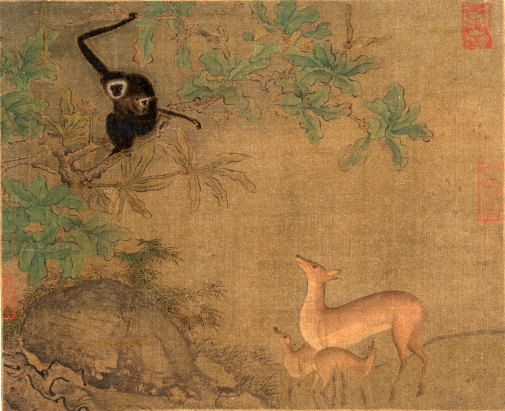
gibbons_and_deer

Unknown artist from Southern Song Dynasty.


Moving away from Gibbons, one unique character I observed in all the apes was a kind of nonchalance. One Gibbon came to the edge of their enclosure, on the farthest out branch and hung there for a few minutes by one arm looking at the strange humans who had come to see her. They are really unhurried and unbothered by anything. The Chimpanzees on patrol walk the edge of their territory unconcerned with all the people watching. Apes don’t ever appear stressed or worried by thoughts – they just do. Perhaps they’re the ultimate masters of mindfulness.

XingYi, the great internal martial art from China, has Monkey (Hu) as one of its 12 animals. I often find myself doing this sequence in a hurried way, since the movements are inherantly quick and fast, but now I think I’m going to try and slow down a bit and add an element of nonchalance to the moves as well. I think to really get that monkey character right you need to appear unconcerned about the attacker – after all, a monkey can often retreat to the safety of the higher branches after engaging, a luxury other animals don’t have when hunting or defending themselves. I think this nonchalant feel is be a key element to being able to master the XingYi animal in the correct way.


The professor

I can’t let the new documentary on Professor Cheng Man Ching, one of the early pioneers of Tai Chi in the West, slip out without giving it a mention on this blog.

chengmanching_sword

Much has already been said about it, so there’s not too much more to add, except that I haven’t seen it yet, and I might blog again after watching it, because it will probably stimulate some thoughts.

Cheng Man Ching is one of those contentious figures who splits opinion. By being one of the very few people in the US publicly teaching Tai Chi in the 1960s, and thanks to the gushing endorsement in books by his student Robert Smith, and his ability to push big, heavy Westoners around with comparative ease, Cheng very quickly achieved a big reputation.


Cheng modified the Yang Tai Chi form he learned from Yang Cheng-Fu, creating one of the first short forms of Tai Chi. His Tai Chi also had a distinctive look compared to his teachers – in (I believe) an effort to stick as closely as possible to the writings of the Tai Chi classics, he changed some of the postures slightly, adopting a more upright body, and a softer hand and arm position. Some would say his Tai Chi was too soft, and his influence is responsible for the typical ‘soft like a noodle’ style of doing Tai Chi often found in the West. But if you watch  him do his form, you can see that he looks solid as hell. He exudes the ‘peng’ quality of energy rising upwards and outwards, and being rooted in the legs.

Undoubtedly he was an example of what happens when a small fish in a big pond suddenly becomes the only fish in a very small pond, but he was also a skilled practitioner of Tai Chi. Of that there can be no doubt. Was he also a world class martial artists? No, probably not. Did his students put him on an unrealistic pedestal? Yes, undoubtedly they did. But that’s what happens with human beings. We’re like that with people we admire.

You can watch the trailer here:

On knowing your lineage

Because only geeks care

Excellent article on lineage in martial arts: http://martialartsstudies.blogspot.com/2015/09/on-knowing-your-lineage.html

in my experience of TCMAs, it always seemed to me that the vast majority of practitioners had only a very vague and shaky relationship with the notion that their styles had either a history or a lineage. Rather, most practitioners seemed most inclined invoke vague allochronistic ideas, about ‘Nature’, ‘Taoism’ or ‘the East’. Those who did believe that they knew their history, those inclined to talk about it, discuss it, dispute it, had one thing in common. They were all (in my experience), universally, and ‘to a man’, men.

The old master and the young apprentice

’twas ever thus

The Karate Kid – master and apprentice.

I love this clip of Master Helio Gracie teaching a private lessons, and it follows on nicely from my previous post about martial arts as theatre.

Here we have Master Helio Gracie, a thousanth degree red belt, probably in his 80’s, teaching a private lesson to a fresh new white belt kid. (The pupil shown here later went on to become a world champion in his own right.)

It’s a dynamic as old as time – the old master and the young apprentice. The whole thing is a performance of sorts, and they both play their roles perfectly – the wise, generous old man knows all the tricks, and teaches the young, enthusiastic beginner who makes all the stupid mistakes, time after time. And again, it’s being filmed, so it’s impossible to ignore the fact they both know the camera is there and they have their roles to play.

Enjoy the show.