The (martial) use of Peng Jin in Tai Chi Chuan

Peng Jin gets talked about all the time in relation to Tai Chi, yet you rarely see anything shown or discussed about its usage and relationship to actual fighting. I wanted to make a video that did that, so here it is!

Tai Chi Chuan, after all, is a martial art, and not just a collection of interesting ways of manipulating ‘force’ in the body for purely health purposes. It’s a martial art that uses Sung Jin, or ‘relaxed force’ in preference to hard strength. One of the reasons why it prefers relaxation over hard strength is that it enables the use of Peng Jin. You simply can’t do Peng Jin unless you are sufficiently relaxed. In terms of martial arts it’s a very useful skill that can be used as shown in the video.

There’s much more to Peng Jin than what I’m showing here – but it would require a much longer video to go into all the intricacies. I don’t, for example, talk about how I’m doing what I’m doing, I just show what the effects are.

Another factor to consider is that Peng Jin should also be a quality that’s always present in the Tai Chi practitioner, rather than something you turn on or off for technique purposes. However it’s the subtle, but powerful, effect of the Peng ‘bounce’ on an opponent that I wanted to demonstrate, so that’s what’s shown here.

The classic “Song of the eight postures” describe Peng Jin as:

“What is the
meaning of
Peng energy?

It is like water
supporting a
moving boat.”

Imagine the way a boat bobs on the water, and that will give you a good insight into Peng.

The delusion of grace under pressure

Surprise! Fighting looks like…. fighting

Photo by Ivan Krivoshein on Unsplash

This blog post grew from a discussion on RSF, a discussion forum on internal marital arts where I’m a pretty active user. Some members were expressing their displeasure at what they saw as low-level skill displayed in the recent 2012 Olympics Judo contest in London.

I was incredulous, since competing on an international stage in a tough sport like Judo requires the athlete to have levels of skill far beyond those of the mere mortal. Yet phrases like “low level” and “muscling” were being thrown about with abandon. The standard thing the detractors of modern Judo say, while explaining how Judo has entered a state of decline from which it can never possibly recover, is that modern athletes are not as good as the old timers. Then they post a black and white video of Mifune (The “God of Judo”) practicing with his students back in the day.

I have one right here:

As you can see, he’s effortlessly controlling his opponent, and demonstrating what is clearly agreed upon as “high level skills”.

Well, for a start, since Kyuzo Mifune was considered the greatest Judo technician to have ever lived, nobody would compare well to him, but that’s beside the point. Their point is that it looks nothing like Olympic Judo, and of course they’re right! Competition Judo will never look like the Mifune demo, because… (drum roll please) it’s a demo!

It’s exactly the same in every martial art – put a Tai Chi fighter in a sparring contest and inevitably people say “that’s not Tai Chi” because it doesn’t look like the super smooth demonstration their instructor does every Friday night at their class, as he effortlessly repels a doddery middle-aged gentleman who is gently pushing on his arm… Quite simply, competition fights do not look like martial arts demos and never will! I am truly perplexed that people can’t understand this… it’s a sort of collective human delusion. And it’s not just martial artists that have this delusion, it’s seeped into the popular consciousness too because of movies like Enter the Dragon, The Matrix, or James Bond. Most people think that if you “know kung fu” you’ll be able to pull some Jackie Chan moves out of your ass in the middle of a real violent encounter. Nothing could be further from the truth.

There are plenty of clips of martial arts masters under real pressure on YouTube, if you look for them. They all have one thing in common – it stops looking like the perfect martial art demo and starts to look scrappy as soon as they have to deal with real resistance, and not a willing student.

Here’s the thing: We’re confusing the training methods with the end result time after time.

Example:

Here’s Kochi Tohei looking graceful, poised and in control while doing a demonstration of Aikido:

Now here he is working against an opponent offering real resistance:

Totally different, right?

This comment on that last video from YouTube is typical of the collective human delusion I am describing:

“if tohei used aikido techniques against this man,which he is not doing until the last bit of the clip,serious injury to uke could have resulted. this was only an exercise in balance.”

It’s time for people to wake up.

Single Whip – ‘Dan Bian’

Yang Cheng Fu performing the Single Whip posture.

Single Whip is one of the most recognisable yet least understood postures in any Tai Chi form. I think the confusion arrises from the name. Hearing “whip” most people think of an Indiana Jones style whip – a strip of leather or cord fastened to a handle. Add to this the phrase “whipping power” that’s often used to describe the type of force used in many Chinese Martial Arts and you get people trying to use the Single Whip posture as a strike that’s like a whip crack. Worse you also see them trying to use the beak-like rear hand to strike with, but more of that later.

Let’s try and solve this mystery.

Personally, I don’t think Tai Chi does use a whipping type of power at all – not in the same way that other Chinese martial arts, like Choy Lee Fut, for example, do. Choy Lee Fut genuinely does use a whipping power – the arms whip out, somewhat wildly, powered by the turning motions of the waist and body, but that’s not the same as Tai Chi movement.  When you ‘whip’ the arms out in this manner you give up control of them for a brief moment, so they’re moving independently. In the  Tai Chi classic by Wu Yuxian it says:

“Remember, when moving, there is no place that does not move.
When still, there is no place that is not still.”

It’s not possible to stop a whipping motion like this, once it’s started, which means it’s not really Tai Chi Chuan, at least not in my book.

Here’s the deal: The ‘whip’ mentioned in the name of the Tai Chi posture isn’t a flexible whip, as you’d imagine it was – it’s more like a stick. If you think about it not all whips are flexible – take a riding crop, for instance. The posture is called Single Whip because the finishing posture looks like somebody carrying a yoke, but only on one side, hence the “Single”.

The Chinese have used yokes – sticks carried across the shoulders and back – to transport good since ancient times. Buckets are usually hung from the ends of the yoke. Here’s a picture from a historical website of an 1860’s Chinese gold digger, starting for work with his tools suspended from a yoke on his shoulders.

Now take a look at this illustration of a Chinese man carrying a yoke with just one hand on the yoke:

That’s starting to look very like Tai Chi’s Single Whip posture, isn’t it?

The ‘whip’ could also be used as a weapon in Chinese Marital Arts. Again, it was usually referring to a short stick, not a flexible whip. In the excellent “Chinese Martial Arts Training Manuals”  by Brian Kennedy and Elizabeth Guo you’ll find a description of a book called “Tiger Tail Whip” by Jiang Rong Qiao published in 1930. It features a “long routine for the metal tiger tail ‘whip’, which is rigid and actually amounts to a type of cane.”
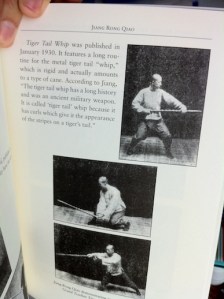
In English the words ‘Single Whip’ cause an understandable confusion. The name is simply an aid to memory for the visual shape of the posture, and it’s not meant to be a clue to how you use it.

And the beak-like hand? It’s simply a stylised version of a grab to the opponents wrist. It’s more elegant to make your finger tips touch your thumb when you perform the form, and it reminds you that this is a wrist grab. A simple application of the Yang style version of Single Whip is to grab one of their wrists and pull it in one direction, while striking them in the face with your other hand. There’s nothing mysterious there, either!

The Song of Peng

This week in class we were working on Peng Jin (Ward off energy), the fundamental Yang energy (Jin) of Tai Chi Chuan.

A lot as been written and debated about Peng Jin in Tai Chi circles, but I think the following quote sums it up pretty well, for me at least.

From the classics:

“The Song of Peng

What is the meaning of Peng energy?
It is like the water supporting a moving boat.
First sink the ch’i to the tan-t’ien,
then hold the head as if suspended from above.
The entire body is filled with springlike energy,
opening and closing in a very quick moment.
Even if the opponent uses a thousand pounds of force,
he can be uprooted and made to float without difficulty.

I like the imagry of water and a boat floating on water. I also like to use the imagery of a rubber ball when teaching Peng to people. If you imagined that you were punching a large rubber ball then the bounce-back you’d experience is Peng. The hard part is turning yourself into that rubber ball!

To manifest Peng you need to be relaxed (sung) – excess physical tension really spoils the technique. There are various exercises you can do to help you develop the feeling of Peng, one of which I present here: Hold out your arms and get a partner to press down on your arms, then try to compress their force into your centre and bounce them out. The big mistake you’ll make first is to use your arms too much to try to push them off you – that’s not it. In this video you can see that my arms are nice and relaxed. You’re looking for that springy force coming back up from the ground.

This exercises also requires that your partner hold their arms somewhat rigidly. If they let their arms go all soft and floppy as you bounce them then nothing happens. This is just a training exercise after all, and not a martial technique, so it require some co-operation, so give your training partner a hand and don’t be too difficult to work with!