When I’m teaching my Friday class one of the things I quite often say is “don’t look down” – however, like most of the short, pithy statements you hear delivered by Tai Chi teachers… it’s not really true. Rather, it depends on the context of what you’re doing. Let me explain.
Yes, generally speaking, you want to be looking at the horizon when doing Tai Chi because you want to keep your head and neck aligned with your spine. Specifically with the head and neck we are talking about the posture principle of ‘suspending the head’. However, there are times in Tai Chi, where it is perfectly acceptable to look down – particularly on moves where the direction of the application is down towards to the ground.
The reason I say “don’t look down” a lot when teaching is that people learning a Tai Chi form have a general tendency to look down (me included!). Generally as we age our posture seems to become more slumped forward, perhaps because we sit down a lot in modern life, but also because scanning the horizon for signs of danger has long since stopped being an evolutionary priority. We also use computers, phones and devices all the time, and they lead to a general posture of our heads being tilted forward slightly. This can result in people doing the whole Tai Chi form while never looking up from the ground.
Extending the qi
In Tai Chi you want to have a feeling of a slight stretch all over the exterior of the body at all times – that’s really what following the posture principles of Tai Chi gives you – things like flattening the lower back, rounding the shoulders and suspending the head. This is known as ‘extending the qi’ all over the body. When you stand in a Zhan Zhuang posture you can feel this slight stretch all over the surface of the body that the posture generates – it’s subtle, but that’s what you’re looking for.
Suspending the head is part of that extension of the qi over the head, and you can keep that extended feeling even when you glance down. What you definitely don’t want to do is break the alignment of the spine and neck, which is what typically people do when looking at their phone, or their feet:
If you want a good fix for this then I find regular Zhang Zhuang (“post standing” or “standing like a tree”) practice is a good way to remedy this and retrain your head position on a subconscious level. Master Lam has a 10-day course on the subject.
The problem with looking down is that our head is rather heavy (between 2.3 and 5kg), and when you take your neck out of alignment with your spine your body automatically compensates for the extra weight that is pulling it forward (or you’d fall) and it does that by tensing some of its posture control muscles, particularly in the middle of the body, and that can interfere with the relaxation and freedom of movement we are looking for in Tai Chi. You also aren’t creating an optimal path for sending incoming forces to the ground or for sending jin up to the head. You are also not ‘extending qi’ to the head.
If you’re going to look down then you need to do it while keeping that slight stretch up the back of the neck and over the head.
Ward-off and martial applications
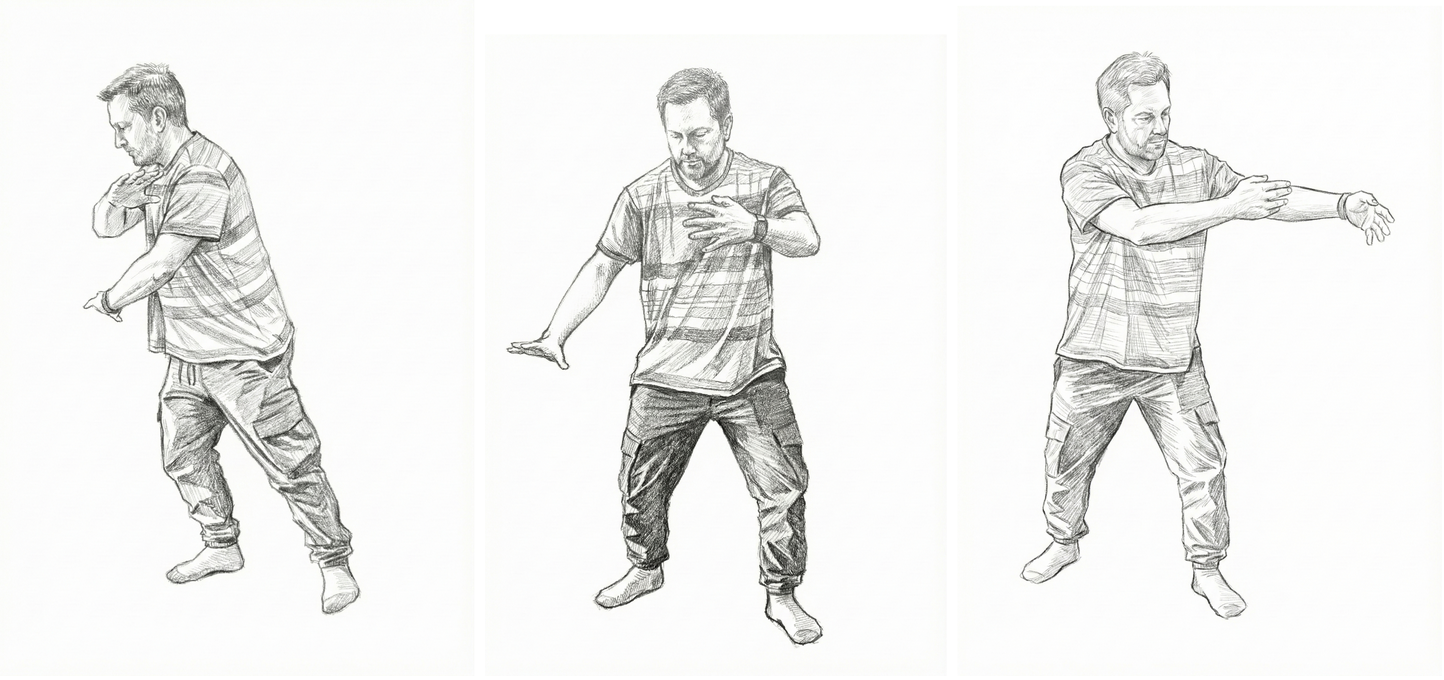
‘Ward off’ is another example of a posture where I do look down, although it’s only briefly. I look down because of the martial application I’m thinking of. My active hand in that posture is first the back hand, which I’m using to send my imaginary opponent to the floor. The front hand can then be used as a deflector, so after I’ve dispatched the first opponent to the floor, I then look up and deflect the second attack, which leads into the ‘roll back’ posture.
Here is the sequence:
In this sequence, the ‘ward off’ is the middle picture, and my focus is on my right hand pushing down from where it was in the previous picture, then in the next picture I refocus on the left hand deflecting, and getting ready to perform a ‘roll back’.
Here’s a much younger and hoplessly naive version of myself showing the marital application at around 19 seconds in this video:
As you can see, where you are looking in the Tai Chi form is dependent on what application you have in mind when doing the movement. So, while there are some useful maxims to remember in Tai Chi, such as ‘don’t look down’, it’s important that you know when it’s acceptable to bend the rules so that your Tai Chi becomes a living practice, with things done for a reason, not just blindly following the rules.
Let’s see if we can explain this without getting lost in too much theory…
(N.B. I’m writing this, to help my own thought process, rather than producing a tidy finished article, so let’s see where we go.)
Yi is one of those confusing terms in taijiquan. I don’t think you can talk about it without reference to jin and fangsong (probably qi too, but let’s try to leave that for now).
Amongst the taijiquan community there are a lot of varied ideas about jin, the “refined strength” or “trained strength” that you find mentioned in the Chinese marital arts, particularly taijiquan.
Many people seem to think that jin is about generating force maximally for whatever movement you’re doing, so a swimmer has ’swimmer jin’ or a weightlifter has ‘weightlifting jin‘.
It’s a tempting idea – after all who wouldn’t want to move with the grace, power and agility of an athlete, but I don’t think that practicing taijiquan should be looked at as some sort of shortcut to those abilities.
Athletic abilities are hard won, don’t last forever and require an awful lot of maintenance to keep a hold of. You can’t just short-cut them.
In taijiquan that is not what’s really meant by the word jin anyway, or there wouldn’t be anything different, at a fundamental level, between the training a boxer does and the training a taijiquan player does (and at this point you may actually be standing on the sidelines shouting, “No, there isn’t and difference!”, however, that’s your choice, but let me try and change your mind…)
In taijiquan we are specifically talking about ground force when we talk about jin. By ground force I mean the solidity of the ground manifested to our fingers. As the saying in the taiji classic says
The jin should be rooted in the feet, generated from the legs, controlled by the waist, and expressed through the fingers.
This is achieved by letting whatever forces we’re working with find their way to your foot to rest on the ground. This ground force can be bounced back from where it comes, turning it into something that can be used actively as well as passively.
When people talk about jin the next word out of their mouth is usual fangsong, to relax. There’s a reason for this.
The only way to let the forces you’re working with rest on the ground as directly as possible is by relaxing your upper body. (Relaxing your legs doesn’t really help much, since the weight of the body is sinking down into them). It’s getting the tension out of your upper body, by letting it dissolve down, that works the magic.
So what does it mean to ‘let forces rest on the ground’, and how do you do it?
Let’s make this a practical example.
If you’re sitting at a desk right now reading this on a laptop, I want you to pick up your laptop with your hands.
Got it? Good. (If you haven’t got a laptop, grab something of equal weight)
Now, you might think you’re fairly relaxed as you sit there holding your laptop off the desk, but what happens if you say to yourself “let the weight of this laptop go to the ground, through my chair”.
Now, if you’re anything like me you’ll notice that something invisible subtly changes inside yourself when you do this. There’s a noticeable switch of the internal musculature of your body (the qi) that is rearranging things for the weight you are holding to be supported by the ground.
I don’t know what exactly changes, because subconsciously your body just does it, and that subconscious switching is a function of your yi, which is usually translated as “intent”.
You can put your laptop back down now.
What I notice when I do this is that when direct forces to the ground my neck feels freer, my shoulders looser and space seems to open up. Mentally I also feel clearer. These are a lot of the benefits that you get from practicing taijiquan.
Your yi is activated when you imagine a direction that you want to send a force into. It does all the hard work of plotting the path through your body on a subconscious level that you aren’t usually aware of. In fact, trying to work out how it’s doing it is a sure way to mess up actually doing it.
If you see people practicing taijiquan, or other internal arts, with that kind of faraway focus that’s about halfway between open awareness and fixed attention, that’s what they’re doing. They’re not communing with the angles, they’re imagining directions for the jin to ‘flow’ in. They are using their yi while doing the form.
Now that was quite a lot of concepts to throw at you in a short while, and probably enough for now, so let’s stop there.
Mike Sigman’s post on qi has made me want to think more about jin and qi again. I realise I haven’t been posting about it very much recently – partly because I’ve been distracted by writing a book about BJJ – but now the book is finished it’s time I came back to the subject. I read another post Mike made recently on his 6H group about pushing against a wall, which I think is a brilliant idea, because it’s so simple.
In a way this post is just me writing it out in my own words as an exercise, so I can understand it, and contextualise it a little more in terms of my tai chi practice.
Pushing is a big deal in tai chi because it features so prominent in the form – one of the four ‘energies’ of tai chi is called push in English, which (as I discussed with Ethan Murchie in my last podcast) is confusing since the translation of “an” into English is more accurately to “press down”, which isn’t what the push posture in tai chi looks like, or how you’d push a wall.
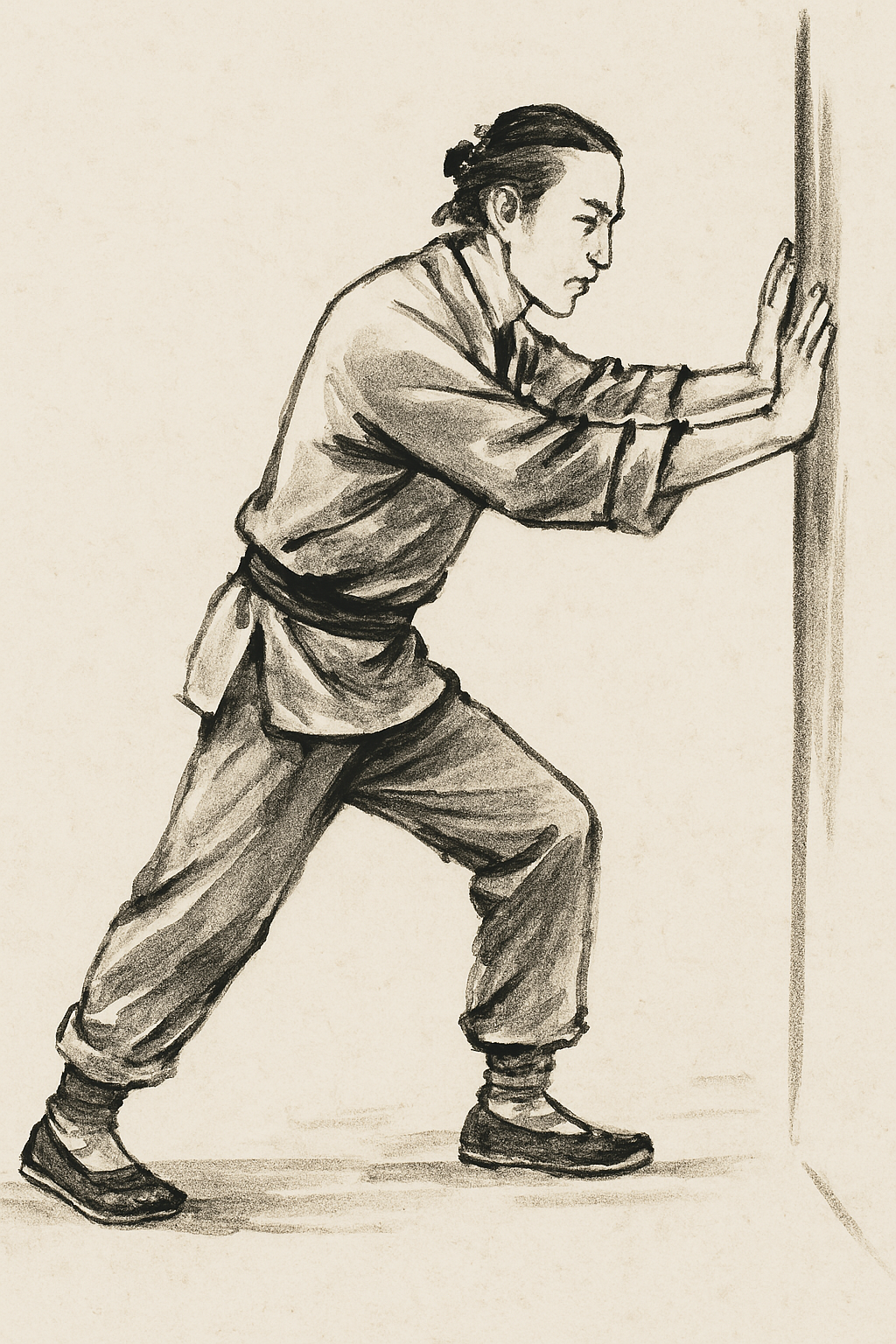
An AI-generated tai chi ‘push’against a wall
Pushing is also part of tai chi’s two person exercise, tui shou – “push hands”. So most tai chi people are pretty familiar with the concept of pushing.
Now imagine you are pushing against a wall and somebody asked you to push harder. Most people would simply push harder with their arms and lean harder into the wall. What you’ll feel when you do this (try it) is that it pushes your upper body backwards and away from the wall quite a bit because it’s impossible to push hard with your arms without introducing excess tension into the system.
This is the “you’re using your shoulder too much!” criticism that a lot of tai chi teachers sling at their students, without really explaining how not to push using the shoulder.
So, let’s look at exactly how you could push harder without using the shoulder.
The only another way to increase the power of your push is to increase the downwards power through your legs. Now, it’s pretty hard to push downwards with your legs, since we have nothing above us to push off from if we want to push downwards. Instead, all we have in a downwards direction is gravity, so how do we use that gravity power? The answer is to relax and sink down into your legs harder.
Put your hands on a wall and try it.
As you sink and relax more through the legs you should feel the power in your arms increasing.
What you’ll notice is that you have to internally align your body correctly for this power to reach your hands. The good news is that you don’t need to think very hard to do this, you can just feel how you need to arrange yourself and your subconscious will do the rest. But you need to properly relax. If you tense up parts of your body – your shoulder being the main culprit – the power won’t slow smoothly and uninterruptedly through the body to reach its destination.
At this point you should start to realize why the word relax (or “sung” in Chinese) is said so often in tai chi practice.
That path from floor to hands is what you’d call a ground path, or a jin path. And the force you are channeling into your hands is known as jin in Chinese. The usual English translation of jin that you see used is “refined strength”.
Again, don’t get hung up with where the path goes through the body, just where you want the force to go.
You should also notice that as the jin force in your arms increases, you don’t get knocked or pushed backwards as easily as you did when you were using brute strength, because there is less tension in your upper body.
Obviously you are not going to push a wall over! But you can now feel the forces in your body that we should be dealing with when doing the tai chi form, and hopefully when you do “push” in the form, your push will now be a little bit different, more refined, a little less clumsy and a lot more tai chi-like.
In this podcast I talk to internal martial artist Ethan Murchie about this teacher Vince Black from whom he learned xing yi mixed with elements of Sufism and Shamanism, as well as the North American Tang Shou Tao Association which Vince set up and which is still running today.
We also discuss how traditional arts can survive alongside MMA, the Yellow Emperor’s Classic of Internal medicine (the Huangdi Neijing) which Ethan teaches through his Living Neijing website, the meaning of Chinese terms like qi, peng, lu, ji and an, as well as his tai chi teacher Liang Dehua and the Yang Shouhou lineage of Yang family tai chi.
And why you shouldn’t train with weights when developing your qi
Mike Sigman has sent me an article to publish on this blog. I don’t normally publish other people’s work, or agree to their requests, but I’ll make an exception because it will hopefully generate some discussion. Regardless of how you feel about him, there’s is always a real depth to Mike’s writings and ideas that you can get a lot from, that you don’t really find anywhere else.
The article is primarily about one of the trickiest subjects in Chinese martial arts – qi (or chi).
I have a few thoughts about it:
1) The article starts by trying to “separate the skin-related qi, which includes the subconscious mind’s involvement, from the theoretical qi of traditional Chinese medicine”.
To some, particularly those people who relish Chinese history and the evolution of the concept of qi as it appears in Taoist thought, or medicine, that just won’t be acceptable, but I think this works for me. It moves the discussion into the realm of the physical and practical. It becomes a feeling and a doing thing.
2) It appears to be written partly as a reaction to a recent trend of mixing, or doing, Chinese martial arts conditioning through the medium of kettle bell or weights training. The question is, is that a waste of time if you want to get to the root of the subject, which is what the Chinese martial artists call qi?
Look, I don’t think there’s anything wrong with making yourself physically stronger at all. In fact, it’s obviously advantageous if you’re learning martial arts… But the article states that to master the internal movement, “the body must be completely retrained to learn to move with the qi, jin, and dantian”, and using weights will not help you in that respect. If you have retrained the body, then you could probably add them.
3) As I’ve said, nobody else really talks about this stuff, or if they do it’s watered down with a lot of other guff. If the article is correct on qi then what exactly are all the big names in modern tai chi seminar circuit and online courses out there actually teaching? Because they talk about qi a lot… but they don’t approach it in the same way as this article does, at least as far as I can see.
4) The article describes internal movement, quite simply and quite succinctly: “Ultimately, you develop a form of movement that uses the solidity of the ground as the focus of all forces to and from the body, while the qi covering of the body is manipulated by the lower-body and the middle to bring power to the arms and upper body.”
I find it hard to disagree with that definition, probably because it’s pretty broad. Sure, we can argue over what the “middle” is, or what the “lower-body” means,etc.. but as a succinct definition, it’s not half bad.
Now, let’s move on to how you do it…
The article talks about breathing exercises as a starting point: “Breathing techniques that stretch the surface of the skin and the involuntary muscle layers are the usual start of the progression.”
Now, I have personally trained in some of the methods that Mr Sigman uses (there’s a link to a video at the end of the article), and experienced what he’s talking about, and I’d agree that I can feel what he’s talking about. But I wouldn’t count myself as an expert in it, or knowledgeable about anything to do with it beyond the initial foot in the door stages, however, I have found that alone to be incredibly valuable and shone a light on some of the other things I was already doing. Even getting a foot in the door took a lot of work and a lot of time.
Anyway, I’ll leave you to read the article now and feel free to comment with your thoughts below.
Graham
Practical Development of Qi
And why you shouldn’t train with weights when developing your qi
by Mike Sigman, March 2025
Discussing qi is difficult because the definition of qi has become a bird’s nest of related topics. Let’s try to narrow the discussion and then describe an approach to practical development.
Most of the skills related to qi, in the physical body, have to do with an area near the skin of the body that is referred to as the “protective qi” or “wei qi”. While the protective qi is often referred to as an “energy”, it is actually a physical set of tissues that is controlled via the autonomic nervous system … but when you learn to control it via the subconscious mind, it does indeed feel sort of like an “energy” because it is apart from the topical sensations of the somatic nervous system, and the qi indeed feels odd, like an energy.
So, let’s separate the skin-related qi, which includes the subconscious mind’s involvement, from the theoretical qi of traditional Chinese medicine: that’s where most of the confusion lies. The skin-related qi and the subconscious mind are the artifacts which give us heightened toughness of the skin, odd sensations of qi, added strength by supplemental our muscle-bone strength, and dantian control of the body as whole connected by skin-related qi, among other things. Jin forces, the manipulation of the solidity of the ground and/or downward forces of gravity, are also the product of the skin-related qi: jin is defined as “the physical manifestation of qi” in many Chinese sources.
The qi of traditional medicine theory is/was an effort to explain the workings of strength, including the strength of our involuntary systems. We don’t need to know all the theories about meridians, putative different types of qi, etc., in order to develop the qi. Breathing exercises and focused physical and mental exercises are more important than complex qi-paradigm explanations.
The skin-area wei qi is initially controlled by respiration and “breathing exercises” are our initial approach to control and development of the qi tissues. During inspiration, if we are slightly extended or stretched out, we can feel a slight inward pulling of the tissues of the fingers and hand. Other areas of the body, upon being slightly stretched taut, can also be felt during the inhale, but many tissues in other areas of the body can’t be felt. They must be developed over time by breathing exercises before we can feel them respond to our breathing and before we can develop them further.
Some Chinese texts mention the fact that this superficial qi is something that animals still use (think of a horse quivering its flanks, for example), but which has atrophied in humans over the course of evolution. In order to regain our qi, we must use deliberate exercises of breathing, mental imagery, and posture manipulation.
Training the Qi in General Movement
Jin force-manipulation is a product of the qi tissues applying stressors within the body’s frame. That’s why jin is defined as “the physical manifestation of the qi”, among other things. We use jin unconsciously in our everyday movements, so another common definition of jin is as an “intrinsic strength”. The full-blown traditional movement methodology that permeates the Chinese (and related) martial arts involves both qi and qi’s subset, jin. Qi and jin. Jin forces are the mind-directed forces from the ground and gravity; qi can be thought of, in a simplified sense, as a superficial muscular layer that connects the whole body.
The basic idea of movement with qi and jin is that the power from the ground and lower body is used as the power source for the upper body. The qi and the jin work from the lower body (including the middle/dantian), so what we have with “internal” movement is a system where the arms and hands are controlled and powered by the lower body and the middle.
The general admonition is that muscle and power are used in the lower body, as needed, while the upper body is moved without the use of local muscle. I.e., a person has to learn to control his/her upper body via manipulation of the lower body and the middle. The person who thinks the internal arts would be best supplemented with typical weight workouts at the gym has lost the plot and is giving away a total lack of understanding about how the “internal” martial arts work.
Developing the Qi
Jin skills are actually fairly easy to learn, although it generally takes a few knowledgeable pointers and some personal, hands-on demonstrations to get someone started. There are a number of written attempts at jin explanations on the internet, particularly through the 6H forum.
Qi is difficult to develop because it takes time and the feelings we need to focus our attention are tenuous at first. Breathing techniques that stretch the surface of the skin and the involuntary muscle layers are the usual start of the progression. Many traditional Chinese martial arts talk about “100 Days” of breathing exercises to develop the qi to a usable status.
Movement of the involves directing all forces upward from the solidity of the ground (so you must “sink your qi”) or use the weight of the body as a basis for downward movement.
Ultimately, you develop a form of movement that uses the solidity of the ground as the focus of all forces to and from the body, while the qi covering of the body is manipulated by the lower-body and the middle to bring power to the arms and upper body.
All Asian martial arts that are labelled as “internal” martial arts, formal calligraphy, qigongs, traditional dance, etc., use this combination of qi and jin for movements. Learning the external choreography and appearance of a martial art, a qigong, etc., no matter how much it resembles the movements of an expert, will not be correct until the system of movement is changed over to the qi, jin, and dantian type of movement.
Almost all of the movements we so often see in western semblances of “Tai Chi”, Aikido, Xingyiquan, Baguazhang, etc., are based from normal movement parameters, rather than qi and jin mechanics and it will take effort to re-learn these arts with the correct movement basis. There is an old saying to that effect: “Taijiquan is easy to learn, but difficult to correct”. So, if your goal is to learn Taijiquan, Aikido, or related arts, remember that all the talk about “relaxation”, “don’t use weights”, etc., is because the body must be completely retrained to learn to move with the qi, jin, and dantian.
Here’s a video of Chen Zhaosen, with translation by John Prince, teaching basic movement drills for the Chen-style Taijiquan. Notice his comment about no strength in the upper body, but whatever strength you need in the lower body. https://vimeo.com/141009942
This video of a lady doing Tai Chi on a balance board popped up in my Instagram feed today and I’ve got to say – not bad at all! Her balance looks fantastic. Obviously, she’s also super flexible ( she looks like she’s adept at modern gymnastic ‘wushu’, not just tai chi, to me), but that has nothing to do with how well she’s balancing.
This balance board device looks like great fun to play with! I’ll have to find one. I like doing things like that that test my balance. My local park has a play area with a strange circular rotating… er… thing?… in it. When my kids were little I used to take them to the park to play on it, and I used to try and do tai chi on it while they jumped on it at the same time:
That thing is very hard to balance on, let alone walk around on while it’s moving. It goes surprisingly fast at times.
I was taught specific body-lightness training as part of my tai chi training, and it really helps with things like this. My teacher’s notes described it as giving you ‘better than normal balance’ and when I read that I thought it was a bit of an exaggeration, but once I got to that part of the training, I realised that this was a perfectly good description of what it gives you. The training involves a chi kung exercise (internal training) as well as doing the form with weights on your ankles (external training) then combing the two. It’s the sort of thing you have to concentrate on to have: Like a switch you can turn it on and off.
Better balance is one of the things I find that people come to tai chi for. The good news is that I think the whole process of learning the form gives you significantly better balance. The specific body-lightness I’m talking about is part of the whole training process and takes time to get to, as well as time to practice before you ‘get it’. Sadly, it’s not something I can just impart to people, because I would if I could. It’s damn useful.
One of the first things I talk about when it comes to alignment is:
Head over shoulders Shoulders over hips Hips over ankles
These three are the basic alignments for standing upright at the beginning of almost all Tai Chi forms and looks something like this (ignore the arm positions):
If one of these things is out of alignment then you are leaning forward or backwards, or your posture is out of whack.
It’s easy enough to keep these three alignments in a standing stance, but things can get more complicated in movement, and when you introduce forward and back-weighted stances. At that point I try and keep the following two alignments:
Head over shoulders Shoulders over hips
The ankles can now be in different places, as reacquired by the stance.
It depends on the style of Tai Chi you do, but if you do a style that advocates a forward lean then you need to make sure that there’s a straight-ish line between your back foot and your head. If you do a style that doesn’t advocate a lean, then your back knee must be bent and you want to keep your body upright with your shoulders vertically over the top of your hips.
But the real answer is that no one style of Tai Chi only does things one way. Most styles contain some moves that lean and some that don’t. Wu style, for example:
If you compare late Yang Cheng Fu to early Chen Man Ching postures, you can see that they are very similar, and are both trying to keep the head over the shoulders, over the hips:
While doing the tai chi form, take a moment to think: ‘where is my head in relation to my hips?’ You don’t want to be sticking your bottom out and destroying your alignment, which often happens in transition movements between postures:
A picture paints a thousand words, especially in Tai Chi. I recently found an incredible source of Tai Chi images drawn (I think) by Anthony of Brisbane Tai Chi.
Just scroll down the main page and look at the images – they’re great! Full of tips on alignment and posture for Tai Chi and Zhan Zhuang (standing practice).
One of Anthony’s best images for thinking about how alignment relates to the tai chi form is this one:
Anthony/Brisbane Tai Chi
I think that image very clearly shows head over shoulder over hip over ankle, and how easy it is to mess that alignment up once you start moving in Tai Chi. You basically want to keep the blocks aligned over each other.
Why?
As it says in the picture, if you align yourself correctly with gravity then your legs become the primary weight holders in the body. That means you can be more relaxed (Sung) in the upper body, so that you can use it to transfer force, instead of tensing up to hold weight that is misaligned. Plus, it just feels better.
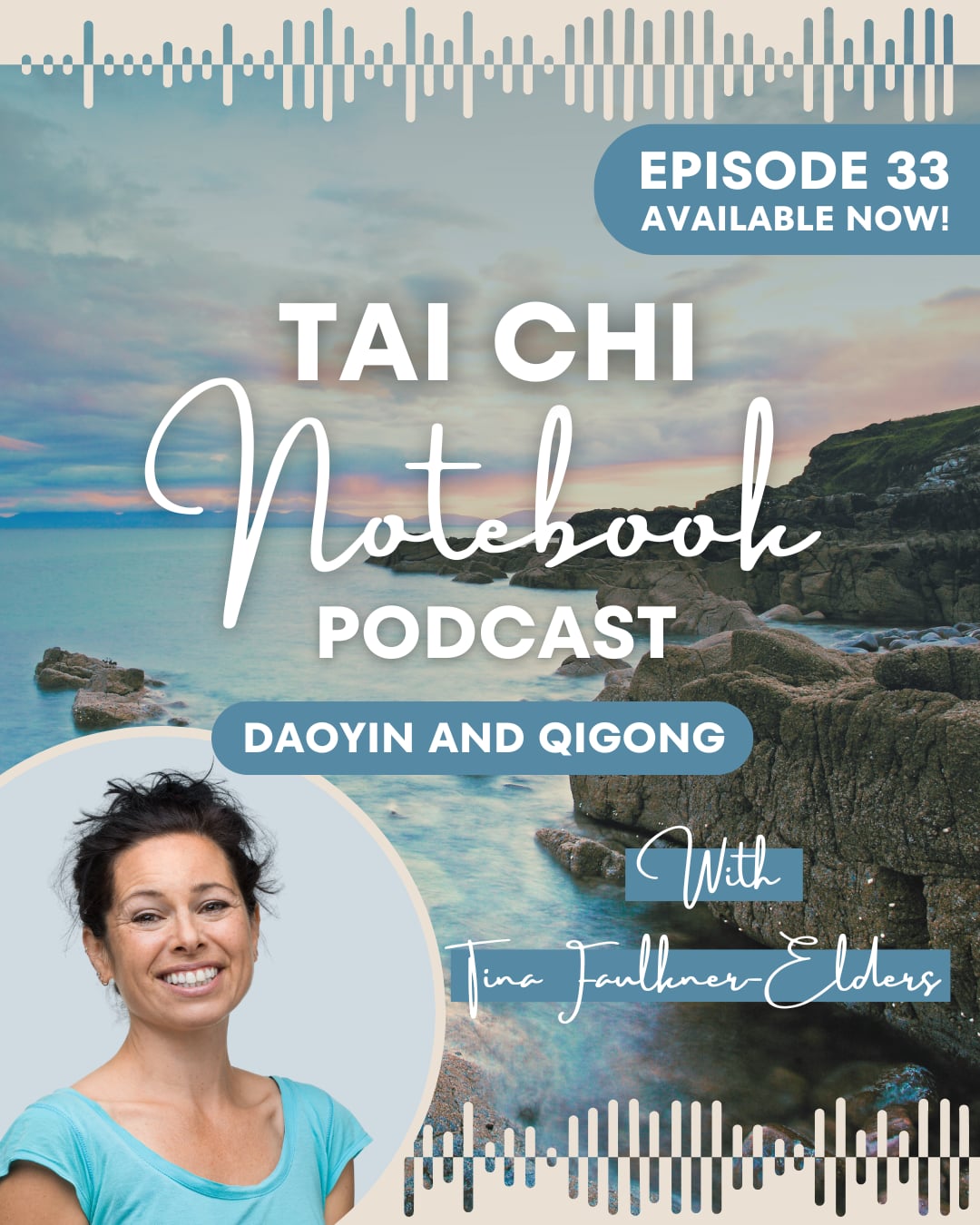
My guest for the latest episode of The Tai Chi Notebook Podcast is Tina Faulkner Elders, chief instructor of the RuYi School of Taijiquan and Qigong in Aberdeenshire. We talk about Tina’s training in qigong, first with her father, then in Beijing, China, and then on Wudang mountain itself, the legendary home of Taoism.
If you’ve been doing Tai Chi, meditation or yoga for any length of time you’ll have heard the old adage to ‘put your tongue behind the two front teeth‘. The explanation given for this is usually that it “connects the two meridians that go up the back and down the front of the body called the Ren and Du meridians, creating the micro-cosmic orbit”.
Micro cosmic orbit connected… man. Photo by Elina Fairytale on Pexels.com
Personally, I have my doubts about the whole idea of ‘energy’ or Qi ‘flowing’ around the body. I often think it’s really an ancient aberration of the simple idea of forces moving inside the body. In Chinese martial arts there’s a phrase you often hear – rise, drill, overturn, fall, which matches this circuit in the body with a martial technique. The best example of which is Pi Quan from Xing Yi, during which forces in the body (jin) rise up and then come crashing down into a strike.
Strength and balance
However, it’s not just Chinese medicine that recommends this tongue position. I’ve recently discovered that there are a lot of Western sources advocating the same tongue position. For example, Colgate toothpaste has an article about correct tongue position on its website that recommends the exact same thing – the tongue resting on the upper palette behind the two front teeth. The article links to a study in Radiology and Oncology called “Three-dimensional Ultrasound Evaluation of Tongue Posture and Its Impact on Articulation Disorders in Preschool Children with Anterior Open Bite“, which notes that “children with poor tongue posture were reported to have a higher incidence of anterior open bite, a type of malocclusion where the front teeth don’t touch when the mouth is shut. This may be because the tongue puts pressure on the teeth which can shift their position over time.” (Colgate).
In this article from Healthline, Dr. Ron Baise, dentist of 92 Dental in London explains “Your tongue should be touching the roof of your mouth when resting… It should not be touching the bottom of your mouth. The front tip of your tongue should be about half an inch higher than your front teeth.“
While dentists may be aware of the benefits of good tongue position for your teeth and preventing problems with your speech, or mouth breathing from occurring, some exercise enthusiasts are going further and claiming that proper tongue position actually increases your strength and balance, something that is undoubtedly important for martial arts, like Xing Yi.
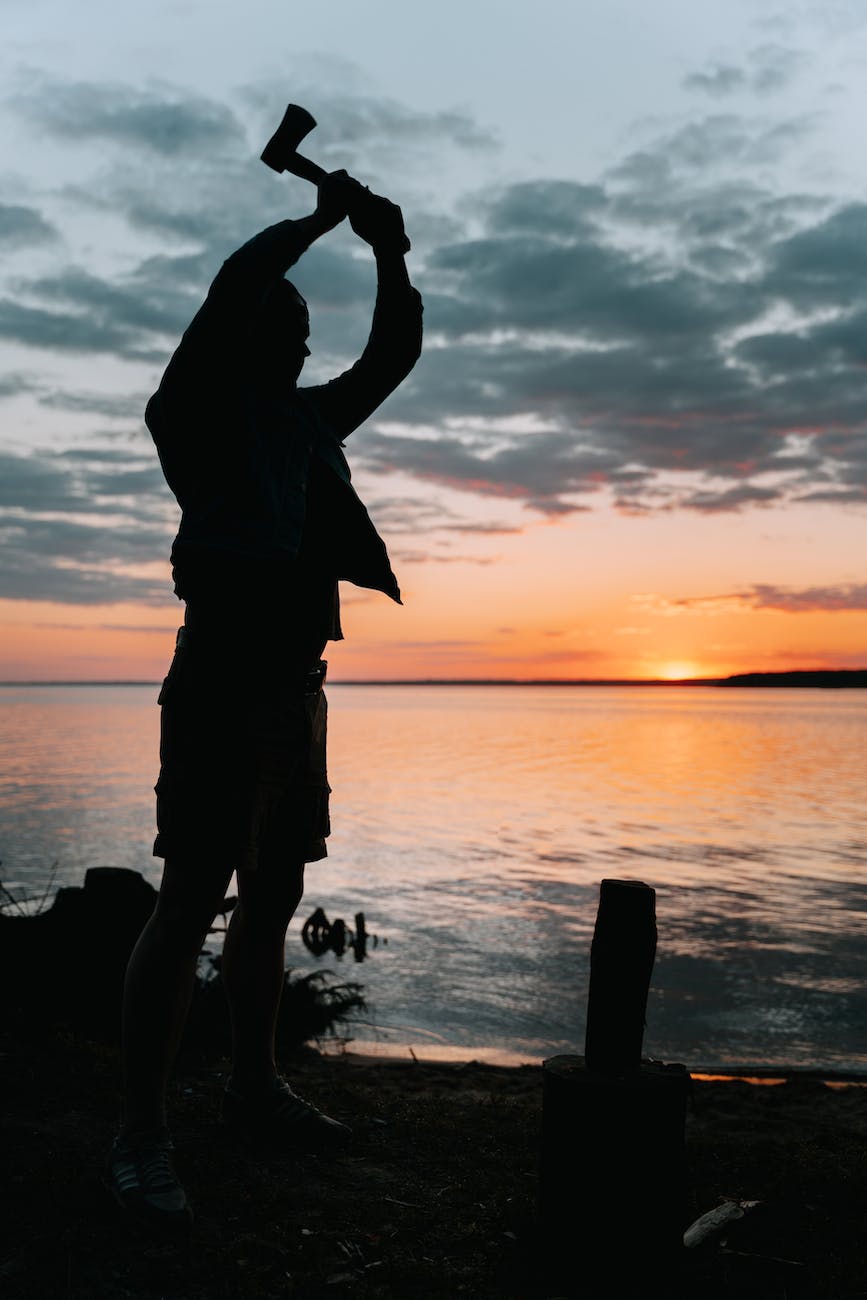
Pi Quan is said to be like the swinging of an axe. (Photo by Ivan Samkov on Pexels.com)
Now, I’m as aware as the next Tai Chi blogger that cherry picking studies that confirm your beliefs (and presumably ignoring everything that doesn’t) is a bit of a red flag. However, the idea that your tongue position effects strength and balance makes more sense to me than imaginary energy channels (Du/Ren) that may, or may not, exist in real life.
Apparently, good tongue placement can give you superpowers!
I remain slightly skeptical about the whole issue, however, my tongue does naturally rest behind my two front teeth on the upper pallet of my mouth… I can feel it there now as I write this. Was it always there? Or have I turned this into my natural position thanks to starting Tai Chi in my 20s?… I don’t know. All I can say is that it feels comfortable, and if my Ren and Du channels are connecting because of it, and my strength and vision is better because of it then…. so much the better.
One observation I have on ‘internal’ martial arts is that there there is often very little focus on the ‘internal’ qualities to a human being. Or if they do address them then it is, not directly and often in passing.
I’m not talking about things to do with forces, or the body, like Qi, Xin and Jin. Yes, the Yi (intent or mind) is mentioned all the time in the Tai Chi Classics, but it’s always in relation to fighting, or releasing and accepting forces on the body. “Quelle surprise”, you might say, since Tai Chi is a marital art, but if I contrast ‘internal’ martial arts with ‘external’ martial arts for a moment, the discussion there is often on the internal qualities of a human that internal martial arts, ironically, neglect.
I’m talking about things like self-control (temperance), endurance and patience.
The goal of improving these internal qualities has been the goal of practical philosophers since man first decided to ponder his/her existence. I could quote from LaoTzu here, but I find it more explicitly written by the Greek philosophers, particularity the Stoics.
In Chapter 10 of the Greek classic of Stoicism, The Enchiridion, we find:
“On the occasion of every accident (event) that befalls you, remember to turn to yourself and inquire what power you have for turning it to use. If you see a fair man or a fair woman, you will find that the power to resist is temperance (continence). If labour (pain) be presented to you, you will find that it is endurance. If it be abusive words, you will find it to be patience. And if you have been thus formed to the (proper) habit, the appearances will not carry you along with them.”
Epictetus, The Enchiridion
Sure, these internal qualities can certainly be learnt from any martial art, however I find it is the external martial arts that really emphasise them. Many Taekwondo schools use the goal of improving your inner qualities as the main sell in their marketing approach. For example, I just did a Google search for Taekwondo clubs in the local area, clicked on Tiger martial arts, and what do I find written on their website, in all caps, so you can’t miss it?
“WE BELIEVE MARTIAL ARTS IS ABOUT MORE THAN JUST KICKING AND PUNCHING”.
This is followed up with “We give students the focus and confidence to achieve in all areas of their lives. Yes, you can learn to take care of yourself in dangerous situations, but really it’s about learning to use your mind and body like a martial artist – learn how to control your body and your mind, and you will be set up for life.”
It’s the same with Karate. I did another random search on Karate clubs and found Bristol Karate Academy whose motto is “virtue in industry” from “Virtute et industria” — or by virtue and industry — from the city of Bristol, which dates back to at least 1569. They explain how that relates to the values of their club on their About us page:
“So what does that mean for us?
Virtue (美徳): We have integrity, in our commitment to traditional, effective Karate and integrity in the way that we treat others. We are respectful, fair and aim for high moral standards. We build character, strive for excellence and show courage in the face of challenges.
Industry (勉励): We work hard to reach our goals. We’re diligent and determined to get better at every single training session. We are rigorous in our approach to improvement and dedicated to our own and each other’s development.
Through hard, honest training we become our best possible selves”
Again, while I’m sure they can kick-ass with their karate, the emphasis in their motto is on the internal qualities of a human being. It’s about becoming your best possible self.
I know what you’re thinking – “perhaps it’s about teaching children?” Things like Karate and Taekwondo can be very orientated towards teaching children, and you obviously don’t want to be raising a hoard of little ninjas who have no idea about the moral implications of using their marital arts. However, it’s not just non-Chinese marital arts that have a heavy emphasis on building moral character. Similar ‘external’ Chinese martial arts do too, and those tend to have as much emphasis on adults as children. Also the moral aspects were there right from the beginning in the Southern arts.
For the history of Southern Chinese martial arts I’d recommend Ben Judkin’s excellent book “The Creation of Wing Chun”. Its tag line is “A social history of the Southern Chinese Martial Arts” because it covers all of them, not just Wing Chun, and particularly Choy Li Fut. When the first professional Choy Li Fut school opened in 1836 a moral education was seen as part of the ethos of the school. The school had 10 rules that had to be followed at all times:
Ten Points 1 Seek the approval of your master in all things relative to the school. 2 Practice hard daily. 3 Fight to win (but do not fight by choice). 4 Be moderate in sexual behavior. 5 Eat healthily. 6 Develop strength through endurance (to build a foundation and the ability to jump). 7 Never back down from an enemy. 8 Practice breathing exercises. 9 Make the sounds (“Yik” for punches, “Wah” for tiger claws, “Tik” for kicks). 10 Through practice you cannot be bullied.
While some of the rules are to do with body use, like making sounds on punches, others are more moral, like being moderate in sexual behaviour. And also eating healthy is a rule! Can you imagine going to a Tai Chi class or a Xing Yi class today and being told that healthy eating is now a rule, and if you don’t follow it, you’re out? In fact, I’d go as far to say that many internal martial arts teachers were renowned for hard drinking and over eating!
(It should be noted that Bak Mei tended to not have this moral emphasis. Reasons for this are explored in the book.)
Moving forward in time and changing locations to Brazil… Carlos Gracie also created a set of rules called the 12 Commandments when he started Brazilian Jiujitsu as an offshoot of Judo.
1 Be so strong that nothing can disturb the peace of your mind. 2 Talk to all people about happiness, health, and prosperity. 3 Give to all your friends the feeling of being valued. 4 Look at things by the enlightened point of view and update your optimism on reality. 5 Think only about the best, work only for the best, and always expect the best. 6 Be as just and enthusiastic about others victories as you are with yours. 7 Forget about past mistakes and focus your energy on the victories of tomorrow. 8 Always make those around you happy and keep a smile to all people who talk to you. 9 Apply the largest amount of your time on self-improvement and no time in criticizing others. 10 Be big enough so you can feel unsatisfied, be noble enough so you can feel anger, be strong enough so you can feel fear, and be happy enough so you can feel frustrations. 11 Hold a good opinion about your self and communicate that to the world, but not through dissonant words but through good works. 12 Believe strongly that the world is in your side, as long as you stay loyal to the best of yourself.
Carlos Gracie
These are mainly forgotten about these days and I’ve noted before that a lot of them were borrowed from somewhere else but they are almost exclusively about internal qualities of a human being.
If you contrast these sorts of rules to what you find in “internal” marital arts schools, well first of all, there are usually no set rules like this at all! Secondly, we tend to look to the classics for our ancient sayings, and finding moral instruction in them is like finding a needle in a haystack. Instead you find simile – for example, “be still like a mountain and move like a great river” from the Tai Chi classics, or philosophy from the Xing Yi classics like The 10 Theses of Yue Fei:
“From the beginning, that which is discrete must have its unification. The divided must be combined. Therefore, between heaven and earth, all that is disordered hasits abode, all the thousand branches and the confusion of then thousand endings, all have their origin. This is because one root divides into ten thousand branches, and ten thousand branches all belong to one root. These events are natural“.
– The Thesis of Integrity
Or you find descriptions of body use and strategy.
The jin should be rooted in the feet, generated from the legs, controlled by the waist, and expressed through the fingers.
What you don’t find a lot of is moral instruction or a reflection on the internal qualities of a martial artist that you find emphasised right up front in external schools.
So, why is this? Good question. One possible answer could be that ‘external’ arts historically coming from the Shaolin Temple (in the usual origin myth, at least) always had a Buddhist religious and therefore moral aspect to them. The internal arts in contrast tended to evolve out of the (violent and bloody) countryside, or they evolved from a Taoist approach to life, which was less prescriptive.
I don’t know – what do you think? What explains the internal/external difference? Let me know in the comments.






 The Tai Chi Notebook