Static stretching vs dynamic stretching – which is best?
I’ll be the first to admit that stretching isn’t the most exciting topic for most people, but it’s kind of important, so I should cover it. Plus, I’ve recently found a video by Ryan Hall that gives some extra insights into common stretches we do before BJJ:
Ryan gives some really valuable little tips on how to do each stretch correctly. Since you generally learn these stretches by just following along in class, with little to no additional information, it’s all too easy to miss the little details. For example, the first stretches he shows are the shoulder stretches you do by pulling the arm across the body (see 9.08 in the video). These are really common stretches used in all sorts of sports, yet the little detail he gives that you should be taking the shoulder down and back while pushing the chest out as you do them makes all the difference. Now you’re actually working the shoulder joint, which is the point of the stretch. Just yanking the arm across the body on its own won’t do squat.
Look at the ‘sprinters stretch’ at 24.26 – everybody I know will reach for that foot (including myself) but as Ryan points out, the point of the stretch is to get really comfortable getting your head to your leg – that’s where the focus needs to be.
What’s also nice about the video, is that Ryan puts each stretch in context – so you can see where it fits into BJJ as a whole. So, he’ll show you why it’s useful to be flexible.
And yet, he’s doing it all wrong. We all are. Or are we? You need to decide this for yourself after reading the latest research into dynamic vs static stretching, which I’ll point you towards here.
Ryan is showing what are called ‘static’ stretches, where you move into position then hold for 10 seconds. The current thinking is that ‘dynamic stretches’ are a better way to warm up. Dynamic stretches don’t involve holding the position at all, you simply take the joint through a range of motion, without holding the position at any point.
The reason of why dynamic stretching is better for you as a warm-up (than static stretching) seems to come down to two things. Firstly, the purpose of a warm-up is to warm the muscles and tendons, ready for the work that’s about to be done. In martial arts the work that is about to be done doesn’t usually involve holding stretched positions in extended periods (although if you’re getting stacked in your guard in BJJ, then it might!) Generally though, we’re about to use our muscles in an explosive way while putting our joints through their full range of motion. This is very different to the experience of a static stretch.
The second part is to do with the Golgi tendon receptor. This is a nerve which is found inside every tendon, and tells the muscle to relax and switch off to avoid it getting injured. So, if your bicep is under load and at full contraction for more than 5 seconds, the Golgi tendon receptor will make it relax, so you don’t tear anything. It’s this nerve which gets activated in a static stretch lasting more than, say, 5 seconds, essentially tricking it into relaxed the muscle further than normal, which means you can stretch further, but it also means the muscle can lack up to 20% of the power it had before it did the extra stretch (because you need tension to create power).
There have also been various studies performed which show that static stretching as a warm-up does nothing to help athletic performance, and in some cases actually diminishes it.
I think it all comes down to how you view the warm-up. If it’s simply to prepare your body for the work to be done, then dynamic stretching makes sense. However, you’re not going to dramatically increase your flexibility with dynamic stretching. So, in an ideal world you’d have both – the dynamic stretch before the activity, as a warm-up, then the static stretch as a cool-down afterwards.
A good source of information on stretching for athletic performance is sports coach Brian Mac, who has a website packed full of articles, like these ones, which contain the following quotes:
“Contained in the tendon of each muscle is the Golgi tendon receptor. This receptor is sensitive to the build up of tension when a muscle is either stretched or contracted. The receptor has a tension threshold that causes the tension to be released when it gets to high. As the Biceps contracts and the threshold is exceeded then a signal is sent to the Biceps causing it to relax. This mechanism prevents damage being done to the Biceps should the weight be to heavy or the movement is to fast.”
Conditioning: How does static stretching affect an athletes performance?
“In conclusion, in most cases static stretching before exercise reduces an athlete’s power and strength. If the athlete participates in power or strength exercises acute stretching may not be recommended. “
“This suggests that dynamic stretches, slow controlled movements through the full range of motion are the most appropriate exercises for warming up. By contrast, static stretches are more appropriate at the end of a workout to help relax the muscles and facilitate an improvement in maximum range of motion.”
Rory Miller is a name that will be familiar to many people involved with martial arts. He wrote the seminal book Meditations on Violence about his experiences facing violence on a daily basis. It’s often described as one of the best books on self defence ever written. He also runs a website that has lots of great articles on it.
A new interview with him by Rafe Kelley of Evolve, Move Play just appear that’s an hour long and well worth your time watching. He tackles some very interesting subjects, particularly his take on violence.
I’ve been watching Rafe’s work on YouTube for a while now with interest – he’s got some great ideas on rough housing and using martial arts as play. Check out the following video:
Very rarely does a kung fu demo look like real fighting, but so what?
Chinese martial arts have a strong connection to what we (by which I mean people in Europe and America) would call ‘theatre’. All kung fu styles have some sort of performance element built into them. Historically a lot of kung fu styles were practiced by Chinese Opera performers, or have links to religious rituals, which became hidden inside Kung Fu styles. I’ve written about this before with respect to Tai Chi and its strange preoccupation with the Taoist Chang Sang Feng.
From the modern view point it’s easy to laugh at this idea, sine we tend to think that martial arts have one purpose – for kicking butt! But I think it’s valid to ask why do almost all Chinese Martial Arts contain so many solo forms if they’re not meant to be performed and appreciated as a performance? Compare it to something like Brazilian JiuJitsu or Wrestling – these arts don’t contain any solo kata or forms anymore, because they’re really just focussed on fighting techniques and conditioning. Sure, forms build up stamina, which is conditioning, and train techniques, and the flow of movements, but a lot of this could easily be done more effectively by repeating individual techniques over and over. Instead, in Chinese Marital Arts, they get put together into a (often highly stylised) form.
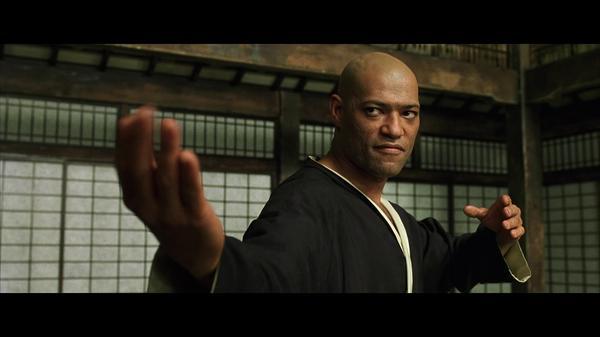
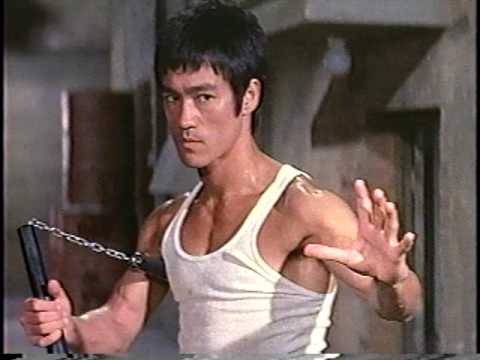
It’s no surprise to me that the kung fu film industry is so big, and has also crossed over into Western cinema, first with Bruce Lee and Enter the Dragon, and recently with Crouching Tiger, Hidden Dragon and The Matrix. It’s because kung fu has always been designed to be performed partly as theatre, making cinema its natural medium.
Kung Fu teachers back in the 1970s when kung fu started to take-off were well aware of this ‘for show’ element to the arts, and didn’t think it was anything to be concerned about. Some techniques were ‘good for show’ and some were ‘good for real use’, and your teacher knew the difference. Of course these days we’re in the era of the YouTube generation, so when a Kung Fu demonstration, with its flashy techniques done against minimal resistance, crops up for discussion there’s an immediate cry of ‘foul!’.
Take this video of a Choy Lee Fut demonstration, which got posted on RSF recently:
The teacher moves well, and clearly has a grasp of using the big swinging techniques of Choy Lee Fut, and demonstrates them with speed and efficiency, which is presumably the point of the demo, but it was instantly greeted with cries of “That was awful”, and “I liked how the camera shakes at some points. Real dragonball effect. Only one question …. why is it none of the “attackers” have their hands covering their heads? Ok one more. Why can they throw 2+ punches or kicks like he does?”
Because of the huge interest in MMA, which is probably as close to actual fighting for entertainment as we can get and still be relatively safe for the participants, everybody has at least some idea of what a fight actually looks like, so we’ve now got people looking at Kung Fu demonstrations questioning why it looks nothing like a fight. This is a good thing, because I get the impression that back in the 1970s and 1980s people thought this was what real fighting should look like. Then the UFC came along in 1993 with a healthy dose of reality that blew everybody’s perceptions out of the water. Sure there’s the usual ‘but that’s not the reality of the street’ and ‘but what about knives?’ objections, but I think they’re missing the point. Fighting looks like fighting. It’s scrappy and messy, and always will be.
These days I’m finding it harder to care that the polished, perfect kung fu demos we’re used to seeing don’t look like real fighting, and I’m just happier to accept them for what they are. Kung fu has evolved over many generations into an art that contains performance related elements, and that’s just the way it is. I’d rather just enjoy the performance and not worry about it being too ‘real’, because that’s what you’re meant to do.
I’m writing this on International Women’s day, so I’m going to end this post with a clip demonstrating that women have a long history in kung fu films, and were violently kicking mens’ butts years before things like ‘trigger warnings’ existed. Let’s not forget that. Here’s to the ladies of kung fu!
We’re not here to take part, we’re here to take over
Kung Fu in MMA is a little guest blog post I wrote for Bookmartialarts.com – on MMA and Kung Fu. They couldn’t link to all the videos I mentioned on their site, so here’s the ones I wanted to show:
A discussion of the similarities between BJJ and Tai Chi
So, finally, here’s my much delayed look at the similarities between BJJ and Tai Chi. This is probably an impossible topic to give justice to fully, but I’ve given it a go and hopefully my perspective will be useful to others. I’ve already attempted to define Tai Chi in a previous post, so the next logical question is, ‘what is Brazilian JiuJitsu?’ Well, explaining what the art is, how it evolved and where it came from is not a simple job but luckily a lot of people have made a lot of (very long) documentaries that explain the whole story of the Gracie family, the in-fighting, the out-fighting and everything else in-between, so you’re better off watching those than having me explain it all again here. If you don’t fancy watching them all then the (very) short version is “it’s an off-shoot of Judo that has more emphasis on ground fighting”.
Try these for size:
The Gracie Brothers and the birth of Vale Tudo in Brazil:
If you want to find out how the art evolved once it entered the United States, and how it compliments other grapplings arts, then check out Chris Haueter’s incredibly entertaining speech at BJJ Globetrotters USA camp:
And finally, don’t miss the excellent Roll documentary on the spread of BJJ in California:
Fighting fire with water
But my concern here is not really the history of the art. I’m more interested in the technical similarities between Tai Chi and BJJ. I’ve heard Brazilian JiuJitsu described as being “like Tai Chi, but on the ground”. I understand where people coming from with that sentiment, but I can’t quite go down that route myself, or rather, I’d settle for saying that it is like Tai Chi, but also explicitly not the same. The one central idea that both BJJ and Tai Chi share is that it’s smarter to not oppose force with force, and instead “yield to overcome” (from a Tai Chi perspective) or “use leverage”, from a JiuJitsu perspective.
As it says in the Tai Chi classic “Treaste on Tai Chi Chuan”:
“There are many boxing arts.
Although they use different forms,
for the most part they don’t go beyond
the strong dominating the weak,
and the slow resigning to the swift.
The strong defeating the weak
and the slow hands ceding to the swift hands
are all the results of natural abilities
and not of well-trained techniques.
From the sentence “A force of four ounces deflects a thousand pounds”
we know that the technique is not accomplished with strength.
The spectacle of an old person defeating a group of young people,
how can it be due to swiftness?”
I’d disagree with the classic on one important point though – most of the traditional martial arts in fact do go beyond the strong dominating the weak, because without that key principle there is not much of an art left in the martial art at all. And I don’t know about the idea of defeating a “group” of young people either (that would be a tall order for any martial art, or martial artists), but to me the classic is suggesting that skill and technique can supersede the natural advantages of youth, such as speed and strength. And when it comes down to it, it’s hard to find an art that can deliver on this promise as well as BJJ can.
BJJ is one of the few martial arts where an older man (or woman) can be expected to regularly beat a younger man (or woman) by having more skill and technique, in a fully resisting scenario, thanks to techniques that manage the distance (a critical self defence skill) and use leverage and technique to overcome brute strength. That’s not to say that no strength is required, but you don’t necessarily need more strength than your opponent to make it work.
Rickson Gracie
To me, the BJJ practitioner that best exemplifies a similarity between Tai Chi and JiuJitsu is the legendary Rickson Gracie. He’s generally agreed to be the best of the Gracies. Compared to the acrobatic extravagances of today’s sport JiuJitsu champions, who favour inverted guards and bermibolos, Rickson’s style of Jiujitsu seems surprisingly simple, yet effective. There are no flashy moves, just basics done at a very high level.
The Rickson documentary “Choke”, which shows his training for a Vale Tudo fight in Japan, is essential viewing if you haven’t seen it before:
In the documentary you can see a young Rickson doing Yoga on the beach. Rumour has it that he also said he studied Tai Chi in a magazine interview, although I’ve not been able to find a transcribed version online to confirm this. Either way, it’s clear that he’s not averse to stepping outside of “pure jiujitsu” to add elements to his exercise, martial and health regimen. The cost of upholding the reputation of JiuJitsu and the Gracie family has been heavy though, and he has several herniated discs in his back, but he’s still on the mats teaching his family art, cornering his son Kron in his MMA fights and giving instruction through his JiuJitsu Global Federation. He also spends a lot of time surfing these days, instead of fighting.
If you read a Rickson seminar review, like this one, you can see that he keeps returning to two common themes – “connection” and “invisible jiujitsu”. The invisible part refers to what you can’t see happening; you can’t see where he is putting his weight and making his connection to his opponent, but you can feel it when he does it. He has detailed ways of making a connection in each position in BJJ.
This sort of teaching from Rickson, to me, is where I find the crossover between Tai Chi and BJJ to be strongest. In Tai Chi Push Hands, for example, we constantly seek to make a connection to the other person, through touch, so its a very familiar concept.
Here’s me doing some push hands:
Forget about the thing I’m trying to teach in the video, just look at the Push Hands routine we’re doing. As you can see, Push Hands very concerned with ‘feeling where the other person is’ and ‘yielding to their force without opposing it’ to neautralise the opponent. From this perspecitve, Push Hands starts to sound a lot like what Rickson is talking about in his seminars, but in a different format.
But the similarities don’t end there. When employing standing techniques Rickson also utilises some of the postural work found in Tai Chi and makes makes subtle nods towards the ‘internal’ method of body movement favoured by Tai Chi. He talks about making a connection to the ground through the feet. I’m not suggesting his ‘body mechanics’ ideas fully embrace everything you’d find in Tai Chi, but I can see the foundations of it being built.
For example, in a Rolled Up episode (3/4) from last year Rickson shows Budo Jake how to use some basic body mechanics to create a better root to the floor when meeting an incoming force while standing. He’s talking about transferring the force applied to the arm down to his foot and into the ground, then back up to move the opponent backwards. This is basic Tai Chi 101.
See here, from the beginning:
At.4.26 he starts to talk about ‘invisible jiujitsu’, specifically at 5.55 about ‘putting the weight in the hands’.
I was taught a very similar drill in Tai Chi – a kind of wrestling game, where you had to stand square on to the opponent and try to unbalance them with a push as they did the same to you. The key to doing it is to ‘put your weight into your hands’, so that when you push, it’s coming from the foot, not the shoulder. And when they push you root the push into the ground, instead of letting it push you over.
Here’s a video of me doing it from a few years ago. The camera is on the ground and not straight, so it looks like I’m leaning forward, but I’m not really:
I’m not an expert at it, and use too much arm strength, but hopefully you can see the similarity between this and what Rickson is talking about in the Rolled Up video.
Of course, Tai Chi takes this idea of creating a path from the foot to the hand to further levels of detail – first the idea of ‘pulling silk’ where you create a stretch from the fingertips (and toes) to the dantien and maintain that connection while moving, so it remains unbroken. Incidentally, the silk analogy refers to the way silk weavers pulled raw silk thread from a cocoon – you had to pull with an even pressure or the thread would break.
The next stage after ‘pulling silk’ in Tai Chi is to create windings on the muscle-tendon channels in the body, controlled from the dantien – the famous ‘silk reeling’ of Tai Chi. I think you can view this as the point where BJJ and Tai Chi diverge and head off along different paths – Tai Chi becomes highly specialised in this type of movement, while BJJ becomes more interested in the practicalities of actual fighting, and taking the fight to the ground (or just dealing with the fight on the ground) where it enters a whole new arena.
Realistically, and practically, there is no need for the type of highly specialised and, frankly, difficult, method of moving the body that Tai Chi employs for actual fighting, and also it’s questionable whether you can actually do ‘silk reeling’ type movement when on the ground, since it relies on using the power of the ground to push up from via the legs. Does that mean one art is better than the other? Well, they both are what they are, and they’re good for different things. I’ll probably leave it at that.
Conclusion
Interestingly, when I started BJJ (almost 5 years ago now) I found that my all years of experience in Tai Chi meant nothing at all on the mat when rolling against an experienced practitioner – even if they were a smaller, weaker person. Fighting on the ground is a completely different animal compared to stand-up. I was submitted as regularly as the next white belt, but I did find that my previous experience in Tai Chi meant I could learn quicker than average (I got my blue belt in a year). It let me see the concepts and principles hidden within the techniques of jiujitsu. And it helped me relax under pressure, which is a huge part of getting better at BJJ. Also, doing the Tai Chi form helped me recover quicker from the physical wear and tear which is characteristic of your first 6 months of BJJ, while your soft, squidgy body is still toughening up.
Unlike Tai Chi, which has, in a sense, become set in stone in terms of its evolution, BJJ is a constantly fluid and evolving art. Thanks to the highly competitive environment of the BJJ competition circuit, new techniques are always being created and being discarded. It’s becoming highly specialised towards what works in the most common competitive rule sets. Where I see the connection to Tai Chi is in the older, ‘original’ BJJ that was more self-defence orientated, as exemplified by Rickson Gracie. Where BJJ is headed next is anybody’s guess. Quite possibly it will evolve in several directions all at once, and it will be interesting to see if the legacy started by Rickson Gracie and his ‘invisible JiuJitsu’ lives on, or even gets expanded upon.
How to build a Tai Chi practice that lasts a lifetime
If you know some Tai Chi moves and you want to practice at home you probably have some questions, like where, when and how?
Firstly, the when. The best answer is ‘whenever’! There’s an old saying that the best time to plan a tree is 20 years ago. The second best time is right now. Just get on an do your Tai Chi practice whenever you have time. While there are some good reasons to practice first thing in the morning (it’s quiet, your brain hasn’t started to worry about the 20 things you have to do that day yet, etc) there’s no medical reason why practice in the early morning is better than midday, for example.
Secondly where should you practice? The traditional way is outside. I like this idea as we don’t spend enough time outside these days feeling the wind, or the sun, on our faces. Time in the elements and away from unnatural lighting and computer screens is actually very important to our health. Just ask Katy Bowman. If you’re going to practice Tai Chi then why not make use of that time to kill two birds with one stone and get some fresh air as well? If it’s cold outside just put on a coat and some gloves. And practicing Tai Chi in the snow is very cool- just ask that Panda in the picture!
Finally, let’s look at how you should practice, if you want to progress, that is. My teacher always advised doing the Tai Chi form a minimum of 3 times. Once to get it out of your system, then a few times (just once or as many times as you like) to work on something, then finally, once through again just to enjoy it. One of my students described this routine as “Once to notice the mistakes, then the next time to work on them”, which is a good way of looking at it. The ‘working on them’ bit can be frustrating, so the final ‘just enjoy it’ rendition is essential if you want to make this a life-long practice. Remember why you wanted to do Tai Chi in the first place – to enjoy it! Performing slow movements in the peace and quiet (or with relaxing music on) is very calming, so just enjoy yourself in movement. In the last run through you should try to be completely uncritical of your performance. It might be helpful to imagine that you have already attained mastery of the art!
I like this approach because ‘3 times minimum’ is something you can realistically fit into a morning routine and it encourages you to practice daily. Because, guess what? It turns out that you need to practice Tai Chi every day to get anywhere. Yes, sadly, daily practice is essential. Tai Chi is weird like that. I remember when I learned the Beng Chuan punch of XingYiQuan it was very hard, almost impossible, to get it right in terms of delivering structure and power together with perfect timing. But once I got it I realised I would never forget how I did it. To me it was like riding a bike. Sure, you can get rusty if you haven’t practiced for a while, but you don’t every really forget.
Tai Chi is different. At least to me it is, anyway. I feel like every time I do the Tai Chi form I’m learning to ride a bike again from scratch. After 3 run-throughs I’m pretty much back on the bike and riding, but it seems to wear off pretty quick, and by tomorrow you need to learn all over again.
6 harmonies movement, the classics and the boxing art
This article was supposed to be a description of some key similarities between BJJ and Tai Chi. Unfortunately while writing it I realised I first needed to define Tai Chi properly before I could successfully contrast the two. Then I realised that this wasn’t an easy task.
Some people consider the fact that it is taught by a family that has a style of Tai Chi named after them to be enough to legitimately say the art they do is “Tai Chi Chuan”. You might consider that attitude to be similar to the attitude of Leung Bik in this little martial arts film clip about Wing Chun where Ip Man meets Leung Bik. When questioned by a young Ip Man if what he’s doing is really “Wing Chun” he says “Whatever comes out of my fist is Wing Chun!”. In essence he’s saying that he is the style, so there is no restriction on what defines the style.
On the flip side, there’s also the argument that for movement to be truly “Tai Chi Chuan” it must follow a strict number of movement principles, or rules. Some of which you’ll find in the Tai Chi Classics, and some of which you won’t.
The Tai Chi classics actually talk a lot about fighting strategy, particularly the idea of not opposing force with force. But I’d argue that this isn’t really what defines Tai Chi. In fact, most martial arts adopt this strategy, since a martial art where your strategy is just to attack like an unthinking robot until your enemy is dead in HULK SMASH! mode is unlikely to keep its students in the long run! Therefore, it’s no surprise to me that a lot of the writing in the Tai Chi classics seem to apply equally to Brazilian JiuJitsu, Jeet Kune Do, Aikido, Karate and lots of Kung Fu styles just as well as they would to Tai Chi. The writing in the classics doesn’t talk too much in the actual mechanics of movement, and instead talks a lot about fighting strategy.
For example, lines like the following could apply to most martial arts:
“The feet, legs, and waist should act together
as an integrated whole”
“Empty the left wherever a pressure appears,
and similarly the right.”
“It is said if the opponent does not move, then I do not move.
At the opponent’s slightest move, I move first.”
So, if you find that the Tai Chi classics cannot be relied upon to adequately define “Tai Chi Chuan”, what can? The best answer I’ve found is held in the concept of 6 Harmonies movement, or 6H for short. The idea of “Six Harmonies” is actually older than Tai Chi Chuan itself.
The six harmonies are broken down into 3 internal harmonies (the “desire” leads the “mind”, the “mind” leads the “qi”, and the “qi” leads the “strength”) and the 3 external harmonies – the shoulders connect with the hips, the elbows with the knees and the wrists with the ankles (or hands and feet, if you want). You can think of the internal harmonies as being about the desire to do something and turning it into a physical action – the actual Chinese word is “Xin”, which translates as “heart”, but in the sense of the desire arising to do something coming from your heart, not your head. In contrast, the external harmonies describe how the movement actually goes through the body (from the fingertips to the toes) via muscle-tendon channels, a process trained in Tai Chi through “silk reeling” exercises.
The distinctive feature of 6 harmonies movement is a complete connection of mind and body, producing force that appears soft, but penetrates deeply. It’s quantifiably different in feel to force produce by local muscle usage, although to somebody unfamiliar with it, it can look just like normal movement it should feel different. While the initial stages of learning 6 harmony movement may use large circular motions, they can be made imperceptibly small by an expert, which makes it even more difficult to quantify and identify.
Credit must be due to Mr Mike Sigman of the 6H Facebook group here for putting these Chinese concepts into words that English speakers (like myself) can understand without too much problem. He’s produced perhaps the most comprehensive and organised explanation of the process I’ve seen written down in English. If you want to delve deeper into it, I’d suggest joining his Facebook group and looking through some of the older posts.
I’m undecided as to wether there was originally a fully formed 6H theory that goes back hundreds of years, and is the origin, or essence of all Chinese martial arts, or if it’s something that has been refined over the years as a distillation of all the “good bits” of Chinese martial arts. The fact that the ancient meridian system used in acupuncture overlays the muscle tendon channels used in 6H is a good indication that it is an old, old theory, and lots of old Chinese martial arts have the phrase “Liu He” (6 harmonies) in their name (like Xin Yi Liu He Quan), which adds weight to the theory, but we’re drifting into speculation here. In a sense it doesn’t matter if you want to think of 6H as the modern distillation of “internal” movement methods or an ancient system, the important thing is the doing of it, and that requires practice.
Note: I’ve left “qi” in my description above, but that’s because, ultimately, I think its more problematic to replace it with an English word, when there isn’t one that’s really up to the job. Please note – there is much more to the theory and practice of 6 harmonies movement than I’m describing here (for example, dantien rotation, open/close, reverse breathing and the microcosm orbit), so I’d suggest that the reader who is seriously interested in the topic join the Facebook group if you want to get a proper handle on it. It is not a trivial subject!
So, to finally return to the question, what defines Tai Chi Chuan? I’d say it’s a combination of all three of the ideas expressed above – it needs to be from a lineage connected to the original Tai Chi families (the Chen, Yang, Wu, Woo and Sun families), it needs to conform to strict principles of movement, the most cohesive set of which I’ve seen is 6 harmonies movement, and it needs to follow the fighting strategy expressed in the Tai Chi classics.
Now that’s covered, I can get onto my intended subject of the similarities between BJJ and Tai Chi, and a look at the legacy of a certain Mr Rickson Gracie…
I’ll admit to being a big fan of Charlotte Joko Beck’s 1993 book Nothing Special. Her first book is good too, but the second really hits the spot for me. It’s about Zen living, but is very light on the ‘Zen’ and very heavy on the ‘living’. What I like is her approach to practice, because I think it relates to Tai Chi practice.
There are so many similarities between the two. Aside from the fact that they’re both meditative in nature, if you want to get anywhere in Tai Chi you need to practice pretty much every day, even when you don’t feel like it, in much the same was as you have to sit and meditate every day to get anywhere in Zen, even when you don’t feel like it. Not that there is anywhere to get in Zen, since you are already right here. In fact, from a Zen point of view it would be better to say that you have to meditate every day just to get back to where you are already, and nowhere else.
Some of my favourite quotes from her work (which I’m not getting just right, but hey, they are close enough):
“When nothing is special, then everything can be.”
“On the withered tree the flower blooms.”
“Stop thinking, stop dreaming and there is nothing that you cannot know”.
Anyway, I’d recommend Nothing Special, the book, and watching the following YouTube documentary about her work.
Charlotte Joko Beck – Ordinary Living-documentary:
Who is ready for some more depressing news about martial arts and China? I bet you are. Anyway, here’s the latest in a long line of Taiji magic tricks that don’t fool anybody:
“We’re challenging these Thais to a match in the spring, I need to show these fighters to my master in Henan,” explained Chen Jia. “It’s going to be televised all over China.”
This is the story of how a Taiji group organised a challenge match against a group of pro Thai boxers. Original article here:
If you know anything about Thai Boxers then you know that this would be the equivalent of a group of school children challenging a Special Forces unit to a gun battle. The author, realising this, tries to stop it going ahead, thinks he has, but at the end of the article it says the fight went ahead anyway, and the Taiji guys won 3-2, with no further explanation. Winning 3 to 2 sounds amazingly good for the Taiji guys, especially considering who they were fighting.
But then another article appeared recently with a further explanation:
“So I got the links and watched the fights. Sadly, this “match-up” was exactly what everyone says fights in China are like. The fights were rigged – Chinese fighters wore black pants to hide shinguards, referee saved Chinese fighters from anything more than a 3-punch combo, Thai guys were paid to take a fall.”
I’m not surprised at all, this is the way everything seems to be done in China. It’s such a continual disappointment, and another reason why the Chinese Martial Arts are in such a poor state.
“A girl atop Huashan outside of Xi’an told me once that “fakery is a part of our Chinese culture,” and she said it with a measure of pride. The trickster has always been a hero in Chinese culture, and held above the great warriors who must eventually sacrifice themselves for either cause or country, while the schemer survives. That tradition, combined with a half-century of non-stop brutal lies and another three decades of desperate money mongering, has reached its most bloated moment.
I don’t think the moment can last forever, and I believe a cleansing of the martial arts will hasten the end of a century of lying.”
I’m not so optimistic, I think it will just continue like this forever until there is a change of government in China and an explosion of democracy. Until then we’re going to get stuff like this on Chinese TV. I wonder if the Chinese people know it’s fake, or not? Sigh.
Tai Chi, like all other traditional martial arts, contains some aspect of performance, show or magic trick. See my previous post about meeting Scott Phillips for more on this idea, but in short, public demonstrations for entertainment have always been a part of the traditional Chinese martial arts. Martial arts street ‘buskers’ doing gymnastic performances, kung fu schools doing en masse demonstrations of their skills, the Shaolin Monks touring the world with their concrete-breaking, skull-cracking performances, etc… The list goes on.
In Tai Chi the publicly-expected demonstration of skill has turned into something more subtle and suitably ‘Taoist’ than merely breaking concrete blocks, or wooden boards. It seems to come down to a ‘master’ figure demonstrating how far he can push a student back with a very light touch, and while it may not be explicitly stated, the assumption is that the master is demonstrating his Chi Power. Sometimes touch is not even necessary and it is done through thin air by the master merely waving his hands at the student. The bigger the reaction of the student then the better the master, or so the unspoken rule seems to go.
Yes, there can be some functional use to this sort of pushing demonstration as a teaching aid. From the students point of view they get to feel what it’s like when somebody with skill puts hands on them and pushes them backwards. Ideally, from a Tai Chi perspective, it should feel different to a muscular, forceful push. It’s not much use as a self-defence technique, but it’s good for demonstrating the type of force you want to be developing in Tai Chi – using the force of the ground via the legs, controlled by the waist and channeled into the hands. It’s a smooth type of effortless power, rather than using the shoulders or back to do a muscular ‘stiff’ sort of push. The difference is subtle and getting hands-on with your teacher is essential if you’re ever going to learn what it is, because you need to feel what it is not, too.
The problem arrises when when the student’s reactions become hyped up in public. In an effort to not let their teacher lose face they can start to over-react to the push. They start to stiffen their arms, and straighten their legs, resulting in a curious type of ‘hop’. It’s not like an agreement was explicitly made before the demonstration that the student should have a big reaction, it’s more that he starts to subconsciously over-egg his response so he doesn’t make his teacher look bad. Anybody who has taught a group of people Tai Chi will be familiar with this phenomenon. Whenever my students tried to ‘fall over’ for me in a demonstration I always reprimanded them and tried to get them to stop ‘helping’ me do the demonstration, and just act like a normal attacker.
On the other side of the coin, you could decide to view these kind of demonstrations as a simple magic trick. A magician (the teacher) is showing a magic trick, and you all know it’s not real, so just enjoy it for the spectacle it is.
At The Fajin Project Facebook group a chap called Stuart Shaw, seems to have no patience for the Tai Chi magician. He’s done some brilliant breakdowns of how various ‘masters’ of Tai Chi do their tricks (he calles them “Woo Woo”). You might have to join the group to view the videos, but I’ll try and link to them below. Why watch it? Well, if your Tai Chi teacher does this stuff to you, then it’s worth being aware of what’s really going on:




 The Tai Chi Notebook