Mr Inbetween – new article and feedback


I’ve written on here before about Mr Inbetween, the Aussie TV show centered around the character of Ray Shoesmith, a hitman for hire, that forever has a soft spot in my heart for the way it covers societies approach to violence.

Well, I recently got the opportunity to write an opinion piece “I can’t stop rewatching this dark Australian comedy drama series on Disney Plus that hardly anyone knows about” for TechRadar about Mr Inbetween, which I really enjoyed writing. It got a pretty good reaction, especially from the Mr Inbetween community on Reddit.

Anyway, I though I’d share the article here because I enjoyed writing it. And here’s a little clip on how Ray dealt with a kid who had been bullying his daughter:

Saoirse Ronan’s viral clip and the debate around women’s safety in the UK

The UK is having a bit of a women’s safety moment right now, and since I’m in the UK and it’s a topic that crosses over into subjects I discuss on my blog, I think I should address it. As well as being about self-defence it’s also about how women and female perspectives are often ignored by a male-focused society. It all relates back to comments made by actress Saoirse Ronan on the Graham Norton Show, a clip of which has gone viral.

You can view the clip here:

She’s sitting on the sofa with fellow actors Denzel Washington, Eddie Redmayne and Paul Mescal. They’re having a lighthearted discussion about training martial arts/self defence for movie roles. While the men laugh and joke about something as ludicrous as thinking about a phone as a weapon of self defence, (can you imagine, lol!?) Ronan points out (she has to try twice to be heard) that this is something women have to think about all the time. The resulting awkward silence speaks louder than anything else.

That this one moment seems to have captured something very familiar to a lot of women – it’s captured men’s ignorance of women’s lived experience in terms of feeling unsafe when moving about in the world and having to think about using things like keys or mobile phones as weapons. Things that men generally don’t have to worry about.

I don’t want to jump on any kind of bandwagon and write an article about how to use a mobile phone as a weapon, because a) you can’t learn self defence from articles! And b) that seems like very opportunistic behaviour.

But what I would say to any women reading this, Brazilian Jiu-Jitsu (BJJ) is a great martial art that will benefit you more in the long run way more than a one-off 2-hour seminar on “self defence for women”. If you really want to feel more confident and less unsafe (of course, there is no guaranteed panacea for this, unfortunately) then I’d recommend starting regular BJJ classes at a BJJ Academy you feel comfortable with, and with an instructor you feel comfortable with (please shop around!), rather than going to a one-off seminar that aims to provide you with a quick fix.

And to the men who might need to become more of women’s lived experience (yes, you at the back!) You might like to read this article from the Guardian, detailing six women’s reactions to the clip, that’s worth a read.

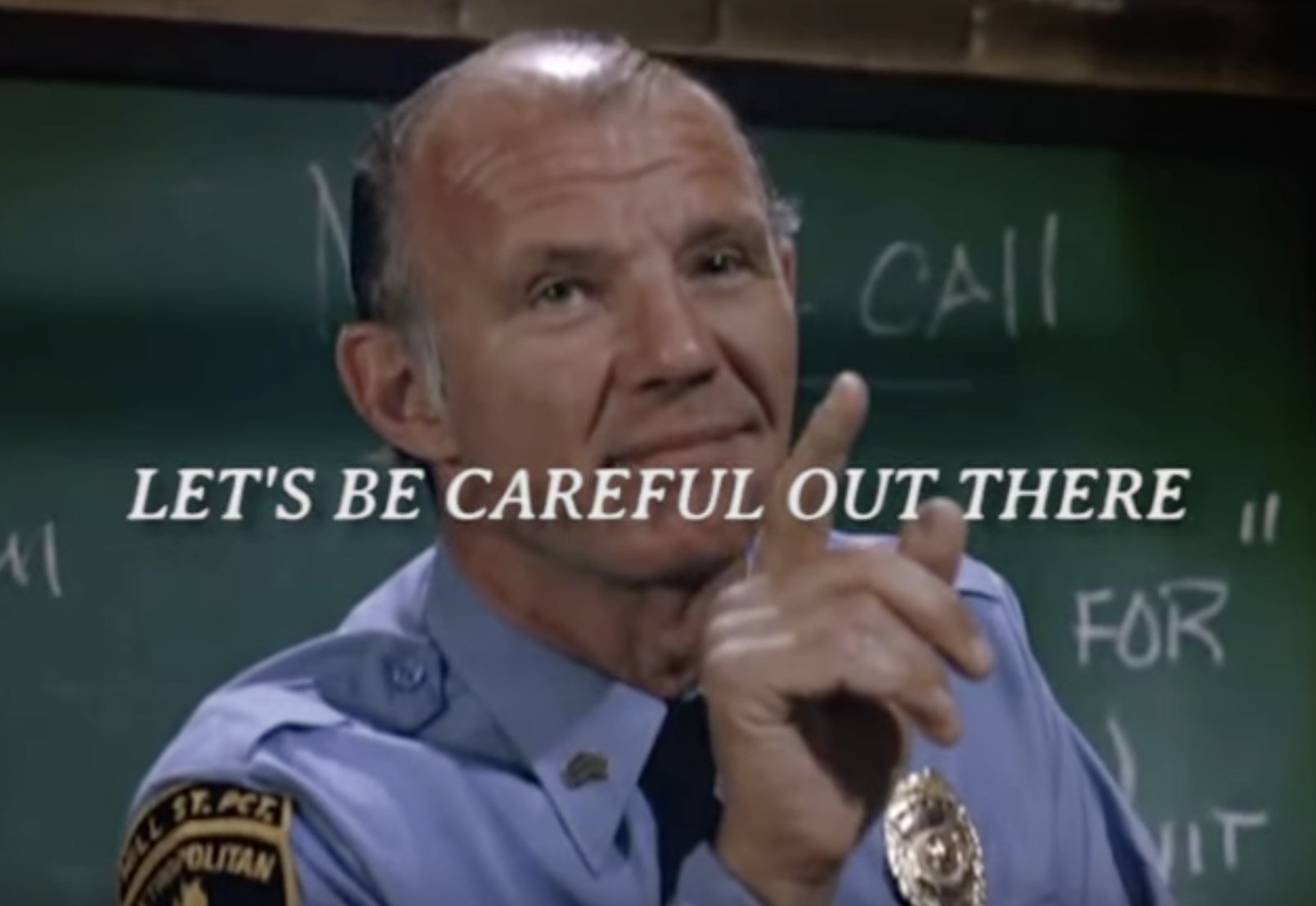
And in the words of the sergeant from Hill Street Blues, “let’s be careful out there”.

Tai Chi as a group practice vs solo practice

A group practices the Tai Chi 24 form together for World Kung Fu and Tai Chi day.

I’ve been getting back into teaching Tai Chi classes recently, and one thing I’ve noticed is the distinct difference there is between doing the form solo in your back yard compared to performing it as part of a group. I’ve been doing the form on my own now for years now. I stopped teaching formal classes in Tai Chi way back in 2011, and although I did a few private lesson things, lockdown really saw an end to that. So, it’s been a long time since I’ve been part of a group all doing the form together.

Group practice changes things. Your awareness in Tai Chi should always be this kind of delicate balance of internal and external. You need to stay aware of your internal sense of self, at the same time as not shutting out the outside world. This is, after all, a martial art, not a meditation session. If you’re not aware of what’s going on outside of you then it wouldn’t be much use for dealing with kicks and punches coming your way. But at the same time, Tai Chi does exist somewhere on the mediation spectrum It demands a sense of stillness and awareness over your inner state. Things like the feeling of your balance, your sense of whether your body is expanding or contracting, your centre of gravity (dantien) and where you are moving from all mater, not to mention keeping your mind fixed on the task in hand and your Yi (intention) flowing with the movements.

Doing that on your own is one thing, but when you are performing the form as part of a group, your awareness needs to also incorporate the group. The group seems to naturally develop a speed together. I wouldn’t say that a group of Tai Chi beginners possess the grace and beauty of a murmuration of starlings (!), but something of the same kind of non-verbal communication is going on. You are constantly picking up on little signals from other people that keep the whole group in check. But at the same time you can’t let the other people distract you and put you off your own job.

A murmuration of starlings

Just like Starlings, we are animals too, so we have these subtle senses and the ability to move in groups. If you’ve ever experienced being in a crowd of people that get a bit paniced you’ll know what I mean. The crowd seems to take on a life of its own and move as one.

Of course, it’s quite possible that you can perform Tai Chi with other people and remain blissfully unaware of any of this, particularly if you are new the Tai Chi and your head is so full of trying to remember the moves, or telling yourself off for getting them wrong, that there’s no room for anything else.

As a final thought, my feelings of seeing people doing Tai Chi together have always been a bit conflicted. On one hand it looks cool to see people brought together over a common goal, all silently concentrating and moving in harmony. But on the other, it expresses some of the worst aspects of the Communist ideas that ended up becoming a part of Tai Chi in the 20th century, that people should be ‘all the same’, bland, expressionless, worker units all doing whatever they are told to with no room for individuality.

There is always this tension between the group and the individual in society. The trick is to try and navigate it successfully.

How much practice is enough?

Photo by Andrea Piacquadio on Pexels.com

I remember reading in a Zen book that I enjoyed that you should not practice for yourself, but just practice for the sake of practice. I like that. There’s a kind of grim realism to it but it raises the issue of how exactly are you supposed to approach these sort of goaless activities, like Tai Chi and Zen? The sort of activities where even having a goal can become a problem because it interferes with the activity itself, because it needs to be about being open and aware in the moment, not thinking about things far off in the future. By definition, if you have a goal you cannot be ‘living in the moment’.

Watching that Bagua Boy documentary that I linked to in my last post I was struck by how much Mr Rogers had practiced over his lifetime. He said he spent a lot of years practicing for hours a day. It’s impressive, but it also sounds very lonely, and even if most people had the free time to do that, they wouldn’t. You need to have some sort of drive deep within you to practice anything that much.

Lots of people in the Tai Chi world practice for hours a day. Some people meditate for an hour a day. Some people stand in Zhan Zhuan for an hour.

Today I read an article by Sam Pyrah in The Guardian that asks the question, at what point does a fitness activity become a ball and chain around your neck? At some point she realised that her life long addiction to running had left her very healthy, but with a very narrow life, and at the end of the day, what was the point?

People start Tai Chi for all sorts of reasons and the reasons for doing it change over a lifetime. Since I discovered Tai Chi I’ve always practiced, but I tend to do my personal practice in little pockets of time scattered throughout the day, not in big chunks of hours at a time. Maybe when I’m too old to work I’ll do a lot more Tai Chi than I ever did before? Everything has a cost, and I wonder if the people who practice for hours a day sometimes sit down and smell the flowers and wonder if it was all worth it… Like the Bear of Little Brain, I’ve always valued doing nothing as a worthwhile activity.

Practicing a bit is good, practicing a lot is better, but sometimes you can practice too much.

Photo by brittany on Pexels.com

The head over foot guy, and Tai Chi

I’m always on the look out for interesting bio mechanical things and that search recently lead me to a character called David Weck, who is known as the ‘Head over Foot Guy’. Of course, that’s not his only idea about biomechanics- he’s got loads of them – but this video is a good introduction to his Head over Foot idea:

(It’s unfortunate that there’s a picture of the controversial social media influencer Andrew Tate in the header image for that video, because he doesn’t feature in the video. I guess they’re just using him as an example of a good walker, but while he may be a good walker, I don’t like him or his opinions, nor do I think he’s a good example for kids to follow).

The ‘head over foot’ idea can be explained very easily – if you’re going to stand on one leg, then your head has to be directly over your foot if you want your balance to be good. You can try this now, by standing on one leg and playing with where your head balances over your foot. I think he’s right – if you move your head anywhere else but over your foot then your balance starts to go.

Weck then takes this into the idea of walking, so instead of the usual description of walking that you read, which is that it’s a series of controlled falls, if you alternately put your head over your foot as you walk then you end up with a more athletic, balanced and confident walking style with a bit of swagger. You can start off over exaggerating the swagger, then work on reigning it in and making it smaller until it’s hardly noticeable.

I like it – it takes a bit of getting used to, but the alternative of trying to keep your spine neutral and upright (as we are encouraged to do in Tai Chi) ends up with a very forced, stiff, walking pattern. The alternative walking pattern of placing your foot over your head creates a kind of infinity symbol movement around the solar plexus with an alternating pattern of one side of the body shortening and the other side extending.

The idea of being upright is talked about a lot in the Tai Chi classics. For example, the Tai Chi classics say “Stand like a perfectly balanced scale” (from the Treatise) and

“The upright body must be stable and comfortable
to be able to sustain an attack from any of the eight directions.
” (from the ‘mental elucidation of the 13 postures’.)

But that doesn’t mean that you should look like a robot when you do it. Your body is a fluid collection of hard unbending bones connected by soft joints that allow for movement. It is designed to move in spirals, and the ‘head over foot’ idea promotes this spiral movement.

A lot, in fact, almost all, of the time in Tai Chi your weight is either on one foot or the other, or you are actually standing on one leg with the other leg kicking. So, I find that thinking about whether your head is over your foot as you do the Tai Chi form is actually a good idea. If it is then your balance will be better.

Think about the classic Tai Chi walk. We do this exercise called the Hero Stroll, which looks like this:

It’s worth doing this and thinking about the concept of keeping your head over your foot as you do it, then applying that to your Tai Chi form. Hopefully you’ll find your Tai Chi becomes more balanced, especially in the kicking movements. I find that this is where a lot of beginners have problems – they can’t balance on one leg. Well, here’s the solution!

Don’t get triggered

One of the things that martial arts training should give you, over the years, is better self control. At least in theory. You see some higher ranked people and it’s clear that it doesn’t always work out that way, but that’s the plan, at least in theory.

I’m a bit fan of Japanese martial arts expert Ellis Amdur who wrote the excellent book Hidden in Plain Sight about Aikido. That’s not the only book he’s written of course, and I really should try to read some of his others, but he’s done a lot of work in the fields of mental health and dealing with conflict resolution in a professional capacity. He made a recent short video, on the use of the word “triggered”, his point is that how we define or label something becomes your reality. If you define yourself as triggered by something, then you are saying that you have no control over the situation. You are, in effect, helpless. But if you redefine how something makes you feel, using a different word then you can define yourself as having agency, and that is the kind of training that martial arts can give you. I kind of agree, but not entirely*.

As Viktor E. Frankl said, “Between stimulus and response there is a space. In that space is our power to choose our response. In our response lies our growth and our freedom.” I think martial arts training should be a way to get used to stressful situations so you can more easily inhabit that space.

Of course, you need to be engaging in practices that take you out of your comfort zone to get these benefits. Most of the time being outside your comfort zone is not where you want to be but with repeated exposure to the discomfort of being pinned, attacked, thrown, etc, you can start to take these things less heavily, and you can learn to play within the spaces that appear once you stop panicking.

*I’d counter argue the point that Ellis is making – just because you say you are triggered by something that doesn’t necessarily imply action. Ellis equates the word trigger to imply a gun, and once a gun has been shot it can’t be un-fired. Well, maybe, but “triggered” could also just mean the state of readiness you are in to fire a gun – you still have that moment to take your finger off the trigger.

There’s a risk of being lost in semantics here, so let’s not lose sight of the whole thing – the point is, finding that moment of freedom and growth between stimulus and response and learning to live in it. Now that is one of the real benefits of martial arts.

Making up your own forms – it’s not as easy as you think

I had an interesting comment on my last post that made me think about the whole idea of making up your own forms (or Tao Lu) – in Tai Chi, Xing Yi, or whatever.

I’ve tried to do this over the course of several years and I’ve come to a few conclusions about it, which I’ll elaborate on here. Firstly, it’s hard. Making up new forms is not as easy as you think. But secondly, it depends what martial art you are making up a form in.

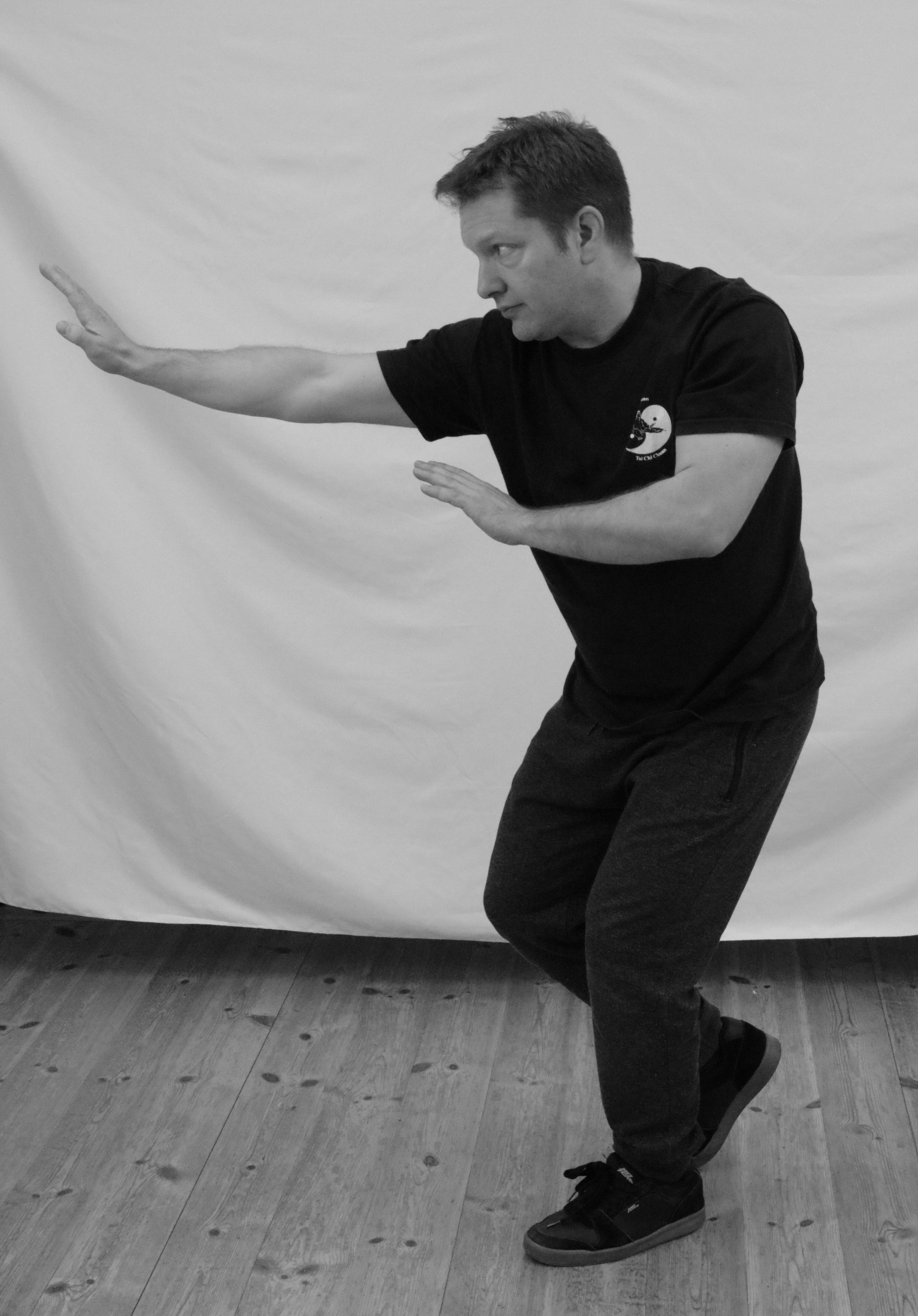
Author, performing Xini Yi Chicken (Ji) posture

If your martial art has forms that are constructed like lego bricks that can be slotted together in any order and still seem to work then it’s pretty simple to concoct a new form. Xing Yi is a good example of a martial art that has this quality. I was always told never to call Xing Yi tao lu by the English name “forms” because the correct term was lian huan which means “linking sequence” for this very reason.

The idea, (in our Xing Yi at any rate), is that all the links you learn are just examples, and you need to be constantly moving towards being able to spontaneously vary them as required, and then ultimately spontaneously create them. This idea has become heretical in the modern Xing Yi world to a large extent because modern Xing Yi has lost a lot of this spontaneous feel it used to (I admit that’s a subjective point) have, and things have become set in stone – forms that were once supposed to be fluid and flexible have become fixed and rigid. Forms of famous masters from the past now tend to be fixed forever. When words like “orthodox” start appearing to describe something you know it’s already dead, or on the way to dying.

But of course, anybody can make up a form, but is it any good? That’s a different matter. And it usually depends on the person doing it, not the moves themselves. With Xing Yi animals you can also ask the question – can I see the character of the animal being used coming out through the moves?

With Tai Chi I find it a lot harder to make up a form. Tai Chi’s approach to a form is quite different to Xing Yi, or other Kung Fu styles. The Tai Chi form tends to be a highly crafted piece of work that has been honed to perfection over many years. It is fixed because you need to be able to forget about the moves and concentrate more on what’s inside. It helps to do that if you don’t have to worry about what’s coming next because you’ve done it so many times that you can let go of that part of your brain and let it be aware of other things.

Tai Chi forms tend to start and finish in the same place for this reason. Usually, anyway. While long forms don’t tend to be balanced on left and right, a lot of the more modern, shorter forms make more of an effort to balance left and right movements.

If you understand Tai Chi and how to ‘pull’ or direct the limbs from the dantien movement then, sure you can make up your own Tai Chi forms, however, there is almost zero history of doing this in Tai Chi circles and it’s not really encouraged. I think this is because Tai Chi has push hands, which can be used as a kind of free-form expression of Tai Chi, completely away from the form and in contact with a partner to give you something to respond to, which is the whole strategy of Tai Chi Chuan, at least according to the Tai Chi Classics it is. To ‘give up yourself and follow the other’ you have to be spontaneous. There’s no other choice!

So, to conclude. I think that’s it’s in its application where the spirit of improvisation and spontaneity can be found in Tai Chi, not in the forms. I don’t think Tai Chi is particularly concerned with creating endless variations of forms and patterns like Xing Yi is, at all. Xing Yi, having a weapons starting point, doesn’t use this hands-on feeling and sensitivity to get started with spontaneity. Instead, it likes to create patterns, then vary them endlessly. Of course, you work with a partner when required, but it’s a different approach. Which is all quite natural, as these are two different martial arts, created by entirely different groups of people in a different locations and time periods.

You might like our Heretics history of Tai Chi and Xing Yi for more on that.


Why I’m a martial arts snob

So, apparently I’m a snob when it comes to martial arts! I must be because on two separate occasions now women have accused me of being one (interesting that it’s women both times!)

A recent exchange went something like this…

Me: Are you going to the seminar with master x this week?
Her: Yes, you?
Me: Yes, but if he teaches a basic hip throw I’m walking out. 🙂
Her: You’re such a marital arts snob! 🙂

As you can see, there were smilies involved, so I don’t think it was meant seriously, but there’s always a grain of truth at the bottom of most jokes.

Photo by Anete Lusina

This got me thinking. I think I am a bit of a snob when it comes to technique in jiujitsu. The popular wisdom goes that after black belt you start to really appreciate the basic techniques and find hidden value in them. Sure, I can see that. It’s true, you do revisit seemingly basic techniques and find things you’ve missed or deeper levels to the technique. But sometimes basic techniques are just… basic. And a bit boring. Show me something new and cutting edge, especially if I’m paying for a seminar!

When it comes to Chinese martial arts (CMA), I’m a snob in a different sort of way. Watching other people do CMA I don’t always express an opinion, but internally I’m very judgy. I find it hard to praise people for a mediocre performance, or even ignore all the bad bits like some people seem to be able to. But equally, when I do see something I like, I’m pretty free with my praise about it.

When watching forms done on video I always try to factor in that “everything looks 20% worse on video compared to real life”, and judge accordingly. But even so, what some people in marital arts deem worthy of sharing with the pubic makes me question their sanity. A lot of it is just embarrassing, but there is something else to look out for…

As I discuss with Jess O’Brien in an upcoming podcast, it can be hard to know what is correct in Chinese marital arts. Quite often, even within the same style, two teachers will have radically different interpretation of the same principles, and they can often both be right at the same time – i.e. they can both make it work. It’s not until you get hands on with a person that you can tell if what they’re doing works, or not. So, it’s usually a good idea to gets hands on with somebody before you criticise them too much.

With that said, I think you do need to be pretty discerning with what you’re accepting as “good” in Chinese martial arts. CMA has always been infiltrated by people who were, shall we say, not very good, but pretended to be so, especially to naive Westerners who can’t tell the difference. Then there are the teachers who hold things back and don’t teach all their skills. There are plenty of ways to waste years in CMA not really learning anything of value.

But what is being a snob? Isn’t it just having high standards? The Cambridge dictionary defines a snob as: “a person who respects and likes only people who are of a high social class, and/or a person who has extremely high standards who is not satisfied by the things that ordinary people like”

OK, ignore the first bit about social class, since that’s got nothing to do with it, but look at the second part. “Not satisfied by the things that ordinary people like”. Hell yeah! I can identify with that.

When it comes to martial arts I think that a snob is a pretty good thing to be. When there are 7 year old kids going around with black belts in Karate or Taekwondo, I’m quite happy to hold myself to higher standards. Most ‘self defence’ videos you find on YouTube are laughably bad. And a lot of Tai Chi videos appear to be cult-like and weird.

If this is what ordinary people think martial arts are, then yes, I’m a snob.

Imposter syndrome and martial arts

I’ve been delving into the depths of imposter syndrome and how it relates to martial arts recently. It started when we had Dr Marc Reid of the Reid Indeed podcast and author of “You are not a fraud” on our Heretics podcast last week.

It was a great interview – one of the best episodes we’ve done, I thought. I’d never really thought much about Imposter Syndrome before, but once we had Marc booked as a guest I realised it was a great opportunity to discuss how it relates to martial arts, and that it was actually something that has been on my mind for quite a while.

I think every martial artist must deal with imposter syndrome to some extent. But, as I learned in the podcast, having a little bit of imposter syndrome can actually be a good thing for your development, as it allows you room to grow and stops you thinking you know everything.

The question, “am I really good at this?” Is one that I think plagues all long-term martial artists… after they get good enough at their art that it becomes a question worth asking, of course.

One thing that’s quite common to see, especially in Chinese marital arts, (where entering competition or testing against resistance is often frowned upon, as it prevents “lethal” techniques being used) is the ‘master’ demonstrating only on his own students who are literally throwing themselves on to the ground for him, at the lightest of touches. I mean, we’ve all seen Aikido demonstrations, right? I often wonder what’s going through the mind of the ‘master’ in those situations, because they must know they’re a fraud, yet they carry on as if they are unbeatable. But I guess that so long as they never out themselves in a situation where they will encounter any real resistance they will be! In a way, it’s almost like the performance of a magic show, and the students are subtly required to play along by the group dynamic by the magician performing his tricks.

Sadly, we’ve all seen the videos of what happens when these ‘masters’ try their tricks on tough people from outside their group who are not going to play along. Of course, not all Chinese marital artists (or Aikido schools) are like this. I need to say that now because otherwise you just get tarred with the “hater” brush.

One of the things that attracted me to BJJ initially was the live sparring. You get to ‘test’ your ability every class, since half the class is usually live sparring. You can see exactly how good you are compared to other people. I love that real, live, feedback – I guess you could call it direct contact with nature because you are experiencing what happens against a live person who is not just going to play along in the same way that somebody who thought they were good at running could try a long distance, or a weight lifter can try lifting a heavy weight.

BJJ sparring has a limited rule set, yes, there’s no punching or kicking, for example, but within the confines of that ruleset you can really go 100% and see what happens. As a tool to keep your ego in check, I think it’s invaluable. (Not that you want to be going 100% every roll, of course).

But even within BJJ there are opportunities for the imposter syndrome to sneak in in other, more subtle, ways. There are belts that get awarded as you progress, and to this day it’s rare for me to find somebody who has just been promoted who thinks they are worthy of the belt they’ve just been given – everybody feels a little bit like a fraud, even with all the live sparring going on, or even entering competitions and testing yourself against people of the same belt rank and age from other schools. Competing is time consuming and expensive and not everybody competes and you can start to worry that you are only good within the confines of your own school.

Bruce Lee had a lot to say about belts “Belts are only good for holding up your pants” was, I think, one of his. I remember that and “boards don’t hit back” being another classic Lee quote from Enter the Dragon. But it’s an interesting perspective – all this worrying about belts and being an imposter is completely in your own head – in realty, belts don’t matter, all that matters is what you can do.

That’s one of the reasons I make an effort to get out and train with other BJJ people whenever the opportunity arises, like at the recent 40+ Grappling event I went to. I get to mix with a range of belt levels, all from different schools.

Getting out there and mixing it up can certainly do wonders for quashing any imposter syndrome that might be building up in your head. Even if you don’t necessarily ‘win’ all the time, I find it really rare that any BJJ practitioner isn’t up to the level their belt suggests. BJJ belts tend to only get awarded when an instructor thinks you’re ready for it. Trust your instructor. They’re usually right.

There are also plenty of complete frauds in martial arts who are clearly running some sort of con. Fake black belts in BJJ tend to get found out pretty quickly, but the marital arts is a very unregulated profession and anybody can set up shop at any time, claiming whatever qualifications they like. If any serious martial arts practitioner compares themselves to these genuine imposters it’s pretty easy to realise that you’re not the imposter you might think you are.

The opposite of the impostor syndrome of course is the over confidence of the person who is slightly, or perhaps very, deluded about their own abilities. I’m sure we all know people who talk a good game (especially on the Internet), but if you ever see them move or demonstrate something they can’t hide their actual true ability, or lack of it.

So, maybe feeling like a bit of an imposter sometimes is actually good for you, and stops your ego taking control and turning you into one of these untouchable master types. I notice all the time when I’m teaching that people will try very hard to put you on a pedestal. To be honest it happened much more often when I was teaching Tai Chi compared to teaching BJJ, but it still happens. I’m very aware of people’s attempts to turn me, the teacher, or me the higher belt into some sort of idol and I try and stop it happening before it starts. A good start is to reject people calling you special Chinese titles like Sifu or Laoshi, (I’m not Chinese) in Tai Chi and in BJJ it’s a custom to call your teacher a Professor (Portuguese for “coach”), but I try and discourage that where I can. I’m happy with just my name. That’s my personal choice, and not a judgement on other people who may have very good reasons for using those titles. They can do what they want.


The Power of Chi – Damo Strikes Back!

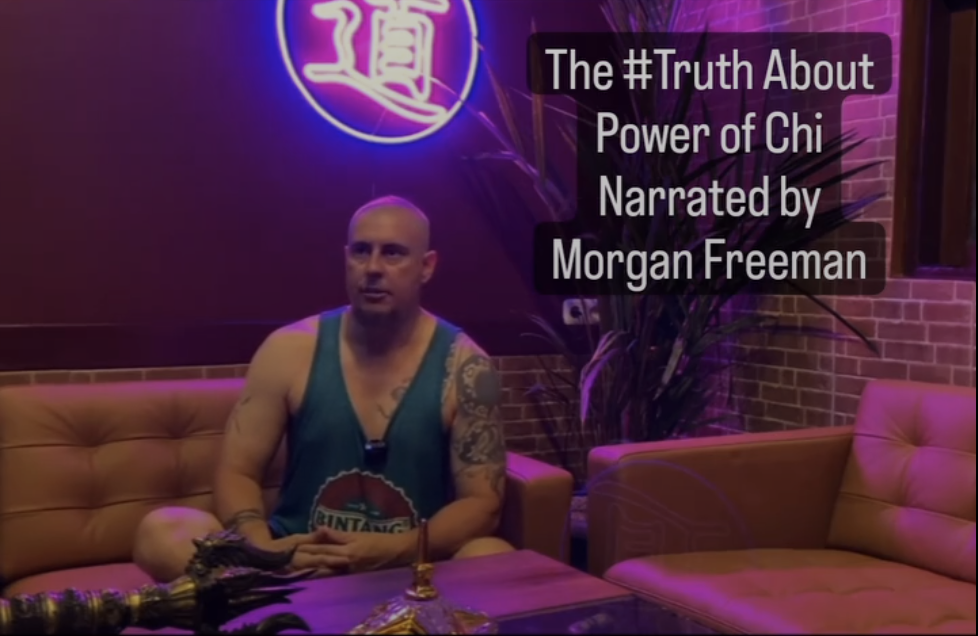
Notable Tai Chi teacher, Damo Mitchell, just released a new video with Adam Mizner where he addresses some of the controversy over The Power of Chi documentary that is worth watching, if you care about these sorts of things. 

Damo Mitchell and Adam Mizner are a couple of the most well-known modern Tai Chi teachers on the seminar circuit, both of whom have a lot of followers on social media, and large organisations of students behind them. The Power of Chi was a movie where Adam Mziner demonstrated his chi/qi on a number of athletes from various sports. The movie has since mysteriously disappeared from the Internet, as far as I can tell, but the trailer is still on YouTube:

You can see from the start of the clip where Damo’s thinking is at (around the 4 minute mark) – the reason people criticise the movie, or himself and Adam, is because they are jealous of how well he and Adam are doing and that the people who criticise them have less followers so are below them and it’s therefore wrong to “punch down” by replying to them. These low level people also “are not in a good space mentally”’.  His other point is that the movie was not made by Adam, he was just a paid performer in it, therefore everybody’s criticism is misplaced.

Well, talk about missing the point entirely!

At no point does he address the central issue I and many others had with the movie – that all this “chi” stuff is nothing to do with chi/qi!  

Now, I’m not egotistical enough to think that Damo is addressing this video specifically to me, but my original post about the documentary is still there for everybody to read. As you can see, I said I thought the whole thing was a bit silly. That’s about the worst of it! 

You can decide for yourself if that means I am racked with jealousy about how many students Adam and Damo have, and how great their lives are… I really am not even playing in the same league as Adam and Damo – they are professional Tai Chi teachers making a living off this, I’m not. I have a real job, and just run this blog in my spare time for fun. It’s the same with my podcast. But that doesn’t mean I’m not serious about my practice.

The other thing I did in my original post was link to my friend Rob Poyton’s video response to the trailer showing how all the supposed Chi feats in the trailer were really done – which I thought was quite cool, but seems to have really put the cat amongst the pigeons. I mean part of the attraction of seeing a stage magician is working out how the magic is really done, right? 

Rob Poyton explaining how to do the feats seen in The Power of Chi movie.

Now that video by Rob seemed to raise the ire of many of Adam’s followers (who posted in the comments section of my blog, which are still there and you can read) who replied with such gems as this:

“I’m disappointed in your entire take on internal power, as indicated by your dismissive way of talking about those who actually do possess some genuine internal power as using “tricks”. To be blunt, you’re just ignorant–that is, you have no personal experience with real practitioners and assume everyone showing such power must be a charlatan. “

“Why do you have a website about Taiji (that’s the correct pinyin spelling btw) when you’ve never met any of the top taiji practitioners – and refuse to meet them before publishing negative theories about the limits of the art? So the best explanation to you is that the top practitioners in the world who have trained thousands of students are merely liars with fake reviews from professional athletes and professional teachers?”

“So you did not see the move, or met anyone in the movie to experience this skill/ attribute first hand. Kind of strange to have such strong opinions on something you have no experience in….”

You can see from the comments that the followers of Adam and Damo really do believe that the feats presented in the movie, The Power of Chi, are real demonstrations of chi power, (or Qi power.) Again, that’s my issue with all this stuff, not that they’re making a good living off teaching Tai Chi.

As a complete co-incidence Rob just released another clip in the last few days, this time about the subject of Empty Force, that’s also worth a watch, and will undoubtedly upset all these same people all over again, for exactly the same reasons:

There’s a long history of the Tai Chi magician. Empty Force is something that the Tai Chi Magicians of the world engage in regularly, and once again, I think it’s cool that Rob is posting a video showing how it works.

As for Damo and Adam, I hope they keep enjoying their cocktails and cigars – they seem to be having a great time, hidden away in all that smoke, being Tai Chi Gurus. I’m not jealous that we have very different lives at all. I wouldn’t trade mine for anything. Spending a month on a retreat in Thailand training Tai Chi full time, (let alone a year!), sounds like absolute hell to me. I’m sure it would send me potty! I’d rather be with my family, friends and pets, thanks. 

It looks like Adam and Damo have some real skills in Tai Chi push hands – I’m not doubting that. After all, they’ve had years training full time to get good at this stuff, so they better have something by now. But as with everything in the internal arts – it pays to keep your feet firmly on the ground.

For me the latest video from Damo and Adam is just another fascinating glimpse into how the mind of a Tai Chi Guru works.