A quick shout out to my friend Rob Poyton of Cutting Edge Systema, who has started a new blog, which hopefully he’ll update regularly.
Starting with a background in various martial arts Rob moved into Tai Chi, then later discovered Systema, the Russian system, and quickly converted. I’ve always been impressed with the practical and down to earth way he approaches training. He’s also very generous with his information and produces lots of videos showing the sort of work he gets up to. Whatever they do, it always looks like they’re having fun, which is a lot more important that you’d imagine in martial arts!
Anyway, his most recent post is about reality in training and contains this great quote:
“Ultimately though, if you want your training to be “real” I suggest you work on a behavioural level. Rather than learning some techniques, or even working on the principles behind the techniques, you train in such a way to make your work something you are rather than something you do. Under any kind of stress, your breathing works as it needs to – rather than you going into a breathing pattern. Your body responds to hostile contact as it would a hot object. No thought required. No plan or technique, just appropriate action. Freedom of thought and freedom of movement go hand in hand. Not clouded by assumptions, fear or agression, just doing what needs to be done. Training in this (Systema) way develops faith in the body, leaving your mind free for other things. Not blind faith, but faith developed over a wide and deep range of training which challenges us on all levels.
It’s difficult to overstate the benefits this has on our overall life. Whether applied tactically, combatively, sporting, or just everyday living, your training becomes reality and reality becomes your training. The world is your gym. No constructs, no wishful thinking, no fooling ourselves, but a powerful way of dealing with life as it unfolds before us.”
Tai Chi contains advancing and retreating movements, combined with circling left and circling right. Of course, in Tai Chi all movements need to be powered by the dantien. That’s easy to say, but on a practical level, how does this work?
One way I like to think about this is that as you retreat you can think about the arm movements being pulled by the dantien and as you advance they are pushed by the dantien. You can think of ‘rollback’ and ‘press’ from the Yang Tai Chi form as being a good example of this. As you shift the weight backwards in rollback you can imagine ropes attached from your dantien to your hands that are gently pulling them as the dantien moves. Rollback is usually performed with a turn of the waist to the side as you do it, so rather than being pulled completely in towards you, the pulling makes the hands go past you and ready to circle into the next movement… which is ‘press’. At this point you can imagine the ropes snap hard and become ‘rods’, which push the hands away, so the ‘press’ is powered by a pushing from the dantien into the hands. It looks like this:
In all of this your shoulder joint is moving, and power is going through it, but the key thing is that it is not the source of the power. The power source is the triangle formed by the two feet, legs, kua and dantien. The power goes through the shoulder to get to the hands, and if you tense the shoulders then you stop the flow.
Of course, these ropes and rods I’m talking about don’t actually exist, but they do give you the idea of a kind of pressure that is either pulling or pushing your arms and hands, which I think is useful. Once you use reverse breathing to pressurise your body you can start to feel this push and pull in the arms and hands. This isn’t imaginary, it’s a genuine feeling.
If you stand in a relaxed stance you can feel the pressurisation that reverse breathing gives you. Pick the classic ‘hold the ball’ Zhuan Zhang position, then stand for a few minutes while doing reverse breathing*.
You need to feel a connection all the way to the fingers and toes that’s connected to the breathing. It should feel like a slight pressure. Then try to get the feeling of pulling that connection in towards the dantien on an in breath and pushing out towards the fingers on an out breath.
The usual disclaimers apply to any type of work with pressure in the body – don’t do anything crazy with the pressure – you don’t want to tear anything in the body, and don’t direct it into your head. That way lies madness, or at least a pretty decent headache 🙂
(* All breathing in Tai Chi is done lower in the body than normal, so that the diaphragm extends downwards when you breath in, as opposed to the chest expanding. In ‘normal’ Tai Chi breathing the abdomen expands as you breathe in, in reverse breathing you change this around so that you contract your abdomen as you breathe in – this creates a kind of pressure in the body, that you can then use to power movement.)
Once you have a handle on the feeling of being pushed and pulled you might like to experiment with a basic arm wave silk reeling exercise – as the arm moves away from you it’s the ‘push’ from the dantien, and as the arm circles back towards you, you are looking for a basic ‘pull’ from the dantien. You need to maintain the pressurised connection at all times.
Here’s Chen Xiao Wang showing some silk reeling exercises – he starts with the basic single arm wave. Unlike me, he’s an actual expert, so pay close attention.
Of course, there’s more going on than this in Tai Chi, but as a basic fundamental it’s a good place to get started. Going back to the example of rollback and press – it’s a good section of the form to work with as both hands move in the same direction. Other Tai Chi movements, like Repulse Monkey for example, are more complex, with one hand going towards you, – a ‘pull’ – and the other going away from you – a ‘push’. Of course, it’s easy to mimic the movement on a surface level, but you need to be doing it from the inside. For now I’ll leave it up to you to think about how Repulse Monkey might work when it’s powered from the dantien.
This could change the way you do martial arts forever
Now, this is interesting. Esther Gokhale has created a method of sitting and walking that she claims will restore your “primal posture”. As you’d expect there’s a book, a DVD, a six-lesson course you can go on, and associated paraphernalia (like cushions) that you can spend more money on, etc, but you can actually get the core of the information for free by watching talks she’s given, like this one at TEDx. If you watch the following video you’ll get the background to what she’s talking about, plus she shows you how to sit in a chair using the method.
I’ve tried it, and I have to say, it makes sitting in a chair way more comfortable than usual for me. I find I can also stay there. Using her ‘sitstretch’ method I lose the urge to fidget around that I normally get when correcting my posture. The slight stretch on your lower back that the method gives you is actually kind of like having a hot bath – very relaxing and restorative.
There are lots of other videos on YouTube for different aspects of the method – like lying and walking. The method is based on observation of tribal people and how they don’t tend to have back pain, and move with a natural grace that we lose as soon as we become ‘civilised’ and live in larger groups in cities.
One idea is the ‘J spine’ – that the spine should be relatively straight, without a large lumbar curve that was associate with an ‘S’ shape.
The J spine in ancient Greek statue.
One tip she gives for keeping this spinal alignement throughout activities is to imagine you have a tail behind you, and you want to keep it behind you and pointing ‘up’. From an evolutionary point of view, this makes sense. Human foetuses actually have a tail, until at some point in our development in the womb it shrinks back into the body.
It’s interesting to apply this idea to Tai Chi, which has long been associated with ‘tucking the tailbone’. I’ve always thought of it as ‘centre’ the tailbone myself, which means that you basically relax the lower back. In fact, the Internet is full of people who have suffered health problems due to excess tucking of the tailbone in Tai Chi practice. There are a lot of people who seem to think that ideally you should form some sort of ‘c’ shape with your spine when doing Tai Chi. I’m of the opinion this is a misunderstanding.
From the classics:
When the tailbone is centered and straight,
the shen [spirit of vitality] goes through to the headtop.
The spine on the right is from an older medical textbook, before the idea of the ‘S’ shape.
Static stretching vs dynamic stretching – which is best?
I’ll be the first to admit that stretching isn’t the most exciting topic for most people, but it’s kind of important, so I should cover it. Plus, I’ve recently found a video by Ryan Hall that gives some extra insights into common stretches we do before BJJ:
Ryan gives some really valuable little tips on how to do each stretch correctly. Since you generally learn these stretches by just following along in class, with little to no additional information, it’s all too easy to miss the little details. For example, the first stretches he shows are the shoulder stretches you do by pulling the arm across the body (see 9.08 in the video). These are really common stretches used in all sorts of sports, yet the little detail he gives that you should be taking the shoulder down and back while pushing the chest out as you do them makes all the difference. Now you’re actually working the shoulder joint, which is the point of the stretch. Just yanking the arm across the body on its own won’t do squat.
Look at the ‘sprinters stretch’ at 24.26 – everybody I know will reach for that foot (including myself) but as Ryan points out, the point of the stretch is to get really comfortable getting your head to your leg – that’s where the focus needs to be.
What’s also nice about the video, is that Ryan puts each stretch in context – so you can see where it fits into BJJ as a whole. So, he’ll show you why it’s useful to be flexible.
And yet, he’s doing it all wrong. We all are. Or are we? You need to decide this for yourself after reading the latest research into dynamic vs static stretching, which I’ll point you towards here.
Ryan is showing what are called ‘static’ stretches, where you move into position then hold for 10 seconds. The current thinking is that ‘dynamic stretches’ are a better way to warm up. Dynamic stretches don’t involve holding the position at all, you simply take the joint through a range of motion, without holding the position at any point.
The reason of why dynamic stretching is better for you as a warm-up (than static stretching) seems to come down to two things. Firstly, the purpose of a warm-up is to warm the muscles and tendons, ready for the work that’s about to be done. In martial arts the work that is about to be done doesn’t usually involve holding stretched positions in extended periods (although if you’re getting stacked in your guard in BJJ, then it might!) Generally though, we’re about to use our muscles in an explosive way while putting our joints through their full range of motion. This is very different to the experience of a static stretch.
The second part is to do with the Golgi tendon receptor. This is a nerve which is found inside every tendon, and tells the muscle to relax and switch off to avoid it getting injured. So, if your bicep is under load and at full contraction for more than 5 seconds, the Golgi tendon receptor will make it relax, so you don’t tear anything. It’s this nerve which gets activated in a static stretch lasting more than, say, 5 seconds, essentially tricking it into relaxed the muscle further than normal, which means you can stretch further, but it also means the muscle can lack up to 20% of the power it had before it did the extra stretch (because you need tension to create power).
There have also been various studies performed which show that static stretching as a warm-up does nothing to help athletic performance, and in some cases actually diminishes it.
I think it all comes down to how you view the warm-up. If it’s simply to prepare your body for the work to be done, then dynamic stretching makes sense. However, you’re not going to dramatically increase your flexibility with dynamic stretching. So, in an ideal world you’d have both – the dynamic stretch before the activity, as a warm-up, then the static stretch as a cool-down afterwards.
A good source of information on stretching for athletic performance is sports coach Brian Mac, who has a website packed full of articles, like these ones, which contain the following quotes:
“Contained in the tendon of each muscle is the Golgi tendon receptor. This receptor is sensitive to the build up of tension when a muscle is either stretched or contracted. The receptor has a tension threshold that causes the tension to be released when it gets to high. As the Biceps contracts and the threshold is exceeded then a signal is sent to the Biceps causing it to relax. This mechanism prevents damage being done to the Biceps should the weight be to heavy or the movement is to fast.”
Conditioning: How does static stretching affect an athletes performance?
“In conclusion, in most cases static stretching before exercise reduces an athlete’s power and strength. If the athlete participates in power or strength exercises acute stretching may not be recommended. “
“This suggests that dynamic stretches, slow controlled movements through the full range of motion are the most appropriate exercises for warming up. By contrast, static stretches are more appropriate at the end of a workout to help relax the muscles and facilitate an improvement in maximum range of motion.”
The ‘Master of Movement’ has a healthy respect for the ‘internal’ Chinese martial arts
If you follow what’s become known as ‘movement culture’ you’ll be familiar with the name Ido Portal, and his brand of movement-based exercise/philosophy called The Ido Portal Method. His method is a kind of freeform, soft-gymnastics influenced by everything from Yoga and Parkour to martial arts (specifically Capoeira), and it’s become popular in the exercise world thanks to videos that show Ido in amazing physical shape performing the sorts of athletic feats normally associated with comic book superheroes like Deadpool or Spider Man. His movement practice looks like this:
Ido recently moved out of the shadows of movement culture and into the mainstream when he appeared with the then UFC interim lightweight title holder Conor McGregor at the open workouts in Las Vegas, before UFC 194 Aldo vs McGregor. Open workouts are a chance to showcase the skills of a fighter and usually consist of demo-mode displays on the pads, followed by a bit of wrestling and groundwork. As well as some of this, Conor’s open workout featured appearances from Ido, who led Conor through a number of unorthodox arm-swinging, rolling and stick drills that left most of the world’s MMA media baffled. They hadn’t seen anything like it before, and therefore didn’t know what to make of it. Here’s a video of Conor’s open workout, followed by Aldo’s so you can see how different they were:
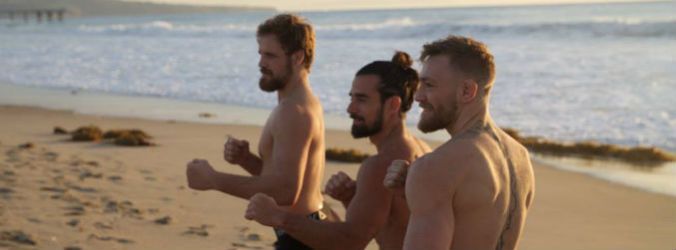
Ido worked with both Conor McGregor and Gunnar Nelson in the week before the UFC. While Gunnar Nelson went on to lose his match he put up brave resistance against a dominant (and more experienced) Demian Maia for three rounds, and avoided the submission. Conor went on to KO Jose Aldo with one perfectly placed punch and became the undisputed UFC Lightweight champion. In that instant Ido’s name and movement culture went global. The fight went down like this:
There’s more video available of Ido working with Conor and Gunnar in the run-up to the UFC. As you can see, it’s primarily about ‘movement’:
and
(As an aside, another thing Ido does really well is have fantastic soundtrack songs for his videos. Note: The amazing acoustic cover of The Black Key’s Lonely Boy by Matt Corby is one of my personal favourites 🙂 )
How much of Conor’s victory was down to training with Ido in ‘movement’ is unclear. He’s been a fan of movement culture for a long time, but it should be stressed that Conor would have been through his usual training camp before Ido was brought in for the last week, which is after all the hard work has been done. In the last week a fighter generally just needs to keep loose and work on his weight-cut. This would have fitted in perfectly with Ido’s routine, which relies more on relaxation and keeping moving than on lifting heavy weights.
If you want to know what on earth they’re doing with that stick in the video then a good primer on what Ido’s work is all about is his latest interview on London Real, in which he talks about his training philosophy and working with Conor. He also shows what he’s doing with that stick:
Another good source of information is the Movement Culture Facebook group. In a recent thread on the group somebody posted a video of an ancient Indian martial art called Kalaripayattu, which is rather grandly titled, “The Origin of all Marital Art”.
The classic story of the origin of Chinese martial arts is of the Buddhist monk Bodhidharma coming to China and on finding the monks in poor physical condition instituting a practice of physical exercise and martial arts, founding the first Shaolin Temple. The ancient fighting style of Kalaripayattu is therefore one possible origin for the Chinese martial arts. In fact, if you look at the 2-man form at 3.08 in the video it looks a lot like a 2-man Northern Shaolin fighting form I used to practice, a version of which is here:
However, all these claims and stories lack evidence. It’s not entirely clear who shared what with whom, and in which direction the information sharing went. Either way, Ido (who has by his own admission researched an incredible amount of martial arts) remains unimpressed with the movement quality he’s seen in Kalaripayattu, especially when compared to the Chinese Neijia (internal family) arts. Here’s his response to the video:
I appreciate his candour, and I agree with him, Kalari may be old, but the ‘movement quality’ shown in the video doesn’t compare to kind of things you can find in Chinese martial arts. It’s especially nice to see his appreciation for the internal arts, which makes me wonder if we’ll see their influence seeping into MMA at some point.
We’re at an exciting juncture in MMA right now. As discussed in a recent Joe Rogan podcast with MMA analyst and commentator Robin Black (see video below), MMA is transitioning from an era where the mantra had become “Boxing, Wrestling and Jiujitsu is the answer to everything” to a world of new possibilities, as exemplified by newer, unorthodox, fighters like Conor McGregor and Stephen ‘Wonderboy’ Thompson who have successfully introduced elements from traditional martial arts, like controlling the distance with kicks, that can catch out a seasoned wrestler/boxer who is not used to that sort of movement.
The best example of new meets old is perhaps Stephen Thompson’s most recent win against high-calibre opponent Johnny Hendricks, who he made look surprisingly ordinary by controlling the distance and utilising his kicks, until getting the KO in the first round. Instead of standing ‘in the pocket’ to trade blows as Hendricks would have liked, he moved in and out with ease. You can watch it here:
A one-time title holder himself, Hendricks had previously taken UFC Welterweight Champion Robbie Lawler through two five-round wars of bloody destruction, only just missing out on the win each time, but faced with somebody who wasn’t going to ‘stand and bang’ he looked lost.
It’s this sort of movement skill that’s the crossing-over point of mixed martial arts and movement coaches, and Ido Portal is definitely not the only person integrating the two worlds. Another person to look out for is Erwan Le Curre of Movenat, who has greatly influenced UFC fighter Carlos Condit, as you can see in the following video:
So, the interesting thing to me, as somebody who has a deep involvement in Chinese martial arts, specifically the Neijia, is what could those arts bring to the table for mixed martial arts?
I’d like to be able to say that going towards the refined Neijia movement would be the natural evolution of MMA, as it moved from its slug-fest beginnings to more evolved fighting techniques, however MMA evolution doesn’t work like that. It’s too simplistic to see it as an evolution from thuggish, brutish origins, to the more refined and technical fighters of the modern age. Sure, the early UFCs featured many pugilists who were more brawlers than anything else. And in contrast, today’s modern MMA fighter is a hugely technical martial artist, who needs to be well-rounded in several fighting disciplines, but the beginnings of the UFC were also characterised by victories obtained via a very, very technical martial art that didn’t require huge levels of athleticism, in the form of Brazilian JiuJitsu. So, while the evolution of MMA isn’t the nice, upward directed straight line starting at “brawling” and ending at “technical” we’d like to see, if we were going to make some sort of convincing argument for ‘more technical’ as being the final destination, things definitely are improving in terms of technique in all areas simultaneously – it’s just that we didn’t start from a level playing field for all the different areas that make up the modern fight game.
Kung Fu has plenty that can be added to MMA in terms of techniques, as I blogged about recently. What the Neijia can add specifically is a lot more subtle -it’s more about using your body as one unit to produce power, but as Ido Portal’s interest in the subject has shown, it is also about improving the quality of your movement, and that can’t be a bad thing for any fighter.



 The Tai Chi Notebook