Warrior scholar: A Jack Slack primer

This guy has been killing it for so long as a martial arts writer, that if you don’t know about him, then you need to know about him…

JohnClark

This is John Clark, not Jack Slack, but that’s besides the point

One of my favourite martial arts writers. Ok, my favourite martial arts writer, at the moment is the one who goes by the nom de plume of “Jack Slack” and he writes for Fightland. His name is a tribute to bare knuckle boxers of yore, but his analysis of modern fights is bang up to date. Jack’s speciality is breaking down the games of modern MMA fighters with one eye on the past, so he can pick up where techniques have originated, where slips and feints first came to prominence and who were the known Southpaws of their day in boxing, wrestling, judo, jiujitsu, karate, you-name-it-he’s-probably-watched-it tournaments since the year dot.

While most MMA articles consist of nothing but vacuous gossip about which fighter might have failed a drugs test, or who said what to who, Jack gets down to the meat and bones of fighting. Reading his stuff makes you smarter – you’ll learn something every time. He’ll show you how Conor McGregor makes his opponents look stationary, how Anderson Silva can move in bullet time and why Ronda Rousey lost so badly to Holly Holm. In short, he’s a ring craft specialist.

Jack grabbed my attention again recently with a left of field article on animals fighting – in particular how the Mongoose is nature’s greatest outfighter, and, typically for a Jack Slack article, it contains a great quote:

“There is a famous line in the Bubishi, the ancient Chinese text that shaped the way karate developed on the island of Okinawa, relating to the generation of power through the use of weight. It remarks that the tiger does not bring down its prey with its claws, they are just the instrument through which it applies its weight.”

You see? I told you you’d learn something interesting. Just think about that quote in relation to Tai Chi… In fact the whole article is about watching the ways that animals hunt and fight, and what we can learn from them, which is something most traditional martial arts are based on, particularly XingYi.

If you’re not familiar with Jack’s work then here are some of my favourites from his most recent articles for you to get acquainted with (the old ones are good too, but a lot of the image gif links are now broken):

Why Garry Tonon Is the Most Exciting Man In Grappling
Garry Tonon is the hottest commodity in grappling and he might be coming to MMA. We take a look at some of his best moments.

Rebuilding the Web: Anderson Silva’s Shot at Redemption
Anderson Silva is coming back to England for the first time since his Cage Rage tenure and it’s a huge deal. And you know what is even more interesting? Michael Bisping might just beat him.

Stephen Thompson and the Wonderful Art of Head Kicking
Four years after he lost his second fight in the UFC and was written off as just another striking savant who couldn’t grapple, Stephen Thompson had worked his way up to the welterweight top ten. We take a look at the techniques and tricks of the Wonderboy.

Wushu Watch: Lessons to Learn from Aikido
Aikido is the punchline of every joke in MMA but maybe there’s something more to it. We examine the flaws and principles of the Japanese martial art.

The Path of Conor McGregor: Rising Through the Ranks
After winning two belts in Cage Warriors, Conor McGregor was signed to the UFC. His first UFC fights did more to make people talk than anyone in UFC history as he climbed from the preliminary card to the main event in just three bouts.

He’s also started a videoblog called Ringcraft. Check it out:
Your kung fu demo doesn’t look like fighting, and I don’t care

Very rarely does a kung fu demo look like real fighting, but so what?

kung-fu-77875413538

Chinese martial arts have a strong connection to what we (by which I mean people in Europe and America) would call ‘theatre’. All kung fu styles have some sort of performance element built into them. Historically a lot of kung fu styles were practiced by Chinese Opera performers, or have links to religious rituals, which became hidden inside Kung Fu styles. I’ve written about this before with respect to Tai Chi and its strange preoccupation with the Taoist Chang Sang Feng.

From the modern view point it’s easy to laugh at this idea, sine we tend to think that martial arts have one purpose – for kicking butt! But I think it’s valid to ask why do almost all Chinese Martial Arts contain so many solo forms if they’re not meant to be performed and appreciated as a performance? Compare it to something like Brazilian JiuJitsu or Wrestling – these arts don’t contain any solo kata or forms anymore, because they’re really just focussed on fighting techniques and conditioning. Sure, forms build up stamina, which is conditioning, and train techniques, and the flow of movements, but a lot of this could easily be done more effectively by repeating individual techniques over and over. Instead, in Chinese Marital Arts, they get put together into a (often highly stylised) form.

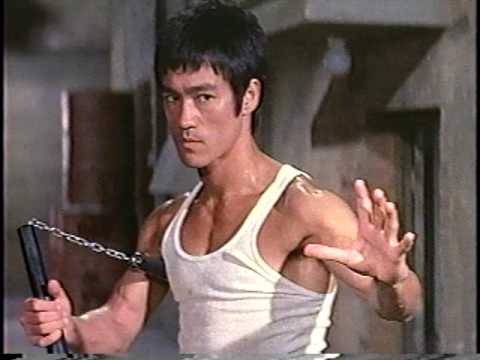
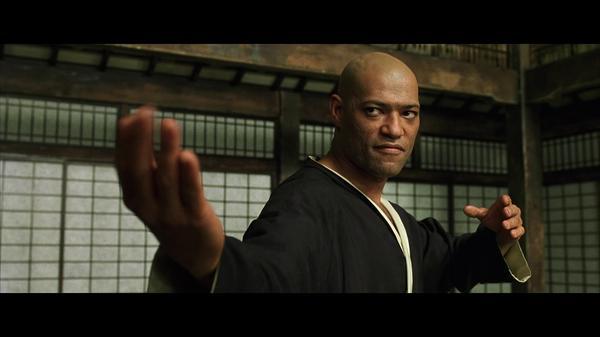
It’s no surprise to me that the kung fu film industry is so big, and has also crossed over into Western cinema, first with Bruce Lee and Enter the Dragon, and recently with Crouching Tiger, Hidden Dragon and The Matrix. It’s because kung fu has always been designed to be performed partly as theatre, making cinema its natural medium.

hqdefault1

Kung Fu teachers back in the 1970s when kung fu started to take-off were well aware of this ‘for show’ element to the arts, and didn’t think it was anything to be concerned about.  Some techniques were ‘good for show’ and some were ‘good for real use’, and your teacher knew the difference. Of course these days we’re in the era of the YouTube generation, so when a Kung Fu demonstration, with its flashy techniques done against minimal resistance, crops up for discussion there’s an immediate cry of ‘foul!’.

Take this video of a Choy Lee Fut demonstration, which got posted on RSF recently:

The teacher moves well, and clearly has a grasp of using the big swinging techniques of Choy Lee Fut, and demonstrates them with speed and efficiency, which is presumably the point of the demo, but it was instantly greeted with cries of “That was awful”, and “I liked how the camera shakes at some points. Real dragonball effect. Only one question …. why is it none of the “attackers” have their hands covering their heads? Ok one more. Why can they throw 2+ punches or kicks like he does?”

Because of the huge interest in MMA, which is probably as close to actual fighting for entertainment as we can get and still be relatively safe for the participants, everybody has at least some idea of what a fight actually looks like, so we’ve now got people looking at Kung Fu demonstrations questioning why it looks nothing like a fight. This is a good thing, because I get the impression that back in the 1970s and 1980s people thought this was what real fighting should look like. Then the UFC came along in 1993 with a healthy dose of reality that blew everybody’s perceptions out of the water. Sure there’s the usual ‘but that’s not the reality of the street’ and ‘but what about knives?’ objections, but I think they’re missing the point. Fighting looks like fighting. It’s scrappy and messy, and always will be.

These days I’m finding it harder to care that the polished, perfect kung fu demos we’re used to seeing don’t look like real fighting, and I’m just happier to accept them for what they are. Kung fu has evolved over many generations into an art that contains performance related elements, and that’s just the way it is. I’d rather just enjoy the performance and not worry about it being too ‘real’, because that’s what you’re meant to do.

I’m writing this on International Women’s day, so I’m going to end this post with a clip demonstrating that women have a long history in kung fu films, and were violently kicking mens’ butts years before things like ‘trigger warnings’ existed. Let’s not forget that. Here’s to the ladies of kung fu!