“The origin of internal arts” is probably what I’d have called this really interesting podcast with Peter Lorge about the history of internal martial arts, however Kung Fu Genius decided to name it “Chinese Martial Arts History is Mostly FAKE” because, well, it probably generates more clicks, or something. Anyway, Lorge turns over a few sacred cows here, and I also liked what he had to say about BJJ.
Have a listen:
I think Peter makes a great point about all these different ‘internal’ things throughout Chinese history all definitely existing, but all being completely separate and unconnected until the 1920s Guoshu Institute needed to create the category of “internal” to exist in opposition to shaolin and external, so it brought them all together. (The gentleman whose name he forgets when talking about this is obviously Sun Lu Tang.)
I do wonder if instead of looking back for mentions of “internal” throughout Chinese history a look back for the phrase Liu He “six harmonies” would make a better connection between the dots of Chinese martial arts history. While the term “Neijia” may not appear very often pre-1920s, Liu He definitely did. If we’re looking at how we got where we are today, then that’s probably a better bet.
Here’s my latest podcast! Mantis boxing, BJJ, Self Defence and heresy in martial arts with Randy Brown.
Randy Brown is a Mantis Boxing and BJJ black belt coach teaching in the USA. In this podcast we explore how Randy has reworked his Mantis Boxing to explore the grappling potential hidden in its forms and how they can interact with his Brazilian Jiujitsu. We talk about a range of subjects including self defence vs sport, weapons vs barehand and how to turn dead systems into living arts again.
So, apparently I’m a snob when it comes to martial arts! I must be because on two separate occasions now women have accused me of being one (interesting that it’s women both times!)
A recent exchange went something like this…
Me: Are you going to the seminar with master x this week? Her: Yes, you? Me: Yes, but if he teaches a basic hip throw I’m walking out. 🙂 Her: You’re such a marital arts snob! 🙂
As you can see, there were smilies involved, so I don’t think it was meant seriously, but there’s always a grain of truth at the bottom of most jokes.
Photo by Anete Lusina
This got me thinking. I think I am a bit of a snob when it comes to technique in jiujitsu. The popular wisdom goes that after black belt you start to really appreciate the basic techniques and find hidden value in them. Sure, I can see that. It’s true, you do revisit seemingly basic techniques and find things you’ve missed or deeper levels to the technique. But sometimes basic techniques are just… basic. And a bit boring. Show me something new and cutting edge, especially if I’m paying for a seminar!
When it comes to Chinese martial arts (CMA), I’m a snob in a different sort of way. Watching other people do CMA I don’t always express an opinion, but internally I’m very judgy. I find it hard to praise people for a mediocre performance, or even ignore all the bad bits like some people seem to be able to. But equally, when I do see something I like, I’m pretty free with my praise about it.
When watching forms done on video I always try to factor in that “everything looks 20% worse on video compared to real life”, and judge accordingly. But even so, what some people in marital arts deem worthy of sharing with the pubic makes me question their sanity. A lot of it is just embarrassing, but there is something else to look out for…
As I discuss with Jess O’Brien in an upcoming podcast, it can be hard to know what is correct in Chinese marital arts. Quite often, even within the same style, two teachers will have radically different interpretation of the same principles, and they can often both be right at the same time – i.e. they can both make it work. It’s not until you get hands on with a person that you can tell if what they’re doing works, or not. So, it’s usually a good idea to gets hands on with somebody before you criticise them too much.
With that said, I think you do need to be pretty discerning with what you’re accepting as “good” in Chinese martial arts. CMA has always been infiltrated by people who were, shall we say, not very good, but pretended to be so, especially to naive Westerners who can’t tell the difference. Then there are the teachers who hold things back and don’t teach all their skills. There are plenty of ways to waste years in CMA not really learning anything of value.
But what is being a snob? Isn’t it just having high standards? The Cambridge dictionary defines a snob as: “a person who respects and likes only people who are of a high social class, and/or a person who has extremely high standards who is not satisfied by the things that ordinary people like”
OK, ignore the first bit about social class, since that’s got nothing to do with it, but look at the second part. “Not satisfied by the things that ordinary people like”. Hell yeah! I can identify with that.
When it comes to martial arts I think that a snob is a pretty good thing to be. When there are 7 year old kids going around with black belts in Karate or Taekwondo, I’m quite happy to hold myself to higher standards. Most ‘self defence’ videos you find on YouTube are laughably bad. And a lot of Tai Chi videos appear to be cult-like and weird.
If this is what ordinary people think martial arts are, then yes, I’m a snob.
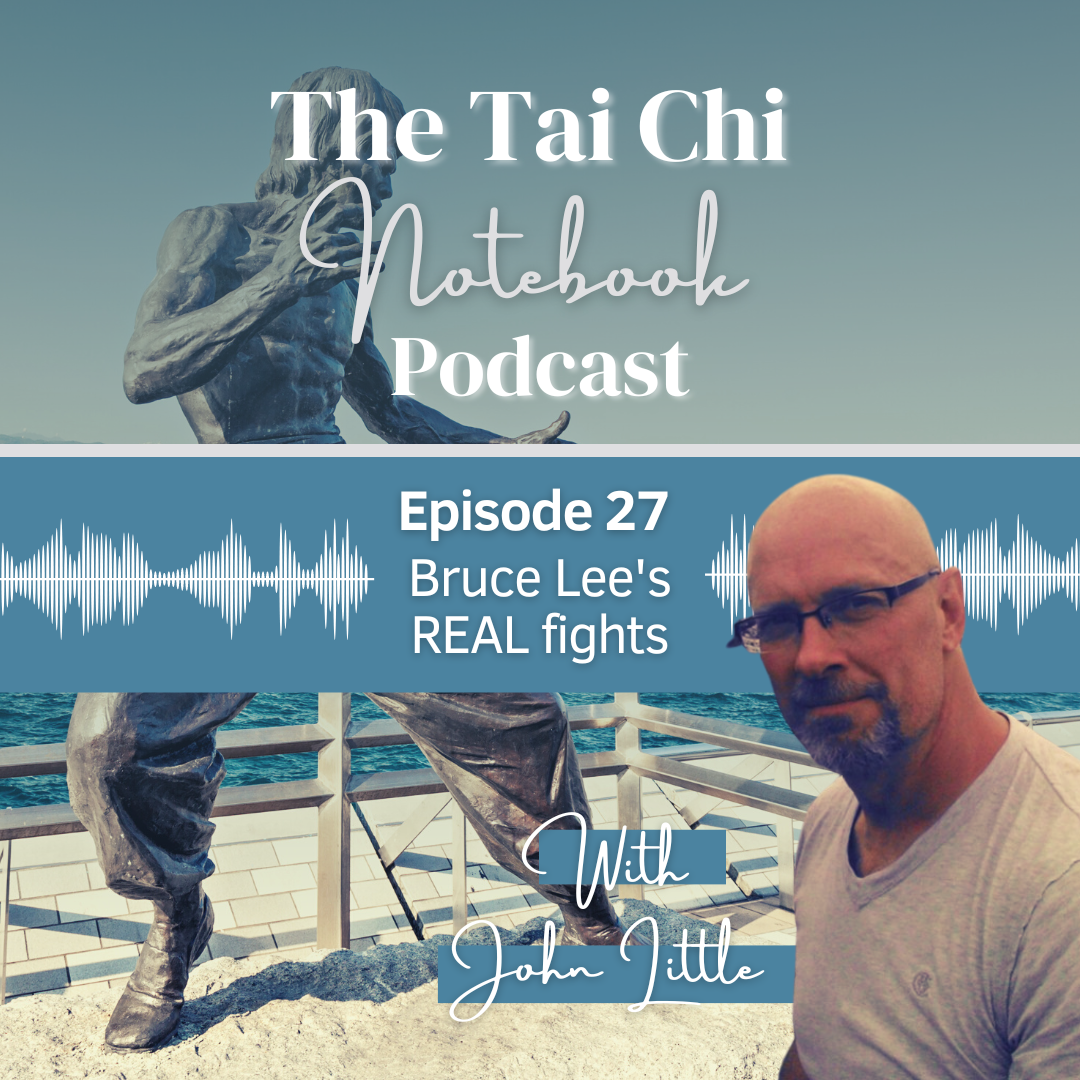
I have a new podcast out! Bruce Lee will be no stranger to anybody listening to The Tai Chi Notebook Podcast – even 50 years after his death he remains the most famous martial artist in the world.
But could he actually fight?
World Champions in karate competition have gone on record to point out that he never once competed in tournaments. So, were his martial abilities simply a trick of the camera?
My guest for this episode is Bruce Lee authority and bestselling author John Little.
To get these first hand accounts John has tracked down over 30 witnesses to the real fights of Bruce Lee as well as those who were present at his many sparring sessions. There are over 30 years of research in this book that took him thousands of miles around the globe.
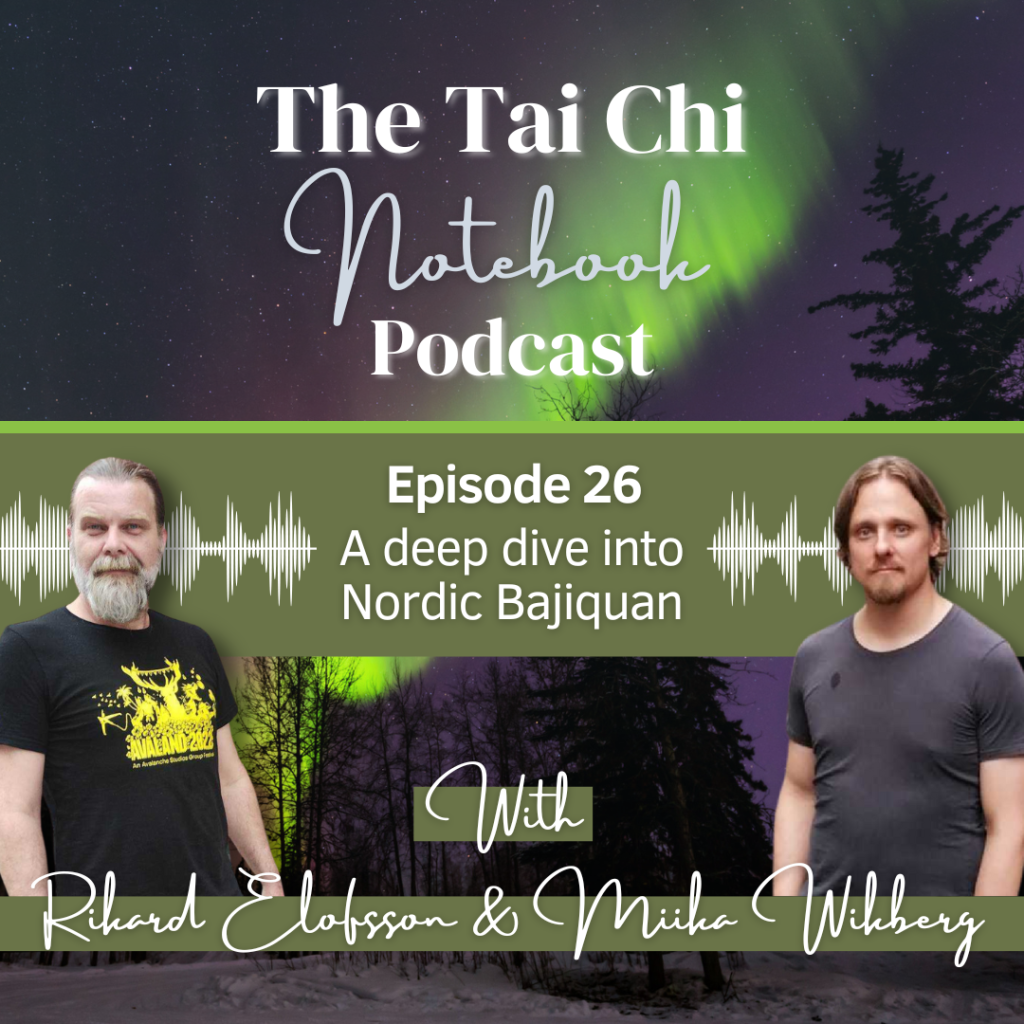
I’ve recorded a follow-up to my recent podcast with Rikard and Miika about Baji, this time with my Heretics podcast co-host Damon Smith, who is also a Baji practitioner. Listen to the new episode here. There’s a lot of talk about technique here, and how it compares to Xing Yi.
Here’s the blurb:
“This episode follows on from Episode 26 of Graham’s Tai Chi Notebook Podcast in which he interviews Woven Energy patrons Rikard Elofsson and Miika Wikberg about the little-known martial art of Baji. We discuss the possibility that the Baji Xiaojia is the most perfectly balanced form from any martial art – “Xiaojia is more Tai Chi than Tai Chi”, and look in a bit more detail at the history, technique, strategy and background to this subtle and robust martial arts style.
Graham, Miika and Rikard’s original episode can be found here: “
Bājíquán (八極拳) or shorter just Baji, is commonly known as “the martial art of bodyguards”. It emphasises the use of attacks that close down the distance as well as explosive close combat techniques such as combinations of elbow, knee and takedown techniques.
Both Rikard Elofsson and Miika Wikberg are senior Baji students of Lü Baochun, based in Finland who has over 40 years’ experience in the training and practice of baji. He has trained under many of the famous martial artists who used the style, such as Han Longquan and Zhang Xuchun.
Timestsamps:
0.40: – Rikard – Introduce yourself/how did you meet your teacher Master Lü Baochun?
3.15: – Miika – Introduce yourself/how did you meet your teacher Master Lü Baochun?
7.15: What makes Baji different to other martial arts?
8.30: Old Baji and new Baji
9.20: Trademark techniques of Baji
10.15: How is Baji power different? Training methods and the 3 stepping methods –
I’ve been meaning to read the story of Matthew Polly’s time spent training at the famous Shaolin monastery for years, but I finally got around to it recently thanks to my Audible.co.uk subscription*. And what a great read it is! I’m sure we can all identify with the teenage Polly, unsure of himself and his place in the world, who falls under the spell of Kung Fu and decides to dedicate his life to the pursuit of it as some kind of escapism from the pressures and fakeness of the modern world. To Polly, Kung Fu represented something sublime, pure and otherworldly that actually meant something. But unlike most of us, he did more than just dream about it, he actually went to Shaolin and lived there for almost a year, at a time when there was no Internet, no easy way to get there and China had only recently opened up to foreigners, so most Chinese people had never even seen a Laowai in the flesh before.
Polly’s story could best be summed up as a sequence of misadventures punctuated by moments of sublime martial arts inspiration. He manages to get into all sorts of scrapes involving accidentally offending senior party officials, being entered into a tournament against a San Da champion and hilarious misadventures with the opposite sex. Part Bill Bryson-style travelogue, and part kung fu geek-out, this is a rewarding, even emotional, look into what the Shaolin monks were really like in the 1990s, just as their international fame as stage performers was starting to spread and take over from the mystical image everybody had of them from the Kung Fu TV show. (Interestingly, at one point Polly watches the Kung Fu TV show with the monks who laughed their heads off at the idea of burning a dragon and tiger into your arms by lifting a hot anvil and dropping it into the snow – “why would you do that???”)
What you really get from this book is a sense of what the Shaolin monks are really like back then, and how much more human, relatable and down to earth they are compared to the lofty ideas we all have of them. It answers all the big questions like, how good are they at actually fighting, how seriously they take the “monk” side of their lives and how they train iron first, arm, head and even iron crotch.
The little snatches of Chinese you pick up by reading the book are also a hidden bonus and bring the characters to life marvellously. By the end of the book you feel like they are your friends and you know them just as well as Polly did. Anybody who likes this blog would love this book. Recommended.
N.B. The cover with a monk holding a Burger King bag is representative of the idea of American values seeping into China, but a little misleading as there were no Burger Kings in China then, and certainly nothing like that in the rural backwater of the Shaolin village.
*Like a number of other books, American Shaolin is included in the cost of an Audible subscription, so if you are a subscriber you get it free.
“When you can take the pebble from my hand, it will be time for you to leave.” – Master Kan
Here’s the blurb:
“Did Western movies and TV lead to the creation of the Shaolin Warrior monks? Did the modern Shaolin fake something that had already been reinvented anyway? Did the Qing Dynasty really destroy the Shaolin temple, or did they instead create it? What influence did three subsequent phases of communism have on Shaolin? Was there a Southern Shaolin Temple, and what about the modern stuff at Wudang Mountain? These questions and more answered in our new episode on the infamous temple and its monks.”
Seeing these old masters from Taiwan looking so good while practicing their external arts has made me wonder about switching my priorities.
I’ve been enjoying the recent series of videos from Will on his Monkey Steals Peach YouTube Channel of his tour of Taiwan Kung Fu schools. The latest one features Long Fist. It’s been great to see so much good technique demonstrated and also a few of the younger students, proving the arts have a future.
But of course, a lot of the practitioners Will has featured are older, but that doesn’t stop them being proficient in dealing out the ass whoppings. This has made me reflect on my own training priorities. A lot of these fit-looking older men are training in arts that would be classified as ‘external’ like Long Fist and Mantis, rather than the so-called ‘internal’ arts like Tai Chi or Xing Yi, which are more normally associated with older people.
Perhaps shifting focus to these external arts, which have longer postures with more twisting and stretching, and are practiced more vigorously is a good idea as you get older?
I’ve got to admit, that while I do feel good after a few run throughs of the Tai Chi form, I probably feel more energised and exercised after a few runs through of a Choy Li Fut form. My cardiovascular system is placed under more stressed for one thing, and my joints get moved through a larger range of motion.
“When you practice the form, the slower the better!” – Yang Cheng-Fu
Of course, Yang Cheng-Fu in his 10 Important Points, famously used this distinction between internal and external to explain that external arts were “harmful” for you, and the fact that you don’t get out of breath doing Tai Chi proved its superiority! He wrote (recorded by Chen Weiming, and translated by Jerry Karrin):
“External martial artists prize leaping and stomping, and they do this until breath (chi) and strength are exhausted, so that after practicing they are all out of breath. In Tai Chi Chuan we use quiescence to overcome movement, and even in movement, still have quiescence. So when you practice the form, the slower the better! When you do it slowly your breath becomes deep and long, the chi sinks to the dantian, and naturally there is no harmful constriction or enlargement of the blood vessels. If the student tries carefully they may be able to comprehend the meaning behind these words.”
Yang Cheng Fu
Now, it doesn’t take a genius to make an observation that Yang Cheng-Fu could have done with losing a few pounds himself, and that since he died relatively young his thoughts on longevity should be taken with a pinch of salt. Frankly, I think he could have done with getting a bit out of breath now and again!
It’s also fairly obvious to anybody who has seen Chen style Taijiquan that ‘leaping and stomping’ can be a part of Taijiquan too.
However, I do think there’s something to what he’s saying. When moving slowly and achieving a mediative state of mind you can experience profound levels of relaxation that do feel different to other types of exercise. When you “slow your breath” and it becomes “deep and long” it can feel wonderful. However, is that enough? I think it’s a mistake to use this type of exercise to replace more traditional cardiovascular exercise, and your body will not thank you in the long run.
Why not do both? Tai Chi has its place, but so do external arts of the Shaolin variety. Perhaps the best approach is to not skew too heavily in favour of either, but to adopt a balanced approach where you train both equally? Let me know what you think.
I was just catching up with a recent episode of Will Wain’s trip to Taiwan to visit various martial arts schools. The episode I was watching was about a style called Six Harmony Mantis. Six Harmony Mantis looks like (and is!) a combination of Xing Yi/Xin Yi and Preying Mantis Kung Fu.
What I like about it is that the way the two arts have been combined is exactly the same way I would have done – take the best bits of both. So, it’s the Xing Yi footwork and body method with a few cool Mantis techniques on top. It’s a great idea!
But what really caught my attention about this episode was the second half, which is a fascinating look into the living tradition of Chinese Folk Religion and how its practiced in Taiwan. I mentioned in a previous post that there are a lot of influences on Chinese Martial Art that don’t come from a military background, and this is a strong one – Chinese Folk Religion. It’s a blend of all sorts of things, and a good contender for being the most widely practiced religion in the world.
In this episode you can learn about family temples, the gods that are honoured on them, spirit possession and more. I think spirit possession and martial arts have a big connection. Often when a person is possessed by a war-like god they perform war-like movements. A bit like marital arts forms…





 The Tai Chi Notebook