Just watched a great clip of 1980s Wushu in China – featuring Sun Jianyun, Sun Lu Tang’s daughter performing Bagua. But there’s also some clips of Tai Chi and some kids doing Northern Shaolin (at least I think it’s Northern Shaolin). Well worth a watch. The martial arts are on their way to being the heavily performance-based WuShu we have today, but are not quite there yet, with martial technique still a priority.
Kung Fu
Real men do Tai Chi, apparently
The latest way of selling tai chi is to say it gets you jacked

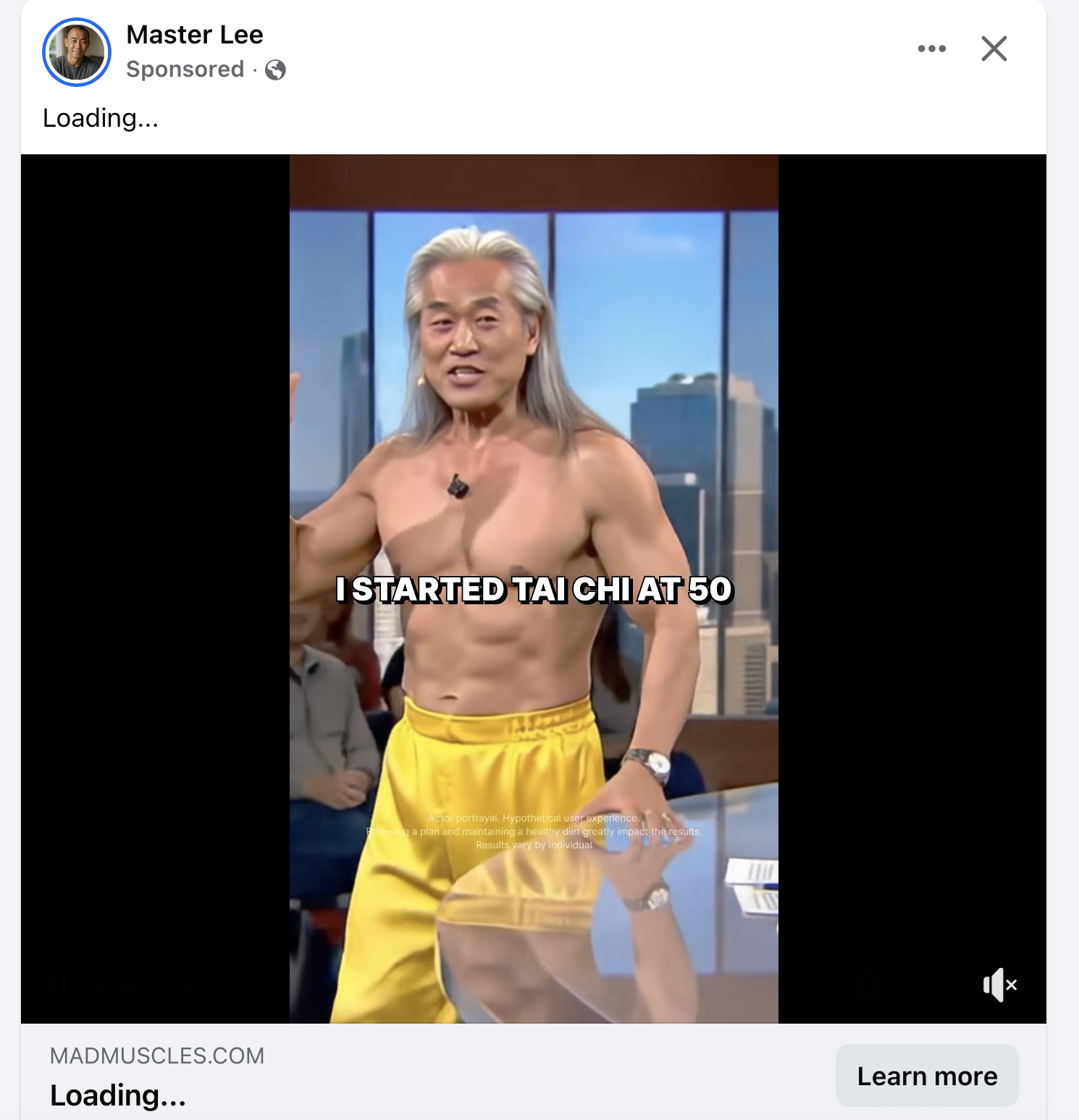
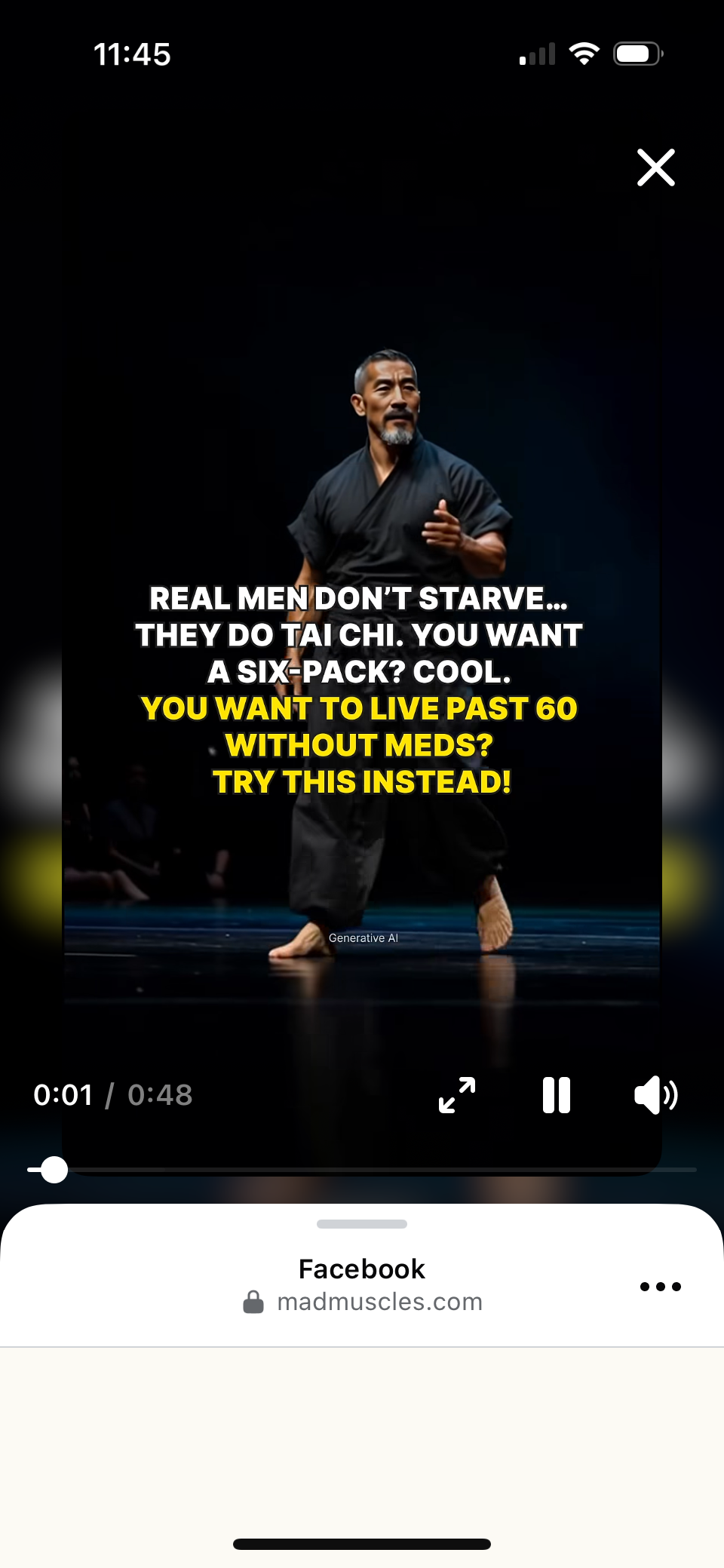
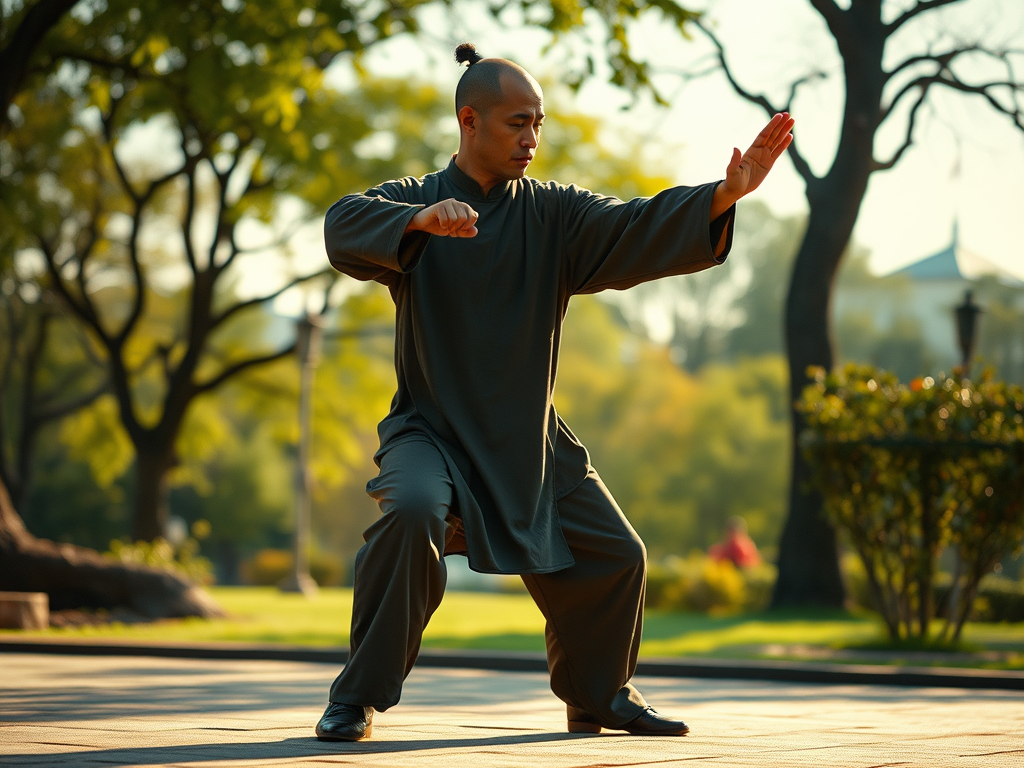
I’ve seen a lot of things come and go in the Tai Chi universe over the years, but the latest marketing trend has got me scratching my head. Almost every advert for Tai Chi courses I see on Instagram and Facebook at the moment promises ripped muscles and a hyper-masculine physique, mainly for men over 50!
Tai Chi, with its soft, slow, flowing, gentle movements, is perhaps the least masculine-looking martial art you could imagine, yet here is “Master Lee” strolling around a TV studio with his top off showing off his impressively-muscled abs, which he says he got from tai chi.
Or this guy, who claims tai chi is the path to a six pack. “Real men don’t starve… they do tai chi”, he proclaims.
So, what’s going on here?
Firstly, these confident, super-tonned Chinese gentlemen, are clearly creations of generative AI video apps. Everything about the videos looks as fake to me as the idea that tai chi on its own will get you that shredded.
Tai chi is good for many things, like learning how to use qi and jin and producing a feeling of tranquility, or as a self-defence system, but producing athletic-looking people over the age of 50 is really not one of them. *
When you look deeper into the exercises being offered here they look like simple, repetitive qigong-style movements. The idea that you’d replace weight training and body weight exercise with these and still build muscle is wrong, as far as I can see.
There’s no getting away from it, if you want to lose weight and build muscle you need a diet, cardio and weight training routine.
—-
* Now, I’m aware that there is another trend at the moment to train intensively with kettle bells and call that “tai chi” or “internal”, but really it’s no different to doing a kettle bell workout and not calling it tai chi.
The 1974 White House Rose Garden WuShu demo, with President Nixon, Dr. Kissinger
Update – December 2025: I received a message from the person who posted the 1974 Whitehouse video linked below, who has written a Wikipedia article with more info: “I just published an article on Wikipedia regarding this chapter of wushu history: https://en.wikipedia.org/wiki/1974_China_national_wushu_team“
I’ve actually only just noticed a comment on my Contacts page from January by Robert Lepper:
“I suggest you do an article about the 1974 historic visit to the United States by the elite Chinese National Wushu Team. There was a famous visit to the White House Rose Garden with President Nixon, Dr. Kissinger and other dignitaries. In October 2024 the team celebrated their 50th year celebration of the U.S. performances in Beijing and Qingdao City. After the U.S. demonstrations in 1974 they demonstrated in Great Britain (1975) and many other countries. These martial artists were the best of the best. It was the opening of China and Chinese martial arts to the world. Jet Li at age 11 was on this famous team.
There are many pictures available and a news video (poor quality) of the demonstration in the White House Rose Garden.”
Well, this actually seems like a good idea, especially since it was Jet Li who was demonstrating. I had a quick look online, and yes, there is a video of the event, showing a young Jet Li demonstrating a 2-man wushu form in front of President Nixon:
From what I can see, this looks like a version of the ‘Shaolin 2-man form’ that I learned years ago. Certainly some of the still postures – like the one in the video thumbnail cover – are postures I recognise.
Here’s a longer video of the event:
Nixon first visited Beijing in 1972, in an effort to start establishing relations with the People’s Republic of China, after years of diplomacy that favoured the Republic of China, based in Taiwan. The visit was a huge symbolic gesture. This 1974 visit looks like a return visit, with the PRC trying to push the image of Chinese Wushu to the West.
It’s interesting to think of how Wushu is being used here as a demonstration of China’s soft power, and there’s no sign of any Taijiquan. This was not long after release of Enter the Dragon, when Bruce Lee had introduced kung fu to the international stage for the first time. Li would later become famous as a kung fu movie star in his own right, starring in films such as Shaolin Temple, the single most influential feature film in Shaolin history, and the film that many people suspected to have caused the re-population of the Shaolin temple with monks and the creation of a major tourist centre in China. I’d recommend Matthew Polly’s book American Shaolin.
It’s such an interesting historical footnote to see both a young Jet Li and President Nixon interacting together, back in 1974.
Happy Year of the Snake
What to do when your Snake Creeps Down
Hello! Happy Year of the Snake, dear reader. On an occasion such as this is would normally be customary for a tai chi blog like mine to do a little post about the influence of the snake on tai chi, kung fu and Chinese culture in general.
Snake is, after all, one of the five main Shaolin kung fu animals, one of the 12 main xing yi animals and frequently appears as a menu item in Chinese restaurants, er no, sorry, I mean, appeared in Kung Fu Panda!
But, no! I’m not going to do that; partly because it’s such an obvious thing to do that I’ve done it before, and I hate being predictable, or at least repeating being predictable, but also because I’ve just recorded an excellent conversation for my next podcast with Australian national treasure and sometimes-Chinese-martial-arts-practitioner, Simon Thakur of Ancestral movement about finding your inner, ancestral animal, including, of course, the snake, and I just need to find the time to get on with editing it so I can get it out to you lovely people.
I think that what Simon says about our human connection to snake-style movement is probably more valuable than whatever I’ve got to say on the subject of our slithering cousin. So, I’ll leave the snake talk until the podcast comes out!

In the meantime, while you wait for that podcast to properly percolate (all the best things take time) I’ll leave you with a thought. “Tai Chi is more than the techniques, it’s the jins that make it interesting”.
If you listened to my last podcast with the esteemed Alan Wycherley of ‘In Defence of the Traditional Arts’, you might be forgiven for thinking that I’m all about training tai chi techniques. Now, while I’ve no objection to practicing a Repulse Monkey or a Part Wild Horse’s Mane (or two), or even a Snake Creeps Down, I definitely agree with the statement that tai chi is more than the moves. In fact, I think we can probably agree that tai chi applications aren’t that great as martial techniques. There are (shock!) other martial arts that have more effective techniques. Hello, Brazilian Jiu-Jitsu, I’m looking at you. Hello, Choy Li Fut. Hello, Western Boxing. Hello, Muay Thai, stop hiding at the back! Yes, all these martial arts have techniques that I would probably put ahead of anything found in a tai chi form, regardless of style. They’re practical and effective. And yet, I practice tai chi. So, why is that?
What tai chi has, and emphasises over techniques, are the eight energies – the jins: Peng, lu, ji, an, etc.. What you are doing when you practice a tai chi form is emphasising energy changes using these eight over technique. Flowing from one to the other a bit like a river flowing along smoothly. Sometimes there are fast bits, sometimes there are slow bits, sometime the river turns one way or another, but its energy flow keeps going.
When I practice other martial arts, my emphasis is more on technique. When I practice tai chi I can relax and get more inside the movement and concentrate on the energy flow.
And of course, in tai chi push hands you get to interact your energy flow with the energy flow of another person in a live situation, and that’s extremely valuable for developing martial ability. Techniques are another thing.
Now, if the analogy of a river doesn’t work for you then think of something else… perhaps, a snake? Snakes can flow along smoothly, they can change direction sharply and they can be incredibly powerful or incredibly quick, as well as slow and suffocating. They’re a great example of energy changes.
Homework
In preparation for my next podcast allow me to recommend a documentary by professional paleontologist and evolutionary biologist Neil Shubin called Your Inner Fish. (He’s written a book of the same name, if you prefer to read about him). Snakes come out to play in episode two. Here you go:
Can traditional martial arts fight?
A video that brings into question the legitimacy of traditional Chinese martial arts as real fighting styles was brought to my attention recently:
The video by Rantwo is called “No, Pak Mei is NOT For Fighting”. And here it is:
It’s a breakdown of a recent video by the Karate Nerd about sparring with Pak Mei expert.
Now, you can agree or disagree with Rantwo’s opinion on whether the Pak Mei guy can fight or not. Personally I think Rantwo brings up some good points, but I’ve heard other people argue that he’s kind of missing the point – sparring never looks good.
Anyway, I don’t want to get into that. My comment on the video would be that Rantwo is making the classic mistake that a lot of people make when looking at videos of traditional master getting beaten up by average/bad kickboxers and then deciding that martial art XYZ must be no good: It’s always a reflection on the person involved, not the whole style.
I don’t think you can view a couple of videos of Pak Mei guys then decide the whole style is “not for fighting”. I can guarantee you there are Pak Mei guys out there who have no problem throwing down. To just dismiss a whole style like that seems to be incredibly naive.
When it comes to sparring, I don’t think there are styles, there are just individuals. At least that’s the way I look at it.
Forget Mount Wudang, the latest hot Kung Fu mountain is Mount Emei, and this time it’s girl groups leading the way
It’s all about the needles
Emei Mountain is the latest hot Kung Fu trend coming out of China, and a group of Kung Fu girls is leading the charge, according to a new article in China’s GlobalTimes.

In April 2024 a video appeared showing nine female Kung Fu performers doing Kung Fu moves against the backdrop of Emei Mountain.
Chen Yufei, 23, one of the group members is quoted in the article: “Unlike the dramatized versions of Emei kung fu in TV shows, which focus on legends, our practice is rooted in the practical skills and traditions of Emei martial arts.”
The video shows performance with a variety of Kung Fu weapons including double whips, swords and of course, the famous Emei needles *, but the phrase “traditions of Emei martial arts” raises a few red flags for me.
A standout line from the article reads “In 2008, Emei martial arts, with a history spanning over three millennia, were designated a National Intangible Cultural Heritage.”
Ok, hang on, what?
Mount Emei has long been a sacred mountain for Buddhism, sure. But a 3,000 year old tradition of Kung Fu?
If you look up Kung Fu training camps on Mount Emei you’ll find a complete history of the martial arts and styles there: “Emei School has 1,093 bare-hand fighting skills, 518 skills with weapons, 41 pair practice routines and 276 practice methods.”
Call me a cynic, but I don’t believe any of this. It appears to me that the Kung Fu traditions of Emei Mountain really belong to the work of modern wuxi fiction of author Jin Yong who wrote a lot about a fictional Emei Sect. In his book, The Heaven Sword and Dragon Saber, the Emei School is founded during the early Yuan dynasty by Guo Xiang around the same time as when the Wudang School is established.
Of course, this being a complete fiction hasn’t stopped the Kung Fu tourist industry from setting up shop on Mount Emei. As this 2012 article describes, there was not much Kung Fu on the mountain back then, but it was starting to be set up, complete with a history. But if you look up Mount Emei today you’ll find Kung Fu competitions are held there, and very much like the operation at Mount Wudang, you can go there to study Kung Fu, for the right price.
The all-female Kung Fu troop heralding from Mount Emei seem to be as much a creation of the Kung Fu tourist industry as anything else, at least to me.
So where does their martial arts come from? Looking through various pages on the Internet I found a Reddit post that sounds true to me: ” “Emei” is just a generic term for martial arts from Sichuan, extremely few styles have any actual direct relation to anyone who loved or practiced on Emei shan. Also almost everything called “Emei” today are modern offshoots of northern Chinese martial arts brought to Sichuan with nationalist troops as they were forced westward by the Japanese in WWII.”
None of which, of course, is to take away from the performance of the Emei all-female Kung Fu group, who are pretty damn good at WuShu.
- Note 1: Mount Emei even has its own weapon, the Emei Ci which are sharp steel rods known as needles or piercers, that can be worn on a ring on your finger and spun around.
A visit to Mount Emei by Will of Monkey Steals Peach:
Tai Chi and the art of occupying the other’s space

You can think of the Tai Chi form as an exercise in claiming your space. We rarely think of the space we occupy or move around in as part of ourselves, but it is. We often let others take our space, or give it away needlessly. We move out of the way when people walk towards us in the street. Rarely do we stand our ground and own the part of the earth that is directly underneath us.
In tai chi push hands we learn to claim our space, to gently redirect people that want to come into it and also to take away other people’s space if we need to, and not let them get it back. In the tai chi form we learn to round out our movements, so that (as the classics say) there are “no hollows or projections” in tai chi. Your goal is to create a kind of sphere with your body, as if you were inside a giant beach ball. Your hands extend to the limits of the ball, and no further.
Finding your centre
In tai chi there is ‘finding your centre’ within yourself, but there is also ‘finding your centre’ when in contact with another person. When two people are in contact, especially if engaged in some form of conflict, they are rarely both in balance, usually the advantage lies with one person or the other. The one in control is usually the person who has made both people part of their ‘centre’. Viewed from above, they become the centre of the circle, around which the other person is orbiting.

In class today I was working on the ward-off posture. I think by far the best way to think about ward off, as a martial posture, is to think about having just slipped a straight punch over your right shoulder by moving your head and turning your body to your left, you then step diagonally into the space occupied by the other person, right under their armpit using the familiar ‘ward off’ posture to keep them off balance. You need to keep that full, rounded, ‘peng’ aspect to your arms here, and once you have them off balance, you never retreat or give up the ground you’ve taken. If you do then you’re simply giving them their balance back. You need to keep them off balance continually, so that they can’t recover and they end up open to strikes or to being knocked over.
That ability is one reason why, while strikes exist in Tai Chi, they’re not really emphasised in the form. Instead, in the form you’re continually learning how to take ground from the opponent and occupying it while remaining in balance. As a means of self defence, it is highly effective, but not easy to understand without feeling it, which is another reason why so many people are confused about how Tai Chi works as a martial art.
You can train Tai Chi with me in Bath/Bristol, and get better at standing on one leg, twice a week.
Listen to a podcast about this blog post.
Thank you for supporting The Tai Chi Notebook. If you are reading this on a website that isn’t thetaichinotebook.com, then it’s highly likely it’s been stolen. Please let me know so I can issue their webhost a DMCA takedown notice for copyright breach. Thanks. And if you have the great idea of starting a tai chi website by stealing other people’s work to fill it with content for clicks then take a good hard look at yourself, and do better.
New podcast! The martial arts of Vietnam with Augustus John Roe
Do you want to find out what traditional martial arts are practiced in Vietnam? Do you want to know what Tai Chi is like in Vietnam? And what Ho Chi Minh had to do with the development of the 24-step Tai Chi form? You do? Well, you’re in luck!
This episode of the Tai Chi Notebook Podcast features martial artist and author Augustus John Roe who lives and works in Vietnam. Enjoy!
The origin of internal arts, with Peter Lorge
“The origin of internal arts” is probably what I’d have called this really interesting podcast with Peter Lorge about the history of internal martial arts, however Kung Fu Genius decided to name it “Chinese Martial Arts History is Mostly FAKE” because, well, it probably generates more clicks, or something. Anyway, Lorge turns over a few sacred cows here, and I also liked what he had to say about BJJ.
Have a listen:
I think Peter makes a great point about all these different ‘internal’ things throughout Chinese history all definitely existing, but all being completely separate and unconnected until the 1920s Guoshu Institute needed to create the category of “internal” to exist in opposition to shaolin and external, so it brought them all together. (The gentleman whose name he forgets when talking about this is obviously Sun Lu Tang.)
I do wonder if instead of looking back for mentions of “internal” throughout Chinese history a look back for the phrase Liu He “six harmonies” would make a better connection between the dots of Chinese martial arts history. While the term “Neijia” may not appear very often pre-1920s, Liu He definitely did. If we’re looking at how we got where we are today, then that’s probably a better bet.
Episode 31: Mantis boxing, BJJ, self defence and heresy in martial arts
Here’s my latest podcast! Mantis boxing, BJJ, Self Defence and heresy in martial arts with Randy Brown.
Randy Brown is a Mantis Boxing and BJJ black belt coach teaching in the USA. In this podcast we explore how Randy has reworked his Mantis Boxing to explore the grappling potential hidden in its forms and how they can interact with his Brazilian Jiujitsu. We talk about a range of subjects including self defence vs sport, weapons vs barehand and how to turn dead systems into living arts again.
Links:
https://randybrownmantisboxing.com/