When I was asked to name my favourite Check Norris film I could only think of the Bruce Lee classic Way of the Dragon, which features the legendary fight between Bruce and Chuck in the Colosseum.
Filmed 54 years ago, and it’s still one of the best fight scenes ever choreographed:
The fact that I couldn’t name another film he’d been in makes me think I knew Chuck as less as a film star and more as an Internet meme, related to his legendary toughness.
I guess he can now get that rematch with Bruce he’s been waiting for. Rest easy.
Traditional martial arts, which are perhaps better described as “martial arts that are not sports”, tend to have a lot of forms, or kata. I’m thinking of karate, tai chi, wing chun, choy li fut, etc.
But what exactly is the role of kata, or forms? And has it changed over time?
In this new episode of the Heretics podcast I discuss the role of kata with Damon Smith who has extensive experience in various martial arts over decades.
It certainly became very trendy once MMA became a big deal to describe forms as useless, however, I think they do have uses, even today. As usual Damon has some pretty interesting insights into how forms have changed over time, and he can look back to the way they used to be trained in the 1980s compared to today.
Now, you can agree or disagree with Rantwo’s opinion on whether the Pak Mei guy can fight or not. Personally I think Rantwo brings up some good points, but I’ve heard other people argue that he’s kind of missing the point – sparring never looks good.
Anyway, I don’t want to get into that. My comment on the video would be that Rantwo is making the classic mistake that a lot of people make when looking at videos of traditional master getting beaten up by average/bad kickboxers and then deciding that martial art XYZ must be no good: It’s always a reflection on the person involved, not the whole style.
I don’t think you can view a couple of videos of Pak Mei guys then decide the whole style is “not for fighting”. I can guarantee you there are Pak Mei guys out there who have no problem throwing down. To just dismiss a whole style like that seems to be incredibly naive.
When it comes to sparring, I don’t think there are styles, there are just individuals. At least that’s the way I look at it.
So, apparently I’m a snob when it comes to martial arts! I must be because on two separate occasions now women have accused me of being one (interesting that it’s women both times!)
A recent exchange went something like this…
Me: Are you going to the seminar with master x this week? Her: Yes, you? Me: Yes, but if he teaches a basic hip throw I’m walking out. 🙂 Her: You’re such a marital arts snob! 🙂
As you can see, there were smilies involved, so I don’t think it was meant seriously, but there’s always a grain of truth at the bottom of most jokes.
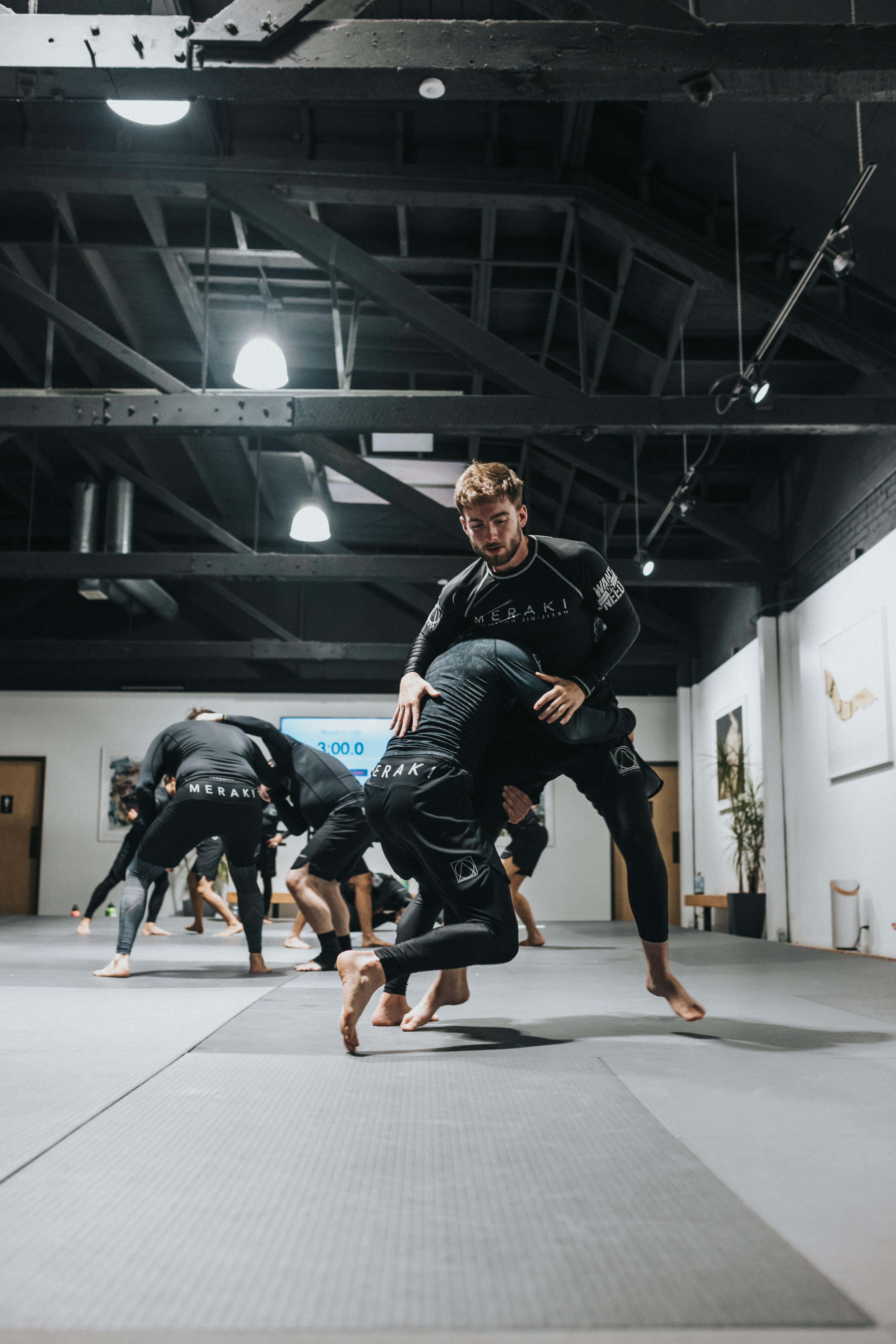
Photo by Anete Lusina
This got me thinking. I think I am a bit of a snob when it comes to technique in jiujitsu. The popular wisdom goes that after black belt you start to really appreciate the basic techniques and find hidden value in them. Sure, I can see that. It’s true, you do revisit seemingly basic techniques and find things you’ve missed or deeper levels to the technique. But sometimes basic techniques are just… basic. And a bit boring. Show me something new and cutting edge, especially if I’m paying for a seminar!
When it comes to Chinese martial arts (CMA), I’m a snob in a different sort of way. Watching other people do CMA I don’t always express an opinion, but internally I’m very judgy. I find it hard to praise people for a mediocre performance, or even ignore all the bad bits like some people seem to be able to. But equally, when I do see something I like, I’m pretty free with my praise about it.
When watching forms done on video I always try to factor in that “everything looks 20% worse on video compared to real life”, and judge accordingly. But even so, what some people in marital arts deem worthy of sharing with the pubic makes me question their sanity. A lot of it is just embarrassing, but there is something else to look out for…
As I discuss with Jess O’Brien in an upcoming podcast, it can be hard to know what is correct in Chinese marital arts. Quite often, even within the same style, two teachers will have radically different interpretation of the same principles, and they can often both be right at the same time – i.e. they can both make it work. It’s not until you get hands on with a person that you can tell if what they’re doing works, or not. So, it’s usually a good idea to gets hands on with somebody before you criticise them too much.
With that said, I think you do need to be pretty discerning with what you’re accepting as “good” in Chinese martial arts. CMA has always been infiltrated by people who were, shall we say, not very good, but pretended to be so, especially to naive Westerners who can’t tell the difference. Then there are the teachers who hold things back and don’t teach all their skills. There are plenty of ways to waste years in CMA not really learning anything of value.
But what is being a snob? Isn’t it just having high standards? The Cambridge dictionary defines a snob as: “a person who respects and likes only people who are of a high social class, and/or a person who has extremely high standards who is not satisfied by the things that ordinary people like”
OK, ignore the first bit about social class, since that’s got nothing to do with it, but look at the second part. “Not satisfied by the things that ordinary people like”. Hell yeah! I can identify with that.
When it comes to martial arts I think that a snob is a pretty good thing to be. When there are 7 year old kids going around with black belts in Karate or Taekwondo, I’m quite happy to hold myself to higher standards. Most ‘self defence’ videos you find on YouTube are laughably bad. And a lot of Tai Chi videos appear to be cult-like and weird.
If this is what ordinary people think martial arts are, then yes, I’m a snob.
One observation I have on ‘internal’ martial arts is that there there is often very little focus on the ‘internal’ qualities to a human being. Or if they do address them then it is, not directly and often in passing.
I’m not talking about things to do with forces, or the body, like Qi, Xin and Jin. Yes, the Yi (intent or mind) is mentioned all the time in the Tai Chi Classics, but it’s always in relation to fighting, or releasing and accepting forces on the body. “Quelle surprise”, you might say, since Tai Chi is a marital art, but if I contrast ‘internal’ martial arts with ‘external’ martial arts for a moment, the discussion there is often on the internal qualities of a human that internal martial arts, ironically, neglect.
I’m talking about things like self-control (temperance), endurance and patience.
The goal of improving these internal qualities has been the goal of practical philosophers since man first decided to ponder his/her existence. I could quote from LaoTzu here, but I find it more explicitly written by the Greek philosophers, particularity the Stoics.
In Chapter 10 of the Greek classic of Stoicism, The Enchiridion, we find:
“On the occasion of every accident (event) that befalls you, remember to turn to yourself and inquire what power you have for turning it to use. If you see a fair man or a fair woman, you will find that the power to resist is temperance (continence). If labour (pain) be presented to you, you will find that it is endurance. If it be abusive words, you will find it to be patience. And if you have been thus formed to the (proper) habit, the appearances will not carry you along with them.”
Epictetus, The Enchiridion
Sure, these internal qualities can certainly be learnt from any martial art, however I find it is the external martial arts that really emphasise them. Many Taekwondo schools use the goal of improving your inner qualities as the main sell in their marketing approach. For example, I just did a Google search for Taekwondo clubs in the local area, clicked on Tiger martial arts, and what do I find written on their website, in all caps, so you can’t miss it?
“WE BELIEVE MARTIAL ARTS IS ABOUT MORE THAN JUST KICKING AND PUNCHING”.
This is followed up with “We give students the focus and confidence to achieve in all areas of their lives. Yes, you can learn to take care of yourself in dangerous situations, but really it’s about learning to use your mind and body like a martial artist – learn how to control your body and your mind, and you will be set up for life.”
It’s the same with Karate. I did another random search on Karate clubs and found Bristol Karate Academy whose motto is “virtue in industry” from “Virtute et industria” — or by virtue and industry — from the city of Bristol, which dates back to at least 1569. They explain how that relates to the values of their club on their About us page:
“So what does that mean for us?
Virtue (美徳): We have integrity, in our commitment to traditional, effective Karate and integrity in the way that we treat others. We are respectful, fair and aim for high moral standards. We build character, strive for excellence and show courage in the face of challenges.
Industry (勉励): We work hard to reach our goals. We’re diligent and determined to get better at every single training session. We are rigorous in our approach to improvement and dedicated to our own and each other’s development.
Through hard, honest training we become our best possible selves”
Again, while I’m sure they can kick-ass with their karate, the emphasis in their motto is on the internal qualities of a human being. It’s about becoming your best possible self.
I know what you’re thinking – “perhaps it’s about teaching children?” Things like Karate and Taekwondo can be very orientated towards teaching children, and you obviously don’t want to be raising a hoard of little ninjas who have no idea about the moral implications of using their marital arts. However, it’s not just non-Chinese marital arts that have a heavy emphasis on building moral character. Similar ‘external’ Chinese martial arts do too, and those tend to have as much emphasis on adults as children. Also the moral aspects were there right from the beginning in the Southern arts.
For the history of Southern Chinese martial arts I’d recommend Ben Judkin’s excellent book “The Creation of Wing Chun”. Its tag line is “A social history of the Southern Chinese Martial Arts” because it covers all of them, not just Wing Chun, and particularly Choy Li Fut. When the first professional Choy Li Fut school opened in 1836 a moral education was seen as part of the ethos of the school. The school had 10 rules that had to be followed at all times:
Ten Points 1 Seek the approval of your master in all things relative to the school. 2 Practice hard daily. 3 Fight to win (but do not fight by choice). 4 Be moderate in sexual behavior. 5 Eat healthily. 6 Develop strength through endurance (to build a foundation and the ability to jump). 7 Never back down from an enemy. 8 Practice breathing exercises. 9 Make the sounds (“Yik” for punches, “Wah” for tiger claws, “Tik” for kicks). 10 Through practice you cannot be bullied.
While some of the rules are to do with body use, like making sounds on punches, others are more moral, like being moderate in sexual behaviour. And also eating healthy is a rule! Can you imagine going to a Tai Chi class or a Xing Yi class today and being told that healthy eating is now a rule, and if you don’t follow it, you’re out? In fact, I’d go as far to say that many internal martial arts teachers were renowned for hard drinking and over eating!
(It should be noted that Bak Mei tended to not have this moral emphasis. Reasons for this are explored in the book.)
Moving forward in time and changing locations to Brazil… Carlos Gracie also created a set of rules called the 12 Commandments when he started Brazilian Jiujitsu as an offshoot of Judo.
1 Be so strong that nothing can disturb the peace of your mind. 2 Talk to all people about happiness, health, and prosperity. 3 Give to all your friends the feeling of being valued. 4 Look at things by the enlightened point of view and update your optimism on reality. 5 Think only about the best, work only for the best, and always expect the best. 6 Be as just and enthusiastic about others victories as you are with yours. 7 Forget about past mistakes and focus your energy on the victories of tomorrow. 8 Always make those around you happy and keep a smile to all people who talk to you. 9 Apply the largest amount of your time on self-improvement and no time in criticizing others. 10 Be big enough so you can feel unsatisfied, be noble enough so you can feel anger, be strong enough so you can feel fear, and be happy enough so you can feel frustrations. 11 Hold a good opinion about your self and communicate that to the world, but not through dissonant words but through good works. 12 Believe strongly that the world is in your side, as long as you stay loyal to the best of yourself.
Carlos Gracie
These are mainly forgotten about these days and I’ve noted before that a lot of them were borrowed from somewhere else but they are almost exclusively about internal qualities of a human being.
If you contrast these sorts of rules to what you find in “internal” marital arts schools, well first of all, there are usually no set rules like this at all! Secondly, we tend to look to the classics for our ancient sayings, and finding moral instruction in them is like finding a needle in a haystack. Instead you find simile – for example, “be still like a mountain and move like a great river” from the Tai Chi classics, or philosophy from the Xing Yi classics like The 10 Theses of Yue Fei:
“From the beginning, that which is discrete must have its unification. The divided must be combined. Therefore, between heaven and earth, all that is disordered hasits abode, all the thousand branches and the confusion of then thousand endings, all have their origin. This is because one root divides into ten thousand branches, and ten thousand branches all belong to one root. These events are natural“.
– The Thesis of Integrity
Or you find descriptions of body use and strategy.
The jin should be rooted in the feet, generated from the legs, controlled by the waist, and expressed through the fingers.
What you don’t find a lot of is moral instruction or a reflection on the internal qualities of a martial artist that you find emphasised right up front in external schools.
So, why is this? Good question. One possible answer could be that ‘external’ arts historically coming from the Shaolin Temple (in the usual origin myth, at least) always had a Buddhist religious and therefore moral aspect to them. The internal arts in contrast tended to evolve out of the (violent and bloody) countryside, or they evolved from a Taoist approach to life, which was less prescriptive.
I don’t know – what do you think? What explains the internal/external difference? Let me know in the comments.
Have you ever wished that running your martial arts academy was more accessible and more efficient? If so, it may be time to look into the latest Martial Arts Management Software.
Managing a Martial Arts School can be overwhelming, but with the right tools, it doesn’t have to be!
Martial Arts Management Software is designed to help make sense of the administrative chaos that comes with running a successful business. Whether you need to keep track of student records, manage bills and invoices, or monitor your academy’s finances, there is sure to be a software system out there that can help.
If you’re wondering whether your school needs this software, here are some signs indicating you should consider using it!
Billing and Collection Issues
One of the most prominent challenges schools face is billing and collecting money from their students. Martial Arts Management Software makes it easy to manage your student accounts, allowing you to keep track of payments, overdue balances, and more.
This can help you stay on top of any collection issues, ensuring that you are getting paid for your services promptly.
Class Scheduling Problems
Managing a martial arts academy can be a complex and time-consuming task, especially when it comes to scheduling classes. However, with the help of advanced software systems, scheduling classes have become much more manageable.
With this software, you can easily create, maintain, and update your class schedule, ensuring that all of your classes are offered on the days and times you need them. This can help ensure that your students always have access to the classes they need so they can go anywhere for their training.
Members Tracking Has Become a Problem
Another common issue facing martial arts academies is keeping track of their members. With so many students coming and going, it can be difficult to keep track of all the different people training at your academy.
Missed Expiring Memberships
One of the biggest challenges when it comes to member tracking is ensuring that you are never missing expiring memberships. Martial arts management software can help to make this process easier, as the software can send automatic reminders to your members about renewing their memberships in a timely manner.
Additionally, with this software, you can set up automatic renewal reminders, which can further help ensure that all of your members are up-to-date on their memberships.
Untracked Achievements, Belts, and Grading
Another issue that can arise when it comes to member tracking is failing to track important milestones, such as belt and grading achievements. Martial arts management software can help with this by providing a convenient platform for recording these milestones.
With the push of a button, you can record your members’ latest achievements, helping you stay on top of their progress. And by automating this process, you can ensure that all of your members’ milestones are tracked and recorded promptly.
Spending Hours On Admin Tasks
If managing financial reports and cash flow takes much more time than teaching Martial Arts, Martial Arts Management Software can help you save time and money. By automating processes such as billing and collecting data and information, you can spend more time on the things that matter most to your business.
Additionally, using martial arts management software often comes along with other benefits, such as improved cash flow and reduced costs. If you want to streamline your academy and make it more efficient, it’s worth considering investing in this type of software.
Messy, Disorganized Paper Filing Systems
The more your martial arts studio grows, the harder it is to keep up with all the paperwork for student registrations, attendance compiled, payment due and instructor qualifications-not to mention classes and business operations that can become confused without proper record keeping.
With Martial Arts Management Software, all of your data and information are stored digitally, making it easy to access and update at any time. This not only helps you to stay organized, but it also helps to keep your data secure, as paper files are often lost or damaged.
Lack Of Financial Reporting Tools
Every martial arts school needs to have efficient financial reporting tools in place, but all too often these can be lacking. This is where martial arts management software can help fill the gap.
A management software system often comes with a wide range of financial reporting tools, helping you stay on top of your business finances and quickly identify any areas that need to be improved.
Inexperienced or Overwhelmed Staff Members
If your academy is experiencing issues with member tracking, financial reporting, or any other aspect of running your academy, it can be difficult to know where to turn.
By using martial arts management software, you can streamline your academy and ensure that all of your members are well taken care of.
Managing School Has Never Been This Easy
If any of these issues sound familiar, then it’s time to consider using Martial Arts Management Software! With the right system in place, you can take control of your business and focus on running a successful academy.
Karate is something I’ve never done before, so it was a surprise to find myself doing some in the form of learning the Anan kata at a recent Foxfist event. The Anan kata is a nice little Karate form. In fact, there’s enough in there for it to be the only form you ever needed to learn for a small, self-contained, but effective, martial system. There are deflections, strikes, stand-up grappling and kicks.
The similarities between Okinawan systems and Southern Chinese martial arts systems are quite obvious in this kata, I think. But see what you think. Here is Anan being performed by somebody who, unlike me, knows what they’re doing with it.
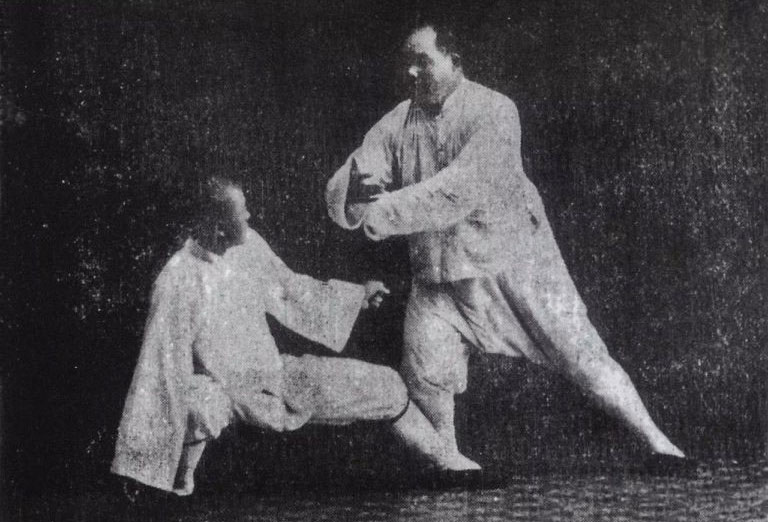
Yang Cheng-Fu showing Tai Chi applications from his book.
In the comments section Richard asked a good question in response to my last post. I wrote a brief reply in the comments, but I thought I’d flesh it out a bit as a blog post, because it’s an interesting topic.
The question is, ‘what’s the point of Tai Chi applications?’ Actually, to be fair, he was talking specifically about the one application video in my last post, not about Tai Chi in general. But personally I think you can extrapolate the question to include the wider Tai Chi universe, and that would be where I’d look for my answer.
There are plenty of videos of respected masters of various styles of Tai Chi running though the applications of their form movements and producing a series of very questionable applications that would require a perfect storm of events to happen for them to work. I don’t want to post them here because I think it would distract from the point I’m making, but look up ‘Name of famous master’ and ‘applications’ on YouTube and you’ll find them.
I really like the phrase “a perfect storm” to describe Tai Chi applications because as far as I can see, most (if not all) Tai Chi applications one would require a ‘perfect storm’ of attacker, positioning and timing for the application work. Therefore the one application video I posted previously is not particularly different to any other Tai Chi application video, at least to me.
That might not be a popular opinion, but I think it’s true.
Contrast this with a martial art like Choy Li Fut. I’ll choose CLF because it’s a kind of a typical Chinese Kung Fu style. It’s has some key techniques like Sao Choy – sweeping fist and Charp Choy – leopard fist and Pao Choy, a kind of big uppercut, Gwa Choy, a backlist, for example.
Here’s 10 of the ‘basic’ techniques that you find in CLF:
I wonder – does the man in the mirror ever punch him back?
If you watch a Choy Li Fut form then you’ll see these 10 techniques crop up again and again, but each form enables you to practice them in different combinations:
A great title for a video “Killer Choy Li Fut form!” It’s actually a great performance, especially with the drumming in the background.
Or check out the famous first form of Wing Chun – Siu Lim Tao, it’s a series of techniques performed very, very accurately so you can refine and practice them:
Now when you do those techniques in a form, you are performing a technique that would work exactly as shown. The only thing you need for success is to actually contact with an opponent and do the move correctly at the right time.
Tai Chi as a marital art just doesn’t work in the same way. We don’t have a toolbag of techniques designed to be pull out and used ‘as is’. Ward off is not a fundamental technique of Tai Chi – instead Peng, the ‘energy’ you use in performing ward-off, is the important thing. And I think this leads to a lot of confusion about what Tai Chi forms are.
So, if we don’t have techniques that exist in the same way as other marital arts, how are you supposed to fight with Tai Chi?
Tai Chi is a set of principles and a strategy that together make it a martial art. In a nutshell the strategy part can be summed up with the 5 keywords of push hands – listen, stick, yield, neutralise and attack. The principles cover how the body is used, resulting natural power derived from relaxation, ground force and a series of openings and closings expressed in the 8 energies. When the principles of Tai Chi are properly internalised you become something like a sphere, which can redirect force applied to you with ease and respond as appropriate. All these things are elucidated in the Tai Chi Classics.
Now that short description probably leaves a lot out, of what Tai Chi is, but at least it’s a starting point.
If that’s your goal, then putting emphasis on individual techniques doesn’t make much sense. Everything you do now exists in relation to an opponent, rather than existing on its own terms. The Tai Chi form then becomes a series of examples of how you might respond to specific attacks. In essence, it is a series of perfect storms, one after the other, put in a sequence that is long enough that you start to internalise the principles of movement and energy use. And obviously the strategy part requires a partner, hence why push hands exists.
I think that’s also the reason why Tai Chi forms are so long and slow, btw, so you internalise things.
As a final note, I’d say the jury is still out as to whether the Tai Chi way is the best approach to teaching people to fight. It’s interesting to note that a lot of martial arts innovators tend towards this same nebulous ‘technique-free’ style of training the further they get into their research into martial arts. Bruce Lee for example, was moving towards freedom and the technique of no technique in his later years – see his 1971 manifesto ‘Liberate yourself from Classical Karate’ for example. Then there’s Wang Xiang Zhai who created Yi Quan by removing fixed forms and routines from Xing Yi Quan and mixing it with whatever else he had studied. See his criticisms of other Kung Fu styles in his 1940 interview, for example.
In contrast a lot of the martial arts that have actually proven effective in modern combat events have turned out to be very, very technique based. Brazilian Jiujitsu, for example, is taught through very specific techniques. So is MMA. Karate, for all of Bruce Lee’s criticisms often does very well in competition against other more esoteric styles because it contains some no nonsense techniques.
Another factor to think of is that while Tai Chi may have those lofty goals of producing a formless fighter in its classical writing, it often isn’t taught like that in reality. One of the martial arts that Wang Xiang Zhai is criticising as having lost its way and become a parody of itself in that 1940 essay linked to above, is, in fact, Tai Chi Chuan!
So, as ever with marital arts, I think the answer is: it’s complicated.
Everybody was kung fu fighting! Photo by cottonbro on Pexels.com
It’s time to say something slightly controversial, and I apologise in advance for the click-baity feel of the headline, but there’s no way to sum up a nuanced argument like this in less than 10 words. The thing is that there’s a real fascination these days with delving into Karate kata or Kung Fu forms and discovering the ‘real’ applications, hidden in plain sight, which are, always, wrestling moves, which were hidden away in the murky depths of time for vague and unspecified reasons.
This marital arts version of a conspiracy theory is a really popular idea at the moment, because, frankly, the wresting interpretations work a lot better than most of the applications of striking you see in these arts. However, that doesn’t mean its true!
Here’s a current example:
No, no, Kung Fu is NOT 90% wrestling. It’s just not!
Now look, I’m not saying that there are no throwing or takedown applications to Karate and Kung Fu moves – of course there are! But just because you can re-engineer some wrestling applications out of what are obviously supposed to be strikes, does not mean that those are the ‘original’ or ‘real’ applications. They are certainly an interpretation, but to claim some sort of historical precedent is going too far for me.
I would call my view somewhat heretical to modern orthodoxy based on the amount of comments I see under videos of people revealing the ‘real’ application of Kung Fu or Karate moves. It’s almost 100% positive, along the lines of “finally this move makes sense!”. I refer you to my previous point – just because these moves work better than the wacky traditional blocking and striking application usually taught does not mean these are the original applications. It’s a logical fallacy. A better question would be to ask, “why did they simplify or dumb these forms down so much that they’re unusable?” But I guess that’s a different topic…
Another reason why this wrestling-first approach is so popular is that learning real grappling or wrestling is just too much like hard work for some people. You’re going to need a working pair of knees and a body that’s probably 20-30 years younger than the one you’ve got, especially if you’re starting grappling from scratch. For the ageing martial artist the idea that they can just keep doing the katas or forms that they already know and now they are somehow also doing grappling is very tempting. As somebody on the wrong side of 50 I can see the attraction of this idea myself! But like all shortcuts, it cuts out the years of experience and hard work you’re going to need to put in if you want something you can use.
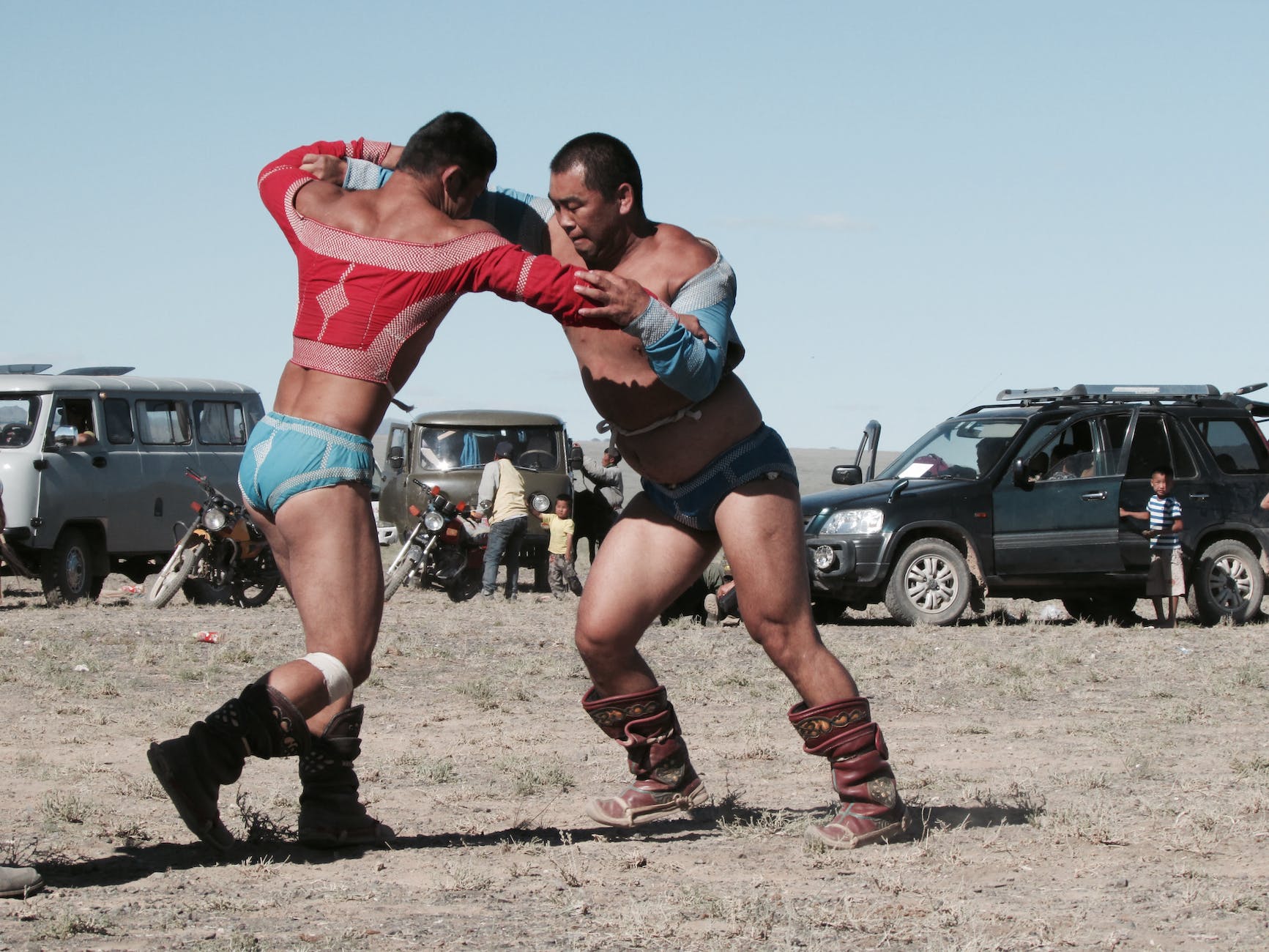
Wresting is, of course, older than martial arts, like Karate or Wing Chun, by thousands of years. This is not disputed. It seems that wherever men or women gathered, in any country, and conflicts needed to be resolved, wrestling naturally appeared as a way for this to happen, or as a way to keep people entertained, build a community connection, or in good physical shape for battle. It was a multi-purposed activity. For example, there has been Mongolian Wrestling for pretty much as long as there have been Mongolians. And it’s a tradition that has survived.
Modern Mongolian wrestlers. Photo by Agostino Toselli on Pexels.com
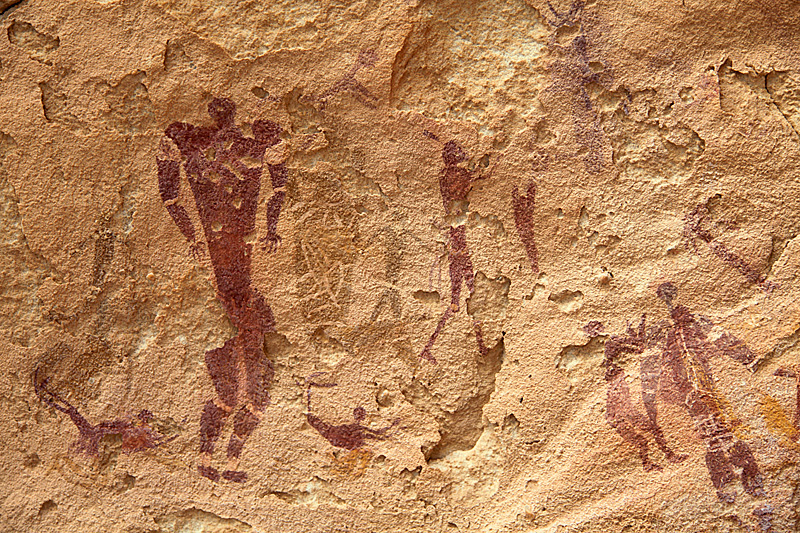
Cave paintings have been found in the Lascaux caves in France that have been suggested to depict sprinting and wrestling in the Upper Paleolithic time period, which is around 15,300 years ago.
Cave man wrestling?
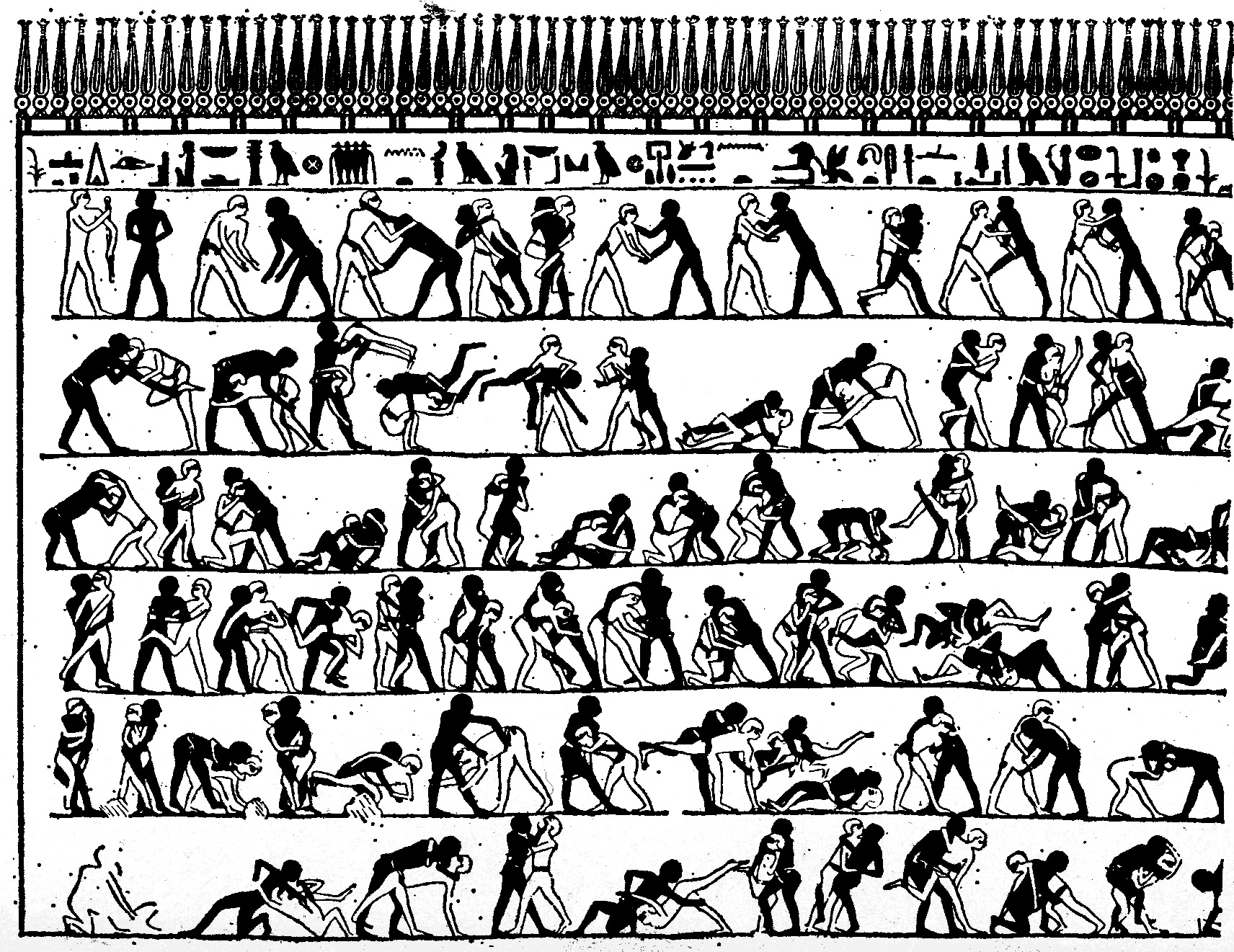
This Egyptian burial chamber mural from Khnumhotep and Niankhkhnum’s tomb dates to aroudn 2400 BC.
Wrestle like an Ancient Egyptian.
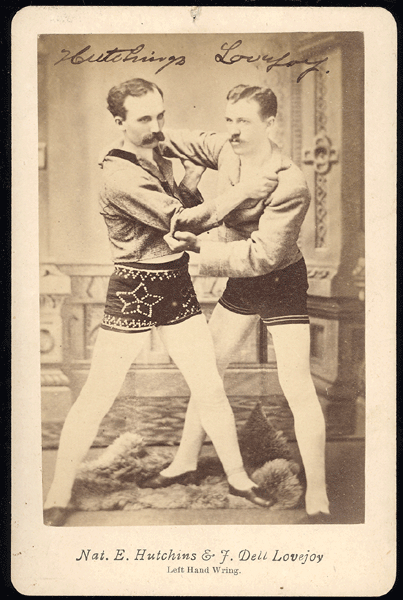
Almost every traditional culture has, or had, some form of indigenous wrestling. Many cultures that have evolved into living in villages, then towns, then cities have managed to maintain their wrestling traditions, even to the modern day. But most we have lost. For example, Collar and Elbow Wrestling was hugely popular in Ireland in the 19th century and spread to America where it again proved hugely popular with thousands of people coming to watch matches (even President Abraham Lincoln was a practitioner!)
Collar and elbow from the 1880s.
But huge changes in where people lived and worked lead to its demise until it vanished completely even in its native country. It seems that whenever a country experiences its industrial revolution, requiring massive shifts in population distribution, the folk traditions tend to die off, and wrestling is a folk tradition.
But that does not mean it is the original of Karate and Kung Fu.
I appreciate that you might not agree with me, so let me give you an example.
This video is comparing a karate technique to a Shuai jiao wrestling throw:
Yes, the movements have a physical similarity, but you are never – never! – going to learn how to do that throw by doing that kata. I mean, you could make that work so long as you only wrestle fellow karate practitioners and never ever get in a match with somebody who actually does wrestling. Then you’ll be fine. 🙂 Was this the original application of this kata? Who knows? But to assume ‘yes, it must be wrestling’ is such an illogical leap that to me it’s going too far. If you want to learn wresting, then just train wrestling. It’s that simple.
Here’s the Karate Nerd with a similar take on Karate Kata. Now, I quite like the Karate Nerd, so this is not an attack on him, but rather just an example of the current trend in marital arts regarding wresting applications and where it’s going.
Anyway, I feel like I’ve made my point and I’m just repeating myself now, so I’ll leave it there. But let me just recap one last time. Yes, there are some wrestling application in Karate and Kung Fu, yes you can re-engineer pretty much any movement to make it into a wrestling move, and no that does not mean that “it’s all wrestling“.
What is Shamanism? And how does it relate to martial arts? In this episode I catch up with my old, friend and teacher Damon Smith to answer some of these questions.
Damon is an incredibly experienced martial artist with a background in various Japanese and Chinese arts including Karate, Kempo, Xing Yi, Baji and Choy Lee Fut. And those are just a few of the arts he’s pursued to a very high level.
But despite being a great martial artist Damon’s true love has always been Shamanism.
And while he’s no stranger to banging a drum, Damon’s shamanism is not the hippy dippy sort of practice you might associate shamans with, instead it’s a very down to earth and practical art, much like the martial arts he does.
In this episode we talk about the link between martial arts and shamanism, and where the crossovers lie.



 The Tai Chi Notebook