Episode 40 of the Tai Chi Notebook Podcast is out on Spotify, Apple Podcasts and elsewhere.
I’m joined by my friend Benjamin Palmer. Ben has been running a Xing Yi Quan training group in deepest darkest Somerset for a good few years now, but Ben has also been training Mishima Kempo, an eclectic Japanese martial art and is thinking of starting a class in that soon.
We share the same Xing Yi teacher, Damon Smith who has been a previous guest on my show.
I visited Ben’s Xing Yi class a couple of weeks ago to teach his group some grappling and afterwards we sat down for a chat, and a nice cup of tea, so here we are in Ben’s kitchen!
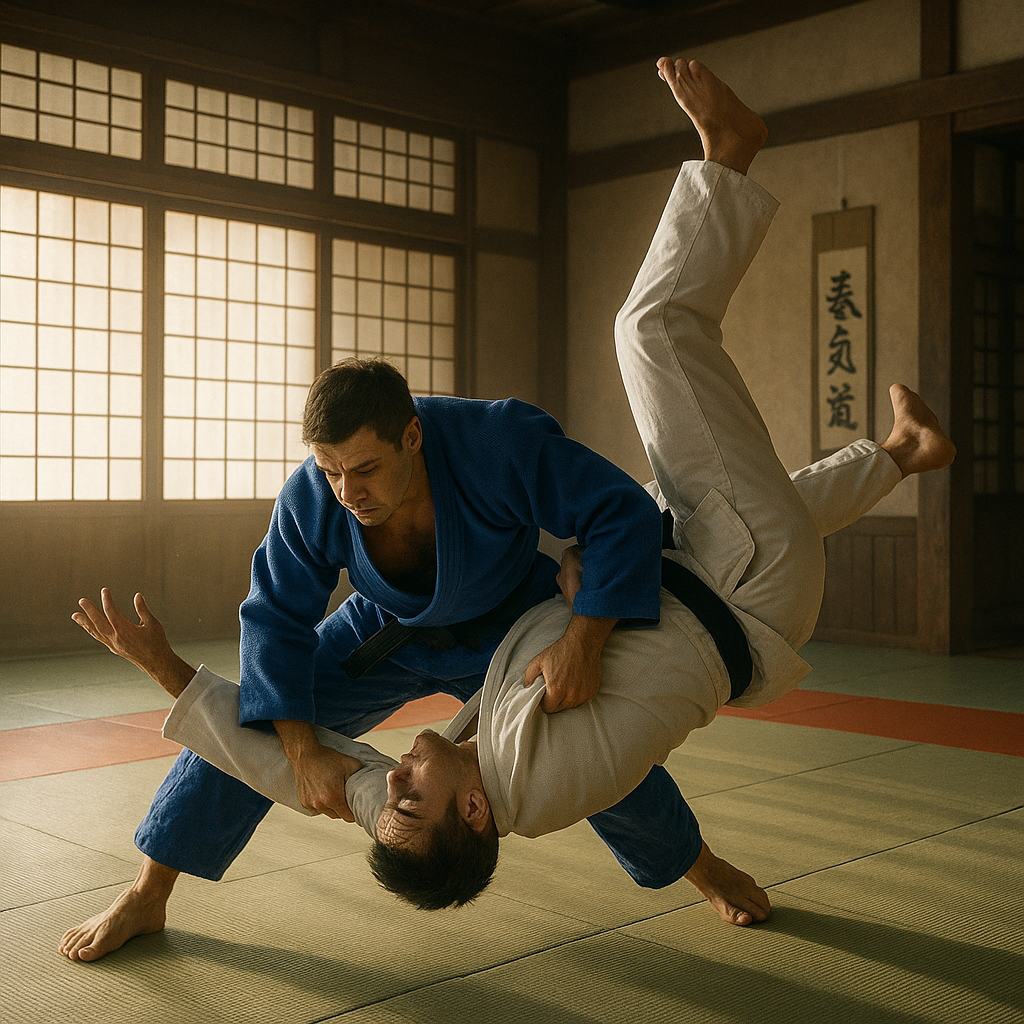
Judo and (Brazilian) Jiu-Jitsu might have exactly the same origins, but they’ve gone down really different paths in their evolution. While Judo has focused more on the sporting elements and becoming an Olympic grappling sport, BJJ has always wanted to keep things closer to its Value Tudo origins, which evolved into modern MMA.
Even today, many BJJ classes have a strong self-defence element, however BJJ is a broad church and some associations and classes are much more orientated towards sport grappling, particularly the no-gi variation.
One of the frequent criticisms of modern Olympic-style judo was that it had sacrificed too much realism in pursuit of beautiful big throws in competition. One way it did this was to make any grab of the pants or legs illegal. This seemingly simple rule change had dramatic effects on the sport. Since the legs were no longer a target the stance of judo players became more upright in their stance, leading to more possibilities for big dramatic throws.
Remember, under Judo rules a match can be won with an Ippon, a throw that lands the opponent on his or her back. In BJJ no such rule applies – a spectacular throw simply earns you two points and the match continues.
All Japan tournament rules
I hadn’t noticed before, but there has been a recent rule change in judo, in a particular Japanese tournament called the All Japan Championship, that means you are allowed to grab the legs again, opening up a whole range of possibilities for long-forgotten judo techniques to make a reemergence.
There are some restrictions though. To grab the pants you have to have a grip on the upper body with one hand, and you cannot grab the legs with two hands. This rules out popular BJJ and wrestling techniques like the single leg or double leg.
Will the new rules get adopted by wider judo federations and ultimately the Olympics? It’s unclear at this stage, and too early to say, but it will mean that going forward, judo could end up looking very different to the way it does now.
Traditional martial arts, which are perhaps better described as “martial arts that are not sports”, tend to have a lot of forms, or kata. I’m thinking of karate, tai chi, wing chun, choy li fut, etc.
But what exactly is the role of kata, or forms? And has it changed over time?
In this new episode of the Heretics podcast I discuss the role of kata with Damon Smith who has extensive experience in various martial arts over decades.
It certainly became very trendy once MMA became a big deal to describe forms as useless, however, I think they do have uses, even today. As usual Damon has some pretty interesting insights into how forms have changed over time, and he can look back to the way they used to be trained in the 1980s compared to today.
My friend Brett teaches Mishima Kempo in Cornwall, and has just updated his webpage with a really good page that answers some questions about what Kempo is and he also has a more detailed page on its history. It’s well worth a read if you want some good information about Kempo.
So what is Kempo? Well the short answer is, to quote from Brett’s page:
Kempo is not a martial art, but rather “Japanese martial arts of Chinese origin or association”.
So, check out his web page for more information, especially if you live in Cornwall and are interested in training Kempo. If you want to dig a little deeper, we started the Heretics Podcast off with a series on the intertwined origins of JuJitsu and Kempo, and that’s still available to listen to.
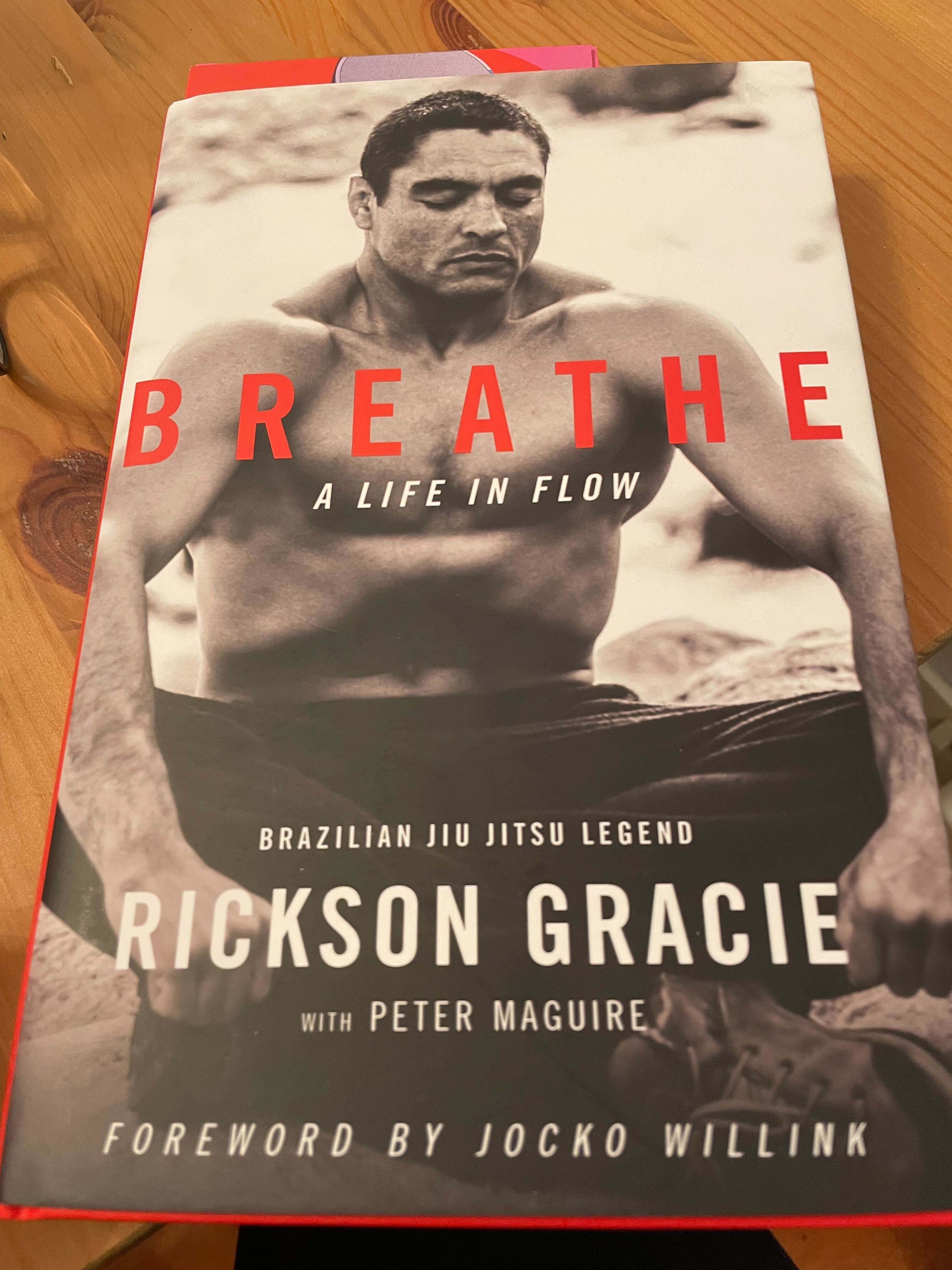
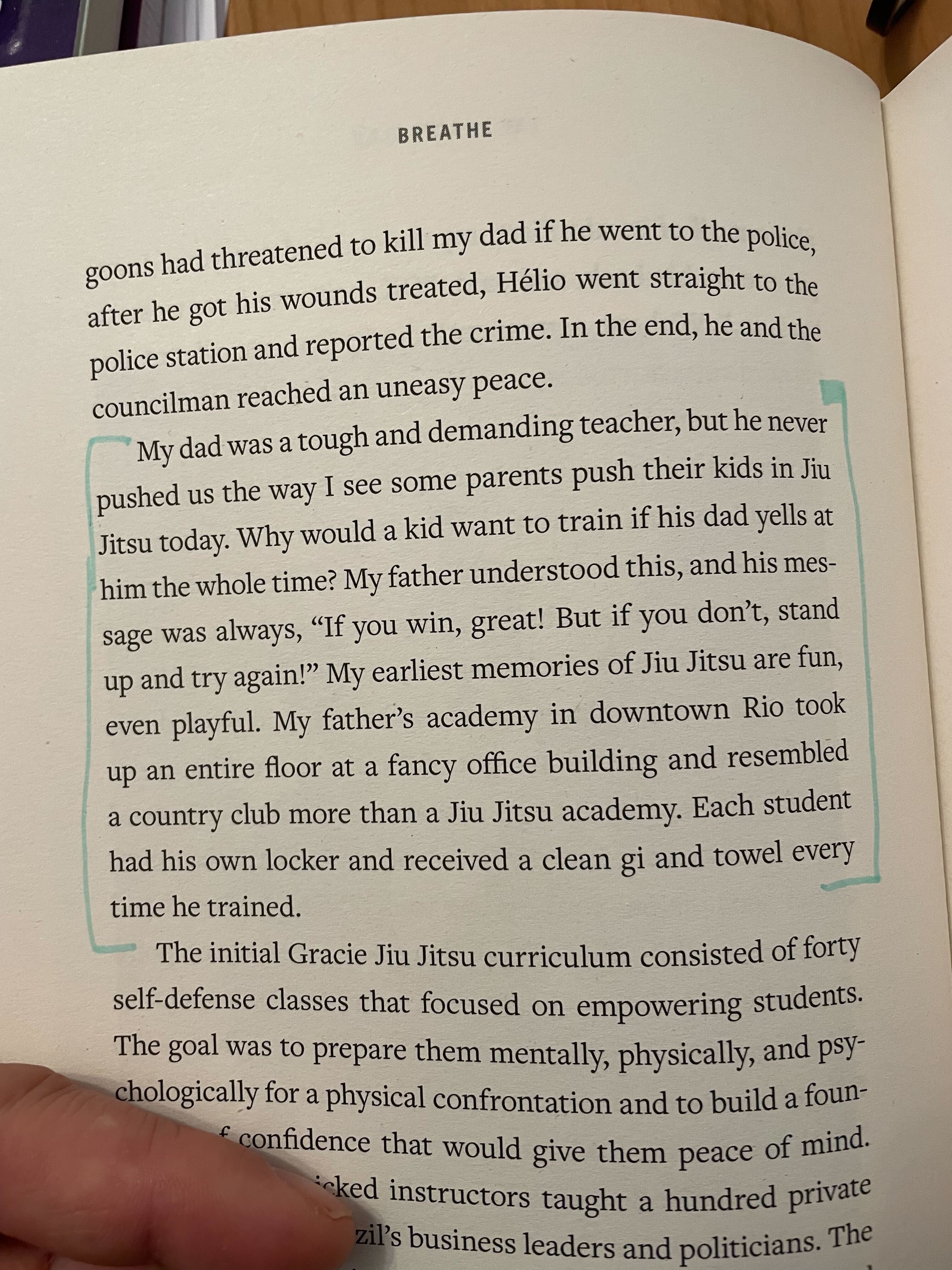
I’ve been finally getting around to reading Breathe by Rickson Gracie, which I got for Christmas last year, just before Christmas, this year 🙂 I found this paragraph near the start that resonated with me.
Over on the Heretics podcast Damon frequently talks about one of his great loves, Mongolian wrestling, and how they create the same relaxed, nurturing training environment, especially for children who start learning through games and just messing around, rather than structured lessons. The child’s natural sense of curiosity and playfulness is encouraged, not shut down, which seems to be the rule in many other ‘martial’ training systems.
The results of this type of training, is that Sumo at the highest levels is dominated by Mongolian-born Sumo wrestlers. The Japanese approach to Sumo training couldn’t be more different to the Mongolian wrestling approach, it is competitive, austere and harsh. The anecdotal evidence is that a more relaxed approach is actually better.
I’m not an expert of Sumo, or even follow it, so I don’t know, but I believe the best Sumo wrestler of all time is generally believed to be Hakuho Sho. Sho was born Mönkhbatyn Davaajargal in Mongolia. If you watch a few of his matches you can see that’s he’s a master of slipping and evading:
The classic BBC TV series, Way of the Warrior’s episode on Shorinji Kempo just appeared online, and it still holds up today.
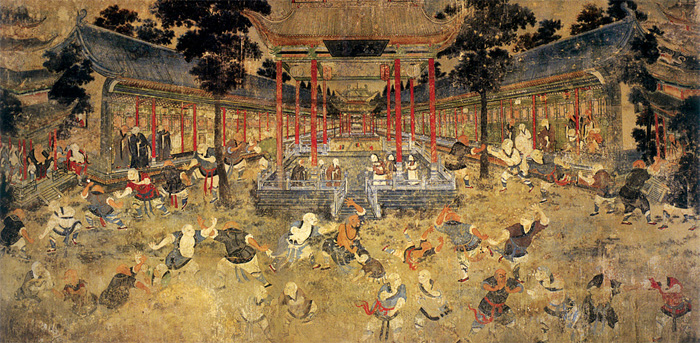
The BBC seem to have complete access to the style to film this, which at the time they say had a million followers and was floating on that ‘cult’ borderline, and it’s a fascinating glimpse into the past. Shōrin-ji kempō means something like Shaolin Temple Fist Way, and was established in 1947 by Doshin So after his time as a spy in China, where he supposedly trained at the Shaolin Temple. I think, as the documentary makes out, that his main form of training at the Shaolin Temple consisted of looking at the famous painting (which is not that old at all) of Chinese and Indian monks fighting. Like all Kempo styles his art is probably an eclectic mix of all sorts of different martial arts he trained in. However, he appears to have used that painting as the inspiration for his whole martial art! The Shaolin origins made a great backstory, anyway.
The mural painting from the Shaolin Temple.
While this is only one type of Kempo from Japan, you can see a lot of the elements we talked about in our Heretics Podcast, History of Kempo and Jiujitsu episodes, that seem to be recurring themes:
The blending of marital arts and religion (in this case Buddhism)
Far right political views
A sense of freedom in where you get techniques from (absorb what is useful)
Helping fight crime as a kind of unofficial police force
A lot of sparring!
What is also interesting is that the film shows the widespread use of the original Shorinji Kempo logo – the Swastica – that they replaced for all branches in 2005 with the so-en (double circle).
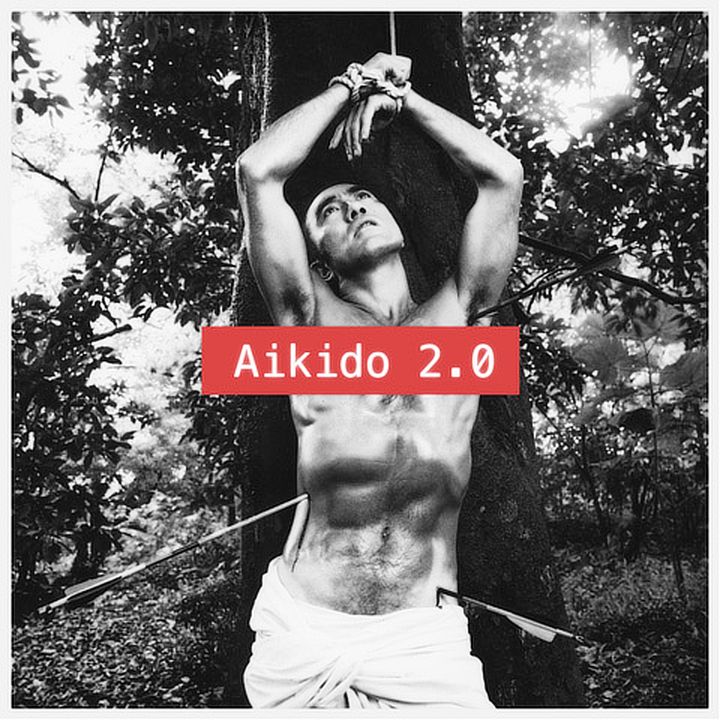
The world is full, or so it seems, of marital artists trying to fix Aikido by making it more practical/better/not as weird. I’m proud to say that my Xing Yi teacher, Damon Smith, (who studied Aikido himself for years) is joining the fray with a new podcast called (wait for it) Fixing Aikido! It’s a podcast where Damon gets together with another friend of ours, Tammo Trantow who is a highly ranked Aikidoka from Austria, and they set about the enormous task of, well, fixing Aikido and creating an Aikido 2.0.
Will it work? Is it a fruitless task? Even if you don’t practice Aikido, or you don’t think it needs “fixing”, it’s quite an entertaining podcast so give it a listen!
Oh, and while you’re here, you can also listen to the now infamous and highly controversial episode of our Heretics podcast that possibly inspired the whole venture. Aikido Heresies
Our new podcast is out! I talk warriorship with the esteemed Matthew Kreuger of the Walking with the Tengu podcast, as part of the #warriorshipconversing project started by Kung Fu Conversations podcast. We also talk about Shuai Jiao, Iaido, BJJ and professional wrestling. You’ll find us on iTunes and Spotify. Search for The Tai Chi Notebook podcast. Enjoy!
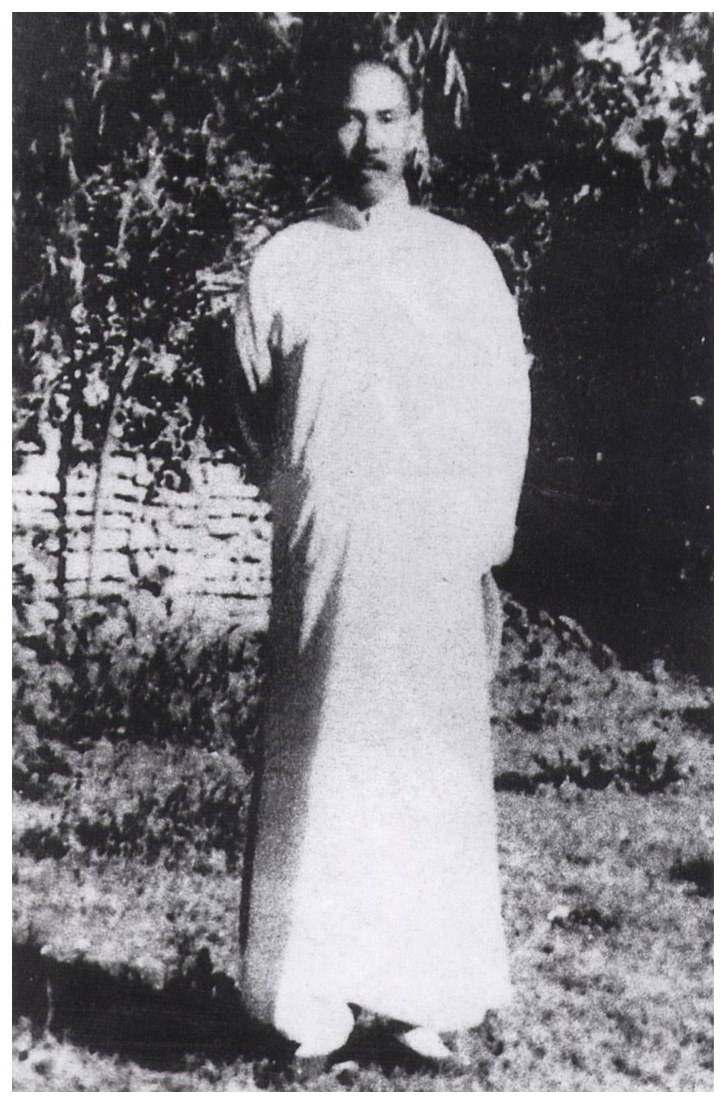
Somebody posted a quote by (founder of Yi Quan) Wang Xiang Zhai from his 1940s interview containing his thoughts on Tai Chi. It is pretty clear, unambiguous and to the point. Have a read:
Wang Xiang Zhai on Taijiquan (from an early 1940’s interview):As masters of the original Taijiquan, I should recommend the Yang brothers Shouhou and Chengfu. They are my friends, and I know that their Taiji has some knowledge of mechanics. But out of one hundred students, not even one gains its essence…and even then, it is still one-sided, because the skills of intuitive perception died out a long time ago. Originally, Taiji consisted of three fists, Wang Zongyue changed it into thirteen postures, and it was later embellished into as much as one hundred and fifty postures. This is the cause of the distortion.Sticking to mechanical movements, seeking beautiful postures and mistaking it for the glory of martial arts…that is terrible. Such a person cannot comprehend boxing for life. If a man of insight sees such a performance, he will feel sick for ten days.As a means of health preservation, Taijiquan restrains the spirit, and brings discomfort to its practitioner. For combat, it harms the practitioner’s limbs and trunk, and causes a useful body to become a mechanical and stiff thing…it’s nothing more than a waste of time.As for the training method—a punch with the fist here, a slap with the palm there, a kick to the left, and another one to the right—it is pitiful and laughable.As for dealing with an enemy in a fight: please do not even consider it. So ruined is this boxing that it has become useless. There are many more things, but I feel embarrassed to say them.
He doesn’t think much of Tai Chi, but there are some things to consider.
Wang was building a brand – Yi Quan – in a commercial setting. Setting out how you are different to/better than your competition is the first stage of building a brand.
2. This “three old fists” idea of history I don’t put much stock in. I think it’s a reference to the three old fists of Xin Yi (info on Jarek’s website), which he is therefore assuming as the origin of Tai Chi Chuan, but there’s not much of a link there that I can see. Or if there is, it’s very tenuous.
3. I think he’s criticising the Tai Chi training method, more than the art. He seems to hold the Yang brothers in high regard, but it’s their students and training methods he thinks are flawed. Wang was never a fan of forms training.
4. I think we need to consider what was happening in China in 1940. China has never (and still doesn’t) had a free press. If this was published it would conform to the political direction of the day.
From Wikipedia:
“In 1940, the Japanese set up the collaborationistWang Jingwei regime, with its capital in Nanking, which proclaimed itself the legitimate “Republic of China” in opposition to Chiang Kai-shek’s government, although its claims were significantly hampered due to its being a puppet state controlling limited amounts of territory.
The United Front between the Kuomintang and the CCP had salutary effects for the beleaguered CCP, despite Japan’s steady territorial gains in northern China, the coastal regions and the rich Yangtze River Valley in central China. After 1940, conflicts between the Kuomintang and Communists became more frequent in the areas not under Japanese control. The Communists expanded their influence wherever opportunities presented themselves through mass organizations, administrative reforms and the land- and tax-reform measures favoring the peasants and, the spread of their organizational network, while the Kuomintang attempted to neutralize the spread of Communist influence. Meanwhile, northern China was infiltrated politically by Japanese politicians in Manchukuo using facilities such as the Wei Huang Gong.”
So while all this conflict with Japan is going on I think the general trend is towards westernising and modernising China, leaving behind the older traditions that had held China back. This interview – looking towards newer scientific methods of martial arts – is in keeping with that trend. Japan was also very into adopting western military methods and building an empire, like the British had.
5. Both Yang Shao-Hou and Yang Cheng-Fu died in 1936, yet Wang is talking about them as if they are still alive in the 1940s, so something doesn’t add up. This interview is either doctored, or was done a long time before it was published in the 1940s.
6. You can get a better idea of his larger themes by reading the whole interview.
What is Shamanism? And how does it relate to martial arts? In this episode I catch up with my old, friend and teacher Damon Smith to answer some of these questions.
Damon is an incredibly experienced martial artist with a background in various Japanese and Chinese arts including Karate, Kempo, Xing Yi, Baji and Choy Lee Fut. And those are just a few of the arts he’s pursued to a very high level.
But despite being a great martial artist Damon’s true love has always been Shamanism.
And while he’s no stranger to banging a drum, Damon’s shamanism is not the hippy dippy sort of practice you might associate shamans with, instead it’s a very down to earth and practical art, much like the martial arts he does.
In this episode we talk about the link between martial arts and shamanism, and where the crossovers lie.


 The Tai Chi Notebook