Traditional martial arts, which are perhaps better described as “martial arts that are not sports”, tend to have a lot of forms, or kata. I’m thinking of karate, tai chi, wing chun, choy li fut, etc.
But what exactly is the role of kata, or forms? And has it changed over time?
In this new episode of the Heretics podcast I discuss the role of kata with Damon Smith who has extensive experience in various martial arts over decades.
It certainly became very trendy once MMA became a big deal to describe forms as useless, however, I think they do have uses, even today. As usual Damon has some pretty interesting insights into how forms have changed over time, and he can look back to the way they used to be trained in the 1980s compared to today.
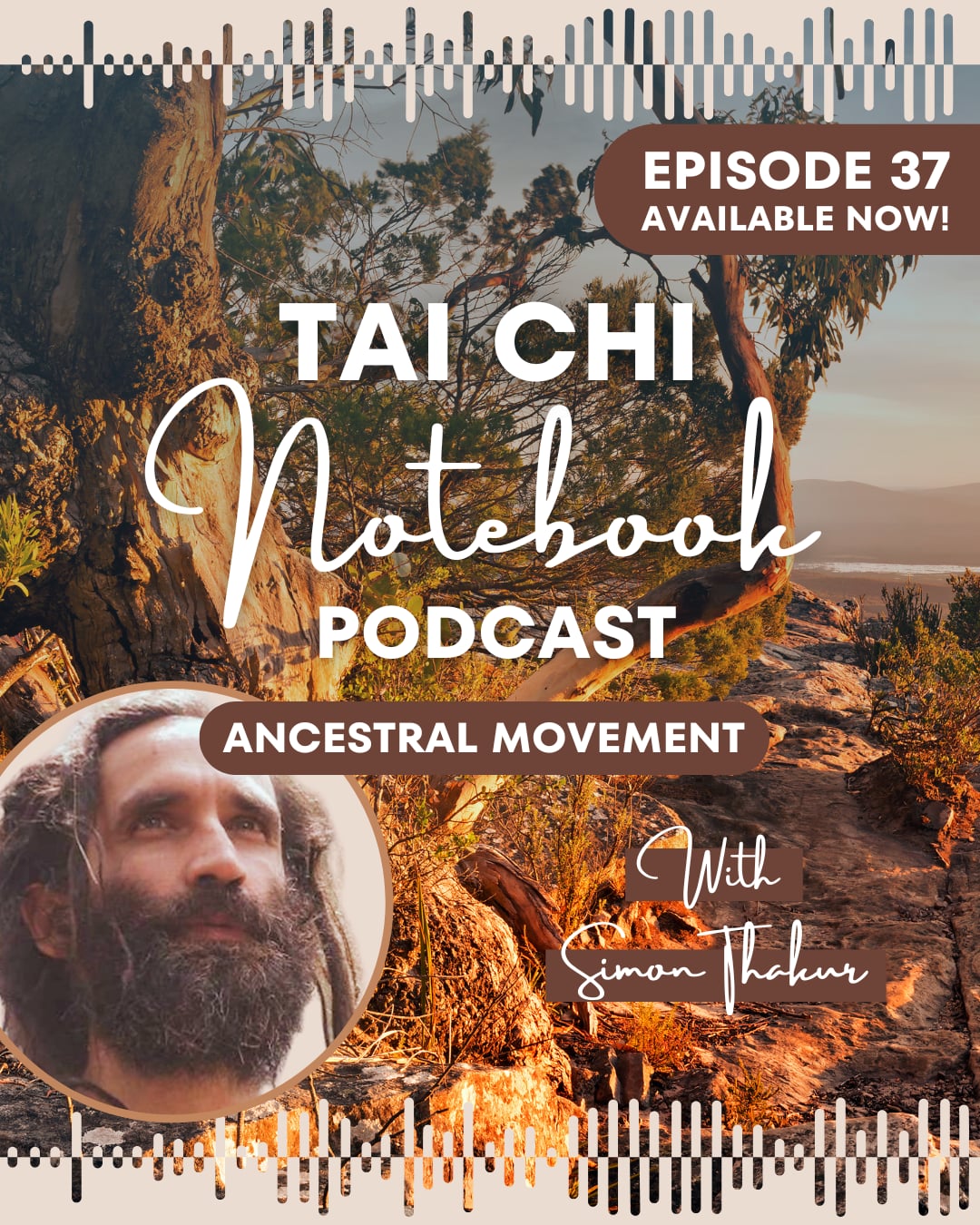
Simon Thakur is the founder of Ancestral Movement, “An ecological approach to movement and mind-body practice, exploring ancient ancestral patterns of movement and awareness built into our bodies, rediscovering the power, grace and ease of natural movement and our bodies’ innate connection to the rest of the living world.”
In this episode we talk about many subjects including Yoga, Chinese Martial Arts, Brazilian Jiu-Jitsu, Tai Chi, Shamanism and more!
My friend Brett teaches Mishima Kempo in Cornwall, and has just updated his webpage with a really good page that answers some questions about what Kempo is and he also has a more detailed page on its history. It’s well worth a read if you want some good information about Kempo.
So what is Kempo? Well the short answer is, to quote from Brett’s page:
Kempo is not a martial art, but rather “Japanese martial arts of Chinese origin or association”.
So, check out his web page for more information, especially if you live in Cornwall and are interested in training Kempo. If you want to dig a little deeper, we started the Heretics Podcast off with a series on the intertwined origins of JuJitsu and Kempo, and that’s still available to listen to.
Here’s my latest podcast! Mantis boxing, BJJ, Self Defence and heresy in martial arts with Randy Brown.
Randy Brown is a Mantis Boxing and BJJ black belt coach teaching in the USA. In this podcast we explore how Randy has reworked his Mantis Boxing to explore the grappling potential hidden in its forms and how they can interact with his Brazilian Jiujitsu. We talk about a range of subjects including self defence vs sport, weapons vs barehand and how to turn dead systems into living arts again.
I had an interesting comment on my last post that made me think about the whole idea of making up your own forms (or Tao Lu) – in Tai Chi, Xing Yi, or whatever.
I’ve tried to do this over the course of several years and I’ve come to a few conclusions about it, which I’ll elaborate on here. Firstly, it’s hard. Making up new forms is not as easy as you think. But secondly, it depends what martial art you are making up a form in.
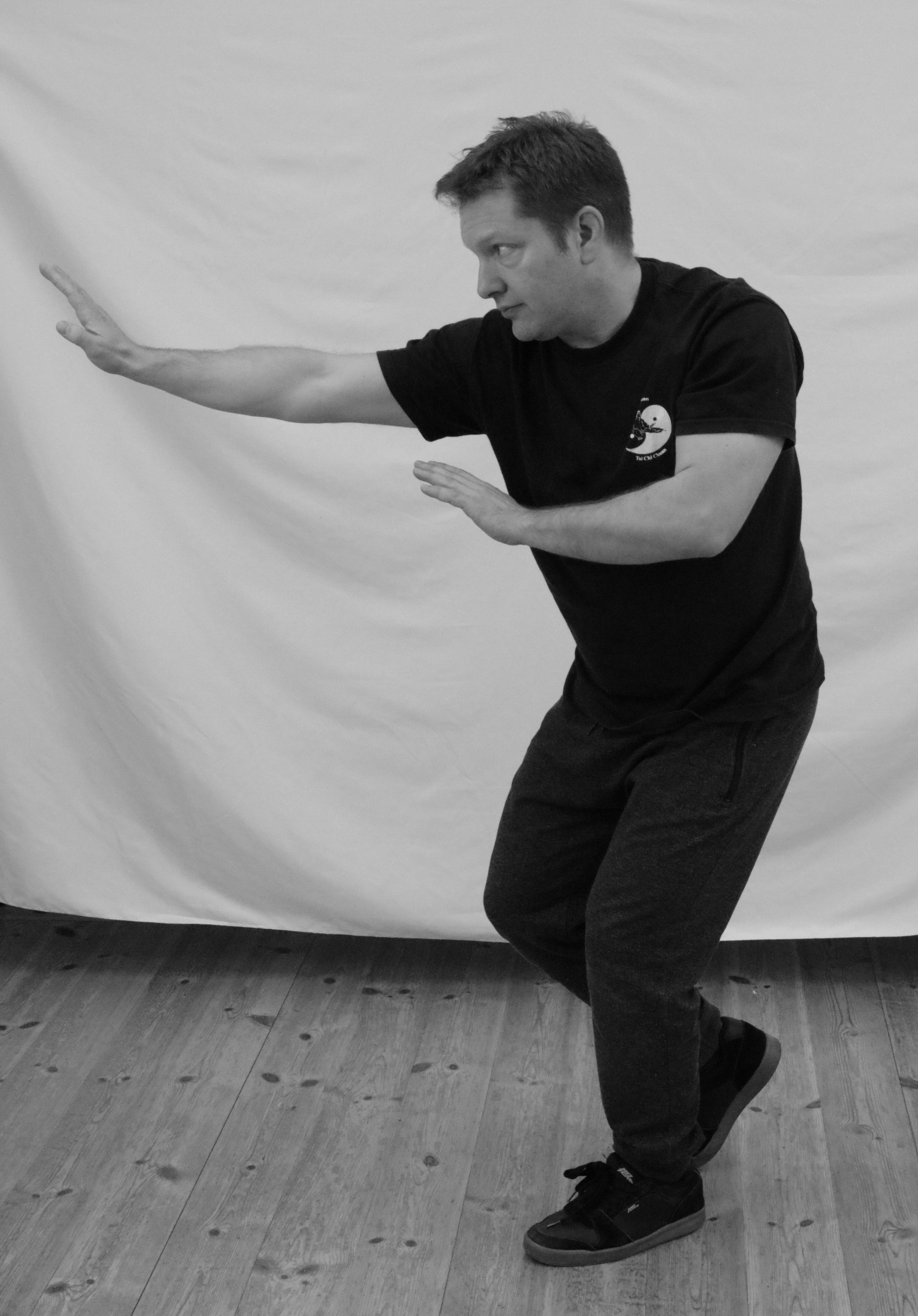
Author, performing Xini Yi Chicken (Ji) posture
If your martial art has forms that are constructed like lego bricks that can be slotted together in any order and still seem to work then it’s pretty simple to concoct a new form. Xing Yi is a good example of a martial art that has this quality. I was always told never to call Xing Yi tao lu by the English name “forms” because the correct term was lian huan which means “linking sequence” for this very reason.
The idea, (in our Xing Yi at any rate), is that all the links you learn are just examples, and you need to be constantly moving towards being able to spontaneously vary them as required, and then ultimately spontaneously create them. This idea has become heretical in the modern Xing Yi world to a large extent because modern Xing Yi has lost a lot of this spontaneous feel it used to (I admit that’s a subjective point) have, and things have become set in stone – forms that were once supposed to be fluid and flexible have become fixed and rigid. Forms of famous masters from the past now tend to be fixed forever. When words like “orthodox” start appearing to describe something you know it’s already dead, or on the way to dying.
But of course, anybody can make up a form, but is it any good? That’s a different matter. And it usually depends on the person doing it, not the moves themselves. With Xing Yi animals you can also ask the question – can I see the character of the animal being used coming out through the moves?
With Tai Chi I find it a lot harder to make up a form. Tai Chi’s approach to a form is quite different to Xing Yi, or other Kung Fu styles. The Tai Chi form tends to be a highly crafted piece of work that has been honed to perfection over many years. It is fixed because you need to be able to forget about the moves and concentrate more on what’s inside. It helps to do that if you don’t have to worry about what’s coming next because you’ve done it so many times that you can let go of that part of your brain and let it be aware of other things.
Tai Chi forms tend to start and finish in the same place for this reason. Usually, anyway. While long forms don’t tend to be balanced on left and right, a lot of the more modern, shorter forms make more of an effort to balance left and right movements.
If you understand Tai Chi and how to ‘pull’ or direct the limbs from the dantien movement then, sure you can make up your own Tai Chi forms, however, there is almost zero history of doing this in Tai Chi circles and it’s not really encouraged. I think this is because Tai Chi has push hands, which can be used as a kind of free-form expression of Tai Chi, completely away from the form and in contact with a partner to give you something to respond to, which is the whole strategy of Tai Chi Chuan, at least according to the Tai Chi Classics it is. To ‘give up yourself and follow the other’ you have to be spontaneous. There’s no other choice!
So, to conclude. I think that’s it’s in its application where the spirit of improvisation and spontaneity can be found in Tai Chi, not in the forms. I don’t think Tai Chi is particularly concerned with creating endless variations of forms and patterns like Xing Yi is, at all. Xing Yi, having a weapons starting point, doesn’t use this hands-on feeling and sensitivity to get started with spontaneity. Instead, it likes to create patterns, then vary them endlessly. Of course, you work with a partner when required, but it’s a different approach. Which is all quite natural, as these are two different martial arts, created by entirely different groups of people in a different locations and time periods.
You might like our Heretics history of Tai Chi and Xing Yi for more on that.
We often label other martial arts groups as a cult, and laugh at their silly behaviour and rituals, but at the same time we are a bit blind to the cult-like aspects to the things we do, because that’s ‘normal’ to us.
I went to a different BJJ school one time and they kept making jokes about my home school being a cult because we have to wear an official gi when training, which is more expensive to buy than a normal gi. There were a few other things mentioned, but that was their main issue. A white belt from another branch of my school had visited previously and he had committed the cardinal sin of facing the corner while tying his belt – that was apparently also a sign of a cult and they recounted the story with much hilarity – “I thought he was having a piss in the corner!”.
However, in that school I observed students doing several things that were equally cult-like, but were apparently completely normal to them:
If you stepped on the mat without bowing, that was 10 burpees.
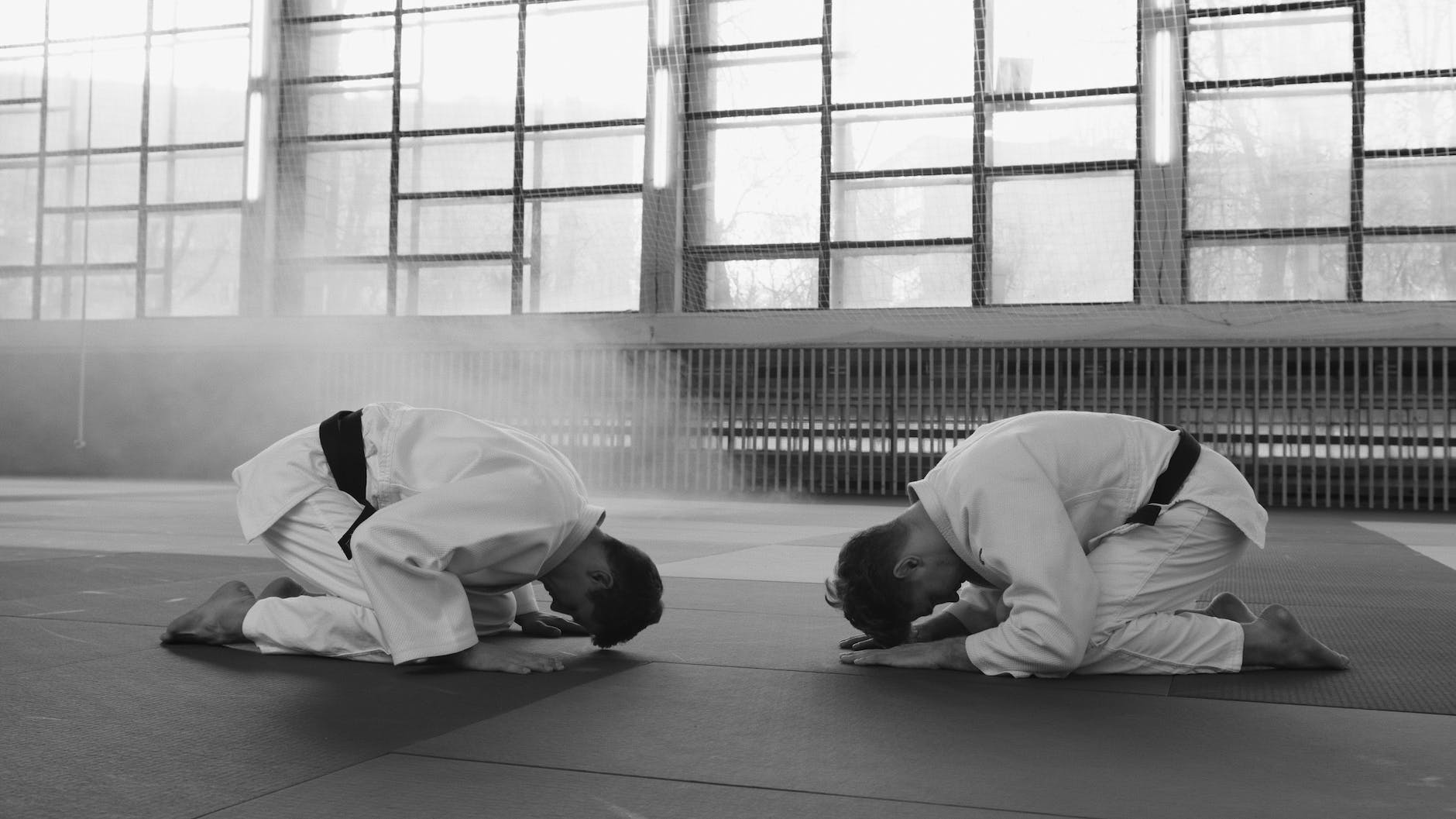
Classes started and ended by lining up and bowing to the teacher.
I (a grown man) had to ask permission from the teacher to have a sip from my water bottle, or if I wanted to leave the mat for any reason. And then ask permission to come back on.
If a black belt asked somebody to roll, they weren’t allowed to say no, even if they had already agreed to roll with another person.
Now we do some of those things in my school too – we line up and bow at the start, for example, and bow onto and off the mat, but some of those things we don’t do. However, they’re all just different versions of showing respect to each other before and during training. We are learning techniques that have the ability to kill and maim, and people could easily get hurt in the training if we weren’t respectful of our partners safety. Building an atmosphere of respect around the training will hopefully instill that in the actual training.
There is something of an uneasy tension in modern martial arts between capitalism and customs. In modern times the people in a martial arts class are usually paying to be there – they are, as modern capitalism likes to call it “paying customers”. The phrase “the customer is always right” has not entirely entered the martial arts vocabulary yet. It still retains these throwbacks to its “traditional” student and master martial arts heritage, for the reasons outlined above.
But let’s not muse on capitalism too much. The point of this post is to draw attention to the blind spots we all have. To return to that BJJ school – the higher belts were technical, but also fighty without being overly aggressive or dangerous, and the instruction was good and clear, the rolls were good too. But I could have done without the undercurrent of tribalism that that had been instilled in the students and was reinforced by the higher belts.
I think it’s worth repeating that all martial arts are cults, and if you think yours isn’t… then isn’t that exactly what a cult member would say? My attitude is to accept the various rules and customs of each particular cult or organisation as the price for them existing. Without any rules anarchy and disorder would break out and there would be no club at all. The Xing Yi classics famously say – “There is only structure, and there is only Chi”. With no structure, the Chi just leaks all over the place, and with too much structure I guess it can’t flow anywhere. A happy medium is what you’re after.
We (human beings) have the same attitude to our own bodies as well – we don’t see our own blind spots. The way we walk feels natural to us, but that might involve pointing the toes outwards at 45 degrees, compromising our lower back, instead of forward, for no good reason except habit. We might have been doing that for 30,40,50 years, and will probably keep doing it until the day we die without question, until somebody comes along and points out our blind spot, at which point it has become our ‘normal’ and it feels weird to walk in any other way.
A little period of self refection on the subconscious and conscious beliefs we hold true, without thinking about them, is always a good thing.
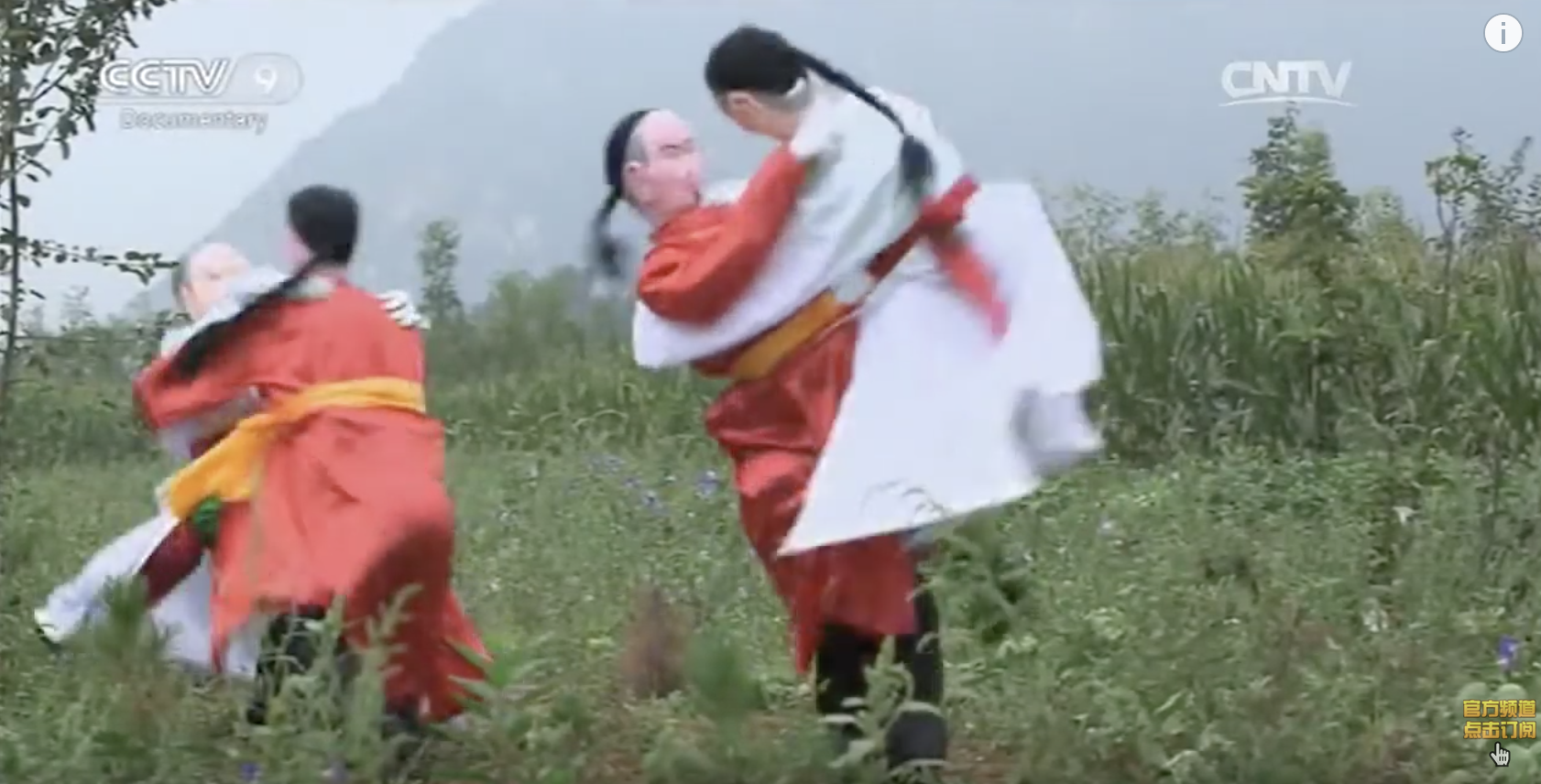
In the last episode of the Heretics podcast we talked about Chinese wrestling – Shuai Jiao – but Damon also mentioned Manchu wrestling quite a bit. He described it, but you can’t get a proper idea of how it works without seeing it done, so let’s look a little closer.
Manchu wrestling is a unique form of puppetry popular in certain parts of China where the participant wears a life-sized puppet of two wrestlers in a costume that turns ther legs and arms into both the puppet’s legs. Various wrestling maneuvers are then performed. The skill is to make it look like the two puppets are really wrestling and pulling off moves on each other.
To a western martial artist interested in only “learning how to defend myself” this might all look a bit silly, but if you watch this documentary you’ll see that there’s quite a lot to it:
There are so many things here worthy of note.
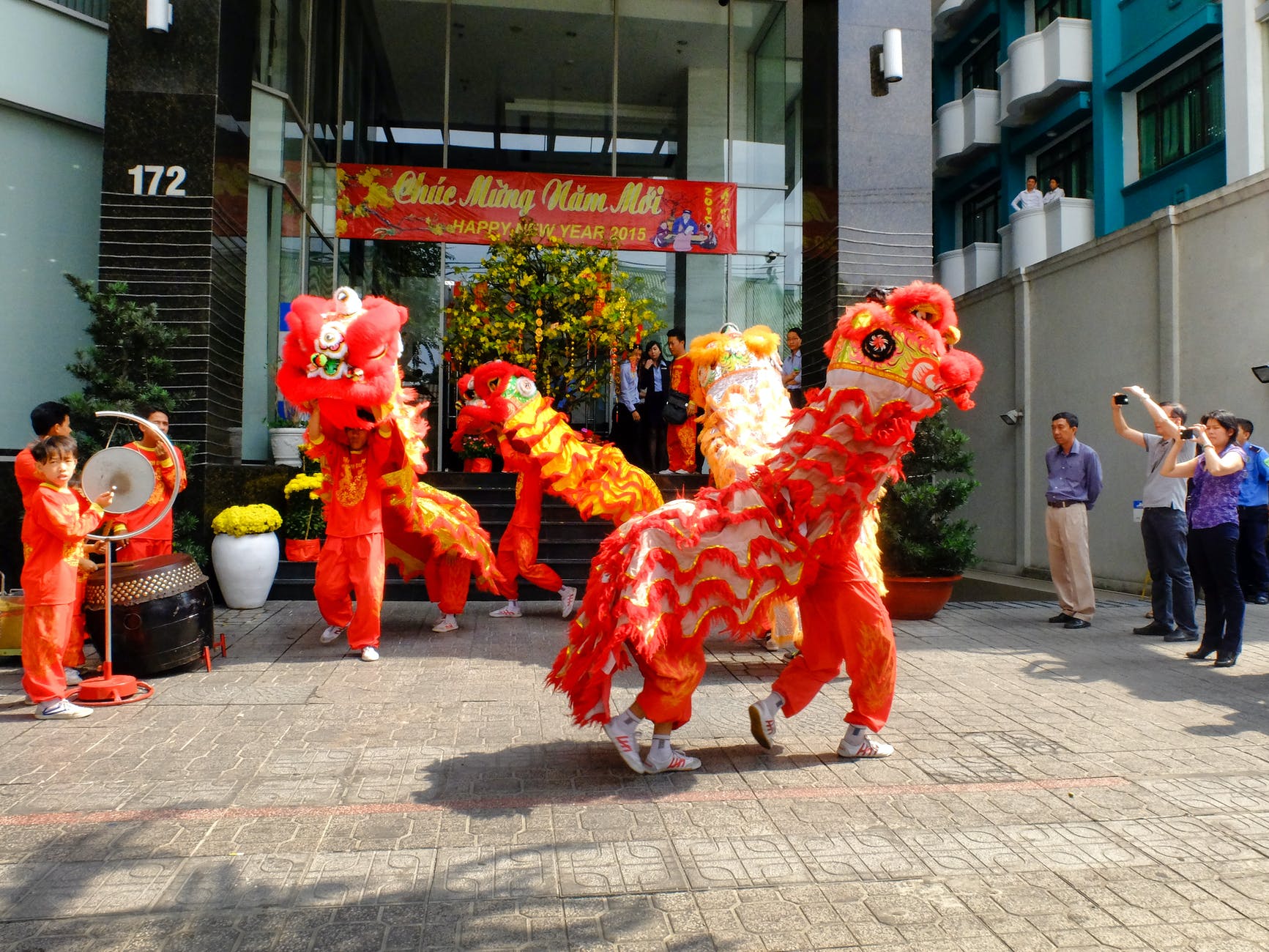
Firstly, the connection between puppetry and Chinese martial art is ripe for research – I’m thinking of the other famous puppet show that martial artists are known for – Lion and Dragon dancing. These cultural and religious practices are still done by martial arts groups at demonstrations and festivals.
Everybody in the Manchu wrestling documentary calls it “wrestling” even though it’s a solo drill. They don’t call it a dance or puppetry. To them this is “wrestling”, but we’d never call it that in Britain, for example – I find that pretty interesting.
It’s a damn good work out. If you’ve ever done any BJJ floor drills where you walk around on your hands and feet you’ll know that it’s instantly exhausting. Manchu wrestling will get you fit! If you don’t believe me then have a go at some of these drills before you tell me I’m wrong:
Manchu wrestling actually looks pretty dangerous – you can easily break a wrist with the high-speed spinning they’re doing, especially if the stick you hold in the shoe breaks.
Mental health benefits: a part of the documentary is focused on the mental health benefits of Manchu wrestling, especially looking at its life-changing benefits for rural Chinese women whose lives seem to be reduced to raising children and farming. I found this interesting in light of how much mental health benefits are talked about in BJJ culture – “BJJ saved my life” is a commonly used phrase amongst gym rats. Perhaps there is something inherently therapeutic about any style of wrestling movements and the human body?
There’s a new episode of the Heretics podcast out. In this chat, Damon and I discuss Shuai Jiao, the popular modern Chinese wrestling style and try and separate fact from fiction. We discuss what martial arts it is related to and also if there is a connection to Japanese Kempo.
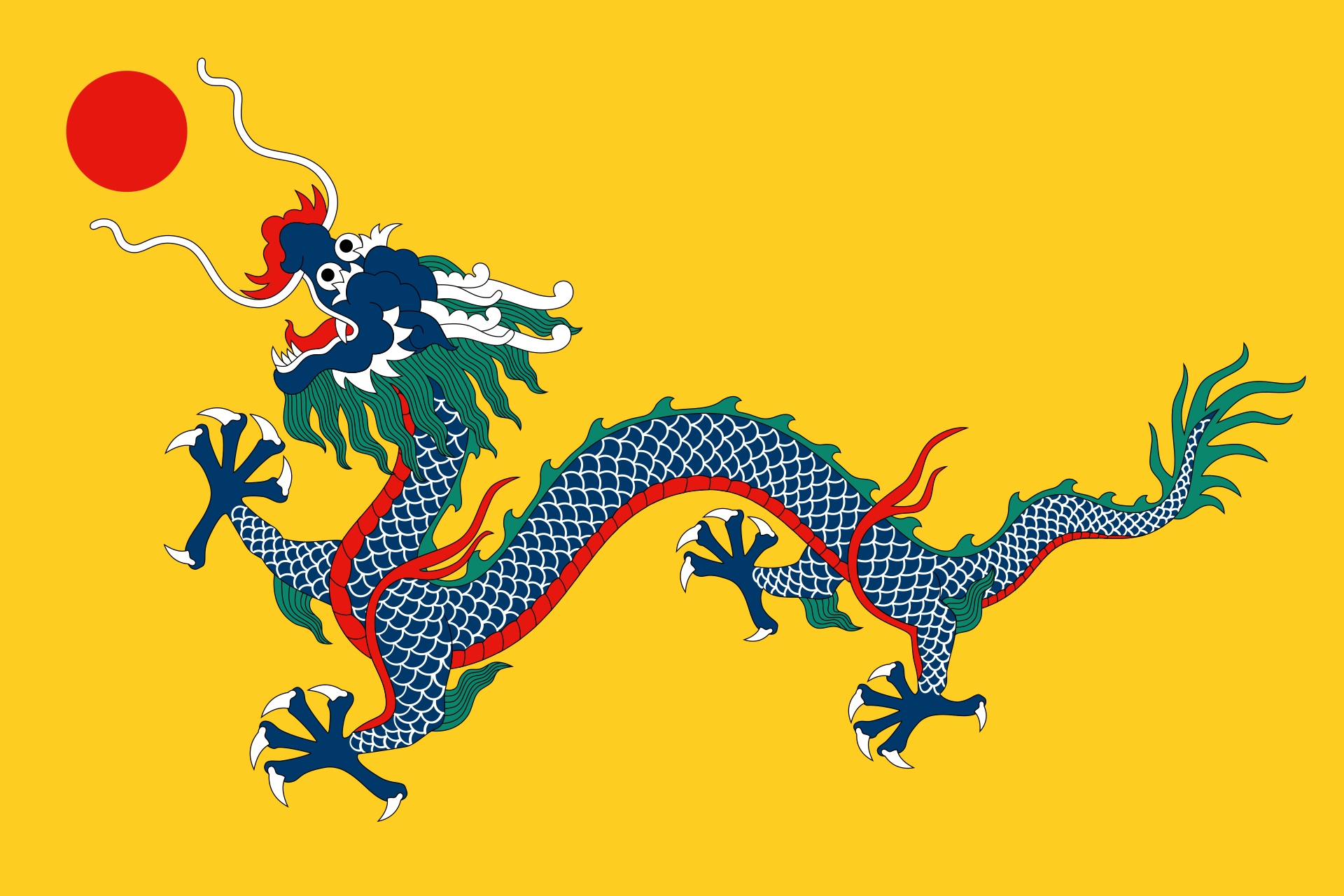
The best thing about this episode is that Damon talks a lot about Chinese cosmology, and how it may related to an earlier form of Chinese wrestling – we look at the cosmological concept of Qinglong, or the Azure Dragon.
The Azure Dragon on the national flag of China during the Qing dynasty, 1889-1912:
I really enjoyed watching the judo at this year’s Olympics. I thought the technical level on display was simply electrifying, which is why I find it odd that people sometimes refer to judo as dumbed-down jujutsu.
I’m a practitioner of Brazilian jiujitsu (which could be described as an offshoot of judo), and I’ve only ever dabbled in a few classes on Japanese jujutsu, so I’d hardly call myself an expert on it. However, from my experience, and what I’ve seen I’m going to make a bold and possibly controversial statement: Judo is more sophisticated than Japanese Jujutsu.
The question is what do I mean by ‘sophisticated’. I certainly don’t mean that there are a greater number or variety of techniques. There is certainly more content in the old jujutsu systems than there is in judo.
Kano created Judo by removing a lot of content from the Jujutsu systems he started learning in 1877, and changing the emphasis from performing kata and drilling applications to randori – free practice. There is also a big emphasis on competition in Judo. Strikes and weapon defence were originally part of Judo, but only in pre-arranged kata and are not included in competition and over time they have receded into the background. Most Judo clubs these days don’t even include the original kata or self defence techniques and simply train for competition.
Broadly speaking, the content Kano removed were the things that couldn’t be practiced safely in randori – throws that landed the opponent on their head, for example, or the sort of techniques that were designed for the battlefield and therefore irrelevant to civilian life. The change resulted in judo becoming the prominent style of jujutsu in Japan and internationally. The key to judo’s effectiveness was this switch in emphasis to randori. By trying to get the same moves to work over and over on resisting opponents, the technical level of the practitioner naturally rises. If you’re going to hip throw somebody in a setting where they know you’re going to try to hip throw them, then your setups for the technique have to evolve and get better. You cannot simply step in and expect your hip throw to work. You’re going to have to improve your ability to fake, shift weight, take balance and finish the techniques massively. This process produces a much more sophisticated level of technique.
Judo is therefore not “dumbed-down” jujutsu – it’s highly evolved jujitsu. To my eyes at least.
We talked a lot about Kano and the creation of Judo in our Heretics Podcast on the history of Kempo and Jiujitsu in Japan.


 The Tai Chi Notebook