How much practice is enough?

Photo by Andrea Piacquadio on Pexels.com

I remember reading in a Zen book that I enjoyed that you should not practice for yourself, but just practice for the sake of practice. I like that. There’s a kind of grim realism to it but it raises the issue of how exactly are you supposed to approach these sort of goaless activities, like Tai Chi and Zen? The sort of activities where even having a goal can become a problem because it interferes with the activity itself, because it needs to be about being open and aware in the moment, not thinking about things far off in the future. By definition, if you have a goal you cannot be ‘living in the moment’.

Watching that Bagua Boy documentary that I linked to in my last post I was struck by how much Mr Rogers had practiced over his lifetime. He said he spent a lot of years practicing for hours a day. It’s impressive, but it also sounds very lonely, and even if most people had the free time to do that, they wouldn’t. You need to have some sort of drive deep within you to practice anything that much.

Lots of people in the Tai Chi world practice for hours a day. Some people meditate for an hour a day. Some people stand in Zhan Zhuan for an hour.

Today I read an article by Sam Pyrah in The Guardian that asks the question, at what point does a fitness activity become a ball and chain around your neck? At some point she realised that her life long addiction to running had left her very healthy, but with a very narrow life, and at the end of the day, what was the point?

People start Tai Chi for all sorts of reasons and the reasons for doing it change over a lifetime. Since I discovered Tai Chi I’ve always practiced, but I tend to do my personal practice in little pockets of time scattered throughout the day, not in big chunks of hours at a time. Maybe when I’m too old to work I’ll do a lot more Tai Chi than I ever did before? Everything has a cost, and I wonder if the people who practice for hours a day sometimes sit down and smell the flowers and wonder if it was all worth it… Like the Bear of Little Brain, I’ve always valued doing nothing as a worthwhile activity.

Practicing a bit is good, practicing a lot is better, but sometimes you can practice too much.

Photo by brittany on Pexels.com

Tongue behind the two front teeth

If you’ve been doing Tai Chi, meditation or yoga for any length of time you’ll have heard the old adage to ‘put your tongue behind the two front teeth‘. The explanation given for this is usually that it “connects the two meridians that go up the back and down the front of the body called the Ren and Du meridians, creating the micro-cosmic orbit”.

Micro cosmic orbit connected… man. Photo by Elina Fairytale on Pexels.com

From a Chinese medicine or Taoist perspective the perceived wisdom seems to be that “circulation of the Qi/Breath in Ren Mo and Du Mo is a bit like an electrical circuit. The two ends of the vessels must be connected for there to be an uninterrupted flow.”

Personally, I have my doubts about the whole idea of ‘energy’ or Qi ‘flowing’ around the body. I often think it’s really an ancient aberration of the simple idea of forces moving inside the body. In Chinese martial arts there’s a phrase you often hear – rise, drill, overturn, fall, which matches this circuit in the body with a martial technique. The best example of which is Pi Quan from Xing Yi, during which forces in the body (jin) rise up and then come crashing down into a strike.

Strength and balance

However, it’s not just Chinese medicine that recommends this tongue position. I’ve recently discovered that there are a lot of Western sources advocating the same tongue position. For example, Colgate toothpaste has an article about correct tongue position on its website that recommends the exact same thing – the tongue resting on the upper palette behind the two front teeth. The article links to a study in Radiology and Oncology called “Three-dimensional Ultrasound Evaluation of Tongue Posture and Its Impact on Articulation Disorders in Preschool Children with Anterior Open Bite“, which notes that “children with poor tongue posture were reported to have a higher incidence of anterior open bite, a type of malocclusion where the front teeth don’t touch when the mouth is shut. This may be because the tongue puts pressure on the teeth which can shift their position over time.” (Colgate).

In this article from Healthline, Dr. Ron Baise, dentist of 92 Dental in London explains “Your tongue should be touching the roof of your mouth when resting… It should not be touching the bottom of your mouth. The front tip of your tongue should be about half an inch higher than your front teeth.

While dentists may be aware of the benefits of good tongue position for your teeth and preventing problems with your speech, or mouth breathing from occurring, some exercise enthusiasts are going further and claiming that proper tongue position actually increases your strength and balance, something that is undoubtedly important for martial arts, like Xing Yi.

Pi Quan is said to be like the swinging of an axe. (Photo by Ivan Samkov on Pexels.com)

Now, I’m as aware as the next Tai Chi blogger that cherry picking studies that confirm your beliefs (and presumably ignoring everything that doesn’t) is a bit of a red flag. However, the idea that your tongue position effects strength and balance makes more sense to me than imaginary energy channels (Du/Ren) that may, or may not, exist in real life.

Apparently, good tongue placement can give you superpowers!

I remain slightly skeptical about the whole issue, however, my tongue does naturally rest behind my two front teeth on the upper pallet of my mouth… I can feel it there now as I write this. Was it always there? Or have I turned this into my natural position thanks to starting Tai Chi in my 20s?… I don’t know. All I can say is that it feels comfortable, and if my Ren and Du channels are connecting because of it, and my strength and vision is better because of it then…. so much the better.

Investing in your neck can be a great way to get better at Tai Chi

Photo by Todd Trapani on Pexels.com

The Tai Chi classics talk a lot about keeping your head “as if suspended from above“, and “Head upright to let the shen [spirit of vitality] rise to the top of the head”, but they don’t mention the neck a lot.

Yang Chengfu gives it a brief mention to the neck in his 10 Important Points, but it’s not the focus of his writing: “Don’t use li, or the neck will be stiff and the chi and blood cannot flow through.”

As such, Tai Chi students don’t spend that long paying attention to their neck. I bet if you just started moving your head in a circle right now you’d hear all sorts of crunching and popping noises, right?

For the past few days I’ve been making an effort to work my neck with mobility exercises every morning, and the results have been quite astounding. Now, when I move my head around in a circle there are way less crunching and popping noises than their used to be. In fact, sometimes there are none at all. Secondly, the space between my neck and shoulders is really opening up. I can feel more room there and as such, my Tai Chi form feels quite different, in a good way. There are all sorts of nerve fibres in the brachial plexus, and having them cramped up all the time is not ideal.

I’ve talked about the importance of how you hold your head in a recent post, but I’m learning that correct head placement on its own can only get you so far – you need to invest in some neck exercises if you want to get the most out of your Tai Chi practice.

There are hundreds of different neck exercises, and I think you’re best off finding the ones that feel good to you, because they’re probably the ones you need. The three I’ve settled on are as follows, and should all be done gently *:

  1. Stir the soup – imagine there is a spoon hanging off your chin and resting in a bowl of soup. Move your chin in a circle one way so that the imaginary spoon stirs the soup, then move the other way.
  2. Diagonal Neck stretch – look forward and down to one side towards your armpit. Hang your same side arm over on the other side of your head to add a bit of weight to the stretch. Don’t pull hard downward, just add the weight of the arm. Do both sides.
  3. Reach both hands behind you against your lower back and pull down on the wrist of one arm with the other hand. Turn your head to one side, looking away from the arm you are stretching. Repeat on the other side.

You can, of course, add in others, like circling the head in the vertical plane. Try some neck exercises every morning and feel the difference it makes to your Tai Chi, and life in general.

  • * N.B. This is not medical advice – please consult a doctor before exercising.

Three more articles of mine you might like:

Rewire your brain in six weeks – the benefits of meditation

There’s an interesting article on the BBC website about how a six week mediation programme (that you can access free online) can produce measurable changes in the human brain. It’s interesting, but does end with the disclaimer that “A final note of caution – it is important to acknowledge that any brain changes we had seen could also be random“.

Photo by Mike Bird on Pexels.com

Tai Chi in 5 minutes a day

I’ve just finished listening to an interesting podcast where Dr. Rangan Chatterjee talks about about how to form daily habits in a way that actually works. The takeaway is that you need to make the habit as easy as possible and also tack it onto something you already do every day if you want it to stick. Dr Chatterjee makes the good point that we don’t have to force ourselves to brush our teeth in the morning and at night – we just do it. We don’t decide, oh, I’m a bit tired tonight or I’ve got a lot of work on, so I’ll just skip it for a couple of days. No, we just do it, and it’s easy.

Doing Tai Chi could be as easy as brushing your teeth. Photo by Andrea Piacquadio on Pexels.com

Forming a regular practice Tai Chi habit however can be hard. It’s very easy to convince yourself to not practice because you’re tired or just not feeling like it.

Tai Chi, Qigong or stretching is also a bit like brushing your teeth, because you don’t get much benefit from not brushing your teeth for a week, and then doing a massive 1 hour deep clean on a Sunday. No, brushing your teeth needs to be done a little every day if it’s going to work, and so does Tai Chi, Qigong and stretching.

Which brings us to the question of how we actually develop a strong practice habit like this for Tai Chi, and that takes me back to Dr. Rangan Chatterjee. Most of us make a pot of coffee, or cup of tea in the morning. It’s a ritual we’re already doing and nobody needs to force us to start doing. (If you don’t do this, I bet there is something similar you do in the morning?) What we need to do is start hacking that existing habit with the new habit we want to instill, in this case Tai Chi, stretching, standing, meditation, or whatever it is.

It’s all about maximising those moments of dead time. Photo by Rachel Claire on Pexels.com

While your coffee is brewing, stop looking at your phone and spend those minutes doing the thing you want to do. One thing I’ve started to do is pour the water on my tea bag, then do a stretching routine while it is brewing. This way I don’t need to rely on motivation to do the routine each morning, because motivation is great when it’s high, but a rubbish thing to rely on when you are feeling tired, rushed or grumpy.

Even a few minutes of whatever it is will make a difference. I already feel like I’m more flexible in my hips because of these few minutes. And doing those few minutes might make me feel like doing more immediately afterwards. Other ideas for things to do while the coffee is brewing would be some single arm silk reeling circles, some standing Qigong, or repeat small sections of the form, like Grasp Birds Tail. The choice is yours. Try it!

If you like this life hack then I’ve talked about a similar idea before to do with brushing your teeth in a horse stance. Check it out!

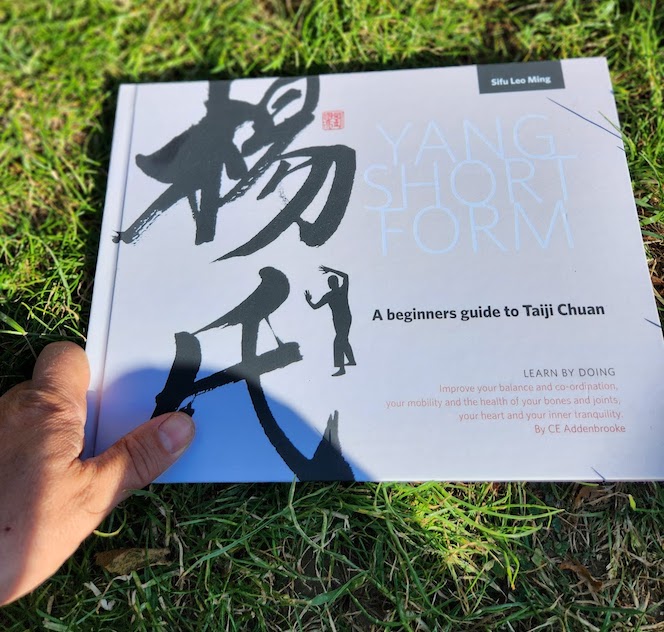
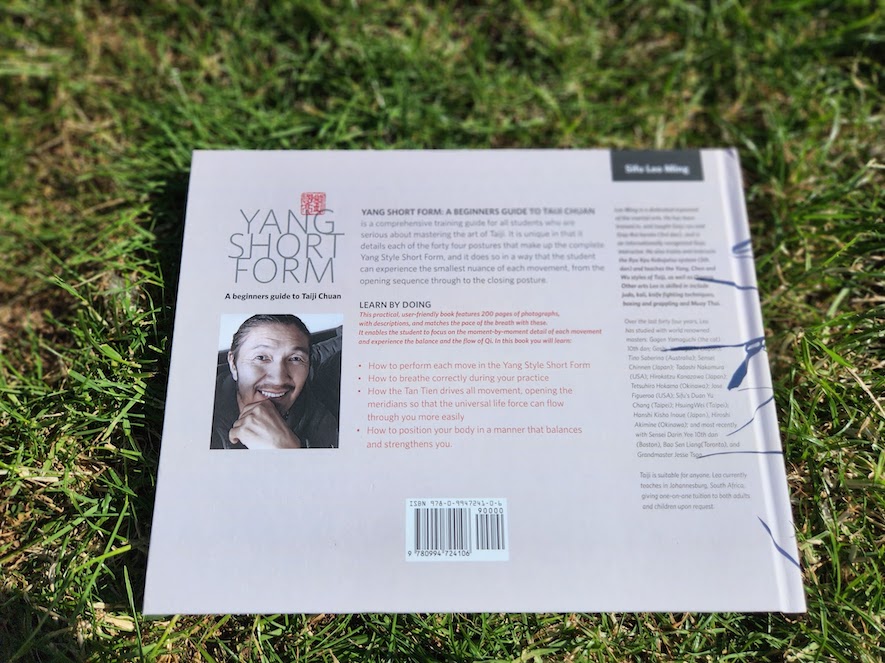
REVIEW: Yang Short form: A beginners guide to Taiji Chuan by Leo Ming and Caroline Addenbrooke

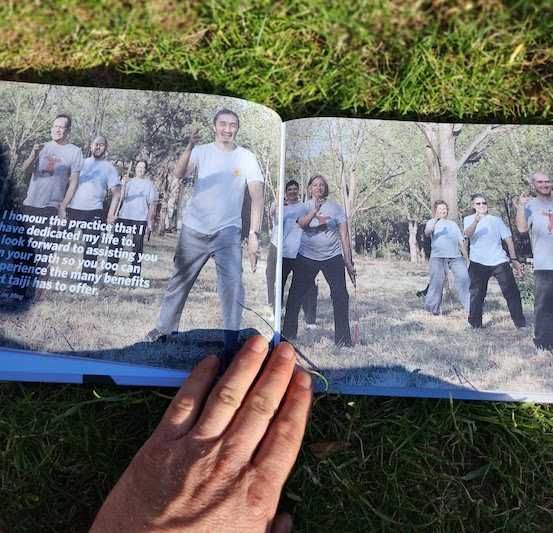
Yang Short Form: A beginners guide to Taiji Chuan, is a beautifully made, hardback coffee-table Tai Chi book, containing a brief section on history and principles of the art, over 200 colour photos mainly for showing you the form, a few verses from the Tao Te Ching to act as inspirational quotes and more.

There’s no denying that at an RRP of £49, it’s expensive. For people wondering why this book costs that much on Amazon (although you could pick it up for 18% less at time of writing), the high production values and hard cover explain the price. Printing in colour is expensive these days.

Sifu Leo Ming is the teacher who appears in the photos, and his student Caroline Addenbrooke is the author.

The main point of the book is to teach you the Cheng Man Ching short form, and if you view the book through the lens of ‘Can I learn a Tai Chi from this book?‘, it succeeds, I just have a few issues with some of the information presented here.

Consider the title

My problems start with the title, “Yang Short Form: A beginners guide to Taiji Chuan“. The Tai Chi form presented in this book is the Cheng Man Ching short form, which is certainly a Yang short form, but it’s a bit of a stretch to call it the Yang short form. People generally call it the Cheng Man Ching Short Form or the Chen Man Ching 37 form, which would have been a more accurate name, since Cheng’s form varies quite significantly from the official Yang form that belongs to the actual Yang family.

Secondly, the use of “Taiji Chuan” awkwardly mixes two different romanisation styles together in a way I’ve never seen done before, making it something of an outlier in the Tai Chi world. Tai Chi is usually either written Taijiquan/Tàijíquán (pinyin) or Tai Chi Chuan/Tai chi ch’üan (Wade-Giles), or shortened to simply “Tai Chi“. I find the decision making process of mixing the two systems together used here to come up with “Taiji Chuan” a bit baffling. Why do that?

Similarly, inside the book there’s a mix of different romanisation styles. Shaolin appears as “Shao-lin”, while changquan appears as “Changquan”, (so they’re happy to use pinyin there…) Dantien appears as “Tan Tien”. But Qi is “Qi”, not “Chi”, and Xingyi is “hsing-i”! I can’t work out the logic. In a way, so long as the system used is internally consistent it doesn’t matter, but it is a bit frustrating.

Finally, “beginners guide” is used in the title without an apostrophe! Well, that is just… wrong.

But, let’s move on from the title of the book and look at what we’ve got here. 

All the history all at once

The history section starts with a pretty safe phrase, “The history of Taiji Chuan is unknown”, and if it had stopped there I think I would have been happy, but it then goes on to tell a version of Tai Chi history anyway that includes every folk tale in the Tai Chi master’s repertoire! It talks about the classic Chan Sanfeng origin story, but also has the Chen village origin story straight afterwards before giving a brief rundown of the current styles of Tai Chi, before then pivoting back further into time and linking Tai Chi to the Shaolin Temple because that’s where “qigong theory” started… If you know anything about the history of Tai Chi you’ll know that these kind of myths are probably just that, myths, but they help the marketing of the art.

There are other problems with the accuracy of information, too – there’s a picture of a statue of Chang Sanfeng in the history section which is captioned “A statue in Chenjiagou depicting the legendary Chang San-Feng”. I thought that didn’t sound right. A quick 5 minutes on Google confirmed that his statue is of Chang, but it’s found (not surprisingly) in the Wudang mountains, not Chen village, as stated. Unless I’m wrong and there are two identical statues, but I don’t think so. The most famous statues in Chen village are the statues of Chen Chanxing and Yang Luchan.

The rundown of the different styles of Tai Chi in existence today is accurate, but if you want a proper investigation of the history of Tai Chi, I’d suggest looking elsewhere.

The section on principles of Tai Chi is also very brief. It’s all the usual advice you find in Tai Chi books about relaxing, centering, evenness and slowness, etc. There’s nothing wrong here, but it’s very surface level.

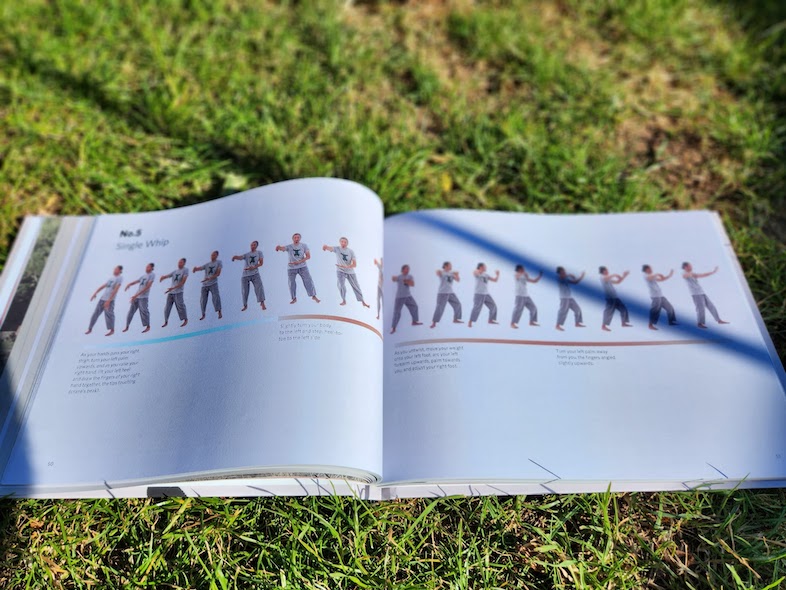
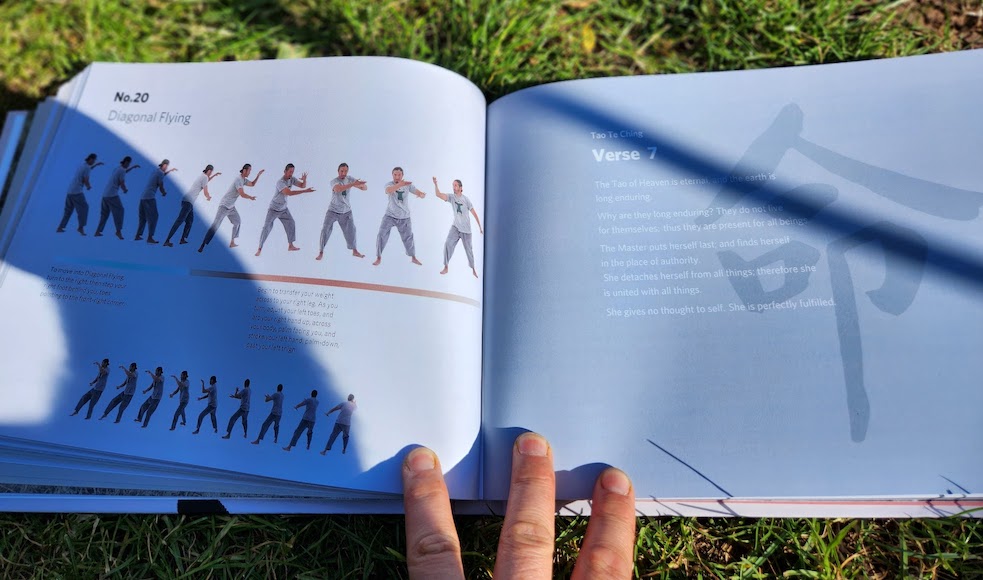
Teaching forms is where Yang Short Form gets it right. The book uses the method of breaking down each move into tiny fragments and showing them next to each other, conveying the sense of movement through the form nicely. As such you can definitely use the book as an aid to memory of this form, or even teach yourself the form from it. Take a look at this example of Single Whip:

Diagonal Flying:

Of course, Tai Chi purists will say that the choreography of the form is not the important part, and that the body method is vastly more important, however, for better or for worse, the vast majority of Tai Chi practitioners in the world are not looking for a book on that. They are simply trying to learn some movements as a form of exercise for health, and this book will serve them very well.

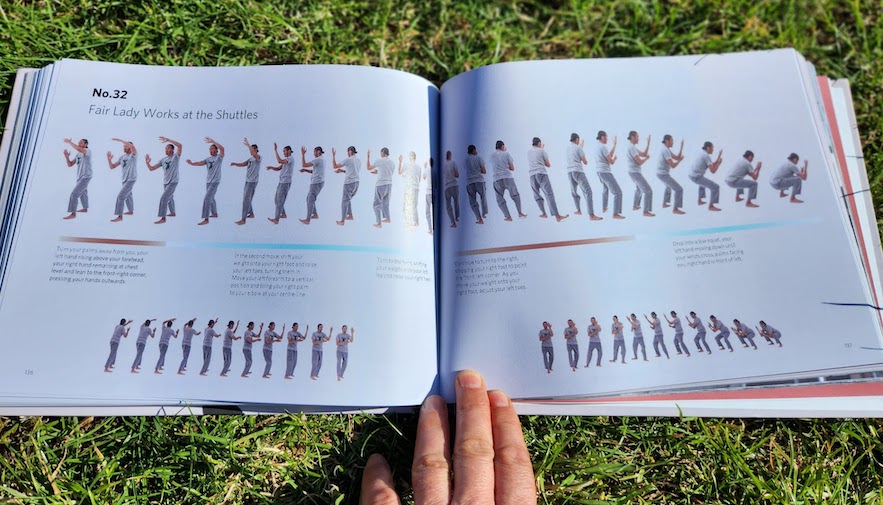
I don’t do the Cheng Man Ching short form myself, but I have learned it in the past, and as I was looking through the movements it struck me that there were one or two idiosyncrasies presented by Sifu Leo that I hadn’t seen before. I noticed three things in particular:

1) A low squat Sifu Leo does as a transition between each ‘Fair Lady Works at the Shuttles’ move: 

2) A front kick/leg raise, he puts into Repulse Monkey.

3) In Golden Pheasant Stands on one leg – he again squats all the way down to the floor between the knee raises.

This struck me as peculiar, so I checked the form against a video of Chen Man Ching, mapping the movements in his video to the ones in the book, and while the forms match (all the movements are here and none have been added), the above curiosities are not performed by Professor Chen Man Ching. 

Also, there are 43 moves in the form shown here, and Chen Man Ching’s form was said to be 37, but I suppose it depends how you count the moves. 

I don’t think these three variations to the Cheng Man Ching form matter that much, but I think it’s safe to say that they are not standard, so I should point them out. It’s also important to note that there are no marital applications or discussion of push hands in the book at all.

Overall, if you practice the Cheng Man Ching short form for health and you want a visual reference to remind you of the moves then this book will fit the bill – it’s beautifully designed and the form is clearly presented. If you’re looking for a scholarly discussion of the history of Tai Chi, or an in-depth dive into the body mechanics, then other books are available.

A simple exercise for opening and closing in Tai Chi

The plum tree in my garden is blossoming, and that can mean only one thing: Spring is here!

Without getting too poetic about it, the potential energy trapped within the tree over Winter is releasing and opening out to the world. So, in keeping with the cycle of the seasons, let’s return our Tai Chi practice to a similar aspect – opening and closing.

All Chinese martial arts contain movements that open and close the body, but I’d go as far as to say that a repeated pattern of opening and closing your body in movement is the fundamental action of Tai Chi Chuan. It’s perhaps the one thing that makes Tai Chi Chuan (Taijiquan) different to other Chinese martial arts.

For instance, a lot of Southern Chinese arts contain movements where the body is tightly closed under tension and then this tension is used to produce a tightly focussed sort of short power. White Crane is a good example – I really like this video of Martin Watts showing the connection between Chinese White Crane and the roots of Japanese Karate, for example.

Then there are also Chinese martial arts that use ‘open’ postures a lot, and produce power from the big turning actions of the waist and shoulders – Choy Li Fut is a good example of this.

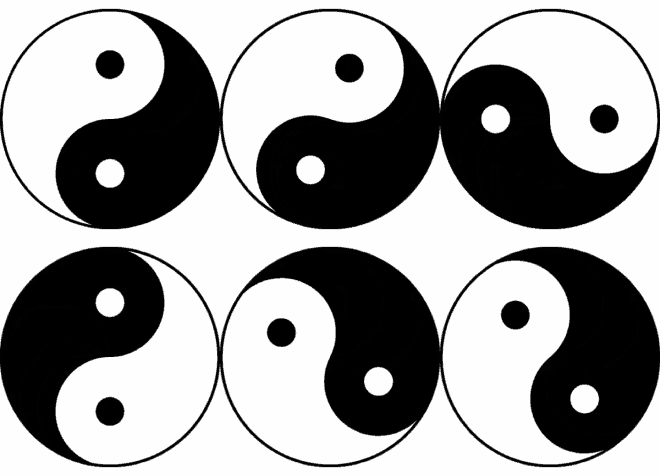
Of course, both these arts make use of both opening and closing movements in application, but what makes Taijiquan different is that it seems to have a rule that the body must constantly cycle through a series of opening and closing postures. You can see this when you look at Tai Chi forms – it shouldn’t matter which style you’re looking at, the opening and closing movements should follow each other in a cycle, very much like the Yin Yang symbol. If you imagine the Yin Yang symbol turning in a clockwise direction then the white fish becomes the black fish, which becomes the white fish, and on and on.

Silk Reeling exercises are a great way to focus on understanding open and close movements, as you just keep repeating the same pattern over and over, so your brain doesn’t get occupied thinking about the movement you are doing next (as it would in a Tai Chi form) and you can focus on the opening and closing actions.

So, what are the opening and closing actions? Well, I went over it in a video series a while ago. You can watch it here:

But it takes a while to watch all that series, so long story short, here’s a written explanation: an opening movement generally stretches out the front of the body (the Yin side – the soft parts, like the inside of the arms, and thigh, calves, and belly) and a closing movement generally stretches out the back of the body (the Yang side – the harder parts, like back of the arms, back and outside of the thighs and shins).

You can see these actions everywhere in nature: Cats tend to stretch along the front and back (yin and yang) of the body when stretching. (And it’s the same with the Yoga “Cat stretch” posture). But you see them in humans too – when you do one of those involuntary yawning/stretching movements in the morning, it tends to be opening the chest (yin stretch), occasionally followed up by a Yang side stretch.

It’s been noted that animals running are opening and closing the Yin and Yang sides of their bodies in sequence. So, this opening and closing action is fundamental to human and animal movement and the more we can utilise it, the more we are returning to our own natural systems of movement. Now, I don’t want to get sidetracked into a debate on what exactly “natural” movement is, but simply put, this opening and closing movement done in the human body feels good, it seems to put you in a good mood and you feel like your body and mind are returning to the way they are supposed to work. It requires less effort to perform tasks using it because it’s very efficient and it feels natural. If you watch skilled workmen and women then you’ll notice that they tend to gravitate towards easy body movements that have this natural opening and closing quality. Many of the people in ancient China who practised kung fu systems would have been agricultural village works who were familiar with natural movement patterns through necessity.


4 Directions Breathing exercise

Silk reeling exercises belong to the Chen style of Taijiquan, and while I (a Yang stylist) have no problem borrowing what works from other styles, a lot of Tai Chi practitioners might not want to do something from another style. However, almost all Qi Gong/Tao Yin type breathing exercises follow the same idea of opening along the Yin side of the body and closing along the Yang side that you find in Silk Reeling exercises.

You probably have some sort of exercise already that’s in your system to try this with, but let’s try one simple exercise to get our heads around the idea of open and close.

Stand in a Horse stance,

  1. Breathe in as you bring your hands up facing you and then move them around a large imaginary ball that’s in front of your chest, so that your hands are facing away from you.
  2. Push the imaginary ball forward away from you as you breathe out.
  3. Turn the hands over and bring them back in towards you as you breathe in, going around the outside of the ball.
  4. Push to the sides as you breathe out.
  5. Bring the hands back in, circling the ball, getting underneath it as you breathe in.
  6. Push upwards as you breathe out.
  7. Bring the hands back in, circling the ball, getting on top of it as you breathe in.
  8. Push downwards as you breathe out.
  9. Bring the hands back in, going around the ball as you breathe in.
  10. Let the palms face down and hands return to your sides as you breathe out.


Adding the opening and closing:

As you bring your arms up and towards you and go around a big ball that’s the opening movement. You can feel the slight stretch opening around the chest area, and you use that slight tension to help push your hands forward. As you do you’ll feel a slight stretch developing along your back. That’s the closing movement. You then use that slight tension to help bring your arms back. This is opening. Then as the arms push to the side, this is closing, and so on.

Here’s a video of me doing it:


Don’t use muscle

You often hear Tai Chi teachers say things like “don’t use muscle”. Normally this drives me mad, as you can’t physically make a movement without using muscles! However, what they’re really talking about is using that slight stretch you can feel to power the movement instead of just moving as you normally would, which results in making it “too physical” for Tai Chi. Finding the right words here is a delicate balance, but what we’re looking for is more of a whole body movement.


Final words

It helps to work on this in a stationary exercise, as described, but when you try your Tai Chi form, try and focus on keeping that feeling of opening and closing going throughout the whole form. The opening and closing movements are already there in the form, it’s up to you to reveal them. It’s a way of approaching the form from the inside, rather than the outside. So, if you’ve been struggling to get a movement to feel right in your form, it could be that the method described here will solve the problem for you. For it to work you have to be “sung” (relaxed) and focused on what you’re doing and the feelings inside the body. If your mind wanders off then inevitably so will your form. This is the start of what we call in the Tai Chi Classics “internal and external combine”.

Further reading: Turning Qigongs into functional Qi exercises

Just one Thing – Dr Michael Mosley on Tai Chi (BBC Radio 4)

The Just One Thing series from Dr Michael Mosley is a radio show on little ideas that might make a big difference to your life. This week he’s looking at Tai Chi, and seeing what difference 15 minutes a day can make.

Dr Mosely looks at the scientific evidence for Tai Chi being as effective as conventional exercise. It’s quite interesting. One study said Tai Chi was better than brisk walking, for example, which is something I’ve always wondered about. He also looks at Tai Chi’s effect on the brain.

Here’s the blurb

“If you’re looking to add more exercise into your lifestyle why not consider Tai Chi. It’s an ancient Chinese martial art – it’s sometimes called “meditation in motion”. It’s a series of different postures that gently flow into each other in slow movements. One of the big benefits to Tai Chi is that it can significantly enhance the activity of our immune system. And although it looks gentle, it can be a surprisingly good workout! Michael Mosley speaks to Dr. Parco Siu from the University of Hong Kong, who has been studying the health benefits of Tai Chi for over a decade. His research has revealed that Tai Chi can lead to faster brain benefits than other exercises. He also found that Tai Chi was as effective as conventional exercise like moderate-intensity aerobic exercise or muscle strengthening activities for reducing body weight and visceral fat!”

Listen here. (15 minutes long).

Martial Arts Management Software: Signs You Should Use It

(Sponsored content)

Have you ever wished that running your martial arts academy was more accessible and more efficient? If so, it may be time to look into the latest Martial Arts Management Software. 

Managing a Martial Arts School can be overwhelming, but with the right tools, it doesn’t have to be! 

Martial Arts Management Software is designed to help make sense of the administrative chaos that comes with running a successful business. Whether you need to keep track of student records, manage bills and invoices, or monitor your academy’s finances, there is sure to be a software system out there that can help.

If you’re wondering whether your school needs this software, here are some signs indicating you should consider using it!

Billing and Collection Issues

One of the most prominent challenges schools face is billing and collecting money from their students. Martial Arts Management Software makes it easy to manage your student accounts, allowing you to keep track of payments, overdue balances, and more.

This can help you stay on top of any collection issues, ensuring that you are getting paid for your services promptly.

Class Scheduling Problems

Managing a martial arts academy can be a complex and time-consuming task, especially when it comes to scheduling classes. However, with the help of advanced software systems, scheduling classes have become much more manageable.

With this software, you can easily create, maintain, and update your class schedule, ensuring that all of your classes are offered on the days and times you need them. This can help ensure that your students always have access to the classes they need so they can go anywhere for their training.

Members Tracking Has Become a Problem

Another common issue facing martial arts academies is keeping track of their members. With so many students coming and going, it can be difficult to keep track of all the different people training at your academy.

  • Missed Expiring Memberships

One of the biggest challenges when it comes to member tracking is ensuring that you are never missing expiring memberships. Martial arts management software can help to make this process easier, as the software can send automatic reminders to your members about renewing their memberships in a timely manner.

Additionally, with this software, you can set up automatic renewal reminders, which can further help ensure that all of your members are up-to-date on their memberships.

  • Untracked Achievements, Belts, and Grading

Another issue that can arise when it comes to member tracking is failing to track important milestones, such as belt and grading achievements. Martial arts management software can help with this by providing a convenient platform for recording these milestones.

With the push of a button, you can record your members’ latest achievements, helping you stay on top of their progress. And by automating this process, you can ensure that all of your members’ milestones are tracked and recorded promptly.

Spending Hours On Admin Tasks

If managing financial reports and cash flow takes much more time than teaching Martial Arts, Martial Arts Management Software can help you save time and money. By automating processes such as billing and collecting data and information, you can spend more time on the things that matter most to your business. 

Additionally, using martial arts management software often comes along with other benefits, such as improved cash flow and reduced costs. If you want to streamline your academy and make it more efficient, it’s worth considering investing in this type of software.

Messy, Disorganized Paper Filing Systems

The more your martial arts studio grows, the harder it is to keep up with all the paperwork for student registrations, attendance compiled, payment due and instructor qualifications-not to mention classes and business operations that can become confused without proper record keeping. 

With Martial Arts Management Software, all of your data and information are stored digitally, making it easy to access and update at any time. This not only helps you to stay organized, but it also helps to keep your data secure, as paper files are often lost or damaged.

Lack Of Financial Reporting Tools

Every martial arts school needs to have efficient financial reporting tools in place, but all too often these can be lacking. This is where martial arts management software can help fill the gap.  

A management software system often comes with a wide range of financial reporting tools, helping you stay on top of your business finances and quickly identify any areas that need to be improved.

Inexperienced or Overwhelmed Staff Members

If your academy is experiencing issues with member tracking, financial reporting, or any other aspect of running your academy, it can be difficult to know where to turn. 

By using martial arts management software, you can streamline your academy and ensure that all of your members are well taken care of.

Managing School Has Never Been This Easy

If any of these issues sound familiar, then it’s time to consider using Martial Arts Management Software! With the right system in place, you can take control of your business and focus on running a successful academy. 

Systema and Tai Chi – similarities and differences

Matt Hill and Vladimir Vasiliev

I had a great visit to The System Academy in Wiltshire last week where I enjoyed a bit of 1-1 Systema coaching from my old friend and owner of the Academy, Matt Hill. I also recorded a podcast episode with him for The Tai Chi Notebook Podcast, which will be coming out in November. Matt trained Aikido in Japan and served as a Captain in the British army, as well as working in crisis management before he became a full time Systema instructor, so he’s got a lot of experience of different types of martial arts and working in pressure scenarios. Because Matt and I live quite close to each other I had the opportunity to get a bit of hands-on work in before we sat down to record the episode. It was great to experience some Systema myself this time, and I particularly enjoyed the striking aspects, which is something I’ve put on the back burner a bit as I’ve got more into grappling over the last few years.

One of those eternal questions that pop up on discussion boards a lot is, ‘how close is Systema to Tai Chi?’, and this was one of the things I’ve been mulling over since I had the lesson. Both these arts stress what Systema calls the Four Pillars – breath, posture, relaxation and movement – but on a basic level I think one of the immediate differences between Tai Chi and Systema is that Systema seems to only exist in relation to something you are doing, whereas Tai Chi has this weighty set of philosophical principles that exist independently to the art, like Taoist philosophy and yin and yang, as well as concepts from the Tai Chi Classics regarding posture, movement and strategy. Tai Chi can certainly be talked about in terms of these abstract concepts and ideas, but in contrast, Systema needs to be shown. When you’re not doing Systema, then where does it go? It’s a bit like your lap – when you sit down you can point to your lap, but when you stand up, it vanishes!

Systema seems intrinsically tied to what you are doing, not what you are thinking. Of course, you can argue that even when you’re doing nothing and not moving, say, just sitting there, you are still doing something, so perhaps Systema is always there: You still have a posture, and you are always breathing, and that means some movement is happening in the body and you can still relax, which is a kind of a movement in itself. But there doesn’t seem to be an underlying theory, comparable to something like Tai Chi’s theory of yin and yang, that underpins it all.

Another interesting difference is that when Systema teachers talk about embodying the 4 pillars – they really mean it! They’re not just paying lip service to the ideas – they are living them. Even outside of the martial art practice, Systema seems to have the potential to pervade everything you do. In Systema you tend to lead movement with your breath, you breathe the tension out of your body as you work and you try not to muscle anything. And that can be applied to anything, not just fighting.

Of course, you could say the same thing is true of Tai Chi, but there’s so much other ‘stuff’ to worry about in Tai Chi – like a form,(and getting the form just right), dantien, and the 6 harmonies or the 8 co-ordinations, etc, etc.. I think inevitably, with so much on your plate, some things slip. But with only 4 principles to keep in mind, you can spend a bit more time really digging into them.

And then there’s the amount of physical discomfort you experience. Tai Chi can be really hard on the legs for sure, but push ups, leg raises, sit ups and squats are the meat and potatoes of Systema, none of which you’ll find in a bog-standard Tai Chi class. Not to mention learning to give and receive strikes. Even more martially inclined Tai Chi classes don’t tend to work on actively standing there and learning how to receive strikes.

Chen Xiaowang, Tai Chi broadsword

Adopting any sort of ‘martial arts pose’ is frowned on in Systema. Again, you can argue that there are no fixed shapes in Tai Chi either, but Tai Chi does put a lot of emphasis on structure – keeping a connection to the ground through a relaxed frame, and there are ‘kung fu’ style postures. Systema seems to prefer you trust in your relaxation and let gravity do its work. For a Tai Chi person, it’s quite freeing and fun not to have any fixed shapes you’re expected to adopt. The emphasis in Systema seems to be on not trapping yourself into patterns of tension that you first have to exit before you can move freely. Fighting somebody else is hard enough already – you don’t want to have to fight seven battles within yourself just to move freely before you even begin!

So yes, Systema is different to Tai Chi. But I think the two work really well together. The Tai Chi practitioner can take from Systema the idea of not being trapped in ‘postures’ – fixed shapes (Ward off, Diagonal Flying, etc) and the value of removing as much tension from your body as you can while still working on moving with an opponent. Also, breathing tends to get only a cursory mention in Tai Chi, but focusing more and more on keeping your breathing smooth and continuous, and noting how that relates to tension in the body, is a great addition to any Tai Chi form, and I think that has to help make your Tai Chi better, by any objective measurement.

For more on Systema have a listen to my chat with Rob Poyton again, and look out for my interview with Matt Hill in the next episode of The Tai Chi Notebook Podcast, coming in November.