Investing in your neck can be a great way to get better at Tai Chi

Photo by Todd Trapani on Pexels.com

The Tai Chi classics talk a lot about keeping your head “as if suspended from above“, and “Head upright to let the shen [spirit of vitality] rise to the top of the head”, but they don’t mention the neck a lot.

Yang Chengfu gives it a brief mention to the neck in his 10 Important Points, but it’s not the focus of his writing: “Don’t use li, or the neck will be stiff and the chi and blood cannot flow through.”

As such, Tai Chi students don’t spend that long paying attention to their neck. I bet if you just started moving your head in a circle right now you’d hear all sorts of crunching and popping noises, right?

For the past few days I’ve been making an effort to work my neck with mobility exercises every morning, and the results have been quite astounding. Now, when I move my head around in a circle there are way less crunching and popping noises than their used to be. In fact, sometimes there are none at all. Secondly, the space between my neck and shoulders is really opening up. I can feel more room there and as such, my Tai Chi form feels quite different, in a good way. There are all sorts of nerve fibres in the brachial plexus, and having them cramped up all the time is not ideal.

I’ve talked about the importance of how you hold your head in a recent post, but I’m learning that correct head placement on its own can only get you so far – you need to invest in some neck exercises if you want to get the most out of your Tai Chi practice.

There are hundreds of different neck exercises, and I think you’re best off finding the ones that feel good to you, because they’re probably the ones you need. The three I’ve settled on are as follows, and should all be done gently *:

  1. Stir the soup – imagine there is a spoon hanging off your chin and resting in a bowl of soup. Move your chin in a circle one way so that the imaginary spoon stirs the soup, then move the other way.
  2. Diagonal Neck stretch – look forward and down to one side towards your armpit. Hang your same side arm over on the other side of your head to add a bit of weight to the stretch. Don’t pull hard downward, just add the weight of the arm. Do both sides.
  3. Reach both hands behind you against your lower back and pull down on the wrist of one arm with the other hand. Turn your head to one side, looking away from the arm you are stretching. Repeat on the other side.

You can, of course, add in others, like circling the head in the vertical plane. Try some neck exercises every morning and feel the difference it makes to your Tai Chi, and life in general.

  • * N.B. This is not medical advice – please consult a doctor before exercising.

Three more articles of mine you might like:

Tai Chi in 5 minutes a day

I’ve just finished listening to an interesting podcast where Dr. Rangan Chatterjee talks about about how to form daily habits in a way that actually works. The takeaway is that you need to make the habit as easy as possible and also tack it onto something you already do every day if you want it to stick. Dr Chatterjee makes the good point that we don’t have to force ourselves to brush our teeth in the morning and at night – we just do it. We don’t decide, oh, I’m a bit tired tonight or I’ve got a lot of work on, so I’ll just skip it for a couple of days. No, we just do it, and it’s easy.

Doing Tai Chi could be as easy as brushing your teeth. Photo by Andrea Piacquadio on Pexels.com

Forming a regular practice Tai Chi habit however can be hard. It’s very easy to convince yourself to not practice because you’re tired or just not feeling like it.

Tai Chi, Qigong or stretching is also a bit like brushing your teeth, because you don’t get much benefit from not brushing your teeth for a week, and then doing a massive 1 hour deep clean on a Sunday. No, brushing your teeth needs to be done a little every day if it’s going to work, and so does Tai Chi, Qigong and stretching.

Which brings us to the question of how we actually develop a strong practice habit like this for Tai Chi, and that takes me back to Dr. Rangan Chatterjee. Most of us make a pot of coffee, or cup of tea in the morning. It’s a ritual we’re already doing and nobody needs to force us to start doing. (If you don’t do this, I bet there is something similar you do in the morning?) What we need to do is start hacking that existing habit with the new habit we want to instill, in this case Tai Chi, stretching, standing, meditation, or whatever it is.

It’s all about maximising those moments of dead time. Photo by Rachel Claire on Pexels.com

While your coffee is brewing, stop looking at your phone and spend those minutes doing the thing you want to do. One thing I’ve started to do is pour the water on my tea bag, then do a stretching routine while it is brewing. This way I don’t need to rely on motivation to do the routine each morning, because motivation is great when it’s high, but a rubbish thing to rely on when you are feeling tired, rushed or grumpy.

Even a few minutes of whatever it is will make a difference. I already feel like I’m more flexible in my hips because of these few minutes. And doing those few minutes might make me feel like doing more immediately afterwards. Other ideas for things to do while the coffee is brewing would be some single arm silk reeling circles, some standing Qigong, or repeat small sections of the form, like Grasp Birds Tail. The choice is yours. Try it!

If you like this life hack then I’ve talked about a similar idea before to do with brushing your teeth in a horse stance. Check it out!

A simple exercise for opening and closing in Tai Chi

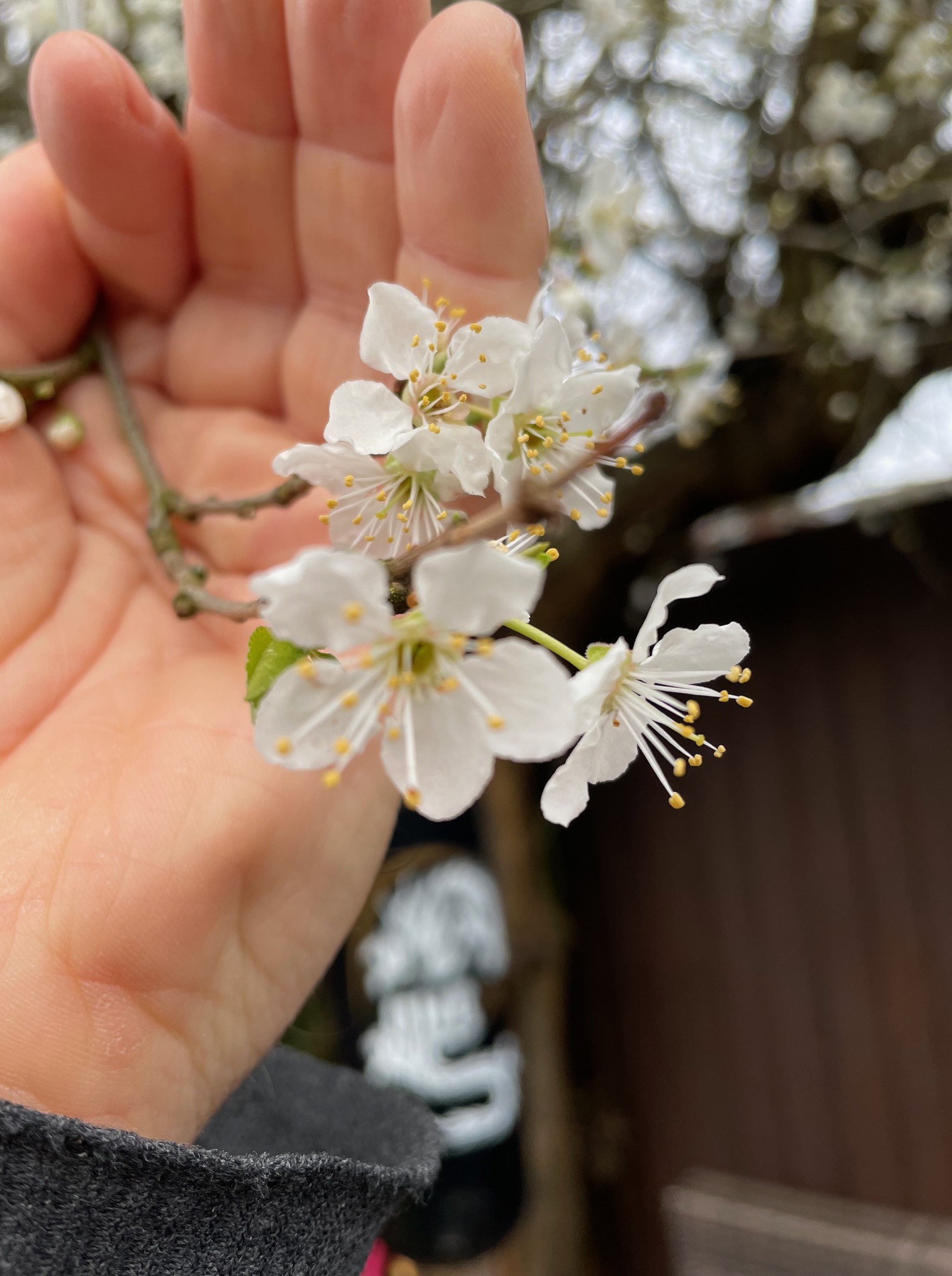
The plum tree in my garden is blossoming, and that can mean only one thing: Spring is here!

Without getting too poetic about it, the potential energy trapped within the tree over Winter is releasing and opening out to the world. So, in keeping with the cycle of the seasons, let’s return our Tai Chi practice to a similar aspect – opening and closing.

All Chinese martial arts contain movements that open and close the body, but I’d go as far as to say that a repeated pattern of opening and closing your body in movement is the fundamental action of Tai Chi Chuan. It’s perhaps the one thing that makes Tai Chi Chuan (Taijiquan) different to other Chinese martial arts.

For instance, a lot of Southern Chinese arts contain movements where the body is tightly closed under tension and then this tension is used to produce a tightly focussed sort of short power. White Crane is a good example – I really like this video of Martin Watts showing the connection between Chinese White Crane and the roots of Japanese Karate, for example.

Then there are also Chinese martial arts that use ‘open’ postures a lot, and produce power from the big turning actions of the waist and shoulders – Choy Li Fut is a good example of this.

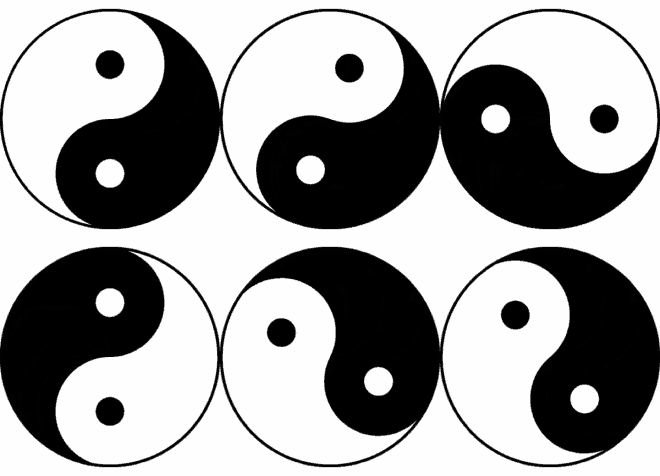
Of course, both these arts make use of both opening and closing movements in application, but what makes Taijiquan different is that it seems to have a rule that the body must constantly cycle through a series of opening and closing postures. You can see this when you look at Tai Chi forms – it shouldn’t matter which style you’re looking at, the opening and closing movements should follow each other in a cycle, very much like the Yin Yang symbol. If you imagine the Yin Yang symbol turning in a clockwise direction then the white fish becomes the black fish, which becomes the white fish, and on and on.

Silk Reeling exercises are a great way to focus on understanding open and close movements, as you just keep repeating the same pattern over and over, so your brain doesn’t get occupied thinking about the movement you are doing next (as it would in a Tai Chi form) and you can focus on the opening and closing actions.

So, what are the opening and closing actions? Well, I went over it in a video series a while ago. You can watch it here:

But it takes a while to watch all that series, so long story short, here’s a written explanation: an opening movement generally stretches out the front of the body (the Yin side – the soft parts, like the inside of the arms, and thigh, calves, and belly) and a closing movement generally stretches out the back of the body (the Yang side – the harder parts, like back of the arms, back and outside of the thighs and shins).

You can see these actions everywhere in nature: Cats tend to stretch along the front and back (yin and yang) of the body when stretching. (And it’s the same with the Yoga “Cat stretch” posture). But you see them in humans too – when you do one of those involuntary yawning/stretching movements in the morning, it tends to be opening the chest (yin stretch), occasionally followed up by a Yang side stretch.

It’s been noted that animals running are opening and closing the Yin and Yang sides of their bodies in sequence. So, this opening and closing action is fundamental to human and animal movement and the more we can utilise it, the more we are returning to our own natural systems of movement. Now, I don’t want to get sidetracked into a debate on what exactly “natural” movement is, but simply put, this opening and closing movement done in the human body feels good, it seems to put you in a good mood and you feel like your body and mind are returning to the way they are supposed to work. It requires less effort to perform tasks using it because it’s very efficient and it feels natural. If you watch skilled workmen and women then you’ll notice that they tend to gravitate towards easy body movements that have this natural opening and closing quality. Many of the people in ancient China who practised kung fu systems would have been agricultural village works who were familiar with natural movement patterns through necessity.


4 Directions Breathing exercise

Silk reeling exercises belong to the Chen style of Taijiquan, and while I (a Yang stylist) have no problem borrowing what works from other styles, a lot of Tai Chi practitioners might not want to do something from another style. However, almost all Qi Gong/Tao Yin type breathing exercises follow the same idea of opening along the Yin side of the body and closing along the Yang side that you find in Silk Reeling exercises.

You probably have some sort of exercise already that’s in your system to try this with, but let’s try one simple exercise to get our heads around the idea of open and close.

Stand in a Horse stance,

  1. Breathe in as you bring your hands up facing you and then move them around a large imaginary ball that’s in front of your chest, so that your hands are facing away from you.
  2. Push the imaginary ball forward away from you as you breathe out.
  3. Turn the hands over and bring them back in towards you as you breathe in, going around the outside of the ball.
  4. Push to the sides as you breathe out.
  5. Bring the hands back in, circling the ball, getting underneath it as you breathe in.
  6. Push upwards as you breathe out.
  7. Bring the hands back in, circling the ball, getting on top of it as you breathe in.
  8. Push downwards as you breathe out.
  9. Bring the hands back in, going around the ball as you breathe in.
  10. Let the palms face down and hands return to your sides as you breathe out.


Adding the opening and closing:

As you bring your arms up and towards you and go around a big ball that’s the opening movement. You can feel the slight stretch opening around the chest area, and you use that slight tension to help push your hands forward. As you do you’ll feel a slight stretch developing along your back. That’s the closing movement. You then use that slight tension to help bring your arms back. This is opening. Then as the arms push to the side, this is closing, and so on.

Here’s a video of me doing it:


Don’t use muscle

You often hear Tai Chi teachers say things like “don’t use muscle”. Normally this drives me mad, as you can’t physically make a movement without using muscles! However, what they’re really talking about is using that slight stretch you can feel to power the movement instead of just moving as you normally would, which results in making it “too physical” for Tai Chi. Finding the right words here is a delicate balance, but what we’re looking for is more of a whole body movement.


Final words

It helps to work on this in a stationary exercise, as described, but when you try your Tai Chi form, try and focus on keeping that feeling of opening and closing going throughout the whole form. The opening and closing movements are already there in the form, it’s up to you to reveal them. It’s a way of approaching the form from the inside, rather than the outside. So, if you’ve been struggling to get a movement to feel right in your form, it could be that the method described here will solve the problem for you. For it to work you have to be “sung” (relaxed) and focused on what you’re doing and the feelings inside the body. If your mind wanders off then inevitably so will your form. This is the start of what we call in the Tai Chi Classics “internal and external combine”.

Further reading: Turning Qigongs into functional Qi exercises

Just one Thing – Dr Michael Mosley on Tai Chi (BBC Radio 4)

The Just One Thing series from Dr Michael Mosley is a radio show on little ideas that might make a big difference to your life. This week he’s looking at Tai Chi, and seeing what difference 15 minutes a day can make.

Dr Mosely looks at the scientific evidence for Tai Chi being as effective as conventional exercise. It’s quite interesting. One study said Tai Chi was better than brisk walking, for example, which is something I’ve always wondered about. He also looks at Tai Chi’s effect on the brain.

Here’s the blurb

“If you’re looking to add more exercise into your lifestyle why not consider Tai Chi. It’s an ancient Chinese martial art – it’s sometimes called “meditation in motion”. It’s a series of different postures that gently flow into each other in slow movements. One of the big benefits to Tai Chi is that it can significantly enhance the activity of our immune system. And although it looks gentle, it can be a surprisingly good workout! Michael Mosley speaks to Dr. Parco Siu from the University of Hong Kong, who has been studying the health benefits of Tai Chi for over a decade. His research has revealed that Tai Chi can lead to faster brain benefits than other exercises. He also found that Tai Chi was as effective as conventional exercise like moderate-intensity aerobic exercise or muscle strengthening activities for reducing body weight and visceral fat!”

Listen here. (15 minutes long).

Martial Arts Management Software: Signs You Should Use It

(Sponsored content)

Have you ever wished that running your martial arts academy was more accessible and more efficient? If so, it may be time to look into the latest Martial Arts Management Software. 

Managing a Martial Arts School can be overwhelming, but with the right tools, it doesn’t have to be! 

Martial Arts Management Software is designed to help make sense of the administrative chaos that comes with running a successful business. Whether you need to keep track of student records, manage bills and invoices, or monitor your academy’s finances, there is sure to be a software system out there that can help.

If you’re wondering whether your school needs this software, here are some signs indicating you should consider using it!

Billing and Collection Issues

One of the most prominent challenges schools face is billing and collecting money from their students. Martial Arts Management Software makes it easy to manage your student accounts, allowing you to keep track of payments, overdue balances, and more.

This can help you stay on top of any collection issues, ensuring that you are getting paid for your services promptly.

Class Scheduling Problems

Managing a martial arts academy can be a complex and time-consuming task, especially when it comes to scheduling classes. However, with the help of advanced software systems, scheduling classes have become much more manageable.

With this software, you can easily create, maintain, and update your class schedule, ensuring that all of your classes are offered on the days and times you need them. This can help ensure that your students always have access to the classes they need so they can go anywhere for their training.

Members Tracking Has Become a Problem

Another common issue facing martial arts academies is keeping track of their members. With so many students coming and going, it can be difficult to keep track of all the different people training at your academy.

  • Missed Expiring Memberships

One of the biggest challenges when it comes to member tracking is ensuring that you are never missing expiring memberships. Martial arts management software can help to make this process easier, as the software can send automatic reminders to your members about renewing their memberships in a timely manner.

Additionally, with this software, you can set up automatic renewal reminders, which can further help ensure that all of your members are up-to-date on their memberships.

  • Untracked Achievements, Belts, and Grading

Another issue that can arise when it comes to member tracking is failing to track important milestones, such as belt and grading achievements. Martial arts management software can help with this by providing a convenient platform for recording these milestones.

With the push of a button, you can record your members’ latest achievements, helping you stay on top of their progress. And by automating this process, you can ensure that all of your members’ milestones are tracked and recorded promptly.

Spending Hours On Admin Tasks

If managing financial reports and cash flow takes much more time than teaching Martial Arts, Martial Arts Management Software can help you save time and money. By automating processes such as billing and collecting data and information, you can spend more time on the things that matter most to your business. 

Additionally, using martial arts management software often comes along with other benefits, such as improved cash flow and reduced costs. If you want to streamline your academy and make it more efficient, it’s worth considering investing in this type of software.

Messy, Disorganized Paper Filing Systems

The more your martial arts studio grows, the harder it is to keep up with all the paperwork for student registrations, attendance compiled, payment due and instructor qualifications-not to mention classes and business operations that can become confused without proper record keeping. 

With Martial Arts Management Software, all of your data and information are stored digitally, making it easy to access and update at any time. This not only helps you to stay organized, but it also helps to keep your data secure, as paper files are often lost or damaged.

Lack Of Financial Reporting Tools

Every martial arts school needs to have efficient financial reporting tools in place, but all too often these can be lacking. This is where martial arts management software can help fill the gap.  

A management software system often comes with a wide range of financial reporting tools, helping you stay on top of your business finances and quickly identify any areas that need to be improved.

Inexperienced or Overwhelmed Staff Members

If your academy is experiencing issues with member tracking, financial reporting, or any other aspect of running your academy, it can be difficult to know where to turn. 

By using martial arts management software, you can streamline your academy and ensure that all of your members are well taken care of.

Managing School Has Never Been This Easy

If any of these issues sound familiar, then it’s time to consider using Martial Arts Management Software! With the right system in place, you can take control of your business and focus on running a successful academy. 

Basic Shuai Jiao exercises for the waist (Yao) and Fa Jin

There have not been many updates to the blog recently, but don’t worry, I’ve been busy working hard behind the scenes. I’ve just recorded a great conversation with Matthew Kreuger of the Walking with the Tengu podcast. “A podcast exploring classic writings as they relate to the modern martial artist.” We covered all sorts of topics including warriorship, philosophy and of course, martial arts. Matthew is going to be my guest on the next episode of the Tai Chi Notebook podcast, so look out for that, coming sometime in October.

One of the things we talked about was how Matthew has integrated Shuai Jiao throwing techniques into the standup component of his Brazilian Jiujitsu training. This is a really interesting approach, as you typically see BJJ integrated with wrestling or Judo, but mixing it with the stand up Chinese jacket wrestling style is not something I’ve seen before.

Shuai Jiao contains a lot of solo exercises for conditioning the body, and my ears pricked up when Matthew said that these exercises had really helped him with a back injury that had dogged his training.

Matthew has been a studying from the online school of Sonny Mannon, co-founder & Head Trainer for Guang Wu Shuai Jiao. I looked him up and found this basic introduction to Shuai Jiao warm up exercises video that he did in 2020.

Having just followed along these exercises I can see how they benefit the waist, core and lower back area. But also the flexibility in the legs – my hamstrings and calf muscles were particularly stiff the day after! That video follows on into this one, which is about ‘belt cracking’.

Belt cracking is less about stretching and more about developing that explosive shake that you see in a lot of Chinese martial arts, sometimes called Fa Jin. It’s interesting stuff, but in Shuai Jiao you’re generally not trying to hit with it, you’re using it to disrupt the opponent’s structure to create openings. You can see some applications of it on Sonny’s Instagram account:

The Balance Tai Chi Brings To Your Weight

Have you ever been in a situation where you suddenly felt a subtle change in your body? Maybe your body is feeling a bit weaker, sluggish, or even a tad stiffer than usual? Maybe you’ve put on a bit of weight, and your body decided to send you a little message. It is interesting how you always have the sense that you need to move, as if your body is trying to tell you something.

Your mind is a powerful instrument. It knows exactly when you need a push and how much push you should be giving your body. One great way to harness your mind’s capability is to channel it through Tai Chi. Tai Chi requires a type of resilience that no other exercise can provide – it requires you to develop the resilience to work slowly and methodically even when your mind is telling you that it would rather do something much more intense. During high-intensity workouts, you can easily tune out and smash your way through them as you blast out tunes to keep you going. Tai Chi requires that you stop and reconnect with your breath before you go through your routine. You are then expected to keep your mind present and engaged throughout. The mental fortitude you develop while doing Tai Chi – which even the British Heart Foundation points out is required for a healthy lifestyle – will better serve you as you face more daunting tasks, like losing weight.

Here are a few beginner-friendly routines to get you started in Tai Chi, if you haven’t started already:

Exercise #1: Tai Chi Walking

As you go through this routine, concentrate on shifting your weight smoothly and without wobbling. Pay particular attention whilst you’re shifting forward onto the turned-out foot as you are twisting your torso. Complete beginners will often find this challenging, so don’t feel frustrated if you have a hard time. Your body will get used to this movement the more often you practice. To make sure you are getting the most out of the workout, try to keep your centre of gravity levelled. Be aware of how much you bend your legs and keep your body from moving up and down as you shift weight.

Exercise #2: Wild Horse Parting Mane

The key to this Tai Chi exercise is to try to combine the weight transfer, torso twisting, and arm separation and perform them in a flowing motion. Be mindful that your legs should be driving the pelvis forward. Feel your spine being in charge of rotating your shoulders as your shoulders propel your arms.

Exercise #3: Cloud Hands

As much as you are able to, draw circles with your arms in a smooth, continuous motion and keep your speed uniform all throughout the routine. With constant practice, you will begin to notice the overhand arm pulling while the underhand arm pushes/stabs. This movement activates the posterior chain on one side of the body while simultaneously engaging the anterior chain on the other.

Committing to a regular exercise routine, like Tai Chi, helps bring you closer to your ideal weight. Moreso, small lifestyle changes like being aware of what you put in your body will also help you tremendously. WeightWatchers notes that the best weight loss programmes work optimally when their main goal is to help you find movement you enjoy. This way, your decision to move becomes a healthy habit that sticks.

If you are still not convinced of the weight loss potential you can get from Tai Chi, you might be surprised to find out that the calm, rhythmic flow of Tai Chi works equally as well as cardiovascular exercise and strength training. The results from Tai Chi are comparable to the mentioned exercises in terms of reducing waist size and cholesterol improvement. A trial published by the Annals of Internal Medicine showed that three 1-hour weekly sessions of this low-impact practice helped the participants lower their level of triglyceride (a type of fat found in the blood). This eventually led to greater drops in body weight.

When it all boils down to it, the best way for you to lose weight is to find an activity that you enjoy, and that makes you feel good. If you are looking for a workout that would help you strengthen your mind as you strengthen your body (and lose weight in the process), give Tai Chi a try.

How I popped my SI joint back in, using baduanjin

A couple of months ago I put my Sacroiliac joint out doing Jiujitsu. Typical symptoms are pain walking, standing in one spot and generally everything involving being alive. I didn’t know it was out initially so carried on training for a couple of days, but the pain steadily increased until I sought help from a sports therapist who diagnosed me, followed by a painful massage which felt good afterwards, not during!

This video shows where the Sacroiliac joint (SI joint) is located (it’s the meeting of the sacrum and the iliac.) The pelvis is not one bone, it’s three bones and the SI joints are what connects them together. The presenters are a bit crazy, but I kind of like them:

As you can see, there’s not much movement in the joint at all, and when it gets jolted it can move out of alignment and that’s when you get all the problems I had. Naturally, your other muscles and tendons have to compensate for the joint being out, and they object, strongly! In my case my piriformis was particularly unhappy about the situation and wanted to let me know by inflaming. Ouch!

I want to post a picture of the piriformis showing its location, but at lot of these medical pictures are copyrighted, so I’ll link to a page that has one instead here. The picture of the posterior of the pelvis is here.

Now the video above shows various ways to pop your SI joint back in the right place, but I did it using the baduanjin exercise I was taught as part of Chinese Qigong, so I thought it was worth talking about here.

After a sports massage to relax the tendons I did the usual Baduajin routine I do regularly as part of my morning routine, and during one particular exercise I felt the SI joint pop back in place straight away.

Baduanjin 八段錦 (translates as ‘8 silk force’ or ‘8 pieces of brocade’) are a set of Chinese exercises that could be up to a thousand years old. Simon Cox has a great history of the baduanjin (including a video of them being done) on his website here.

The version of baduanjin I do is way simpler than Simon’s version from Wudang mountain. Here’s a video of my version done by Sifu Kerr of the Spinning Dragon Tao Youtube channel (whose videos are worth checking out as well):

At 6.48 he does “Stretch and Glare to the Horizon” which is the exercise that immediately popped my SI joint back in. I prefer to do that one with my hands in fists rather than the “sword fingers” Sifu Kerr is using, I don’t think it would make any difference to what’s happening to your SI joint either way.

In the Okanagan Valley Wading video that exercises is called “7. 攒拳怒目增力气 Make a fist and with glaring eyes increase your power and qi,”:

But they do it with the fist vertical and very much as a hard punch. The variation I prefer myself is doing it as a slower stretch and I keep my fists horizontal, and a bit bent downwards, so effectively out of alignment for a punch, but with an increased stretch across the yang channels on the outside of the forearm. With the slower stretch version you can really feel the counter rotation on the spine as one arm is stretching forward, the other is simultaneously stretching backwards and you are doing your best to not let your pelvis move – just keep it facing 100% forward and level in a horse stance… And that’s what did it – pop! I felt my SI pain immediately go and the joint felt normal again. Relief!

Clench the Fists and Glare Fiercely, circled in red, was the exercise that did it for me.

As you can see, there are many variations on the baduanjin, (just look at how many you can find on YouTube!). So, I’d suggest sticking with whatever version your teacher gives you. The important thing is these exercises put my SI joint back in place, and for that I’m very thankful, as is my piriformis, which took a couple of weeks to quieten down, but hasn’t bothered me since.

If you ever put your SI joint out, it’s good to know how to put it back, so try the above. I’d recommend a sports massage as well, to deal with the inflamed tendons caused by it being out of place.

Just as an aside, Ellis Amdur wrote a brilliant article that I’d recommend about Baduanjin Used as a Therapeutic Activity Within a Youth Detention Facility. Check it out.

Victorian & Edwardian Martial & Exercise Films

If you enjoy historical martial arts footage as much as I do then you’ll find the Victorian & Edwardian Martial & Exercise Films YouTube channel an absolute goldmine of footage.

This channel displays films and film segments that were created at the beginning of film making in the 19th Century through to the first half of the 20th century in relation to martial art and exercise.

Here are few examples of the content you’ll find here that caught my eye:

1897 Boxe Francaise (Savate) & Baton Demonstration – Lyon France

Filmed: Spring – June 6th 1897
Location: Lyon-France
These films show members of the 99th Infantry Regiment demonstrating Savate & Baton. These demonstrations are not sparring sessions. They are an exchange of techniques for the camera, in the form of a flow drill. In the Savate demonstration you can see that the practitioner on the left is aware of the camera position, and motions the other practitioner back into the frame of the camera. Sparring in this era was conducted on a “touch point system” along the same lines as fencing and points were scored for making contact, and the aim was not to seek a knock out.

https://www.youtube.com/watch?v=MLcG_QZPWek

1896 Burmese Martial Art in London

“These two films were filmed in July 1896 by Lumiere camera operator Alexandre Promio. The Location was Sydenham Crystal Place Park London. The first film depicts a form of Burmese martial art which includes open hand strikes, kicking and grappling. It is unclear what style is depicted as Burma (Myanmar) has a large variety of styles. (Martial Styles of Myanmar) https://www.youtube.com/watch?v=96IBH… Both practitioners seem to be sparring in a light friendly manner for the camera. The second film presents a solo performance of the ball exercises known in Burma (Mynamar) as Chinlone. Chinlone dates back over 1,500 years, and is heavily influenced by traditional Burmese martial art and dance. It was originally conceived as a form of entertainment for Burmese royalty. It is also played as a team sport and over the centuries, players have developed more than 200 different ways of kicking the ball. Form is all important in Chinlone, there is a correct way to position the hands, arms, torso, and head during the moves. A move is considered to have been done well only if the form is good.”

Victorian & Edwardian Martial & Exercise Films

1919 Self -Defence (Jiu-Jitsu) – Johnny Kilbane

Film Date: 24-10-1919
Location: Cleveland (Ohio) U.S.A.
Description: Champion Boxer Johnny Kilbane teaching his wife self-defence (Jiu-Jitsu).

https://www.youtube.com/watch?v=flpOOrdI14I

Facing adversity

Why do we exercise? It may be that we have been told we must by a doctor because we are facing some sort of health crisis, for which the most obvious solution is to take up more regular exercise. Usually these problems are related to being overweight and the multitude of health problem this can exacerbate, or indeed cause. But sometimes it can be something more subtle, like just not feeling comfortable in our body. We know when our body feels weak, soft, stiff or unused and needs exercise. The sense that we need to move, to stretch or to run is always there within us, if we choose to listen to that inner voice.

The Stoics were very big on the idea of accepting “voluntary hardships” as a kind of “shortcut to virtue”. Like the Cynics before them, or the holy men of India at the time of the Buddha, they would often become beggars, or live like poor people for extended periods of time to refocus on what was important in life, or to simply stop themselves from getting too soft. In life we generally try and avoid pain and discomfort in all areas, and this can lead us into tremendous difficulties in the long run. By seeking to avoid pain we let small problems fester until they become big problems.

Photo by Kelvin Valerio on Pexels.com

“although most people don’t like pain and discomfort, we generally accept that learning to endure it within reason can potentially toughen us up.  That’s what most physical exercise is about, to some extent.  It improves our fitness but also teaches us to endure pain and fatigue.”

Donald Robertston

Which brings me on to Tai Chi. Generally motivating yourself to get out of bed, or off the couch, to practice Tai Chi involves the same mental toughening up process that is involved in motivating yourself to do any other form of exercise. There’s no difference there, but the difference is in the type of exercise.

Tai Chi is a slow burn. It requires a different type of resilience. You need to develop the resilience to work slowly and patiently at something when your mind is telling you that you’re bored now and you should really be doing something much more exciting or intense.

To some extent you can turn your mind off during sets of star jumps, squats and push ups and just blast through them, maybe while listening to pumping music to help keep you going. In contrast, the first thing you are asked to do in Tai Chi is to stand still and connect with your breath before you even lift a finger. Then you are expected to keep your mind on the job throughout.

But if you try it, you’ll find that this “getting in touch with yourself” first before exercising can lead to a different kind of experience. It’s the gateway to marvels. Maybe you won’t burn as many calories as you do down the gym with your mind on autopilot, but your body will feel better for it, reconnecting with the living spirit of nature that flows through you, and (if Obi-Wan Kenobi is to be believed) all things.

It starts with the breath. Become aware of the breath. Don’t interfere with it, just watch it rise and fall. Once you do that you’ll find that facing minor adversity doesn’t feel like such a big problem anymore, and you can just do it.