Defining Tai Chi Chuan

6 harmonies movement, the classics and the boxing art

crane
This article was supposed to be a description of some key similarities between BJJ and Tai Chi. Unfortunately while writing it I realised I first needed to define Tai Chi properly before I could successfully contrast the two. Then I realised that this wasn’t an easy task.

Some people consider the fact that it is taught by a family that has a style of Tai Chi named after them to be enough to legitimately say the art they do is “Tai Chi Chuan”. You might consider that attitude to be similar to the attitude of Leung Bik in this little martial arts film clip about Wing Chun where Ip Man meets Leung Bik. When questioned by a young Ip Man if what he’s doing is really “Wing Chun” he says “Whatever comes out of my fist is Wing Chun!”. In essence he’s saying that he is the style, so there is no restriction on what defines the style.

On the flip side, there’s also the argument that for movement to be truly “Tai Chi Chuan” it must follow a strict number of movement principles, or rules. Some of which you’ll find in the Tai Chi Classics, and some of which you won’t.

The Tai Chi classics actually talk a lot about fighting strategy, particularly the idea of not opposing force with force. But I’d argue that this isn’t really what defines Tai Chi. In fact, most martial arts adopt this strategy, since a martial art where your strategy is just to attack like an unthinking robot until your enemy is dead in HULK SMASH! mode is unlikely to keep its students in the long run! Therefore, it’s no surprise to me that a lot of the writing in the Tai Chi classics seem to apply equally to Brazilian JiuJitsu, Jeet Kune Do, Aikido, Karate and lots of Kung Fu styles just as well as they would to Tai Chi. The writing in the classics doesn’t talk too much in the actual mechanics of movement, and instead talks a lot about fighting strategy.

For example, lines like the following could apply to most martial arts:

“The feet, legs, and waist should act together
as an integrated whole”

“Empty the left wherever a pressure appears,
and similarly the right.”

“It is said if the opponent does not move, then I do not move.
At the opponent’s slightest move, I move first.”

So, if you find that the Tai Chi classics cannot be relied upon to adequately define “Tai Chi Chuan”, what can? The best answer I’ve found is held in the concept of 6 Harmonies movement, or 6H for short. The idea of “Six Harmonies” is actually older than Tai Chi Chuan itself.

The six harmonies are broken down into 3 internal harmonies (the “desire” leads the “mind”, the “mind” leads the “qi”, and the “qi” leads the “strength”) and the 3 external harmonies – the shoulders connect with the hips, the elbows with the knees and the wrists with the ankles (or hands and feet, if you want). You can think of the internal harmonies as being about the desire to do something and turning it into a physical action – the actual Chinese word is “Xin”, which translates as “heart”, but in the sense of the desire arising to do something coming from your heart, not your head. In contrast, the external harmonies describe how the movement actually goes through the body (from the fingertips to the toes) via muscle-tendon channels, a process trained in Tai Chi through “silk reeling” exercises.

The distinctive feature of 6 harmonies movement is a complete connection of mind and body, producing force that appears soft, but penetrates deeply. It’s quantifiably different in feel to force produce by local muscle usage, although to somebody unfamiliar with it, it can look just like normal movement it should feel different. While the initial stages of learning 6 harmony movement may use large circular motions, they can be made imperceptibly small by an expert, which makes it even more difficult to quantify and identify.

Credit must be due to Mr Mike Sigman of the 6H Facebook group here for putting these Chinese concepts into words that English speakers (like myself) can understand without too much problem. He’s produced perhaps the most comprehensive and organised explanation of the process I’ve seen written down in English. If you want to delve deeper into it, I’d suggest joining his Facebook group and looking through some of the older posts.

I’m undecided as to wether there was originally a fully formed 6H theory that goes back hundreds of years, and is the origin, or essence of all Chinese martial arts, or if it’s something that has been refined over the years as a distillation of all the “good bits” of Chinese martial arts. The fact that the ancient meridian system used in acupuncture overlays the muscle tendon channels used in 6H is a good indication that it is an old, old theory, and lots of old Chinese martial arts have the phrase “Liu He” (6 harmonies) in their name (like Xin Yi Liu He Quan), which adds weight to the theory, but we’re drifting into speculation here. In a sense it doesn’t matter if you want to think of 6H as the modern distillation of “internal” movement methods or an ancient system, the important thing is the doing of it, and that requires practice.

Note: I’ve left “qi” in my description above, but that’s because, ultimately, I think its more problematic to replace it with an English word, when there isn’t one that’s really up to the job. Please note – there is much more to the theory and practice of 6 harmonies movement than I’m describing here (for example, dantien rotation, open/close, reverse breathing and the microcosm orbit), so I’d suggest that the reader who is seriously interested in the topic join the Facebook group if you want to get a proper handle on it. It is not a trivial subject!

So, to finally return to the question, what defines Tai Chi Chuan? I’d say it’s a combination of all three of the ideas expressed above – it needs to be from a lineage connected to the original Tai Chi families (the Chen, Yang, Wu, Woo and Sun families), it needs to conform to strict principles of movement, the most cohesive set of which I’ve seen is 6 harmonies movement, and it needs to follow the fighting strategy expressed in the Tai Chi classics.

Now that’s covered, I can get onto my intended subject of the similarities between BJJ and Tai Chi, and a look at the legacy of a certain Mr Rickson Gracie…


(How to) Move from the centre

Let’s get this thing moving!

solar-system-fully-animated-1-728


It’s pretty well established now that you need to ‘move from the centre’ in Tai Chi – (or ‘center’ if you’re American). But what is the centre?

In the ‘internal’ model of moving the body in Chinese martial arts, the centre is expressed as the ‘Dan Tien’, the point roughly an inch below the navel and 2 inches in from the surface. This is where you put your mental focus to move your body from. So, rather than the arm movements coming from the shoulders they come from the torso, which is turned by moving the waist, which is, in turn, powered by moving the dantien. So it all works together, but with the movement coming from the dantien.

The problem with moving from the centre like this is that you can do it roughly correctly and your movements will still be flat (for want of a better word) and lacking power. Sadly, most of the Tai Chi you see demonstrated is like this. I could post a video, but it would seem like picking on somebody, so I won’t – but just search YouTube for Tai Chi videos and ask yourself if they look powerful or not. It’s far too easy to have the dantien ‘floating’ on top of the hips, so that the legs are just propping it up, rather than being involved. To make the movements truly powerful you need to get the legs involved.

As it says in the classics, the jin (power) should be…

“rooted in the feet,
generated from the legs,
controlled by the waist, and
manifested through the fingers.”
If you imagine a triangle drawn from the two feet up to the dantien, that’s the power source of Tai Chi. So, as the dantien turns, so the legs need to spiral in and out to help support the movement and transfer this spiral force to the rest of the body.

Chen Xiao Wang explains it very well in this video. After talking about the legs and rotating dantien he goes on to talk a lot about Qi and Yin and Yang, which can be confusing, but just concentrate on what he says at the start for now about the legs working with the dantien to power the arms.

Of course, there’s more to it, which he goes on to discuss, but that’s for another time.

Chen and Yang style Tai Chi, compared, side by side

Yang and Chen style compared on video

This great video is worth coming back to again and again. Obviously, there has been some manipulation – the sequence of each player is paused or slowed down at key moments so that they stay in sync, but it shows how Chen style and Yang style, which initially look quite different, are in fact, variations of the same form.

The road less traveled

What I’m actually teaching is…

The road less traveled

The road less traveled

“He stood about 20 yards away from me, and I closed my eyes and I could feel the power of his chi coming out of him, pushing me over”

So said my latest Tai Chi student, as we were talking about what styles of Tai Chi he had done before. I just sighed and said “Sorry, but I don’t do any of that. Derren Brown can do it very well though…” and carried on with the lesson, never returning to the subject of Chi again. He didn’t seem to mind. In fact, he seemed to quite enjoy the focus on correct movement – it seemed rather new to him…

I only teach on a one-to-one basis these days. It’s much easier format than teaching a whole class of people, all at different levels, and you can really drill down into what needs to be worked on right now with the student for them to improve. Most of the people I teach are complete beginners, which is fine, but occasionally I’ll get somebody who has had some previous Tai Chi experience, as was the case here. In general, this is more fun, since I can usually ramp up the amount of detail in what I’m teaching. However, it can throw up a few curve balls, like the above.

I often wonder what will happen when I refuse to go down the road of “chi tricks” with new students in conversation or teaching. Will they decide I’m not the enlightened Chi Master they were searching for, and leave disappointed? Will they think I don’t have the ‘real thing’ (whatever that is)?

In the end I’ve decided not to worry about it. I just teach what I know I can do, and leave it at that. It’s up to them if they want to say. They usually do.

Towards the end of the lesson (which went really well, actually) I remember saying “what you’re trying to do here is to learn to use your body’s natural power, through the movements of Tai Chi. The co-ordinated, natural power of the body in motion, which we call ‘sung jin’ or ‘relaxed force’. You don’t need to get too attached to the movements themselves – they’re just examples – it’s what they’re trying to teach you that’s important.”

I think that sums it up nicely.

The Tai Chi magician

Woo! Everywhere is Woo!

Tai Chi, like all other traditional martial arts, contains some aspect of performance, show or magic trick. See my previous post about meeting Scott Phillips for more on this idea, but in short, public demonstrations for entertainment have always been a part of the traditional Chinese martial arts. Martial arts street ‘buskers’ doing gymnastic performances, kung fu schools doing en masse demonstrations of their skills, the Shaolin Monks touring the world with their concrete-breaking, skull-cracking performances, etc… The list goes on.

In Tai Chi the publicly-expected demonstration of skill has turned into something more subtle and suitably ‘Taoist’ than merely breaking concrete blocks, or wooden boards. It seems to come down to a ‘master’ figure demonstrating how far he can push a student back with a very light touch, and while it may not be explicitly stated, the assumption is that the master is demonstrating his Chi Power. Sometimes touch is not even necessary and it is done through thin air by the master merely waving his hands at the student. The bigger the reaction of the student then the better the master, or so the unspoken rule seems to go.

Yes, there can be some functional use to this sort of pushing demonstration as a teaching aid. From the students point of view they get to feel what it’s like when somebody with skill puts hands on them and pushes them backwards. Ideally, from a Tai Chi perspective, it should feel different to a muscular, forceful push. It’s not much use as a self-defence technique, but it’s good for demonstrating the type of force you want to be developing in Tai Chi – using the force of the ground via the legs, controlled by the waist and channeled into the hands. It’s a smooth type of effortless power, rather than using the shoulders or back to do a muscular ‘stiff’ sort of push. The difference is subtle and getting hands-on with your teacher is essential if you’re ever going to learn what it is, because you need to feel what it is not, too.

The problem arrises when when the student’s reactions become hyped up in public. In an effort to not let their teacher lose face they can start to over-react to the push. They start to stiffen their arms, and straighten their legs, resulting in a curious type of ‘hop’. It’s not like an agreement was explicitly made before the demonstration that the student should have a big reaction, it’s more that he starts to subconsciously over-egg his response so he doesn’t make his teacher look bad. Anybody who has taught a group of people Tai Chi will be familiar with this phenomenon. Whenever my students tried to ‘fall over’ for me in a demonstration I always reprimanded them and tried to get them to stop ‘helping’ me do the demonstration, and just act like a normal attacker.

On the other side of the coin, you could decide to view these kind of demonstrations as a simple magic trick. A magician (the teacher) is showing a magic trick, and you all know it’s not real, so just enjoy it for the spectacle it is.

At The Fajin Project Facebook group a chap called Stuart Shaw, seems to have no patience for the Tai Chi magician. He’s done some brilliant breakdowns of how various ‘masters’ of Tai Chi do their tricks (he calles them “Woo Woo”). You might have to join the group to view the videos, but I’ll try and link to them below. Why watch it? Well, if your Tai Chi teacher does this stuff to you, then it’s worth being aware of what’s really going on:

>> Woo Fajin Analysis — Adam Mizner Jalapeños <<

>> Analysis of Woo-Fajin << Michael Phillips

>> Analysis of Woo-Fajin – Seated Push Trick << Chee Soo

>> Woo Fajin Analysis – Huang Shyan vs. Liao Kuangcheng <<

Martial arts as theatre, theatre as martial arts – meeting Scott P. Phillips

A new theory on the origins of Tai Chi

pulteney-bridge-bath

One of the benefits of posting on the Rum Soaked Fist internal martial arts discussion forum for so long now, and also working in the beautiful city of Bath, is that I’ve met up with various US Chinese internal martial artists on their travels through this fair isle. Bath is lovely and deservedly on the tourist trail for travellers from across the pond. They come to Bath and we meet up and talk through our favourite subject – martial arts – usually over lunch, then potter off to a local park to exchange techniques. It works out perfectly because they get to see some touristy culture as well as geek-out about their favourite subject – martial arts – with me. I’ve also been across to the US on a few occasions too, and managed to fit in meet ups with various people I’ve known from RSF. Meetups are usually fun and interesting because people always have different perspectives from my own, and I like that. I enjoy seeing the world from a different point of view. How else are you going to expand your horizons if you don’t meet new people?

Last year I met up with the notable Tai Chi practitioner Scott Meredith, or “Tabby Cat” as he’s known on his semi-famous Tai Chi/Astral Animal blog. We had a great time. Scott’s forte is fixed-step push hands from the Cheng Man Ching lineage via his teacher Ben Lo. Scott showed me some of his method and I shared a bit of my XingYi in return. He mentions meeting me in a post here. Scott is a great guy and very skilled at his style of push hands, and I’d really recommend hooking up with him if you get the chance. This week I met up with another Scott, who’s also a big personality on the Tai Chi scene – namely Scott P. Phillips of North Star Martial Arts in Boulder, Colorado. Scott was over here in the UK for the first ever Martial Arts Studies conference at Cardiff University, run by my good friend and erstwhile martial arts student Dr. Paul Bowman. Scott has practiced many different martial arts, including Chen style Tai Chi and XinYi Liu He Quan with George Xu (I really liked the look of his Xin Yi)and has recently become involved in teaching seminars with the Li Shi organisation on Taoist movement.

Scott Phillips performing Ba Ga Zhang.

Scott Phillips performing Ba Ga Zhang.

My experience with martial artists is that each person has their ‘thing’ – whatever that may be – that is their individual take on the whole martial arts shaboodle; its point. Why you should practice it. Or a particular method. With Scott I’d say that thing is ‘martial arts as theatre’. He’s theatrical in nature, and boy, does he love to perform! Over a local stout (which turned out to be delicious, despite the waitress describing it as ‘like Guinness, but not as good’) we discussed many martial subject – too many in fact – and while I can’t say that all of the mud he flung at my wall stuck (he blasted me with probably two decades worth of research material into martial arts, theatre and traditional dance over the course of a single hour!) the one idea of his that really struck home for me was the under-appreciated role of traditional Chinese theatre and folk religion ritual in forming today’s martial arts. Scott’s argument is that Chinese Opera needs much more credit for its role in creating and shaping Chinese martial arts styles than we give it. Much more. For an example of what he’s talking about watch this old video he made on the role of established characters in Chinese Opera, and their relation to the typical warm ups you find in a Tai Chi or Kung Fu class:

https://www.youtube.com/watch?v=gyms4lomW50

But his theory goes much deeper than this, way beyond mere warm-ups and further down the rabbit hole. You really need to see him jump up out of his seat and perform his guided walkthrough of the opening of the Chen Tai Chi form to ‘grok’ what he’s talking about. With spunk and vigour he relates each posture to a part of the story of Chang Seng Feng (Zhang Sanfeng), the legendary founder of Tai Chi. He’ll show you how some of the hand positions from Tai Chi have well-established operatic meanings – for example, the hands with the wrists crossed – a position found near the start of the Chen form – means “awaking from a dream”. His theory is that the Tai Chi form tells the story of Chang Seng Feng, and as you move through it you are performing the ritual of his canonisation. The Chen form (and hence, its derivatives like Yang, Sun and Wu) therefore is a canonisation ritual immortalised in a set of martial arts movements. Let’s take Crane Spreads Wings as an example. As the story of the form unfolds Chang Seng Feng journeys to the capital, and sees a fight between a snake and a crane on the way, which inspires him to create Tai Chi Chuan. In the form, this is the point where you do White Crane Spreads Wings, and so on and on it goes, with each posture representing another part in the story.

Zhan Sanfeng, shown in a posture that’s rather similar to Buddah’s Warrior Attendant Pounds Mortar from the Chen Tai Chi form.

This theory explains the long established, yet sometimes baffling, connection between Tai Chi and Chang Seng Feng. It sounds ridiculous, but when you see him perform it (and I really mean to use the word “perform” here, with facial gestures, and dramatic pauses to boot), it’s a strangely compelling argument. Or maybe it was the stout talking, but I don’t think so – there’s definitely something to the unappreciated role of theatre and ritual in all martial arts.

Take Tai Chi Chuan, for example. People often need to be told that it’s a martial art, because it doesn’t look like one. How did we get to this place where we have a martial art that doesn’t even look like a martial art? People always point to the more fighty and vigorous Chen style (there are fast punches and kicks that make it look like a proper martial art) compared to slow, graceful pace of Yang style, yet it’s pretty obvious from watching the opening of the form that most of the movements are floaty and obscure and don’t even look martial in nature at all. Take postures like Buddha’s Warrior Attendant Pounds Mortar, where you stamp your foot and strike your own palm with your fist, then make a circular, rotational motion with the hands and belly as an example. The stamp looks martial, and makes a nice noise, but what are you doing? As a martial arts technique it looks utterly unpractical. Sure I’ve seen people demonstrate a supposed martial application for the movement, but it never looks convincing. If your aim is to learn to fight, then there must be a quicker way than this… But, what if the move is really just the acting out of part of a ritual – the metaphorical mixing of two elements in a mortar and pestle? That explanation suddenly sounds a lot more feasible than this being a deadly martial arts technique!

Even the traditional start to all Tai Chi forms – the raising and lowering of the hands had a meaning related to theatre – it signalled the start of a performance in Chinese Opera.

The idea that all Chinese martial arts are based, in part at least, on theatre and ritual, also opens up new explanations for why we do things the way we do them. For example, why do we practice long solo forms, unless they are designed to be seen and performed? Why have (even secretive) Chinese martial artists always done public demonstrations of their skills? What’s all that breaking of boards and bricks really about? Why are there so many videos of ‘Chi tricks’ out there showing Tai Chi masters moving their students using nothing but the power of their Chi? Perhaps, we’re all just performers, who have forgotten we’re part of a very,very old play? What if it’s all just a variation of a magic trick? You’re not supposed to get upset that all these chi masters are not teaching real-world self defence – it’s just a magic trick after all, and you’re supposed to just enjoy it as theatre, and nothing more. And everybody knows, you’re not supposed to ask the magician how he does it, as that would spoil the magic!

It’s a fascinating idea, and an awakening from a dream, of sorts.

As I said, you need to see and hear Scott explain things himself to really do his theories justice. At best I’m probably misrepresenting them horrendously, but all I’ve got to go on are my memories from one meeting, slightly clouded by excellent stout. Scott tells me that a professionally made video of his guided Chen Tai Chi walkthrough (complete with Chinese subtitles) is on the way. Plus, Three Pines Press is expected to publish an extended academic essay about his theory with pictures in December, in a book called Daoism and the Military.

Look out for both. And do get out there and meet people – you’ll always learn something.

Tai Chi lacks ground fighting

It’s true – it does

A recent Internet clip https://www.youtube.com/watch?v=fs_kdGe8Ljc showed what was supposed to be a random attack on a subway somewhere that looks a lot like China or Japan. Two men get onto the subway, involved in some sort of disagreement, one pushes on the shoulder of the other who applies a swift wrist lock, throwing him to the floor, then acts like he’s about to help the attacker up, then the clips ends.

Firstly, it may or may not be a real clip. There’s something about the whole confrontation, and the technique used that looks a bit staged. The technique is too clean, the attacker looks like he’s acting, etc. It could all be being played out for the camera, to make it look real, or not.

Either way, there’s something you can learn from this – mainly that the defender has no idea what to do with a person on the floor that he’s just put there. Standing back to let them get up is a really bad idea. Think about it – you’ve just hurt them, humiliated them by throwing them on the floor and now you’re going to let them get up? Odds are that you’re really going to be in trouble now, because they’re really mad.

It’s a tactical error to let them get up, but one that probably happens because the defender is afraid of going to the ground. 6 months work in some sort of grappling art would sort this right out. I’d say restrain the person on the floor until you can safely get away, or they have stopped being a threat, or law enforcement arrives. Anything else is a big risk.

But why not just kick them in the head, you might ask? Well, in a court of law I think you might end up in trouble for doing that. Laws vary between countries, but I think it’s safe to say that your level of response has to be appropriate to the level of aggression.

So, yes, it’s probably a good idea to incorporate what to do to a downed opponent into your martial art studies.

Using your opponent’s force against them

A neat twist on an old idea…

From the Treaste on Tai Chi Chuan 

“When the opponent is hard and I am soft,
it is called tsou [yielding].”

The idea of yielding to overcome is the main combat strategy of Tai Chi Chuan, but there are various ways of thinking about this idea. It’s another way of saying to use your opponent’s strength against them. Recently I found another way of thinking about this that you might find useful.

From Buckling the Crippler 

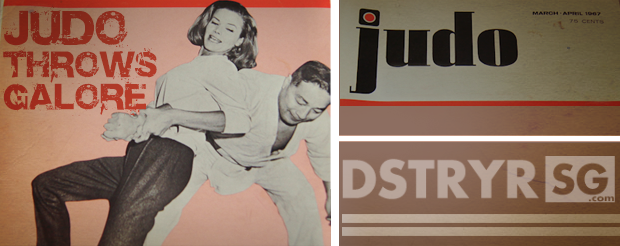
“In the martial arts, there is often talk of taking the opponent’s strength and using it against him, but normally this is illustrated in books and films with a woman performing a judo throw on a male aggressor. But I contend that there is no better example of using and opponent’s strength against him than drawing him onto your blows and having him double the force for you.”

The absurdity of Single Whip

Yes, it’s pretty absurd

/home/wpcom/public_html/wp-content/blogs.dir/a6c/3733799/files/2014/12/img_0635.jpg

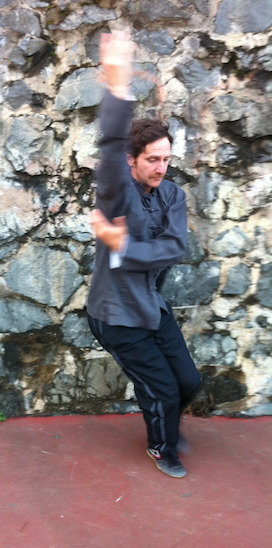
This is the ‘end point’ of the Single Whip posture. Like many, if not all, the postures in a Taichi form, it doesn’t look much like something you’d see in a fight. Why is this?

Even when demonstrated by the practical, hardcore, or no-nonsense tribe of Tai Chi practitioners, it’s a pretty absurd fighting application. That’s just my opinion, so feel free to reject it, but to be honest, a lot of Chinese martial art is pretty absurd, when it comes to fighting applications (“Monkey steals the peach!”, anyone?) Even the ruthlessly practical styles have a few applications that are aways on the edge, but anyway…

I was picking up on this old post from internal strength adept Mike Sigman:

“Silk-Reeling and the Taiji of Yin-Yang

There are two basic martial-arts postures in Asian martial-arts: Open and Close. In “Close” there is stress inward along the front of the body and the inward parts of the limbs; the knees and elbows and the joints bend and are generally under contractile forces of the front. Wing Chun’s basic stance, Uechi Ryu karate’s basic stance, “Play PiPa” (in Taiji), the closed aspect of “Squatting Monkey” (in Dai Family Xinyi), and in many other martial arts can be found variations of the Closed position of stances.

In “Open” the expansive forces from the back of the body and the outsides of the limbs pull the knees and elbows outward and the body lengthens, joints opening. Postures like “Single Whip” exemplify Open. In classically correct postures there is always a balance of the forces of Close and Open or Yin and Yang.”

So, if the point of practicing a Tai Chi form is to get used to going from open to closed in a sequence of postures, perhaps it becomes less relevant what those postures are. Of course, this implies that the form isn’t really for fighting, and that it’s for teaching a body method, which you then use in fighting… which means that the “fighting” probably doesn’t look any different to regular “fighting”, whatever that may be….

If you want to go from close to open then why not create a nice series of postures rather than simply repeat the same movement over and over. That way you get used to doing it in a good variety of positions.

Anyway, food for thought.

Single Whip – ‘Dan Bian’

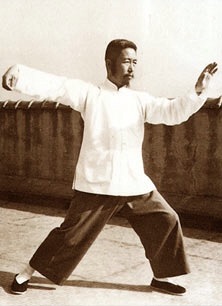
Yang Cheng Fu performing the Single Whip posture.

Single Whip is one of the most recognisable yet least understood postures in any Tai Chi form. I think the confusion arrises from the name. Hearing “whip” most people think of an Indiana Jones style whip – a strip of leather or cord fastened to a handle. Add to this the phrase “whipping power” that’s often used to describe the type of force used in many Chinese Martial Arts and you get people trying to use the Single Whip posture as a strike that’s like a whip crack. Worse you also see them trying to use the beak-like rear hand to strike with, but more of that later.

Let’s try and solve this mystery.

Personally, I don’t think Tai Chi does use a whipping type of power at all – not in the same way that other Chinese martial arts, like Choy Lee Fut, for example, do. Choy Lee Fut genuinely does use a whipping power – the arms whip out, somewhat wildly, powered by the turning motions of the waist and body, but that’s not the same as Tai Chi movement.  When you ‘whip’ the arms out in this manner you give up control of them for a brief moment, so they’re moving independently. In the  Tai Chi classic by Wu Yuxian it says:

“Remember, when moving, there is no place that does not move.
When still, there is no place that is not still.”

It’s not possible to stop a whipping motion like this, once it’s started, which means it’s not really Tai Chi Chuan, at least not in my book.

Here’s the deal: The ‘whip’ mentioned in the name of the Tai Chi posture isn’t a flexible whip, as you’d imagine it was – it’s more like a stick. If you think about it not all whips are flexible – take a riding crop, for instance. The posture is called Single Whip because the finishing posture looks like somebody carrying a yoke, but only on one side, hence the “Single”.

The Chinese have used yokes – sticks carried across the shoulders and back – to transport good since ancient times. Buckets are usually hung from the ends of the yoke. Here’s a picture from a historical website of an 1860’s Chinese gold digger, starting for work with his tools suspended from a yoke on his shoulders.

Now take a look at this illustration of a Chinese man carrying a yoke with just one hand on the yoke:

That’s starting to look very like Tai Chi’s Single Whip posture, isn’t it?

The ‘whip’ could also be used as a weapon in Chinese Marital Arts. Again, it was usually referring to a short stick, not a flexible whip. In the excellent “Chinese Martial Arts Training Manuals”  by Brian Kennedy and Elizabeth Guo you’ll find a description of a book called “Tiger Tail Whip” by Jiang Rong Qiao published in 1930. It features a “long routine for the metal tiger tail ‘whip’, which is rigid and actually amounts to a type of cane.”

In English the words ‘Single Whip’ cause an understandable confusion. The name is simply an aid to memory for the visual shape of the posture, and it’s not meant to be a clue to how you use it.

And the beak-like hand? It’s simply a stylised version of a grab to the opponents wrist. It’s more elegant to make your finger tips touch your thumb when you perform the form, and it reminds you that this is a wrist grab. A simple application of the Yang style version of Single Whip is to grab one of their wrists and pull it in one direction, while striking them in the face with your other hand. There’s nothing mysterious there, either!