A look at the Cloud Hands movement of Tai Chi, and what it’s really all about
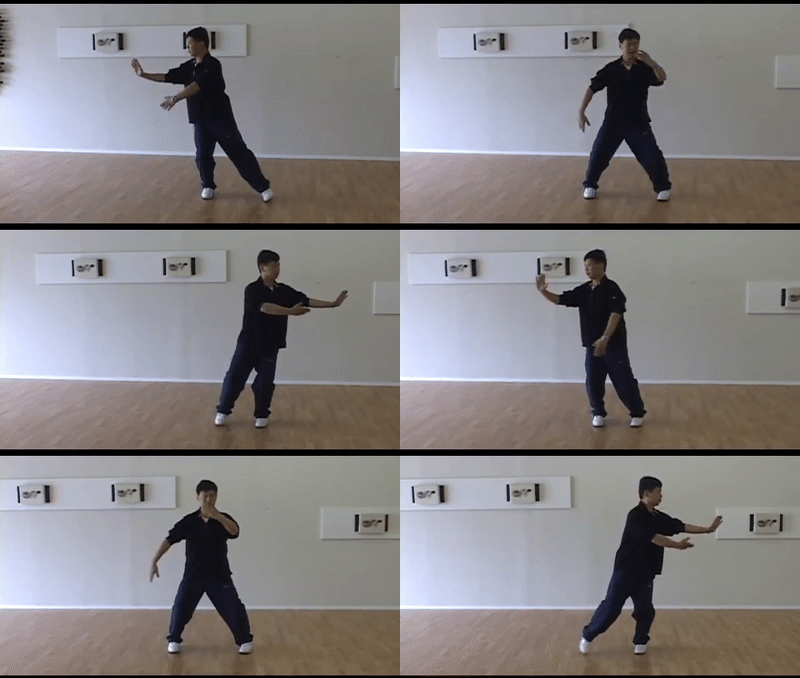
Cloud hands, or ‘wave hands like clouds’ as it’s also known, is one of those classic Tai Chi movements that characterise the art. It’s done in slightly different ways in different Tai Chi styles. Take a look at the variations:
Master Yang Jun, (Yang Cheng Fu, Yang style):
Master Chen Zhen Lei, (Chen style):
Master Sun Ping, (Sun style):
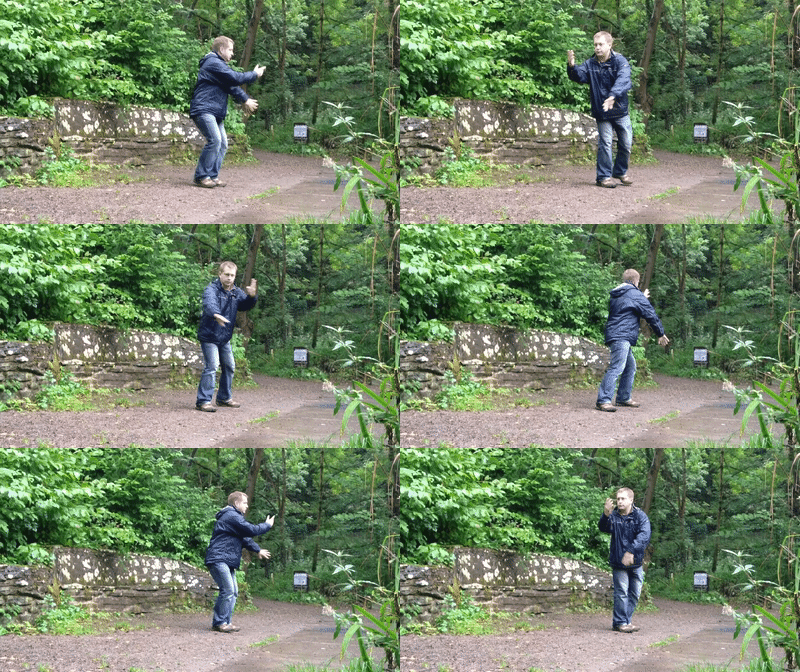
I’m not comparing myself to the masters above, but here’s a GIF of me doing it, since I have that on video I might was well add it to this post:
Me: (Old yang, also called Gu style)
As you can see, the Yang style is more of a vertical arm block, the Chen style is more of a horizontal elbow strike while the Sun style has the palms facing outwards. It’s a case of different horses for different courses, but while there are subtle differences between them, they all involve the common theme of stepping to the side while rotating the arms in circular motions (presumably like clouds on a windy day).
Martially speaking, I think of this movement as intercepting an opponent’s strike and throwing the attacker out, or applying a lock to their arm through the action of turning your waist. To the attacker it should feel like they’re putting their hand into a blender – it gets caught up and crushed and it shouldn’t feel easy to retract your arm once it’s trapped.
It’s easy for beginners to make the arms ‘flat’ in this posture – instead they need to be continually projecting outwards. I think of them as being like the antlers of a stag, or the branches of a tree – they grow outwards, and are slightly curved. If you’re going to intercept your opponents strike with this technique, then it’s going to help ‘catch’ their attack if the intent in your arms (your antlers) is to project outwards.
The real lesson of Cloud hands though is to turn the waist. It’s a common mistake to not turn the waist enough in Tai Chi, and I find that, for the beginning student, a breakthrough in this area often only comes about through a study of Cloud Hands as an isolated technique, repeated over and over. Notice that if you removed the stepping from Cloud Hands then it wouldn’t be a million miles away from the stationary silk-reeling exercises that go along with Tai Chi, with one hand performing a clockwise circle and the other an anticlockwise circle. Indeed, performing Cloud Hands repeatedly can serve a similar function to basic Silk Reeling exercises.
As it says in the Tai Chi classics, the body should be directed by the waist at all times, so as you turn from side to side in Cloud Hands (let’s not worry about the stepping for now) your arms should only be moving because your waist is moving. If your waist stops, then your arms should stop too. This especially applies at the crossover points, when you’ve turned all the way to the side and the arms swap position, so that the lower one becomes the upper one, and vice versa. This is the point that beginners usually drop the principle and use some isolated arm movement, instead of keeping it all coming from the waist. It’s usually a revelation to the student here that you need to turn the waist a little more than you think you do to keep it as the commander of the movement – you should feel this using muscles in your lower back you normally don’t reach.
Remember, in Tai Chi you’re looking to continually maintain a connection (a slight pull) from the toes to the fingers, with movement directed by the dantien like the spider at the centre of a web. If you keep this connection (or slight tension) and the waist control at these crucial crossover points in Cloud Hands then you’ll be well on your way to keeping it throughout your whole form performance.
This could change the way you do martial arts forever
Now, this is interesting. Esther Gokhale has created a method of sitting and walking that she claims will restore your “primal posture”. As you’d expect there’s a book, a DVD, a six-lesson course you can go on, and associated paraphernalia (like cushions) that you can spend more money on, etc, but you can actually get the core of the information for free by watching talks she’s given, like this one at TEDx. If you watch the following video you’ll get the background to what she’s talking about, plus she shows you how to sit in a chair using the method.
I’ve tried it, and I have to say, it makes sitting in a chair way more comfortable than usual for me. I find I can also stay there. Using her ‘sitstretch’ method I lose the urge to fidget around that I normally get when correcting my posture. The slight stretch on your lower back that the method gives you is actually kind of like having a hot bath – very relaxing and restorative.
There are lots of other videos on YouTube for different aspects of the method – like lying and walking. The method is based on observation of tribal people and how they don’t tend to have back pain, and move with a natural grace that we lose as soon as we become ‘civilised’ and live in larger groups in cities.
One idea is the ‘J spine’ – that the spine should be relatively straight, without a large lumbar curve that was associate with an ‘S’ shape.
The J spine in ancient Greek statue.
One tip she gives for keeping this spinal alignement throughout activities is to imagine you have a tail behind you, and you want to keep it behind you and pointing ‘up’. From an evolutionary point of view, this makes sense. Human foetuses actually have a tail, until at some point in our development in the womb it shrinks back into the body.
It’s interesting to apply this idea to Tai Chi, which has long been associated with ‘tucking the tailbone’. I’ve always thought of it as ‘centre’ the tailbone myself, which means that you basically relax the lower back. In fact, the Internet is full of people who have suffered health problems due to excess tucking of the tailbone in Tai Chi practice. There are a lot of people who seem to think that ideally you should form some sort of ‘c’ shape with your spine when doing Tai Chi. I’m of the opinion this is a misunderstanding.
From the classics:
When the tailbone is centered and straight,
the shen [spirit of vitality] goes through to the headtop.
The spine on the right is from an older medical textbook, before the idea of the ‘S’ shape.
A discussion of the similarities between BJJ and Tai Chi
So, finally, here’s my much delayed look at the similarities between BJJ and Tai Chi. This is probably an impossible topic to give justice to fully, but I’ve given it a go and hopefully my perspective will be useful to others. I’ve already attempted to define Tai Chi in a previous post, so the next logical question is, ‘what is Brazilian JiuJitsu?’ Well, explaining what the art is, how it evolved and where it came from is not a simple job but luckily a lot of people have made a lot of (very long) documentaries that explain the whole story of the Gracie family, the in-fighting, the out-fighting and everything else in-between, so you’re better off watching those than having me explain it all again here. If you don’t fancy watching them all then the (very) short version is “it’s an off-shoot of Judo that has more emphasis on ground fighting”.
Try these for size:
The Gracie Brothers and the birth of Vale Tudo in Brazil:
If you want to find out how the art evolved once it entered the United States, and how it compliments other grapplings arts, then check out Chris Haueter’s incredibly entertaining speech at BJJ Globetrotters USA camp:
And finally, don’t miss the excellent Roll documentary on the spread of BJJ in California:
Fighting fire with water
But my concern here is not really the history of the art. I’m more interested in the technical similarities between Tai Chi and BJJ. I’ve heard Brazilian JiuJitsu described as being “like Tai Chi, but on the ground”. I understand where people coming from with that sentiment, but I can’t quite go down that route myself, or rather, I’d settle for saying that it is like Tai Chi, but also explicitly not the same. The one central idea that both BJJ and Tai Chi share is that it’s smarter to not oppose force with force, and instead “yield to overcome” (from a Tai Chi perspective) or “use leverage”, from a JiuJitsu perspective.
As it says in the Tai Chi classic “Treaste on Tai Chi Chuan”:
“There are many boxing arts.
Although they use different forms,
for the most part they don’t go beyond
the strong dominating the weak,
and the slow resigning to the swift.
The strong defeating the weak
and the slow hands ceding to the swift hands
are all the results of natural abilities
and not of well-trained techniques.
From the sentence “A force of four ounces deflects a thousand pounds”
we know that the technique is not accomplished with strength.
The spectacle of an old person defeating a group of young people,
how can it be due to swiftness?”
I’d disagree with the classic on one important point though – most of the traditional martial arts in fact do go beyond the strong dominating the weak, because without that key principle there is not much of an art left in the martial art at all. And I don’t know about the idea of defeating a “group” of young people either (that would be a tall order for any martial art, or martial artists), but to me the classic is suggesting that skill and technique can supersede the natural advantages of youth, such as speed and strength. And when it comes down to it, it’s hard to find an art that can deliver on this promise as well as BJJ can.
BJJ is one of the few martial arts where an older man (or woman) can be expected to regularly beat a younger man (or woman) by having more skill and technique, in a fully resisting scenario, thanks to techniques that manage the distance (a critical self defence skill) and use leverage and technique to overcome brute strength. That’s not to say that no strength is required, but you don’t necessarily need more strength than your opponent to make it work.
Rickson Gracie
To me, the BJJ practitioner that best exemplifies a similarity between Tai Chi and JiuJitsu is the legendary Rickson Gracie. He’s generally agreed to be the best of the Gracies. Compared to the acrobatic extravagances of today’s sport JiuJitsu champions, who favour inverted guards and bermibolos, Rickson’s style of Jiujitsu seems surprisingly simple, yet effective. There are no flashy moves, just basics done at a very high level.
The Rickson documentary “Choke”, which shows his training for a Vale Tudo fight in Japan, is essential viewing if you haven’t seen it before:
In the documentary you can see a young Rickson doing Yoga on the beach. Rumour has it that he also said he studied Tai Chi in a magazine interview, although I’ve not been able to find a transcribed version online to confirm this. Either way, it’s clear that he’s not averse to stepping outside of “pure jiujitsu” to add elements to his exercise, martial and health regimen. The cost of upholding the reputation of JiuJitsu and the Gracie family has been heavy though, and he has several herniated discs in his back, but he’s still on the mats teaching his family art, cornering his son Kron in his MMA fights and giving instruction through his JiuJitsu Global Federation. He also spends a lot of time surfing these days, instead of fighting.
If you read a Rickson seminar review, like this one, you can see that he keeps returning to two common themes – “connection” and “invisible jiujitsu”. The invisible part refers to what you can’t see happening; you can’t see where he is putting his weight and making his connection to his opponent, but you can feel it when he does it. He has detailed ways of making a connection in each position in BJJ.
This sort of teaching from Rickson, to me, is where I find the crossover between Tai Chi and BJJ to be strongest. In Tai Chi Push Hands, for example, we constantly seek to make a connection to the other person, through touch, so its a very familiar concept.
Here’s me doing some push hands:
Forget about the thing I’m trying to teach in the video, just look at the Push Hands routine we’re doing. As you can see, Push Hands very concerned with ‘feeling where the other person is’ and ‘yielding to their force without opposing it’ to neautralise the opponent. From this perspecitve, Push Hands starts to sound a lot like what Rickson is talking about in his seminars, but in a different format.
But the similarities don’t end there. When employing standing techniques Rickson also utilises some of the postural work found in Tai Chi and makes makes subtle nods towards the ‘internal’ method of body movement favoured by Tai Chi. He talks about making a connection to the ground through the feet. I’m not suggesting his ‘body mechanics’ ideas fully embrace everything you’d find in Tai Chi, but I can see the foundations of it being built.
For example, in a Rolled Up episode (3/4) from last year Rickson shows Budo Jake how to use some basic body mechanics to create a better root to the floor when meeting an incoming force while standing. He’s talking about transferring the force applied to the arm down to his foot and into the ground, then back up to move the opponent backwards. This is basic Tai Chi 101.
See here, from the beginning:
At.4.26 he starts to talk about ‘invisible jiujitsu’, specifically at 5.55 about ‘putting the weight in the hands’.
I was taught a very similar drill in Tai Chi – a kind of wrestling game, where you had to stand square on to the opponent and try to unbalance them with a push as they did the same to you. The key to doing it is to ‘put your weight into your hands’, so that when you push, it’s coming from the foot, not the shoulder. And when they push you root the push into the ground, instead of letting it push you over.
Here’s a video of me doing it from a few years ago. The camera is on the ground and not straight, so it looks like I’m leaning forward, but I’m not really:
I’m not an expert at it, and use too much arm strength, but hopefully you can see the similarity between this and what Rickson is talking about in the Rolled Up video.
Of course, Tai Chi takes this idea of creating a path from the foot to the hand to further levels of detail – first the idea of ‘pulling silk’ where you create a stretch from the fingertips (and toes) to the dantien and maintain that connection while moving, so it remains unbroken. Incidentally, the silk analogy refers to the way silk weavers pulled raw silk thread from a cocoon – you had to pull with an even pressure or the thread would break.
The next stage after ‘pulling silk’ in Tai Chi is to create windings on the muscle-tendon channels in the body, controlled from the dantien – the famous ‘silk reeling’ of Tai Chi. I think you can view this as the point where BJJ and Tai Chi diverge and head off along different paths – Tai Chi becomes highly specialised in this type of movement, while BJJ becomes more interested in the practicalities of actual fighting, and taking the fight to the ground (or just dealing with the fight on the ground) where it enters a whole new arena.
Realistically, and practically, there is no need for the type of highly specialised and, frankly, difficult, method of moving the body that Tai Chi employs for actual fighting, and also it’s questionable whether you can actually do ‘silk reeling’ type movement when on the ground, since it relies on using the power of the ground to push up from via the legs. Does that mean one art is better than the other? Well, they both are what they are, and they’re good for different things. I’ll probably leave it at that.
Conclusion
Interestingly, when I started BJJ (almost 5 years ago now) I found that my all years of experience in Tai Chi meant nothing at all on the mat when rolling against an experienced practitioner – even if they were a smaller, weaker person. Fighting on the ground is a completely different animal compared to stand-up. I was submitted as regularly as the next white belt, but I did find that my previous experience in Tai Chi meant I could learn quicker than average (I got my blue belt in a year). It let me see the concepts and principles hidden within the techniques of jiujitsu. And it helped me relax under pressure, which is a huge part of getting better at BJJ. Also, doing the Tai Chi form helped me recover quicker from the physical wear and tear which is characteristic of your first 6 months of BJJ, while your soft, squidgy body is still toughening up.
Unlike Tai Chi, which has, in a sense, become set in stone in terms of its evolution, BJJ is a constantly fluid and evolving art. Thanks to the highly competitive environment of the BJJ competition circuit, new techniques are always being created and being discarded. It’s becoming highly specialised towards what works in the most common competitive rule sets. Where I see the connection to Tai Chi is in the older, ‘original’ BJJ that was more self-defence orientated, as exemplified by Rickson Gracie. Where BJJ is headed next is anybody’s guess. Quite possibly it will evolve in several directions all at once, and it will be interesting to see if the legacy started by Rickson Gracie and his ‘invisible JiuJitsu’ lives on, or even gets expanded upon.
6 harmonies movement, the classics and the boxing art
This article was supposed to be a description of some key similarities between BJJ and Tai Chi. Unfortunately while writing it I realised I first needed to define Tai Chi properly before I could successfully contrast the two. Then I realised that this wasn’t an easy task.
Some people consider the fact that it is taught by a family that has a style of Tai Chi named after them to be enough to legitimately say the art they do is “Tai Chi Chuan”. You might consider that attitude to be similar to the attitude of Leung Bik in this little martial arts film clip about Wing Chun where Ip Man meets Leung Bik. When questioned by a young Ip Man if what he’s doing is really “Wing Chun” he says “Whatever comes out of my fist is Wing Chun!”. In essence he’s saying that he is the style, so there is no restriction on what defines the style.
On the flip side, there’s also the argument that for movement to be truly “Tai Chi Chuan” it must follow a strict number of movement principles, or rules. Some of which you’ll find in the Tai Chi Classics, and some of which you won’t.
The Tai Chi classics actually talk a lot about fighting strategy, particularly the idea of not opposing force with force. But I’d argue that this isn’t really what defines Tai Chi. In fact, most martial arts adopt this strategy, since a martial art where your strategy is just to attack like an unthinking robot until your enemy is dead in HULK SMASH! mode is unlikely to keep its students in the long run! Therefore, it’s no surprise to me that a lot of the writing in the Tai Chi classics seem to apply equally to Brazilian JiuJitsu, Jeet Kune Do, Aikido, Karate and lots of Kung Fu styles just as well as they would to Tai Chi. The writing in the classics doesn’t talk too much in the actual mechanics of movement, and instead talks a lot about fighting strategy.
For example, lines like the following could apply to most martial arts:
“The feet, legs, and waist should act together
as an integrated whole”
“Empty the left wherever a pressure appears,
and similarly the right.”
“It is said if the opponent does not move, then I do not move.
At the opponent’s slightest move, I move first.”
So, if you find that the Tai Chi classics cannot be relied upon to adequately define “Tai Chi Chuan”, what can? The best answer I’ve found is held in the concept of 6 Harmonies movement, or 6H for short. The idea of “Six Harmonies” is actually older than Tai Chi Chuan itself.
The six harmonies are broken down into 3 internal harmonies (the “desire” leads the “mind”, the “mind” leads the “qi”, and the “qi” leads the “strength”) and the 3 external harmonies – the shoulders connect with the hips, the elbows with the knees and the wrists with the ankles (or hands and feet, if you want). You can think of the internal harmonies as being about the desire to do something and turning it into a physical action – the actual Chinese word is “Xin”, which translates as “heart”, but in the sense of the desire arising to do something coming from your heart, not your head. In contrast, the external harmonies describe how the movement actually goes through the body (from the fingertips to the toes) via muscle-tendon channels, a process trained in Tai Chi through “silk reeling” exercises.
The distinctive feature of 6 harmonies movement is a complete connection of mind and body, producing force that appears soft, but penetrates deeply. It’s quantifiably different in feel to force produce by local muscle usage, although to somebody unfamiliar with it, it can look just like normal movement it should feel different. While the initial stages of learning 6 harmony movement may use large circular motions, they can be made imperceptibly small by an expert, which makes it even more difficult to quantify and identify.
Credit must be due to Mr Mike Sigman of the 6H Facebook group here for putting these Chinese concepts into words that English speakers (like myself) can understand without too much problem. He’s produced perhaps the most comprehensive and organised explanation of the process I’ve seen written down in English. If you want to delve deeper into it, I’d suggest joining his Facebook group and looking through some of the older posts.
I’m undecided as to wether there was originally a fully formed 6H theory that goes back hundreds of years, and is the origin, or essence of all Chinese martial arts, or if it’s something that has been refined over the years as a distillation of all the “good bits” of Chinese martial arts. The fact that the ancient meridian system used in acupuncture overlays the muscle tendon channels used in 6H is a good indication that it is an old, old theory, and lots of old Chinese martial arts have the phrase “Liu He” (6 harmonies) in their name (like Xin Yi Liu He Quan), which adds weight to the theory, but we’re drifting into speculation here. In a sense it doesn’t matter if you want to think of 6H as the modern distillation of “internal” movement methods or an ancient system, the important thing is the doing of it, and that requires practice.
Note: I’ve left “qi” in my description above, but that’s because, ultimately, I think its more problematic to replace it with an English word, when there isn’t one that’s really up to the job. Please note – there is much more to the theory and practice of 6 harmonies movement than I’m describing here (for example, dantien rotation, open/close, reverse breathing and the microcosm orbit), so I’d suggest that the reader who is seriously interested in the topic join the Facebook group if you want to get a proper handle on it. It is not a trivial subject!
So, to finally return to the question, what defines Tai Chi Chuan? I’d say it’s a combination of all three of the ideas expressed above – it needs to be from a lineage connected to the original Tai Chi families (the Chen, Yang, Wu, Woo and Sun families), it needs to conform to strict principles of movement, the most cohesive set of which I’ve seen is 6 harmonies movement, and it needs to follow the fighting strategy expressed in the Tai Chi classics.
Now that’s covered, I can get onto my intended subject of the similarities between BJJ and Tai Chi, and a look at the legacy of a certain Mr Rickson Gracie…
It’s pretty well established now that you need to ‘move from the centre’ in Tai Chi – (or ‘center’ if you’re American). But what is the centre?
In the ‘internal’ model of moving the body in Chinese martial arts, the centre is expressed as the ‘Dan Tien’, the point roughly an inch below the navel and 2 inches in from the surface. This is where you put your mental focus to move your body from. So, rather than the arm movements coming from the shoulders they come from the torso, which is turned by moving the waist, which is, in turn, powered by moving the dantien. So it all works together, but with the movement coming from the dantien.
The problem with moving from the centre like this is that you can do it roughly correctly and your movements will still be flat (for want of a better word) and lacking power. Sadly, most of the Tai Chi you see demonstrated is like this. I could post a video, but it would seem like picking on somebody, so I won’t – but just search YouTube for Tai Chi videos and ask yourself if they look powerful or not. It’s far too easy to have the dantien ‘floating’ on top of the hips, so that the legs are just propping it up, rather than being involved. To make the movements truly powerful you need to get the legs involved.
As it says in the classics, the jin (power) should be…
“rooted in the feet, generated from the legs, controlled by the waist, and manifested through the fingers.”
If you imagine a triangle drawn from the two feet up to the dantien, that’s the power source of Tai Chi. So, as the dantien turns, so the legs need to spiral in and out to help support the movement and transfer this spiral force to the rest of the body.
Chen Xiao Wang explains it very well in this video. After talking about the legs and rotating dantien he goes on to talk a lot about Qi and Yin and Yang, which can be confusing, but just concentrate on what he says at the start for now about the legs working with the dantien to power the arms.
Of course, there’s more to it, which he goes on to discuss, but that’s for another time.
Yesterday I taught the ‘Grasp Bird’s Tail’ sequence in the form. I don’t know why, but I drifted into talking about trigrams as I was teaching it. Trigrams are the series of three broken or unbroken lines that make up the Bagua and are usually associated with the ancient book of Chinese wisdom, the I-Ching, or “classic of changes”, which contains 64 hexagrams (two trigrams on top of each other).
This diversion into ancient philosophy is somewhat unusual for me, but not unheard of, as I usually don’t like to get sidetracked into theoretical discussions too much when I teach. I think theory has its place, but I’ve seen too many Tai Chi teachers who seem to need a whiteboard and marker pen to teach you how to throw a punch. The thing is, the trigrams aren’t purely theoretical to me, and they do have relevance to teaching and practical application, as I will explain.
The four fundamental forces used in Tai Chi are Pung, Lu, Ji and An, (usually translated as Ward off, Rollback, Press and Push) and are most clearly expressed in Yang style-derived Tai Chi forms in the section known as Grasp Bird’s Tail. Each of the energies has a trigram related to it for a specific reason.
Peng is three unbroken, or yang, lines: “heaven”
Lu is three broken, or yin, lines: “earth”
Ji is one solid, yang, line surrounded by two yin lines: “water”
An is “fire”, a yin line surrounded by Yang lines.”fire”
Heaven, earth, water and fire – four fundamental elemental forces.
Because of their symbolic makeup, the trigrams can help you understand what’s ‘inside’ the postures, and what makes them different to each other – what makes a Peng a Peng, for instance, and not a Lu? And how is that different again to a Ji? And how is An different again?
It’s about the feel of each movement.
For example: Peng is represented by three yang lines – this is maximum yang at its fullness. In this posture you should feel internally inflated – a positive, outward expression of energy at its maximum. That doesn’t mean it is “hard” – it is actually more like a large rubber ball – a springy kind of energy on contact.
Lu is represented by three yin lines. This is the most empty a posture can be, but again, it’s not lacking or depleted, it’s just empty. There’s still a structure, like the way a vase is empty in the middle. You are guiding force past you, without adding in your own force, but also without losing your own stability.
Then you get Ji and An, which mix both yin and yang lines. Ji is a solid yang line between two broken yin lines – the needle in the cotton. This is how the energy should be expressed in Ji – soft, but with a hard centre. Push is the opposite – it appears to be hard, but is open and empty inside, giving the push a warmer fire-like feel.
Again, we are talking about how each posture feels here, so words will always be inadequate, which is why the trigrams can be a useful visual symbol to represent the feeling of each energy and help you distinguish them.
The use of trigrams is not limited to Grasp Bird’s Tail. (There are another four in use in Tai Chi, which are further mixtures of yin and yang balances, but I often feel like the theory is being shoehorned slightly into Tai Chi to accomodate them into a nice neat number 8, as there’s no real reason to go as far as 8, and you could also go further.).
Once you can understand the feeling of the four energies in Grasp Bird’s Tail you can see how it applies in other areas of the form. For example – what energy do you want to express at the very end of Brush Knee Twist Step? Is it a Ji or an An with the projecting hand?
Well, the interesting thing is, you could do it either way, so long as you know what you’re doing and why you’re doing it.
Addendum: One of the joys of symbols is that you can interpret them in different ways. If what I’ve written goes directly against what your teacher has told you, then that’s fine – you can interpret these things in different ways. This is just the way I do it.
“When the opponent is hard and I am soft,
it is called tsou [yielding].”
The idea of yielding to overcome is the main combat strategy of Tai Chi Chuan, but there are various ways of thinking about this idea. It’s another way of saying to use your opponent’s strength against them. Recently I found another way of thinking about this that you might find useful.
“In the martial arts, there is often talk of taking the opponent’s strength and using it against him, but normally this is illustrated in books and films with a woman performing a judo throw on a male aggressor. But I contend that there is no better example of using and opponent’s strength against him than drawing him onto your blows and having him double the force for you.”
Another of the Internal Arts of China is Bagua, the core practice of which is walking a circle with various different palm positions. While I don’t really practice Bagua I do have a great circle walking training tool at my local park. Check it out:
As you can see, it’s important to fit your training into your life, and the local park provides many different training opportunities.
As it says in the Tai Chi Classic,
“In motion the whole body should be light and agile, with all parts of the body linked as if threaded together.”
Obviously you need to be light and agile to keep your balance while stepping on this childrens’ ride. Lightness and agility are important qualities that need to be trained in Tai Chi, and always practicing on a perfectly flat wooden floor of a dojo, or the flat concrete of a patio won’t help you. I strongly advocate training the form on a variety of surfaces, both even and uneven, sloping, staggered and even moving, as shown here! Also, it never hurts to have a little fun time with your kids 🙂
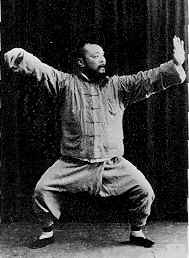
Wu Jianquan of Wu style Tai Chi demonstrating how to centre the coccyx perfectly.
People often get very confused about “tucking the tailbone” in Tai Chi Chuan. It’s a posture requirement that’s mentioned in the Song of the 13 Postures, where it says:
“When the tailbone is centered and straight,
the shen [spirit of vitality] goes through to the headtop.”
The tailbone is what’s more normally known as the coccyx. Notice, there’s no mention of “tucking” here at all, just keeping it centered and straight, which makes me wonder where everybody gets the idea of tucking it from? It’s quite a crucial misunderstanding because the word “tucking” implies bending the hips and tucking under, which results in an unnatural and distorted posture that isn’t comfortable at all. You can’t even stand comfortably like that, let alone fight!
I find that the best way to achieve a centered coccyx is to first bend the knees (you can’t ‘centre’ you coccyx with straight legs) and then relax the lumbar region of your spine. You’re looking for a natural feeling of lengthening. A dropping down. Once you’ve got that feeling then your coccyx will be in the right place. You shouldn’t feel any of the muscles or tendons in the backs of your legs being activated when you do this either, so look out for introducing tension there – it’s usually a sign that you’re starting to “tuck”, rather than lengthen the spine.
“Think over carefully what the final purpose is:
to lengthen life and maintain youth.”
– Song of the 13 postures.
I’m basing today’s sermon on this often overlooked couplet from the Song of 13 Postures. You see, there’s a lot of talk on online discussion forums asking where it all went wrong for Tai Chi Chuan. How did this deadly pugalistic art of the Chen and Yang families from the bloody 1800s in China become this watered-down, series of sanitised slow-motion movements for old people to do in parks?
As this line from the classic points out, it was never just about fighting anyway. Tai Chi Chuan was always about something more. The argument for staying healthy is a strong one. Even if your main purpose in pursuing the art is to acquire fighting skills what good are they if you’re overweight, ill or have limited movement in your joints? If you’re not healthy then that’s going to seriously inhibit your ability to defend yourself. Yet, do the historical masters of Tai Chi Chuan live up to this ideal? Sadly not. The famous Yang Cheng-Fu was also famously obese and his most famous student, Cheng Man-Ching, was often famously inebriated. Neither of these two unfortunate facts takes anything away from their skill levels in the art.
Is Tai Chi Chuan enough for health? Bear in mind when the words of the Song of 13 Postures were written. Daily life was much more of a grind in 1800s China than it is for us today, with all our fantastic labour (and boredom) saving devices. These days very few of us lift heavy objects, walk very far or move about as much as people used to do on a regular basis. We also eat a lot more, and most of it is high-sugar, high-fat crap.
Quietly, to myself, I often ponder whether the health benefits to be gained by Tai Chi Chuan match up to those that can be gained by, say, going ballroom dancing twice a week. In conclusion, I’d say ballroom dancing is probably the more healthy option, but you can’t go ballroom dancing for those brief 10 minutes in the morning when you’ve got the kitchen to yourself before the kids charge down the stairs and start wrecking the joint. You can’t ballroom dance in that last half hour of the day while the wife is catching up on her soap operas and you slip, unnoticed into the back yard to do a little bit of the form under the stars. And most importantly, for me, you can’t ballroom dance your way out of a violent confrontation.
So, I’m left with Tai Chi Chuan. The great all-rounder. It’s hard to but a label on what it is exactly. It doesn’t specialise in one area too much, but touches on many. Jack of all trades, master of none, or universal panacea? You decide.







 The Tai Chi Notebook