Behind the gesture is a code about power, respect, and control
I always finish my Tai Chi class, which takes place in the UK and is taught by me, a British person with no connection to Chinese culture outside of martial arts, with a small Chinese-style salute.
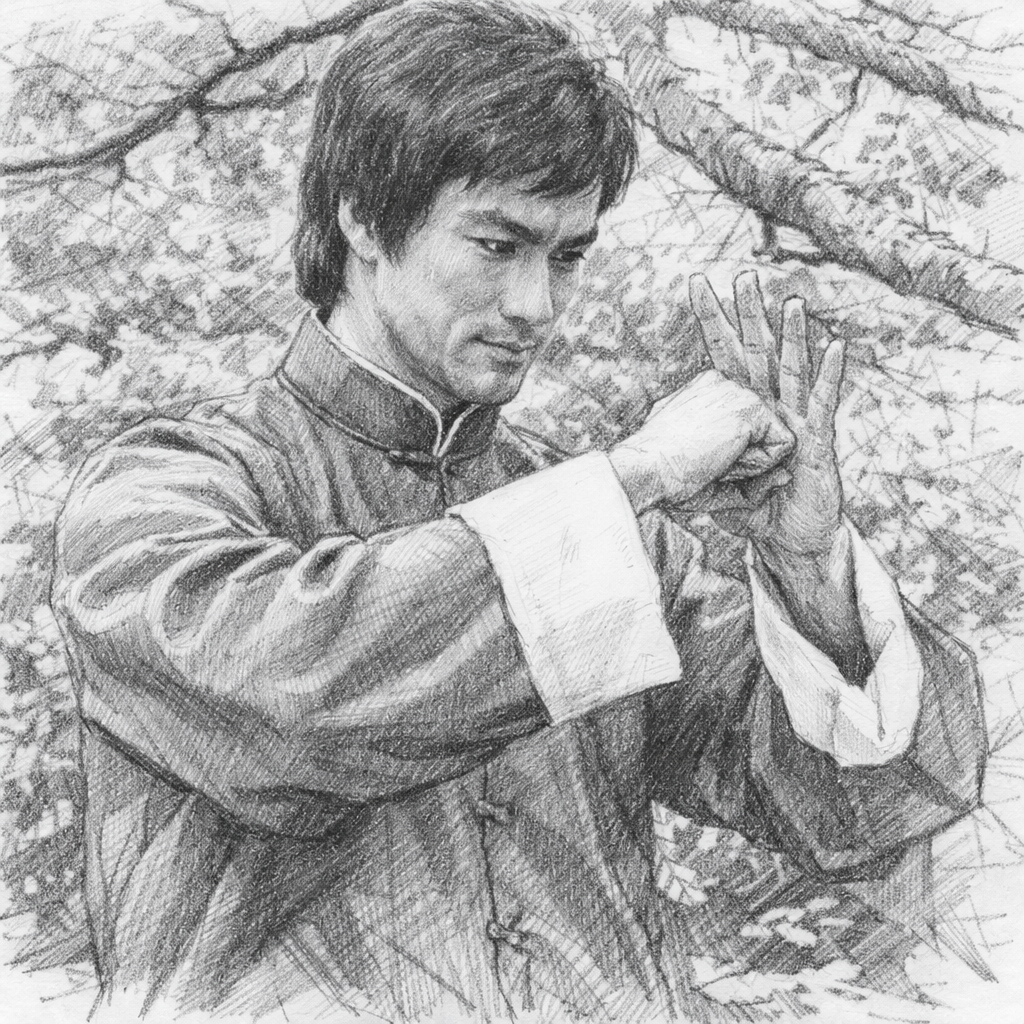
Often called the “sun and moon” salute, it’s a traditional greeting in Chinese martial arts circles. It’s the same one you see Bruce Lee do to his student at the start of Enter the Dragon. But like most things in Chinese martial arts, it has both an obvious meaning and a hidden one. Of course, you don’t need to know the hidden meaning to use it.
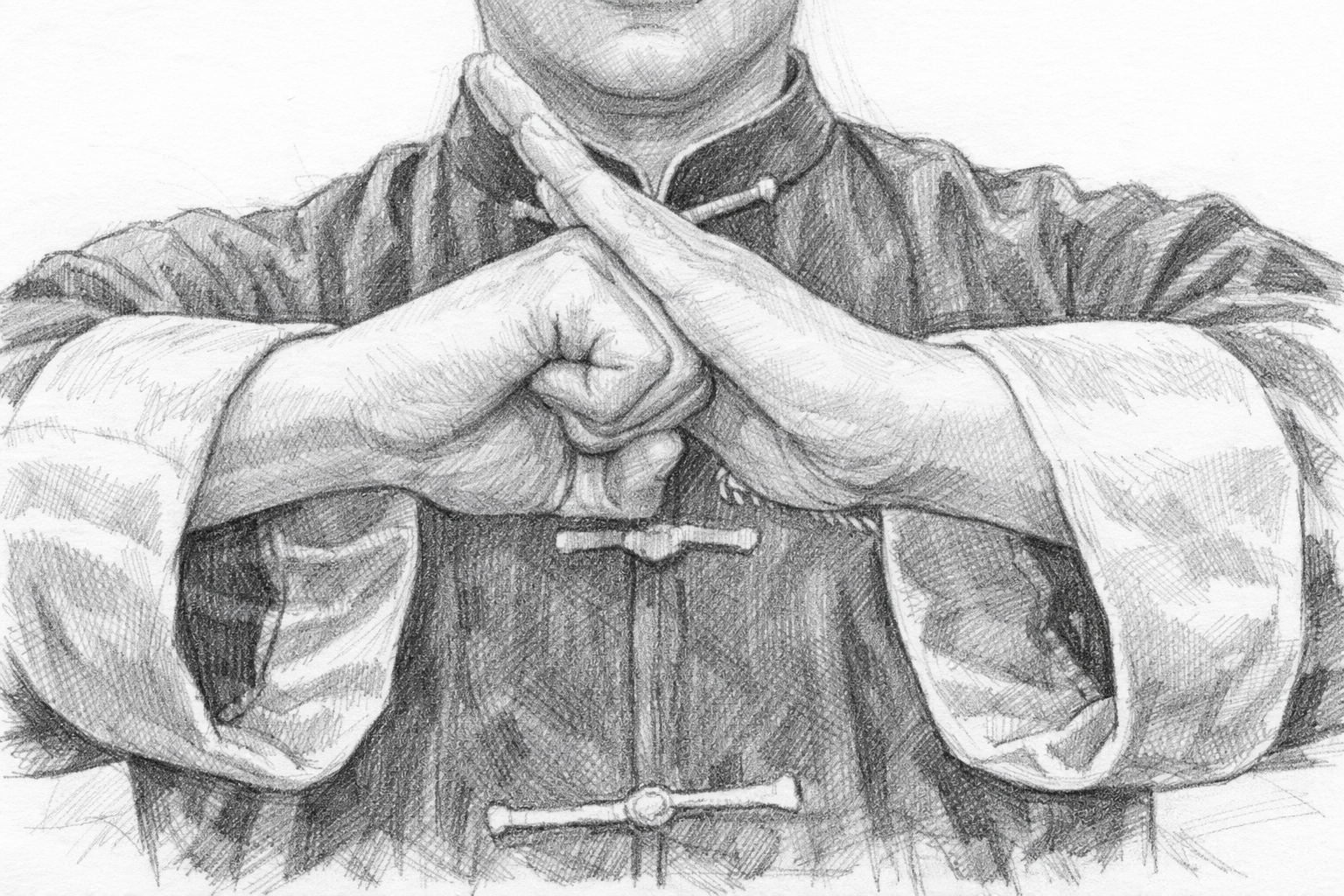
In Chinese, the salute is called bàoquán lǐ, which roughly translates as “fist-wrapping rite.” Your right hand forms a fist — the “sun” — and your left hand presses flat against it — the “moon.” You stand straight, feet together. It’s accompanied by a short, respectful nod of the head rather than a deep formal bow, while maintaining eye contact.
Sometimes the fingers are folded instead. This seems to be a softer, less formal greeting (and it’s the one I usually use). This variation is often called gōngshǒu lǐ (“cupped hands greeting”) and is traditionally gendered — the closed fist is the right fist for men and the left fist for women.
It’s worth noting that this is far from the only hand position used for greeting across China’s long history, particularly within religious traditions.
Why do it?
The bàoquán lǐ isn’t a tradition added to Chinese martial arts — it’s a remnant of a moral code that existed before they were formally named.
At a basic level, the fist represents martial skill or strength, while the palm represents civility, restraint, and wisdom. The palm covering the fist symbolizes martial power governed by virtue or, put simply: I can fight, but I choose respect and control.
When I do it at the end of class, it’s quick and almost reflexive, sometimes even a little embarrassed. I don’t expect my students to do it back. It’s a brief gesture with a clear purpose: it marks the end of the session and acts as a quiet “thank you” for the work they’ve just done.
When I do it to my kung fu teacher, it carries a different weight. My teacher (who is not Chinese) still greets his own teacher (who was Chinese) with this salute every time they meet, and that tradition was passed on to me. I still greet my teacher this way whenever I see him. Even though it isn’t part of my culture, the meaning is clear when I do it.
In that sense, I suppose I’ve passed on a “light” version of the tradition to my own students by using the salute at the end of class. Even if they don’t return it, it’s something they now recognize. The tradition has softened over time, we don’t use it to greet each other, and honestly, I think it would feel strange if we did.
I’d describe my teacher’s period of training with his teacher as serious, and my own training as semi-serious by comparison. People in modern Tai Chi classes aren’t devoting their lives to this with the all-or-nothing commitment that might have been expected in 1860s China. For most people, it’s a hobby. A social activity. Ideally, people leave class feeling better than when they arrived, or at least like they’ve worked hard and learned something.
Hidden meanings
As with most things in a culture that has existed continuously for thousands of years, meanings tend to come in layers.
The sun and moon are obvious representations of yin and yang, shown here as equal forces held in harmony, suggesting balance rather than dominance.
There’s also a practical dimension. A level of formality in martial arts is useful. What we’re engaging in is potentially dangerous, and maintaining respectful ritual helps reinforce that fact.
(Incidentally, that’s one reason I don’t mind bowing in Brazilian Jiu-Jitsu training too. We routinely put our training partners in potentially life-changing situations, and a moment of ritual respect is a good reminder that what we’re doing carries real consequences.)
One of my favorite hidden interpretations, though, comes from Chinese history, specifically the Ming–Qing dynasty transition.
The Ming were the last ethnically Han Chinese ruling dynasty. The Qing were Manchu invaders from the north, and they were deeply unpopular with large parts of the population. Resistance movements emerged almost immediately.
The slogan “Overthrow the Qing, restore the Ming” (反清復明, Fǎn Qīng fù Míng) became a rallying cry for secret societies and rebel groups from the fall of the Ming in 1644 well into the early 20th century.
The bàoquán lǐ salute was reportedly adopted by some of these movements as a covert signal of allegiance. The closed fist was said to represent the character for sun (日), while the open palm represented moon (月). Together, these two characters form 明 (Míng), meaning “bright” or “to illuminate,” and also the name of the fallen dynasty.
Which means that, technically speaking, every time I’ve used this greeting, I’ve been quietly expressing support for the overthrow of the Qing dynasty.
But no, my Tai Chi class isn’t secretly plotting the restoration of a long-collapsed Chinese dynasty. But I do like the idea that a small, slightly awkward gesture at the end of a community hall class carries echoes of philosophy, rebellion, and restraint. Even if most of the time, it’s really just a polite way of saying: thanks for showing up — see you next week.
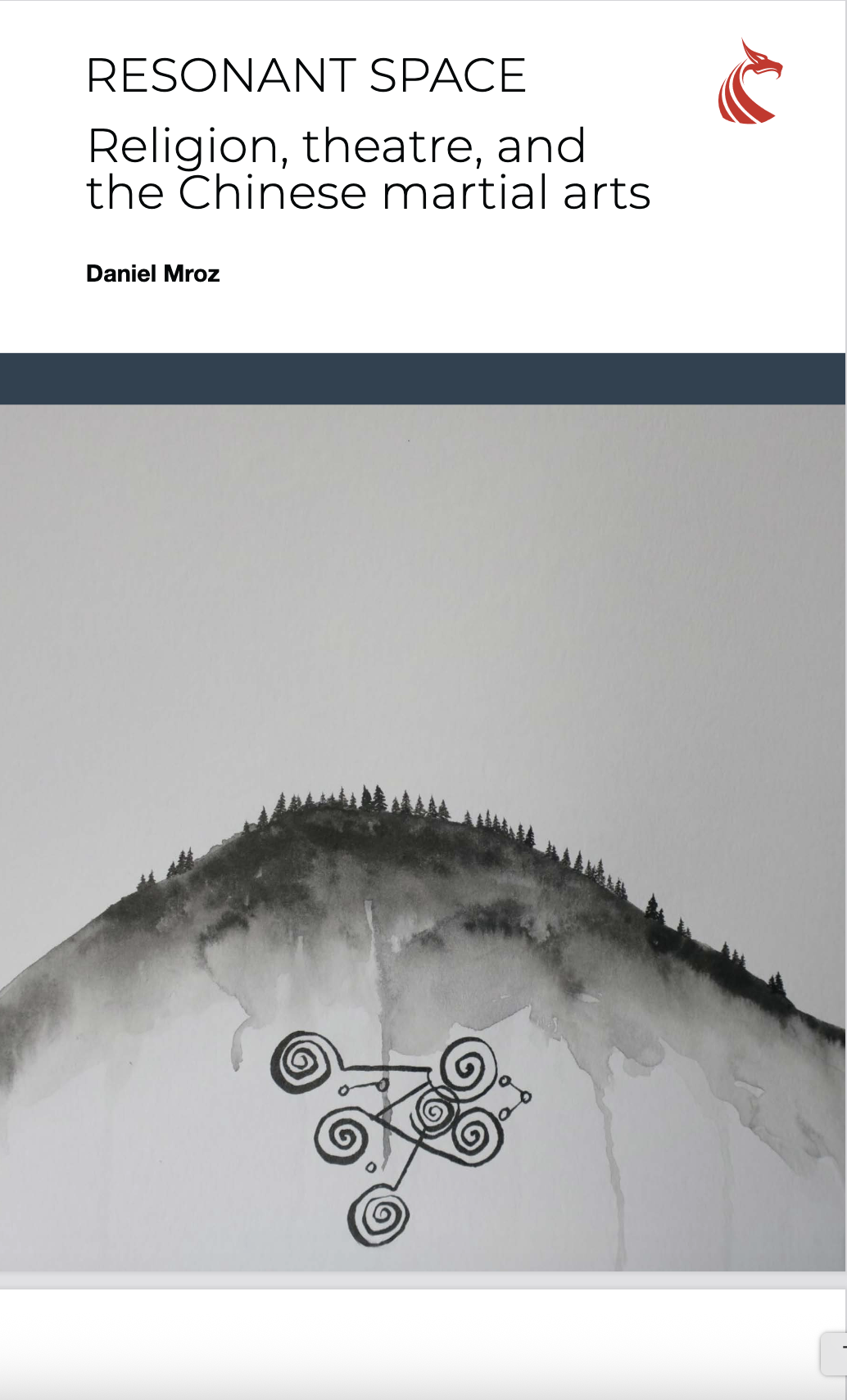
Religion, Theatre, and the Chinese Martial Arts, by Daniel Mroz
My good friend Daniel Mroz’s new book Resonant Space is out now! Daniel was the first guest on my podcast — back when I had no idea what I was doing with recording and editing audio, so it sounds pretty bad compared to my more recent efforts. However, what he talked about remains as insightful and up to date now as it did then. This book takes his ideas even further.
Here’s the blurb:
“Resonant Space constellates the martial, ritual, and theatrical elements of the Chinese martial arts with the practice of contemporary theatre and dance. This interdisciplinary approach blends the embodied experiences of the author, a lifelong student of the Chinese martial arts and a theatre director and dance dramaturg, with the study of Chinese cultural history. This is a work for scholars and practitioners of the Chinese martial arts, of contemporary dance and theatre, and for scholars of Chinese religion and cultural history.”
If you are at all interested in the intersection of Chinese martial arts, magic, theatre, military methods, violence, dance, self defence and religion, then you can’t miss this. I have read bits of this book already (it’s excellent), but I haven’t read it all yet, so I’m yet to appreciate it as a whole, and to see how he makes all the pieces fit together. I’m very excited to finally get to read the complete thing.
If you’re a practitioner of Chinese marital arts, then I can guarantee that this book will make you think. In good ways. There’s almost an embarrassment of riches packed into every page. So, rather than attempt to describe it, I thought I’d just throw three random quotes at you from the first chapter of the book, without context. Hopefully they’ll make you want to find out more.
“In the Chinese martial arts and in military strategy more generally, excellence in fighting is secondary to trickery and wisdom.”
“Perhaps the most famous failure of war magic was experienced by the Yìhéquán 義和拳 fighters of the Boxer Rebellion of 1899, who discovered they were not impervious to the bullets of Western colonial powers.”
“Given its spectacular nature and emphasis on dramatic fights, it comes as no surprise that Chinese theatre, or xìqǔ 戲曲, employs many training methods that are virtually identical to those used in martial arts.”
Again, you can read the whole book for FREE from Cardiff University Press as a PDF, or you can buy a printed copy for a reasonable price. Don’t miss this!
Just watched a great clip of 1980s Wushu in China – featuring Sun Jianyun, Sun Lu Tang’s daughter performing Bagua. But there’s also some clips of Tai Chi and some kids doing Northern Shaolin (at least I think it’s Northern Shaolin). Well worth a watch. The martial arts are on their way to being the heavily performance-based WuShu we have today, but are not quite there yet, with martial technique still a priority.
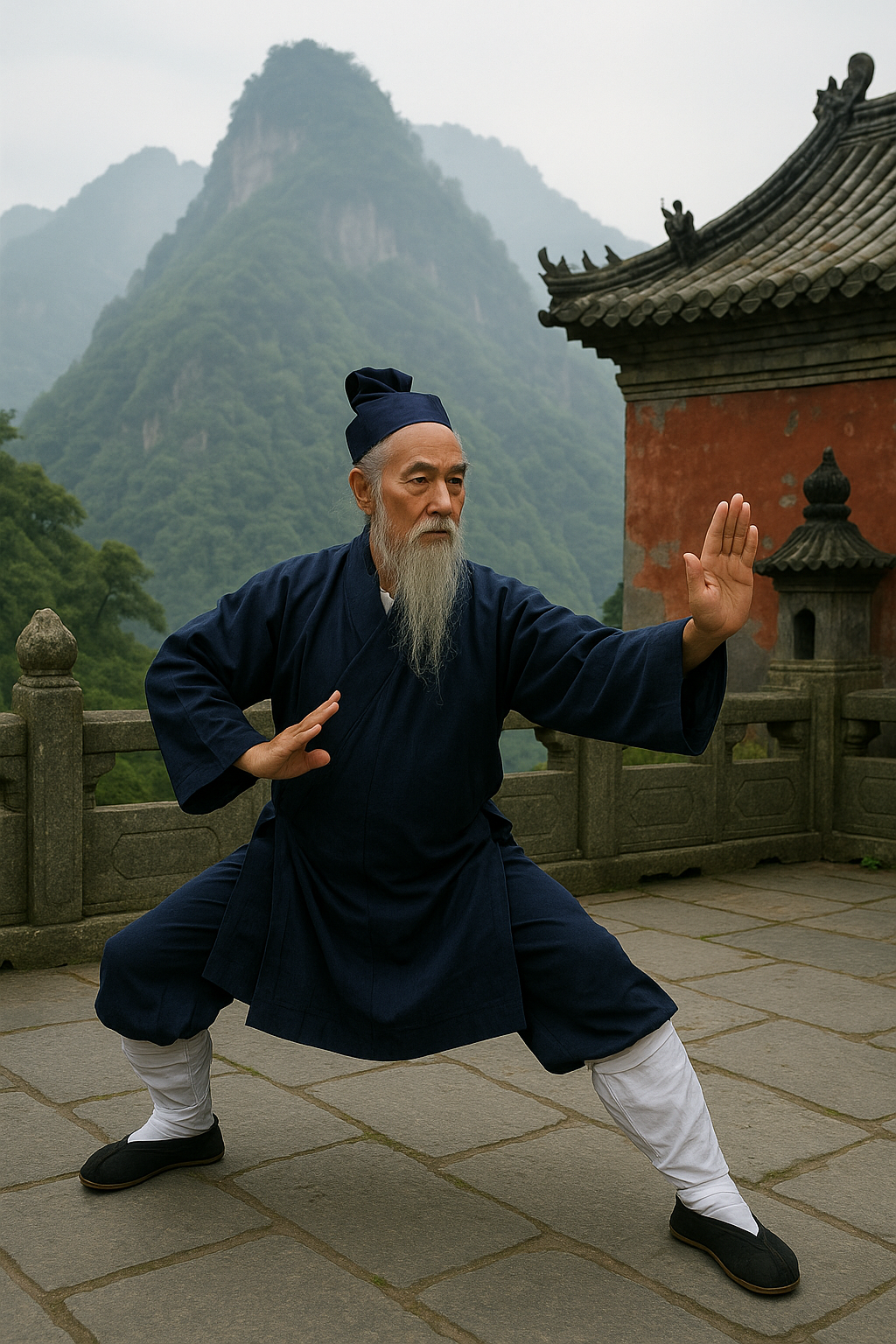
(FYI AI-generated image of a monk practicing martial arts at Wudang).
This is an excellent article called The Sacred Cash Cow: Wudang Mountain’s Martial Arts Tourism Empire by The_Neidan_Master on the massive amount of commercialisation of the martial arts in Wudang, which has really leaned into its claims as the birthplace of tai chi.
I don’t think it’s worth debating the authenticity of these claims again, I’ve done a couple of podcasts with people who have lived at Wudang and trained there, one with Simon Cox, and the other with George Thompson – both very different experiences, which reflects the diversity over such a wide area, since Wudang is a vast collection of mountains and temples/schools, rather than a single place – and I don’t know what more is gained by going over that ground, but I think it’s better to simply accept that there is a growing cultural force that is pushing Wudang, a traditional home of Taoist studies, as one of the centers of modern tai chi training.
If your goal is to train tai chi at Wudang then its worth reading the article to get a balanced view of the place before going there.
Here’s a great quote:
“For travelers seeking authentic martial arts experiences at Wudang, awareness of these commercial realities provides crucial context. Understanding that most schools are modern businesses rather than ancient temples allows for more informed decisions about where and how to invest time and money.”
I think we have to accept that for ancient traditions to exist and continue in the modern age there needs to be some soft of commercial aspect, but that means that you need to approach these traditions with eyes wide open.
Traditional martial arts, which are perhaps better described as “martial arts that are not sports”, tend to have a lot of forms, or kata. I’m thinking of karate, tai chi, wing chun, choy li fut, etc.
But what exactly is the role of kata, or forms? And has it changed over time?
In this new episode of the Heretics podcast I discuss the role of kata with Damon Smith who has extensive experience in various martial arts over decades.
It certainly became very trendy once MMA became a big deal to describe forms as useless, however, I think they do have uses, even today. As usual Damon has some pretty interesting insights into how forms have changed over time, and he can look back to the way they used to be trained in the 1980s compared to today.
And why you shouldn’t train with weights when developing your qi
Mike Sigman has sent me an article to publish on this blog. I don’t normally publish other people’s work, or agree to their requests, but I’ll make an exception because it will hopefully generate some discussion. Regardless of how you feel about him, there’s is always a real depth to Mike’s writings and ideas that you can get a lot from, that you don’t really find anywhere else.
The article is primarily about one of the trickiest subjects in Chinese martial arts – qi (or chi).
I have a few thoughts about it:
1) The article starts by trying to “separate the skin-related qi, which includes the subconscious mind’s involvement, from the theoretical qi of traditional Chinese medicine”.
To some, particularly those people who relish Chinese history and the evolution of the concept of qi as it appears in Taoist thought, or medicine, that just won’t be acceptable, but I think this works for me. It moves the discussion into the realm of the physical and practical. It becomes a feeling and a doing thing.
2) It appears to be written partly as a reaction to a recent trend of mixing, or doing, Chinese martial arts conditioning through the medium of kettle bell or weights training. The question is, is that a waste of time if you want to get to the root of the subject, which is what the Chinese martial artists call qi?
Look, I don’t think there’s anything wrong with making yourself physically stronger at all. In fact, it’s obviously advantageous if you’re learning martial arts… But the article states that to master the internal movement, “the body must be completely retrained to learn to move with the qi, jin, and dantian”, and using weights will not help you in that respect. If you have retrained the body, then you could probably add them.
3) As I’ve said, nobody else really talks about this stuff, or if they do it’s watered down with a lot of other guff. If the article is correct on qi then what exactly are all the big names in modern tai chi seminar circuit and online courses out there actually teaching? Because they talk about qi a lot… but they don’t approach it in the same way as this article does, at least as far as I can see.
4) The article describes internal movement, quite simply and quite succinctly: “Ultimately, you develop a form of movement that uses the solidity of the ground as the focus of all forces to and from the body, while the qi covering of the body is manipulated by the lower-body and the middle to bring power to the arms and upper body.”
I find it hard to disagree with that definition, probably because it’s pretty broad. Sure, we can argue over what the “middle” is, or what the “lower-body” means,etc.. but as a succinct definition, it’s not half bad.
Now, let’s move on to how you do it…
The article talks about breathing exercises as a starting point: “Breathing techniques that stretch the surface of the skin and the involuntary muscle layers are the usual start of the progression.”
Now, I have personally trained in some of the methods that Mr Sigman uses (there’s a link to a video at the end of the article), and experienced what he’s talking about, and I’d agree that I can feel what he’s talking about. But I wouldn’t count myself as an expert in it, or knowledgeable about anything to do with it beyond the initial foot in the door stages, however, I have found that alone to be incredibly valuable and shone a light on some of the other things I was already doing. Even getting a foot in the door took a lot of work and a lot of time.
Anyway, I’ll leave you to read the article now and feel free to comment with your thoughts below.
Graham
Practical Development of Qi
And why you shouldn’t train with weights when developing your qi
by Mike Sigman, March 2025
Discussing qi is difficult because the definition of qi has become a bird’s nest of related topics. Let’s try to narrow the discussion and then describe an approach to practical development.
Most of the skills related to qi, in the physical body, have to do with an area near the skin of the body that is referred to as the “protective qi” or “wei qi”. While the protective qi is often referred to as an “energy”, it is actually a physical set of tissues that is controlled via the autonomic nervous system … but when you learn to control it via the subconscious mind, it does indeed feel sort of like an “energy” because it is apart from the topical sensations of the somatic nervous system, and the qi indeed feels odd, like an energy.
So, let’s separate the skin-related qi, which includes the subconscious mind’s involvement, from the theoretical qi of traditional Chinese medicine: that’s where most of the confusion lies. The skin-related qi and the subconscious mind are the artifacts which give us heightened toughness of the skin, odd sensations of qi, added strength by supplemental our muscle-bone strength, and dantian control of the body as whole connected by skin-related qi, among other things. Jin forces, the manipulation of the solidity of the ground and/or downward forces of gravity, are also the product of the skin-related qi: jin is defined as “the physical manifestation of qi” in many Chinese sources.
The qi of traditional medicine theory is/was an effort to explain the workings of strength, including the strength of our involuntary systems. We don’t need to know all the theories about meridians, putative different types of qi, etc., in order to develop the qi. Breathing exercises and focused physical and mental exercises are more important than complex qi-paradigm explanations.
The skin-area wei qi is initially controlled by respiration and “breathing exercises” are our initial approach to control and development of the qi tissues. During inspiration, if we are slightly extended or stretched out, we can feel a slight inward pulling of the tissues of the fingers and hand. Other areas of the body, upon being slightly stretched taut, can also be felt during the inhale, but many tissues in other areas of the body can’t be felt. They must be developed over time by breathing exercises before we can feel them respond to our breathing and before we can develop them further.
Some Chinese texts mention the fact that this superficial qi is something that animals still use (think of a horse quivering its flanks, for example), but which has atrophied in humans over the course of evolution. In order to regain our qi, we must use deliberate exercises of breathing, mental imagery, and posture manipulation.
Training the Qi in General Movement
Jin force-manipulation is a product of the qi tissues applying stressors within the body’s frame. That’s why jin is defined as “the physical manifestation of the qi”, among other things. We use jin unconsciously in our everyday movements, so another common definition of jin is as an “intrinsic strength”. The full-blown traditional movement methodology that permeates the Chinese (and related) martial arts involves both qi and qi’s subset, jin. Qi and jin. Jin forces are the mind-directed forces from the ground and gravity; qi can be thought of, in a simplified sense, as a superficial muscular layer that connects the whole body.
The basic idea of movement with qi and jin is that the power from the ground and lower body is used as the power source for the upper body. The qi and the jin work from the lower body (including the middle/dantian), so what we have with “internal” movement is a system where the arms and hands are controlled and powered by the lower body and the middle.
The general admonition is that muscle and power are used in the lower body, as needed, while the upper body is moved without the use of local muscle. I.e., a person has to learn to control his/her upper body via manipulation of the lower body and the middle. The person who thinks the internal arts would be best supplemented with typical weight workouts at the gym has lost the plot and is giving away a total lack of understanding about how the “internal” martial arts work.
Developing the Qi
Jin skills are actually fairly easy to learn, although it generally takes a few knowledgeable pointers and some personal, hands-on demonstrations to get someone started. There are a number of written attempts at jin explanations on the internet, particularly through the 6H forum.
Qi is difficult to develop because it takes time and the feelings we need to focus our attention are tenuous at first. Breathing techniques that stretch the surface of the skin and the involuntary muscle layers are the usual start of the progression. Many traditional Chinese martial arts talk about “100 Days” of breathing exercises to develop the qi to a usable status.
Movement of the involves directing all forces upward from the solidity of the ground (so you must “sink your qi”) or use the weight of the body as a basis for downward movement.
Ultimately, you develop a form of movement that uses the solidity of the ground as the focus of all forces to and from the body, while the qi covering of the body is manipulated by the lower-body and the middle to bring power to the arms and upper body.
All Asian martial arts that are labelled as “internal” martial arts, formal calligraphy, qigongs, traditional dance, etc., use this combination of qi and jin for movements. Learning the external choreography and appearance of a martial art, a qigong, etc., no matter how much it resembles the movements of an expert, will not be correct until the system of movement is changed over to the qi, jin, and dantian type of movement.
Almost all of the movements we so often see in western semblances of “Tai Chi”, Aikido, Xingyiquan, Baguazhang, etc., are based from normal movement parameters, rather than qi and jin mechanics and it will take effort to re-learn these arts with the correct movement basis. There is an old saying to that effect: “Taijiquan is easy to learn, but difficult to correct”. So, if your goal is to learn Taijiquan, Aikido, or related arts, remember that all the talk about “relaxation”, “don’t use weights”, etc., is because the body must be completely retrained to learn to move with the qi, jin, and dantian.
Here’s a video of Chen Zhaosen, with translation by John Prince, teaching basic movement drills for the Chen-style Taijiquan. Notice his comment about no strength in the upper body, but whatever strength you need in the lower body. https://vimeo.com/141009942
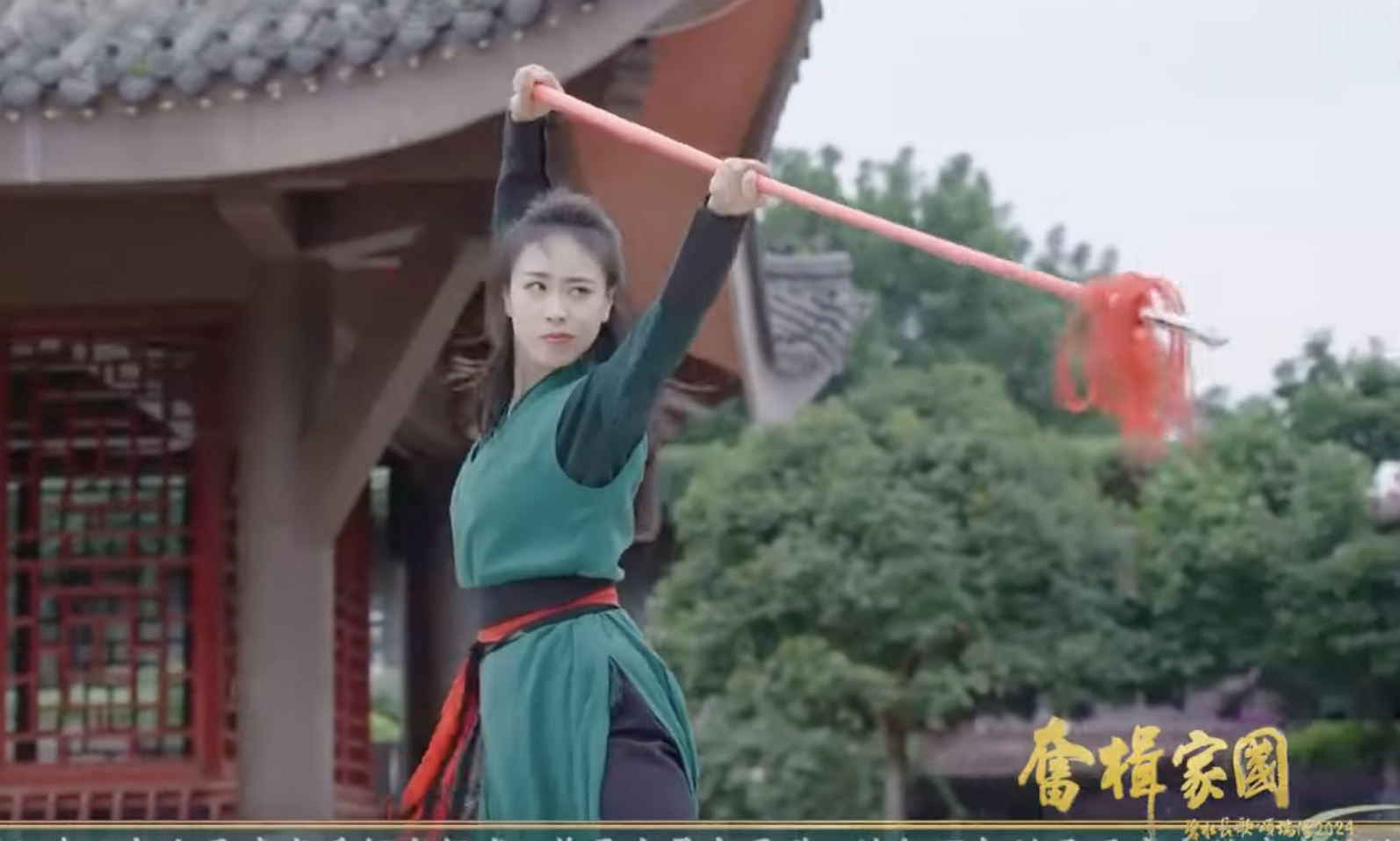
Emei Mountain is the latest hot Kung Fu trend coming out of China, and a group of Kung Fu girls is leading the charge, according to a new article in China’s GlobalTimes.
In April 2024 a video appeared showing nine female Kung Fu performers doing Kung Fu moves against the backdrop of Emei Mountain.
Chen Yufei, 23, one of the group members is quoted in the article: “Unlike the dramatized versions of Emei kung fu in TV shows, which focus on legends, our practice is rooted in the practical skills and traditions of Emei martial arts.”
The video shows performance with a variety of Kung Fu weapons including double whips, swords and of course, the famous Emei needles *, but the phrase “traditions of Emei martial arts” raises a few red flags for me.
A standout line from the article reads “In 2008, Emei martial arts, with a history spanning over three millennia, were designated a National Intangible Cultural Heritage.”
Ok, hang on, what?
Mount Emei has long been a sacred mountain for Buddhism, sure. But a 3,000 year old tradition of Kung Fu?
If you look up Kung Fu training camps on Mount Emei you’ll find a complete history of the martial arts and styles there: “Emei School has 1,093 bare-hand fighting skills, 518 skills with weapons, 41 pair practice routines and 276 practice methods.”
Call me a cynic, but I don’t believe any of this. It appears to me that the Kung Fu traditions of Emei Mountain really belong to the work of modern wuxi fiction of author Jin Yong who wrote a lot about a fictional Emei Sect. In his book, The Heaven Sword and Dragon Saber, the Emei School is founded during the early Yuan dynasty by Guo Xiang around the same time as when the Wudang School is established.
Of course, this being a complete fiction hasn’t stopped the Kung Fu tourist industry from setting up shop on Mount Emei. As this 2012 article describes, there was not much Kung Fu on the mountain back then, but it was starting to be set up, complete with a history. But if you look up Mount Emei today you’ll find Kung Fu competitions are held there, and very much like the operation at Mount Wudang, you can go there to study Kung Fu, for the right price.
The all-female Kung Fu troop heralding from Mount Emei seem to be as much a creation of the Kung Fu tourist industry as anything else, at least to me.
So where does their martial arts come from? Looking through various pages on the Internet I found a Reddit post that sounds true to me: ” “Emei” is just a generic term for martial arts from Sichuan, extremely few styles have any actual direct relation to anyone who loved or practiced on Emei shan. Also almost everything called “Emei” today are modern offshoots of northern Chinese martial arts brought to Sichuan with nationalist troops as they were forced westward by the Japanese in WWII.”
None of which, of course, is to take away from the performance of the Emei all-female Kung Fu group, who are pretty damn good at WuShu.
Note 1: Mount Emei even has its own weapon, the Emei Ci which are sharp steel rods known as needles or piercers, that can be worn on a ring on your finger and spun around.
A visit to Mount Emei by Will of Monkey Steals Peach:
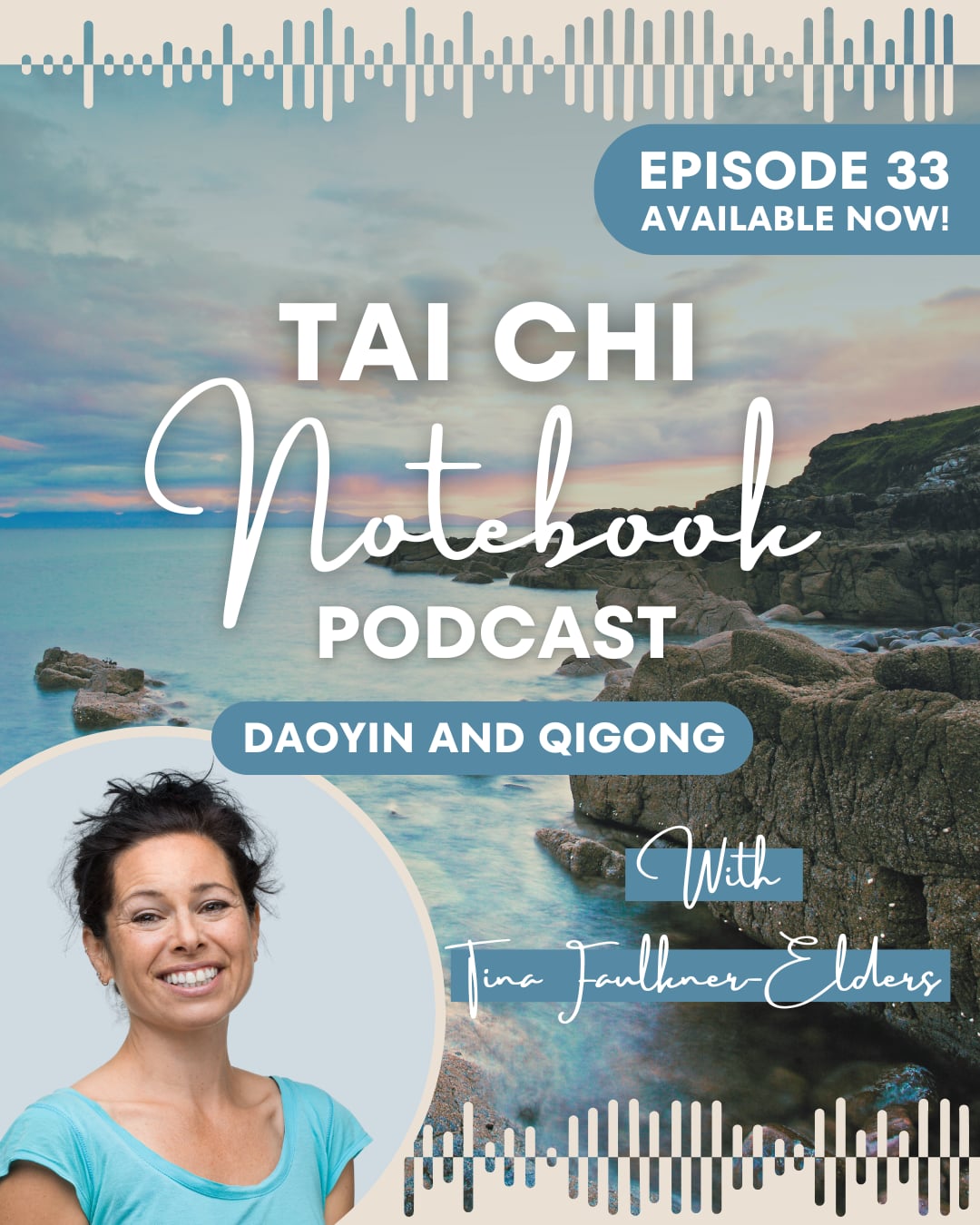
My guest for the latest episode of The Tai Chi Notebook Podcast is Tina Faulkner Elders, chief instructor of the RuYi School of Taijiquan and Qigong in Aberdeenshire. We talk about Tina’s training in qigong, first with her father, then in Beijing, China, and then on Wudang mountain itself, the legendary home of Taoism.
 The Tai Chi Notebook