This video has been doing the rounds online, showing some tai chi (taijiquan) fighting applications.
I don’t think there’s much to say about it, but it does perhaps prove useful for answering that question you get a lot: “can tai chi be used for fighting?”.
Let’s just try to say a few things about it though:
Firstly, he’s clearly just taking a tai chi posture (‘Play Guitar’) that looks very like that an ‘on guard’ position and using it in the same way a boxer does to parry and block punches. The hand he has by his chin he’s using in just the same way a boxer does their back hand to parry a jab. Is there anything wrong with that? Maybe not. You could use the posture like that, but is that its purpose?
Is that what that posture is designed to be used for? At this point, who knows. Usually you see ‘play guitar’ used as an arm locking posture, or combined with a foot sweep into a shuai jiao-style throw.
On the positive side, he’s actually getting the guy to throw the attacks properly, which is nice to see. Maybe they could be a smidgen closer together, so the punch would actually land, but compared to most applications you see from non-committal attacks, it’s not bad.
No, it’s not sparring, but not everything has to be. I don’t think it would look quite as much like ‘tai chi’ if it was sparring.
Finally, is there much ‘tai chi’ going on here? I’d be looking for smoothly flowing into sticking, yielding, and neutralising. He follows up a couple of times, but I don’t see much in the way of controlling the opponent here. The opponent is more often than not just blocked, and not controlled.
The bar for tai chi applications is pretty low. There are too many videos of people bouncing away at the slightest touch to muddy the water, so I think we have to say that this is at least a step in the right direction.
When Josh Robenblatt got to the age of 32 and realised he wanted to fight in an MMA match, he had to confront a lot of physical problems as well as inner demons before he set foot inside the cage. While the physicality of fighting is explored, this book is mostly about Josh’s internal struggles as a lifelong pacifist coming to terms with the casual approach to violence that MMA engenders. For many people Josh’s exact internal struggles wouldn’t exist (especially his frequent reference to his Jewish ancestry), but in a general sense they do exist in some form in all of us, and that’s what makes this book fascinating for anybody who trains in a martial art. It’s also a rare insight into the realities of training for an MMA fight – how much training is actually required, dealing with injuries, how it affects your relationships with friends and family and what the brutal realities of weight cutting are all about.
Josh writes well, particularly when it comes to articulating his inner thoughts on the subject of dealing with actual violence, either as a participant or an observer, and the transformative, almost transcendent, power that coming to terms with it often provides. I found he had managed to put into words something I’d felt before in my own life, but never stopped long enough to really think about and verbalise. As such ‘Why We Fight’ kept my attention constantly until the end, and you do become drawn into his underdog story and intrigued to find out what happens when he finally gets into that MMA match. I won’t spoil it here.
Now we’re a few months/years away from the high point of the Xu Xiaodong controversy it’s good to get a reasonable perspective on the matter from somebody who actually knows him and moves in the same martial arts circles in China.
It’s quite a long talk, but you can think of it like a podcast and listen to it while you’re doing your conditioning exercises. Wait, you are still doing those, right? 🙂
I used to train jiujitsu with Brad back in the day, before he went on to become a UFC fighter, so I’ve known him for years. Brad is retired from the UFC now, but he recently accepted a fight offer from the famous D.K. Yoo, who teaches martial arts seminars all over the world. The fight is scheduled to happen on December 4th on pay-per-view here:
Brad and Joe are flying off to South Korea in just a few days for a boxing match that looks set to make a huge impression on the martial arts scene.
So, let’s find out how it all happened, how Brad’s training is going and what the boys think is going to happen on December 4th.
Bowman notes that instead of helping people, the myth busting of martial arts which is going on all the time in academic circles is probably destroying the careers of some martial arts teachers. So it’s “doing a service to the world which is actually also a kind of violence”. It’s an interesting point. He notes that people often fall in love with the martial arts for silly orientalist reasons – they fall for the myth of studying an ancient and mystical martial art, then read a well-researched book about it, by somebody like Ben Judkins or Peter Lorge, which shatters their beliefs and makes then doubt the validity of the art they are doing.
My own Heretics podcast does its fair share of myth busting too – our Aikido episode, Kempo & Jiujitsu history series and Tai Chi history series spring to mind as good examples. I’ve had first had experience of those episodes visibly upsetting teachers I know. Whether they know it or not, these teachers are heavily emotionally invested in the myths of their own arts superiority – they believe all the stories of old practitioners and the amazing feats they can do, and know exactly why their martial art is superior to others. If you start to chip away at those beliefs then the whole facade is at risk of crumbling, and they don’t like it! Unfortunately reality is usually disappointing when compared to the myths.
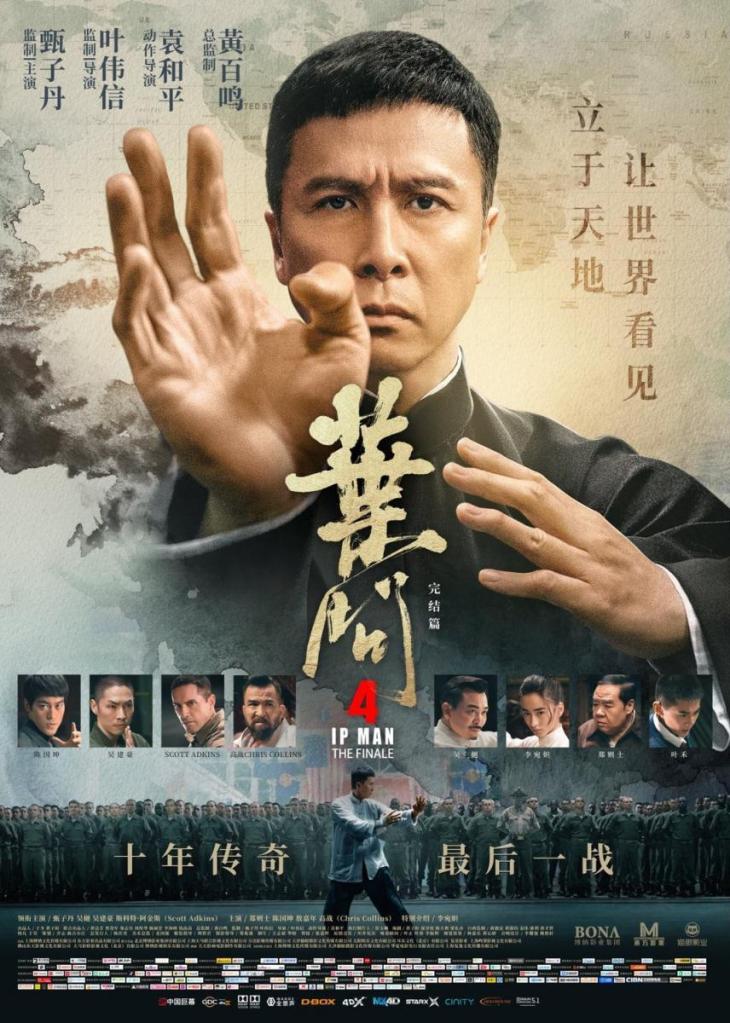
When the Chinese martial arts first started making an impact on the West in the 1970s they were full of obvious untruths. Tall tales of Buddhist and Taoist origins abounded. For example, that Tai Chi was apparently created by a Taoist immortal who had a dream about a crane fighting a snake, and Wing Chun was named after the girl who was taught it by a female Buddhist monk, when it turns out that there’s no evidence that she even existed. Over time these myths then get added to by other myths – like the one that Yang LuChan was “invincible”, for example. Even in the modern age the myth of Ip Man has been enhanced to bursting point by a series of pseudo-historical films in which he combats the Japanese, western wrestlers, boxers and even Mike Tyson at one point!
Ip Man 4
These more marketing-orientated myths about the prowess of practitioners – how deadly they were, how unbeatable their martial arts was, how the power of Qi was greater than physical strength all fed directly into all that nonsense about no touch knockouts and “empty force” that has marred the image of Chinese martial arts in the modern age.
And politics also gets involved. When obvious myths about the origins of martial arts are dispelled they often get replaced by more politically motivated stories about the arts origins that are equally as unprovable and unreliable yet fit a natioanlist agenda. It seems like the Chinese martial arts are forever being used to support some sort of Chinese government propaganda.
In short, the Chinese martial arts world was in need of, and remains in need of, a lot of myth busting, because much of what we are being told and sold is basically not true. But Bowman’s fears, that we are in danger of spoiling the fun for everybody with this relentless search for the truth, holds true, I think. I was certainly attracted to Chinese martial arts by a steady diet of orientalist propaganda from the likes of David Carradine’s Kung Fu TV series and Marvel comics with heroes like Iron Fist. This is often what draws us to the martial arts in the first place and there has to be some way of searching for truth in the martial arts, but keeping the magic that drew us there in the first place.
Here’s an interesting post, complete with pictures, by David Ross of NY Sanda about the Lei Tai tournaments in China in the 1920s. These were supposedly the first organised national martial arts championships. They would have been part of the GuoShu movement of the Republic as they set about using martial arts to strengthen the nation.
The following are some quotes said about the tournament, from his post. I’m just providing them here without commentary. I leave it up to the reader to draw their own conclusions.
Some quotes said about the tournament:
– 这次比赛没有看到高深的内功,没有发人于丈外的场面 You don’t see high level internal power, and Faijin that send people flying 10 feet away in this tournament.
– 太极打法毫无建树,四量难拨千斤 The Taiji principle didn’t work well. 4 oz could not defeat 1000 lb.
– 也就是说号称以巧取胜的中国功夫 实际上也是在跟人拚勇力比高大 The taller, heavier, stronger guys won in that tournament.
– 要学打擂台的拳术 After this tournament, people wanted to learn the style that can be used on the Leitai.
There’s a great article over on Kung Fu Tea (Chinese Martial Studies) that talks about the long term impacts of the COVID-19 pandemic on martial arts training, but as usual takes in a lot of other stuff.
I really like this quote:
“Setting questions of charlatans, deluded masters and outdated training methods aside, I am going to hypothesize that even in the best-case scenario, there is a pretty simple reason why professional boxer/mma fighters will always beat the traditional martial arts master in those YouTube videos. It comes down to specialization, or simply putting in the hours. All else being, equal the individual who trains all day for one task will be beat the individual who trains for four and then runs an afterschool program to pay the bills. It is a mathematical fact, and the reason why ever-increasing degrees of specialization have become the dominant paradigm for social development in the current era.”
Of course, the question of “deluded masters” is quite a large one. Or maybe it only appears that way because of the media exposure these events create.
But his point is that traditional martial arts have to be all things to all people. MMA, boxing or San Da classes are designed to develop a very specific set of skills, and are full of people who all want to do the same thing. Traditional arts tend to have all sorts of different customers, and provide varied social functions, including kids classes. This obviously has disadvantages for the traditional arts when it comes to competing against practitioners of highly specialist fighting arts
“All else being, equal the individual who trains all day for one task will be beat the individual who trains for four and then runs an afterschool program to pay the bills.”
However, Ben’s argument is that it gives the traditional arts more flexibility, both economic and organisationally, when it comes with dealing with the challenges thrown up by the global pandemic.
Narrow specializations presupposes economies of scale that may be achievable in some-times and places, but not others. In periods of prolonged economic contraction a neighborhood martial arts schools which can do a little bit of everything might have a better chance of surviving than the large BJJ academy focused only on competition, the reality fighting school focused only on paramilitary knife/gun defense ,and the Wushu program with an emphasis on gymnastics.
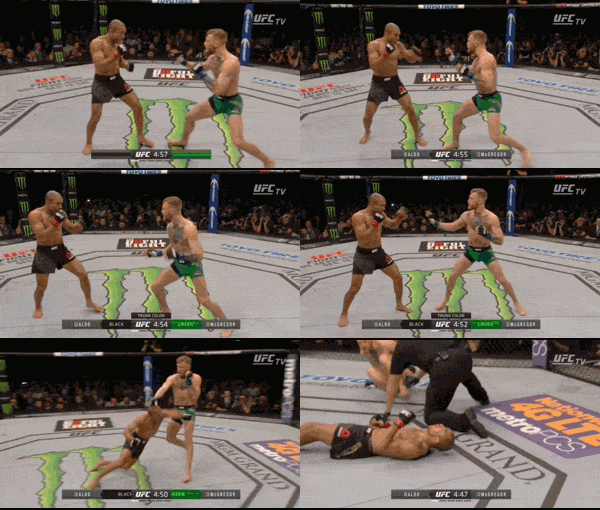
When boxers or MMA practitioners get knocked out by a punch it’s usually from one they didn’t see coming. The counterpunch is a deadly strike in combat because at the very moment you think you are punching them, they’re hitting you. Its effectiveness is partly down to surprise, and often you get a double impact because the attacker is moving forward into the punch of the counter attacker – a perfect example of ‘using their own force against them’.
But the surprise factor and force on force don’t explain why a punch that the guy doesn’t see coming is often twice as effective as a punch he is mentally prepared for.
I believe the answer is to do with jin and the subconscious mind. When you can see a punch coming, your brain can – in the fractions of a second you have available, – make subtle postural adjustments so that the force is absorbed by your body better against the ground. This is similar to the idea of a jin path to the ground we’ve already talked about. I believe we automatically and subconsciously do this in response to any impact we can see coming.
When we can’t see that punch coming it’s more damaging because we are not ‘in position’ to receive it as well.
The next time you watch a boxing match or an MMA match, think about this idea and see if it looks true on the slow-motion replay.
I’m always looking for ways that the sticky hands-like training found in Chinese martial arts like Tai Chi Chuan, Wing Chun, Praying Mantis, White Crane and Hung Gar, where contact between the forearms or hands is maintained and the practitioner is encouraged to ‘listen’ to the movements of the opponent through this contact, can be used in MMA.
A clip of Bruce Lee showing sticky hands training
The problem with transferring these sorts of skills to MMA is quite obvious: nobody in a ‘real’ fight is going to offer up their arm to you to stick too. Instead, they’re just going to punch you straight in the face, and not leave their fist hanging in the air afterward for you to grab.
Perhaps the most famous MMA practitioner ever, Conor McGregor, is a master of counter-attacking and timing. He waits for the opponent to commit to a strike before throwing his deadly left hand and catching him just as he comes in. He mixes this up with kicking techniques straight from a Tae Kwon Do instruction manual.
Other fighters like Nate Diaz are known for their straight-up boxing style hands and fighters like Gobrandt and Cruz have evolved the MMA striking game into a movement based style.
One of the names you don’t often hear mentioned regarding striking is the UFC light heavyweight champion, and now the new heavyweight champion, Daniel Cormier. Cormier, a former Olympic Wrestler, has a strong background in grappling but has dominated the light heavyweight division (despite two losses to Jon Jones, who keeps getting disqualified and banned for failing drug tests), achieving 10 TKO or KO victories from striking.
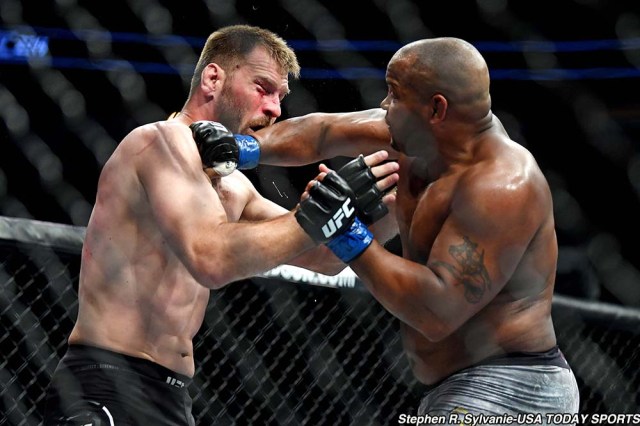
Using wrestling as his base he’s developed a style of clinch-based dirty boxing that has been very successful. He doesn’t look like a typical striker, with both his hands outstretched, instead of in a typical boxing guard. When engaging an opponent on his feet Cormier seeks to smother the other guy’s hands, and feed in strikes once they are out of the way, moving into a clinch position, then looking to land a strong hook as either he or his opponent exit the clinch. And of course, once in the clinch, he can use his wrestling to get a takedown. Video here.
If he can catch his opponent with his hands down as he exits the clinch then a short hook can mean its lights out, as the ex Heavy Weight champion Stipe Miocic found out to his cost this Saturday at UFC 226 when Cormier moved up a weight division to challenge for the belt, becoming a two-division champion in the process as Miocic collapsed to the floor following a clean hook to the chin from Cormier.
Cormier’s tactics have a president in boxing. Jack Johnson and George Forman used to smother opponents hands to set up their own fence and draw loopier punches that they could cut inside of.
MMA Analyst Jack Slack has broken down the stylistic punching of Cormier in Clash of Kings: Tactical Guide to Stipe Miocic vs Daniel Cormier, ahead of the UFC 226 heavyweight clash. Slack calls it the “mummy” style of guard, presumably because it resembles a horror movie mummy approaching with outstretched arms.
Jack Slack breaks Cormier’s style down further in a subsequent article, after the event, which looks at Cormier’s use of a blocking arm, known as a barring arm. Video here.
But what peaked my interest was the idea that this style of fighting could be the ‘way in’ that Chinese Martial Arts practitioners are looking for when transitioning to MMA (or heck, just even real fighting). Cormier’s style makes extensive use of subtle angle changes and sensitivity that push hands and sticky hands training builds up.
If you’ve got a background in this style of sticky hands then read those Jack Slack articles and take a closer look at what Cormier is doing because it could be a style of fighting that would probably work for you too.




 The Tai Chi Notebook