Our new podcast is out! I talk warriorship with the esteemed Matthew Kreuger of the Walking with the Tengu podcast, as part of the #warriorshipconversing project started by Kung Fu Conversations podcast. We also talk about Shuai Jiao, Iaido, BJJ and professional wrestling. You’ll find us on iTunes and Spotify. Search for The Tai Chi Notebook podcast. Enjoy!
It’s one of the fundamentals of controlling somebody on the ground when you’re on the top, but it’s not really a technique, so it’s never taught specifically, you just kind of pick it up as you go. In fact, most of these little pearls of wisdom feel like they could belong to Tai Chi as much as Jiujitsu.
Inevitably the new white belt, overjoyed that they’ve actually managed to get on top for once, (perhaps it’s even the first time they’ve got somebody in side control or mount), will hold on like their life depends on it and inevitably be rolled over because they are holding too tight.
Imagine sitting on a horse for the first time – you’d hold on pretty tight, right? Well it’s the same thing with a person. Your brain is telling you to squeeze hard and not let go. The problem is, the harder you squeeze, the more tense you are and more tense you are the lighter you feel and the easier you are to move. You’re effectively joining your body to their body in a way you don’t want to.
One of the most basic escapes from a bad position on the bottom is to try and roll over. The escapes that are usually taught in jiujitsu class are more technical and go in stages, – a grip here, a leg there, a hip movement – but a complete beginner will often just try and grab the person on top and roll them over out of instinct. And the thing is, quite often it works.
Rolling people over is not basic or wrong – and there are more technical and skilled ways of doing it, of course. You can subtly bump their weight forward so they are slightly off balance without realising it, and then trap an arm or a leg that’s in the direction you want to go, so when the roll happens they can’t reach out with the limb to widen their base and prevent it.
But whether done out of pure instinct or with technical precision, the roll often works because the person on top is squeezing too tight.
If you are on top then ideally you want to let your relaxed weight sink into them, not hold them with muscular tension. That’s how you feel heavy. And that way, when they do an explosive bridge or a sudden roll, you can surf the movement like a wave and not get carried along with it. You might need to change position on top, but that’s the best way to control somebody from the top – go with their movements, and keep changing position so you are always behind their force, not in front of it where you get pushed off.
We’ve just had the Olympics of grappling, ADCC 2022 and as always, there were some great matches. Unsurprisingly, Gordon Ryan dominated the 96kg+ division. He just walked through every high level opponent they threw at him, even finishing Andre Galvao in the Superfight and making it look easy in the process.
Here’s his quickest (11 second!) victory on his way to the final!
Despite Ryan’s absolutely horrible social media personality, it was refreshing to see how calm and respectful he was to his opponents on the mat. Even when Galvao resorted to dirtier tactics, like slapping him, Ryan didn’t get angry. He just laughed.
For me the Kade Ruotolo was a standout this year – he submitted all his opponents on his way to the 77kg crown. That’s a 100% submission rate on his first attempt. And he’s only 19, making him the youngest ever champion, and he’s 100% natural (i.e. no juice). I really enjoyed his match with Lachlan Giles especially because it was a perfect match up of guard player vs guard passer. The finish picked up some criticism because it looked like Kade was kicking Lachlan in the face to secure the armlock, but meh, Lachlan didn’t seem too upset about it, so it can’t have been that bad. See what you think:
Shout out to Ffion Davies who becomes the UK’s first ADCC champion. A great results for the UK and for Wales.
ADCC runs trials all over the world for people to qualify and is open to everybody who does any form off grappling, but once again no Tai Chi players made the finals…
Let’s be honest though, the only people who made it to the finals were Brazilian Jiujitsu guys and girls, because the rule set is designed to favour them. Nobody stands you up if you end up on the ground and almost all submissions are legal. Obviously, despite Push Hands being a form of grappling there is no Tai Chi on the ground, and leg locks aren’t part of the art.
Once again, I think it’s worth noting that if you want to be a well rounded martial artist, you really need to address the ground aspect otherwise there will always be a massive hole in your game.
Recently I’ve been training a lot of a short drill-like form that Phil Duffy taught me years ago. It’s a little sequence that contains about 8 or 9 basic Choy Li Fut techniques (depending on how you count them) and runs in a loop so you can just keep doing it over and over. If you wanted a good introduction to Choy Li Fut, that’s it. There’s pretty much everything you need in there to get proficient at something that at least resembles Choy Li Fut. There are no complicated animal methods or anything too fancy, just practical blocks, deflections and strikes done in a CLF style and using the basic Choy Li Fut stances.
And then I started wondering about what it would be like if a person only ever practiced that little form, but drilled it intensely every day over and over and also spared the techniques for a year. I wonder how good you could get if you just did that? I think you’d actually get pretty good! You’d need other conditioning drills, of course, and stretches, but you’d definitely have the essence of something.
And that got me thinking about the whole concept of simplicity in martial arts. Quite often we make martial arts overly complicated, especially in Chinese internal styles. There are basics to master first – fundamental principles of body movement, posture and breathing, that all need to be coordinated together with the internal elements like mental intent, jin and calm focus, etc. Then there are long forms to master, and then other forms on top of that. And that’s not even touching on the techniques you need to master. And push hands and weapons forms. It just goes on and on. It’s like Tim Cartmell said in our recent podcast conversation (and I’m paraphrasing him here) “in some of these styles you do so much body work that you forget the other guy is actually going to throw a punch!”
The heavy sparring emphasis I’ve experienced in BJJ has taught me that martial techniques can’t be too complicated if they’re going to stand a chance of working when the rubber hits the road. A six move combo to sweep somebody, pass their guard and choke then out is pretty unlikely to work in sparring just the way you drilled it in practice because no plan survives contact with the enemy. What works in real life are techniques and strategies that hit that sweet spot somewhere between the level of “too dumb” and “too complicated”. Those sorts of techniques, drilled to become second nature, have a real chance of working when you need them to. That’s the simplicity you want to aspire to in martial arts, and to me that’s the real power of martial arts like Choy Li Fut – they have enough subtly to make them interesting, but not enough to make them too complicated and impractical.
When I get time over the weekend I’m going to film my little mini Choy Li Fut routine and put it in the Patron’s area, so you can check it out there.
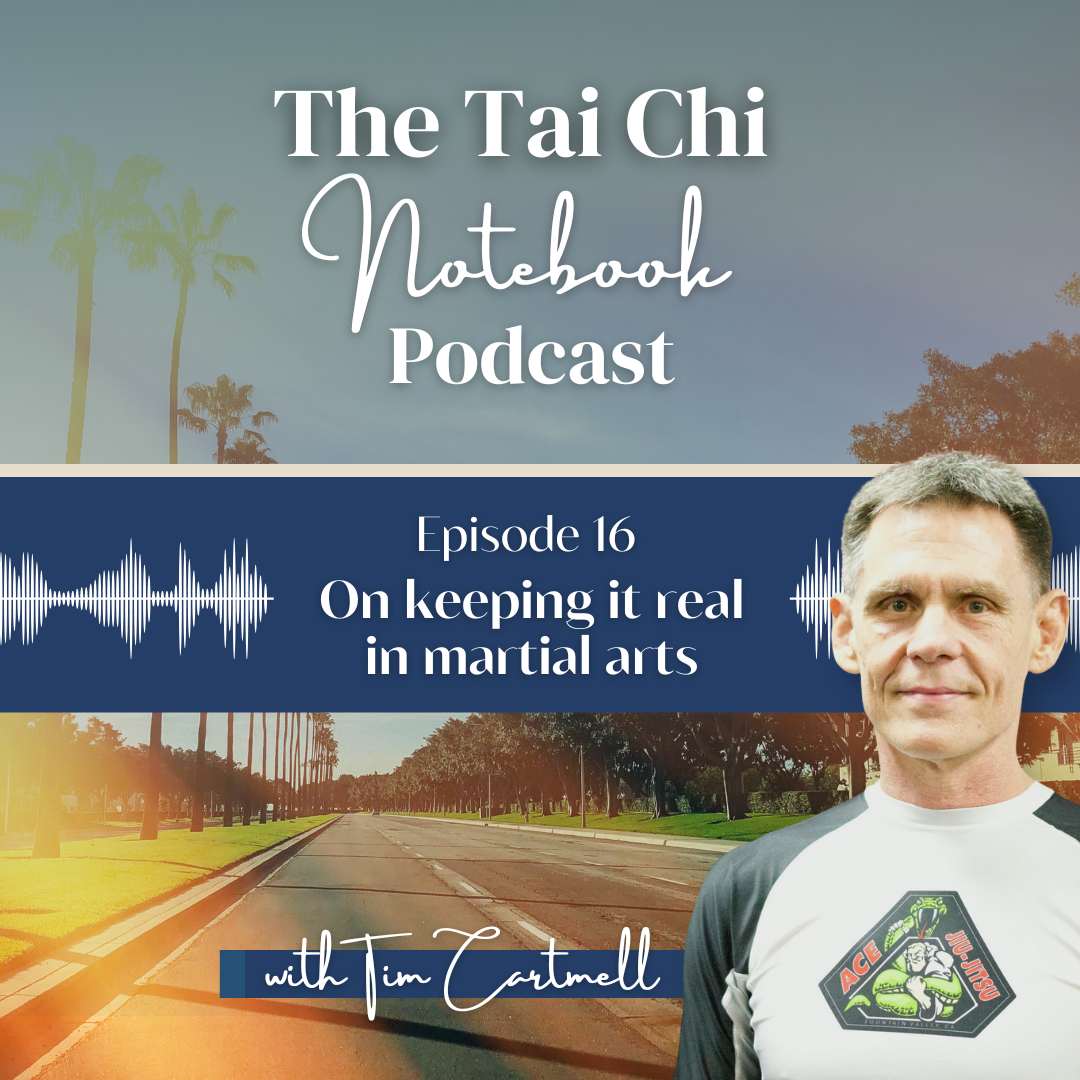
My guest in this episode will need no introduction to anybody who trains in the Chinese styles of Xing Yi and Baguazhang, especially in the United States. Tim Cartmell is a lifelong martial artist who spent many years living in Asia learning the internal arts, before heading back to the US where he took up BJJ, becoming a black belt. Tim is now the head jiujitsu coach at Ace Jiujitsu Academy in Fountain Valley, California where he teaches classes and trains professional MMA fighters. https://www.acejiujitsu.com/
In this podcast I ask Tim about his training tips, especially for older martial artists, where he thinks martial arts is going in the future and his approach to combining all the arts he knows into a single principle-based, reality-driven approach.
You can find out more about Tim at his website www.shenwu.com and don’t forget to check out the Shen Wu Martial Arts group on Facebook.
I hadn’t talked to Tim before this interview, but many of the people I’ve had as guests on my podcast have rated him highly, and now I know why – for somebody with so much experience of martial arts Tim is a very humble and genuine guy, as I hope you’ll discover over the next hour or so.
You can support The Tai Chi Notebook Podcast by becoming a patron. Head over to www.patreon.com/taichinotebook and become a patron today! You’ll get a version of the podcast you can download, exclusive video clips and articles.
I’ve always liked the turtle position in BJJ. It’s supposed to be a position that you don’t go to voluntarily, however, I’m quite happy there and I find there are good opportunities for sweeping your opponent. This is one particular sweep I’ve always liked doing.
It’s off the opponent’s attempted toreando pass. They grab your gi pants at the knee, ready to toreando. You hold both sleeves, so you can adapt to whichever side they go to. Once they move a side is chosen, you turn away from them and stiff arm the sleeve that’s now your top arm. Your bottom arm starts building a base from elbow to hand and gets you into turtle right underneath them. You then wrap the stiff arm around your body and execute a shoulder throw from your hands and knees. In most cases it’s a pretty easy sweep and they go head over heels and land on their back. If the armbar is available then take it, otherwise side control is there for the taking.
A couple of months ago I put my Sacroiliac joint out doing Jiujitsu. Typical symptoms are pain walking, standing in one spot and generally everything involving being alive. I didn’t know it was out initially so carried on training for a couple of days, but the pain steadily increased until I sought help from a sports therapist who diagnosed me, followed by a painful massage which felt good afterwards, not during!
This video shows where the Sacroiliac joint (SI joint) is located (it’s the meeting of the sacrum and the iliac.) The pelvis is not one bone, it’s three bones and the SI joints are what connects them together. The presenters are a bit crazy, but I kind of like them:
As you can see, there’s not much movement in the joint at all, and when it gets jolted it can move out of alignment and that’s when you get all the problems I had. Naturally, your other muscles and tendons have to compensate for the joint being out, and they object, strongly! In my case my piriformis was particularly unhappy about the situation and wanted to let me know by inflaming. Ouch!
Now the video above shows various ways to pop your SI joint back in the right place, but I did it using the baduanjin exercise I was taught as part of Chinese Qigong, so I thought it was worth talking about here.
After a sports massage to relax the tendons I did the usual Baduajin routine I do regularly as part of my morning routine, and during one particular exercise I felt the SI joint pop back in place straight away.
Baduanjin 八段錦 (translates as ‘8 silk force’ or ‘8 pieces of brocade’) are a set of Chinese exercises that could be up to a thousand years old. Simon Cox has a great history of the baduanjin (including a video of them being done) on his website here.
The version of baduanjin I do is way simpler than Simon’s version from Wudang mountain. Here’s a video of my version done by Sifu Kerr of the Spinning Dragon Tao Youtube channel (whose videos are worth checking out as well):
At 6.48 he does “Stretch and Glare to the Horizon” which is the exercise that immediately popped my SI joint back in. I prefer to do that one with my hands in fists rather than the “sword fingers” Sifu Kerr is using, I don’t think it would make any difference to what’s happening to your SI joint either way.
In the Okanagan Valley Wading video that exercises is called “7. 攒拳怒目增力气 Make a fist and with glaring eyes increase your power and qi,”:
But they do it with the fist vertical and very much as a hard punch. The variation I prefer myself is doing it as a slower stretch and I keep my fists horizontal, and a bit bent downwards, so effectively out of alignment for a punch, but with an increased stretch across the yang channels on the outside of the forearm. With the slower stretch version you can really feel the counter rotation on the spine as one arm is stretching forward, the other is simultaneously stretching backwards and you are doing your best to not let your pelvis move – just keep it facing 100% forward and level in a horse stance… And that’s what did it – pop! I felt my SI pain immediately go and the joint felt normal again. Relief!
Clench the Fists and Glare Fiercely, circled in red, was the exercise that did it for me.
As you can see, there are many variations on the baduanjin, (just look at how many you can find on YouTube!). So, I’d suggest sticking with whatever version your teacher gives you. The important thing is these exercises put my SI joint back in place, and for that I’m very thankful, as is my piriformis, which took a couple of weeks to quieten down, but hasn’t bothered me since.
If you ever put your SI joint out, it’s good to know how to put it back, so try the above. I’d recommend a sports massage as well, to deal with the inflamed tendons caused by it being out of place.
Almost by accident I watched Onama vs Landwher from UFC: Marlon Vera vs Dominick Cruz this morning and heavens above, that was one hell of a fight! Possibly the fight of the year. I’ve no idea how you’d score it. Landwher won by decision, but it was possibly the MMA fight of the year. Wild exchanges throughout with both fighters being so tired they could hardly stand up, but somehow kept going. It looked like they both had almost beyond the levels of human endurance, going from looking so tired they could barley move to pulling off flashy 3 move combinations.
You could almost see their spirit rising within to propel them on. It reminded me of all the phrases about the internal harmonies (san nei he) that we use in the Internet arts. The Xin (heart) leads the Yi (intention/mind), the Yi leads the Qi (energy to work) and the Qi leads the Li (physical movement). Initially this seems rather simplistic, say if you want to do something like make a cup of tea then you first have a desire to do it (heart) that travels to the brain (yi) that decides and then it ends up in a physical movement (li) and you find your feet moving you towards the kettle.
But that process happens automatically in humans and all animals, so why do we need to make a big deal of it and describe all the parts that build up to making an automatic process happen?
It’s often explained as putting the intention and will (the brains and heart) behind the movement. You can do things with a sense of purpose, or you can do them absent mindedly. In the internal arts, like Xing Yi, Bagua and Tai Chi, your actions need to have a sense of purpose. Your mind needs to be on the job, not half engaged. That’s one reason, but I think there’s more to these internal harmonies than just this.
I remember in BJJ training sometimes being so exhausted it was like my mind left my body and I became somewhat detached from my surroundings. It’s at moments like that that you start to be able to feel your “spirit” or mind as an identifiable thing. Through a sheer act of will you can force your mind to not give up and get back to the job and it can give you the energy you need to carry on fighting. That’s what I saw happening in Obama vs Landwher. A sheer force of will was being used to make them continue – their internal was leading the external.
Frankly, most people training only internal arts without hard sparring pay a lot of lip service to the internal co-ordinations, but do they ever reach an intensity of training where they can actually feel these things as tangible elements?
I’m not saying that you need to get an an MMA cage to experience your internal state under extreme physical stress before you have any idea what it is, but you can experience it in a safer way through things like Jiujitsu. Maybe Systema, too. Just some food for thought, and another reason why I think all Tai Chi instructors who re physically able should try and get a blue belt in BJJ if they are teaching the art beyond the health aspects.
There’s a risk, when reading this that people might think that using your Yi, or Xin in Tai Chi technique simply means to furrow you brow, put on a mean face, stare hard at something, get really tense and act like you really mean it, man. Because that’s not it either. That’s not what using “martial intent” or Yi means in internal arts at all. If I see people practicing internal arts like that I think it’s just bad karate. Not that there’s anything wrong with karate, of course.
Your internal state can be serious, but come from a place of calm. It’s a strange contrast between being expansive, yet laser focused, like the eyes of an eagle who is high up in the sky looking for prey. He’s taking in all his surroundings, but can pinpoint down on a single point when required. That’s using the 3 internal harmonies properly.
I think this is a Kite, not an Eagle, but you get the idea. Photo by Flo Maderebner on Pexels.com
The Tai Chi classics say:
To fajin, sink, relax completely, and aim in one direction!
There it is – the (sung) relaxed body is the first requirements, once you have it you can ‘point your mind’ in the direction you want your power to go, so that the internal movement matches the external movement. When the inner and outer harmonise together, then you have internal power.
Multiple time BJJ world champion Leandro Lo died a couple of days ago in a nightclub in Brazil. He was shot twice in the head in an altercation over essentially nothing by an undercover cop carrying a gun. The tragedy is a waste of his life and talent.
It reminded me of some self defence sayings that are worth remembering:
Don’t ever start a fight over something that isn’t worth dying over.
If you do end up in an altercation then win.
and:
It takes a stronger man to walk away from a fight than to start one.
Rest in power Leandro Lo. Let’s remind ourselves of what it was that made you great thanks to the BJJ Scout breakdowns of his matches, which inspired so many of us back in the day:
Except for that tiny minority of ambidextrous people, most human beings have a dexterous hand and a non-dexterous hand. We use our dexterous hand for things that require precision, like writing and the non-dexterous hand for holding and framing. I’m sure we’ve all tried to write with our non-dexterous hand before and found it almost impossible, but here’s another thing to try…
Put your non-dexterous hand behind your back and try to write as normal with your dexterous hand. You’ll find it’s hard because you use your non-dexterous hand more than you think, in this case, to steady the paper you’re writing on and stop it moving. Both hands are actually involved in writing, but both have different jobs. If you wanted to get all “Tai Chi” about it we could call it a Yin and Yang split between the hands, which work together as a whole, and talk about the sword hand, but layering a bit more philosophy on the concept is probably not necessary, I prefer the phrases dexterous and non-dexterous hands.
Large-Scale Postures Boxing Set by Huang Hanxun 1959
It’s the same in martial arts. I’m sure we’re all used to doing a technique quite competently on one side, then swapping it to the other side and feeling like a complete beginner. For this reason I’m quite against the idea that we should be able to do everything equally on both sides. Learning to do a technique on your non-dexterous side will be arduous, time-consuming and you’ll never be able to do it with the same flair, so why invest all that time in a pointless campaign?
If you look at the Tai Chi form (I’m thinking of Yang style, here since it’s the one I’m most familiar with) then you’ll see that some techniques are done equally on both side (brush knee, for example) but some techniques are only done on one side (all the grasp bird’s tails, for example go to the right, while all the single whips end to the left). I believe this is because the creators of these movements were well aware of the difference between our dexterous and non-dexterous hands.
In stand up arts of punching you see the same thing – people generally poke a jab with their non-dexterous hand to set up the big overhand from the dexterous side. I find if I put my dexterous side forward (southpaw) it results in a jab I can hit harder with but a cross that is less accurate.
But how do you choose which techniques to do on one side and which to do equally? The answer is simply to feel what works. And for this you’re going to need to do a lot of practice on another human, not solo form.
For example, in jiujitsu I have developed this one-sided approach through countless hours of practice. It’s most noticeable in my guard passing, but it also applies to my guard playing, although I’m not sure the idea extends to the legs – they both seem equally non-dexterous when compared to our arm! But in guard passing I notice that I naturally do some passes to my left and different passing to my right. For example, I knee cut with my right knee on both sides of the opponent’s body, so if I’m going left, I lead with my right knee and if I’m going to the right I also lead with my right knee – this naturally leads to two different techniques being used.
So, the answer is to feel, and don’t try to force yourself to do techniques that feel awkward because they are on the “wrong side” – look to see if there is something else you can do in that situation that fits better.







 The Tai Chi Notebook