In the latest episode of the Tai Chi Notebook podcast I’m talking to the man, the legend, that is Stephan Kesting. Stephan has taught thousands of people martial arts through his famous website grapplarts.com which, back in the day, was one of the first sites to put out quality Brazilian jiujitsu instructional material and is still putting out top notch instructional material today.
Stephan is a fireman, he has competed in marital arts, he has trekked across the Canadian wilds with a canoe and recently he’s undergone a full hip replacement and documented his recovery – and he’s about to return to training again, so he’s one tough old dude.
Stephan also hosts his own podcast, the Strenuous Life Podcast, which I’d recommend you listen to – because it’s always super interesting, especially his episodes debunking conspiracy theories.
One of the ways you can tell genuine history from a ‘made up’ history (in Chinese martial arts, or in anything really), is that the real history is always pretty messy, convoluted and complicated, and a conveniently invented origin myth or history of a style is usually pretty simplistic. Tai Chi Chuan is a good example, I think. Attributing the origin of Tai Chi to one particular Taoist immortal, or one particular remote rural village, is a very neat and simple solution – and probably not the whole truth.
And I think the same thing applies to Chinese martial arts as a whole. The Chinese martial arts, (as we know them today) were not just invented fully formed, hundreds of years ago and have remained unchanged ever since. On this blog I’ve often quoted those who have proposed that kung-fu has a more convoluted pedigree than one might otherwise have expected. Historian Charles Holcombe’s excellent “Theatre of combat” on the subject of kung fu history from 1990 is a good starting point for this line of enquiry. Also check out my first podcast episode with Daniel Mroz.
To quote from Holcombe:
“In China the martial arts are far more than just techniques of hand-to-hand combat, although actual fighting skills are indeed traceable far back into antiquity. In China the martial arts are an aspect of religion, with all of the attendant mystery and miracles. At the same time, the public face of the martial arts has often been that of the entertainer, and the self-image of the martial artist has been thoroughly imbued with motifs drawn from fiction and the theater. The martial arts of today must be understood as a confluence of China’s unique approach to physical combat, Buddho-Taoist religion, and theater.”
Theater of Combat – Charles Holcombe
It’s worth reading that quote a couple of times.
One curious thing I’ve noticed from other martial artists is that they often can’t comprehend this argument at all. They don’t seem able, or unwilling, to hear it properly. Some internal bias seems to prevent it. I’ve had people come back to me a year later saying, “I thought you were saying that all Chinese martial arts comes from dance”. Or theatre. No, that’s really not what I’m saying. I’m saying, it’s complicated. I’ve even gone back to these people and shown them the exact thing I wrote, a year ago, saying exactly the opposite of what they think I said. But for some reason, it doesn’t go in. They hear what they think I’m saying rather than what I’m actually saying.
Real history is always complicated. “Kung Fu came from dance” is just too simplistic to be true.
Sadly, yesterday the Tai Chi community lost Dan Docherty, who for a time was without a doubt the biggest name in Tai Chi in the UK. He represented a dynamic, full-contact style of Tai Chi that he learned during his time as a police man in Hong Kong from Grandmaster Chen Tin Hung and his 24 Nei Kung exercises, which he taught alongside his Tai Chi Chuan.
Dan was diagnosed with Parkinson’s Disease at age 56. He recently celebrated 50 years in martial arts this September and you can hear the story of his life, and diagnosis, told by the man himself here.
My condolences to family, friends and students. May he rest in peace
I’d just like to draw your attention to this excellent article by SSD about Stanley Henning’s often-quoted article ‘Ignorance, Legend and Taijiquan’ on the origins of the term Taijiquan. Henning’s article is often used to discredit the idea of Taoist origins of Taijiquan. However, it’s not without its problems, as Adrian Chan-Wyles (ShiDaDao) writes:
“The tone and design of this work is generally dismissive and denigrating toward the subject of Chinese traditional culture, and represents, in my opinion, a continuation of the imperialist Eurocentric attitude that is essentially ‘materialistic’ in nature, and implicitly ‘intolerant’ to any other world-view. Astonishingly, this attitude that misrepresents Chinese culture is prevalent (even dominant) amongst Western martial arts media, and is found within martial arts online discussion forums, etc. One or two Taijiquan magazines in the West even partake in this attitude that demeans the Chinese cultural basis of the martial art they practice and support. Working from Chinese language source texts – which I do – I can say without a doubt that Henning’s viewpoints are not acknowledged as legitimate, and are ignored in China. The idea that certain lineal descendants of the Wu family of Taijiquan claim to have written the Yang family Taijiquan Classic texts appears to be only a Western trend – as this idea is not accepted within China. Indeed, such a claim is viewed as the Wu family trying to raise their lineage of Taijiquan above that of the Yang, but again, such a phenomenon could only happen in the West, outside of the cultural controls of Chinese culture. What is important is that the traditional Chinese cultural heritage is acknowledged and treated with respect. SDD)
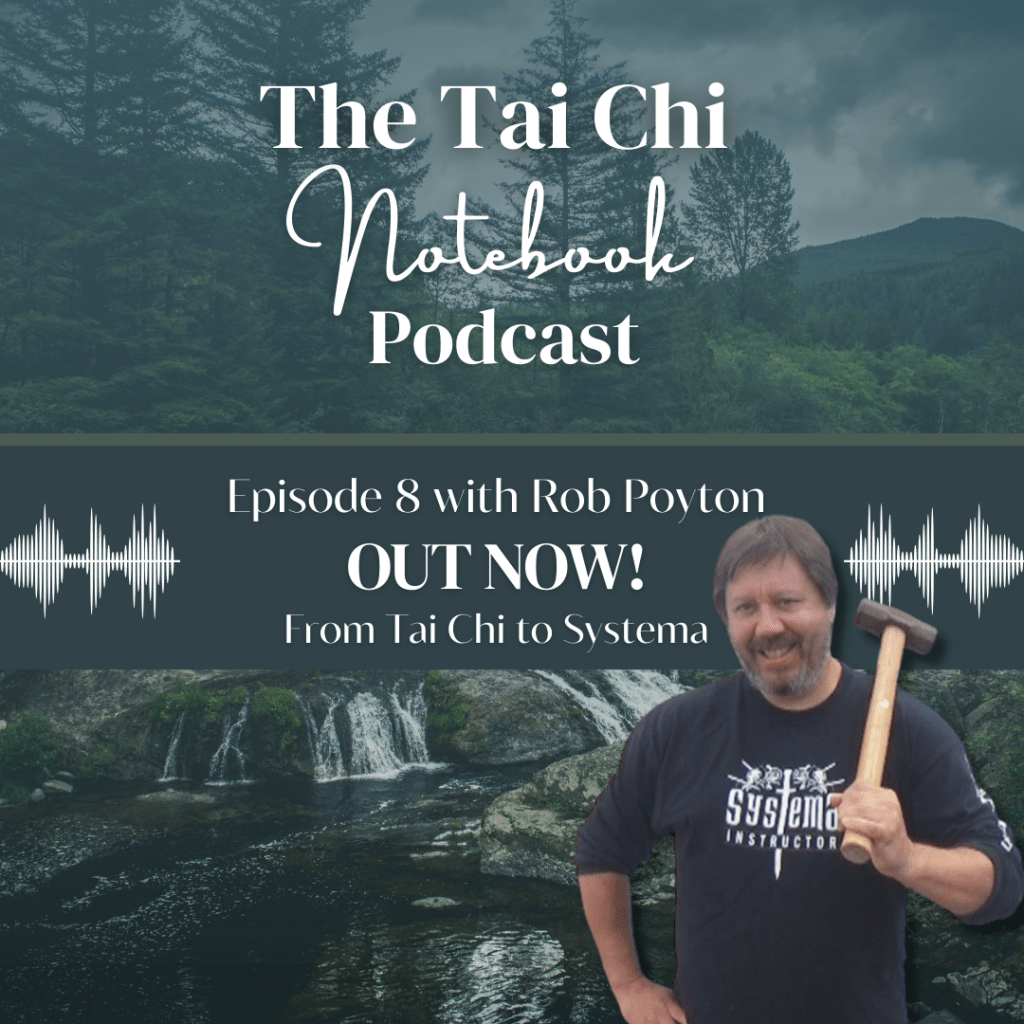
My guest this episode is Rob Poyton a veteran of the UK Tai Chi and martial arts scene. These days Rob is a teacher of the Russian martial art of Systema, which he has been teaching in the UK since the early 2000s and has run workshops and seminars all over Europe. Rob is also a prolific author of Systema books and videos which you can get via his website Cutting Edge Systema which is found at systemauk.com
In this wide-ranging discussion we talk about what the UK Tai Chi scene was like back in the 80s and 90s, and the similarities and differences between Tai Chi and Systema. We even get into a bit of politics, and talk about Rob’s experiences as a professional musician and his sideline as a horror fiction writer. So, sit back and enjoy as we get under the skin of Tai Chi and Systema.
I used to train jiujitsu with Brad back in the day, before he went on to become a UFC fighter, so I’ve known him for years. Brad is retired from the UFC now, but he recently accepted a fight offer from the famous D.K. Yoo, who teaches martial arts seminars all over the world. The fight is scheduled to happen on December 4th on pay-per-view here:
Brad and Joe are flying off to South Korea in just a few days for a boxing match that looks set to make a huge impression on the martial arts scene.
So, let’s find out how it all happened, how Brad’s training is going and what the boys think is going to happen on December 4th.
Picture Grog, the caveman. He’s sitting around the fire with his tribe, wearing animal skins and singing the songs of his ancestors, while his kids run around the back of the cave and paint bison on the walls. Compared to the sabre tooth tigers with their man-splitting canines and the huge giant sloths with their throat-cutting claws that roam freely the valley below, Grog hiding in this cave, doesn’t look like much. But in a mere 10,000 years Grog is going to become the dominant species on this planet. In fact, he probably already is.
Homo sapiens special power is that we’re a tool-making and tool-using creature. Our opposable thumbs gave us fine motor control to skillfully manipulate objects, and our brains have the super power of being able to picture what an object is going to look like before it exists in reality. These two factors, combined with our other abilities, like language and social bonds, put us on track to dominate the earth thousands of years ago. From humble beginnings, like making spears and flint knives, our tool use has grown exponentially into the today’s miracles of engineering like cars, planes, and penis-shaped space rockets. And don’t forget, in the past we’ve managed to build huge, complex structures with what would be considered only basic tools by today’s standards.
When it comes to combat, it’s no different. Our ancestors didn’t charge into battle barehanded as well as bare-chested. Well, maybe some of them did, but they’re not around anymore. We devised a whole range of deadly tools to effectively chop, sever and dismember our opponents, while wearing skillfully-made armor designed to protect our vital organs as best it could. In today’s more peaceful society our preference is for safe, unarmed martial arts, which we use to de-stress ourselves with after work. But these toothless tigers belie the long and bloody history of deadly weapons use amongst humans. And in terms of effectiveness between armed and unarmed, it’s not even a contest: even a professional boxer has very little chance against an unskilled man wielding a sharp knife.
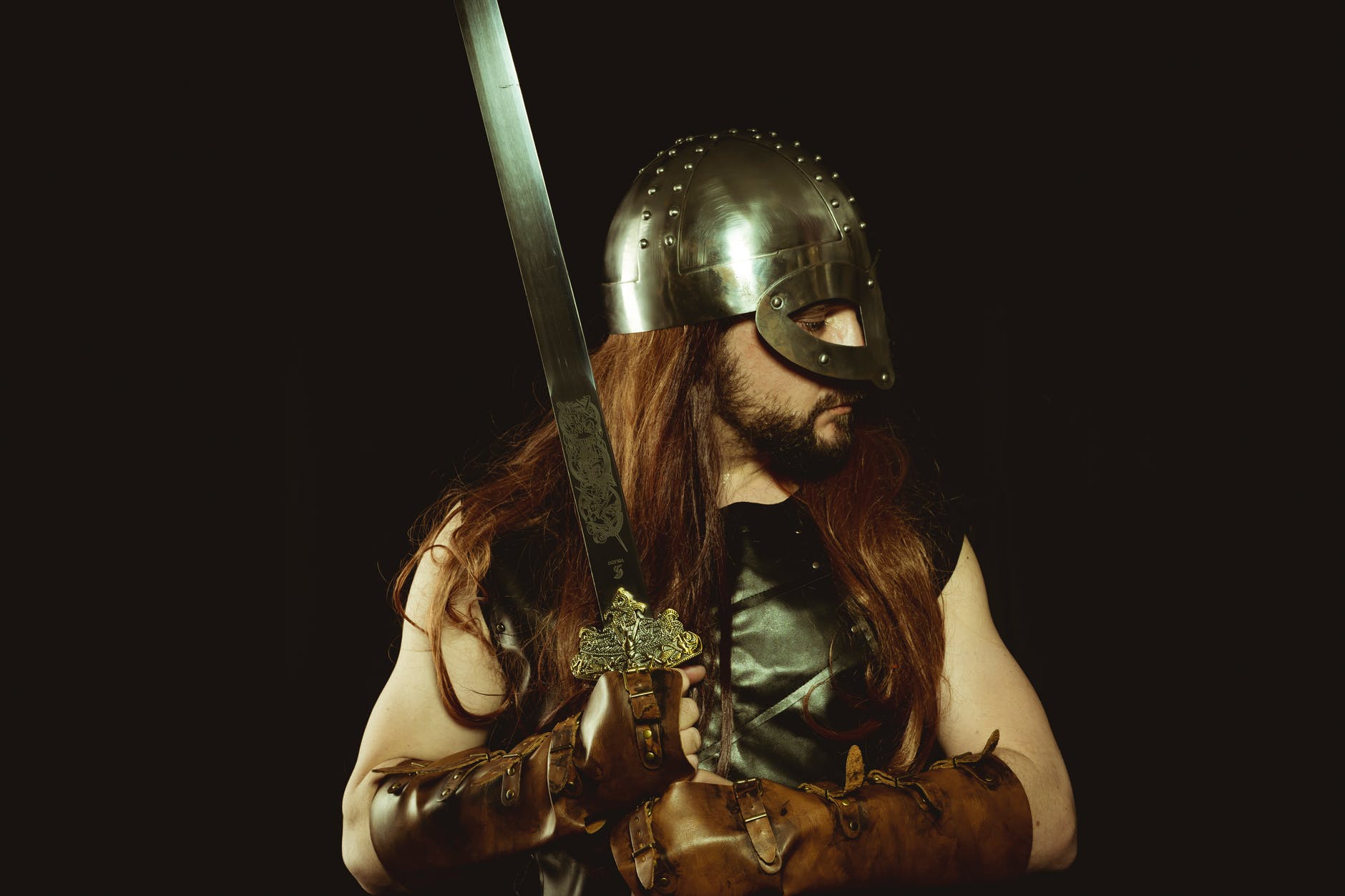
Modern interpretation of a Viking warrior: Photo by Fernando Cortu00e9s on Pexels.com
I remember having an interesting conversation with my martial arts mentor and teacher, Damon Smith, about what kept him interested in a martial arts over such a long period of time. He said that, for him, a marital art needed to contain weapons or he loses interest. While they might not be practical in the modern age, adding weapons to a martial art increases its difficulty level as well as its effectiveness hugely, providing a new physical and cognitive challenge in the process. And by ‘adding weapons’ I mean actually learning to fight with them, not just performing a solo form.
Of course, there is a long history of weapons usage in martial arts. In fact, many modern martial arts started off as weapons systems before transitioning into purely bare-hand arts in modern times. Weapons are found in almost all ‘traditional’ Chinese martial arts and consist of things like spears, nunchucks, swords, throwing darts and wooden staffs. European martial arts use quarterstaff, sword and buckler, amongst other things. The gladiators in the Colosseum in ancient Rome use swords, shields, tridents and nets.
But there’s one marital art that most people would consider a purely bare-hand grappling art, which I think should be more accurately categorised as a weapons system, and that’s Brazilian Jiujitsu, (or BJJ for short).
While most systems of Japanese Jujitsu train with traditional weapons you rarely see them shown in BJJ beyond basic defences to a few random knife or gun attacks, and we certainly don’t train to use things like swords or spears in defence or offense. However there is one weapon that we use all the time – the gi.
Jiujitsu was an import to Brazil from Japan, and adopted and taught by the famous Gracie family in Brazil in the early 20th century. It was originally practiced in the kimono, or “gi” as we call it today , and that is still how the majority of clubs train around the world, although the “no gi” or ‘spats and shorts’ version has been proving more popular in recent years.
The gi is a thick, and durable uniform that can stand up to tugging and wrenching without falling apart. It’s tied at the middle with a belt, which changes colour as you progress through the grades. For adults it goes from white to blue to purple to brown and finally black. There are belts after black, but most normal people don’t reach these.
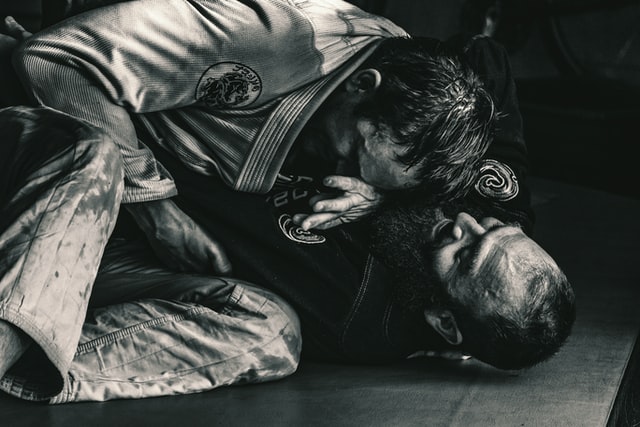
The gi doesn’t look like it, but it is actually a weapon. Chokes can be performed in BJJ with almost any part of your body. The famous triangle choke, for instance, uses the legs to shut off the bloody supply to the head, causing unconsciousness, unless the person taps first. However, when you’re wearing the gi the number of chokes available increases massively. Chokes using the collar can be performed from almost any angle. You can also wrap the lapels of your gi, or their gi around the neck to create a choke.
Soft weapons, like the rope dart in Chinese martial arts, have long been respected in martial circles for their efficiency and the gi is no different. In the hands of a skilled exponent of the art, the gi becomes simply another weapon with which to attack. While some people might consider that ‘cheating’ and no use for ‘the street’, there are plenty of others who point out that most people wear clothes when they go outside their house (and usually in their houses too), so these skills are transferable to real life situations.
There are plenty of videos online showing how gi chokes can be done even on somebody wearing a t-shirt:
I’ve stuck with Jiuitsu for 11 years now myself. and I think a large part of the attraction is the gi and the huge number of possibilities it offers. And while I favour a basic collar and sleeve grip when playing guard myself, there are whole systems of BJJ guard playing dedicated to intricate lapel grips, popularised by famous practitioners like Keenan Cornelius, the most famous of which is his Worm Guard:
The gi offers the same level of cognitive challenge that using a weapon does in other martial arts. And while Brazilian JiuJitsu takes the use of the gi to new levels, I think the same could be said about other grappling arts that make use of clothing, like judo and Mongolgian wrestling. Modern judo has become all about the grip fighting, for instance, and a good grip on the opponent’s clothing can give you a real advantage in arts like Mongolian wrestling.
There are downsides to fighting with the gi of course. Firstly, the damage to your fingers is real, especially as you get older. Too much gripping of the gi really takes it out of your fingers, especially once your grip gets twisted and your opponent is trying hard to break it.
The gi game tends to be a little bit slower-paced as well, since just having one grip somewhere on somebody can stop an attack completely. But while some people find that frustrating, to me it’s just another problem to solve, and more brain-tingling fun to keep training the mind as hard as the body.
This channel displays films and film segments that were created at the beginning of film making in the 19th Century through to the first half of the 20th century in relation to martial art and exercise.
Here are few examples of the content you’ll find here that caught my eye:
1897 Boxe Francaise (Savate) & Baton Demonstration – Lyon France
Filmed: Spring – June 6th 1897 Location: Lyon-France These films show members of the 99th Infantry Regiment demonstrating Savate & Baton. These demonstrations are not sparring sessions. They are an exchange of techniques for the camera, in the form of a flow drill. In the Savate demonstration you can see that the practitioner on the left is aware of the camera position, and motions the other practitioner back into the frame of the camera. Sparring in this era was conducted on a “touch point system” along the same lines as fencing and points were scored for making contact, and the aim was not to seek a knock out.
“These two films were filmed in July 1896 by Lumiere camera operator Alexandre Promio. The Location was Sydenham Crystal Place Park London. The first film depicts a form of Burmese martial art which includes open hand strikes, kicking and grappling. It is unclear what style is depicted as Burma (Myanmar) has a large variety of styles. (Martial Styles of Myanmar) https://www.youtube.com/watch?v=96IBH… Both practitioners seem to be sparring in a light friendly manner for the camera. The second film presents a solo performance of the ball exercises known in Burma (Mynamar) as Chinlone. Chinlone dates back over 1,500 years, and is heavily influenced by traditional Burmese martial art and dance. It was originally conceived as a form of entertainment for Burmese royalty. It is also played as a team sport and over the centuries, players have developed more than 200 different ways of kicking the ball. Form is all important in Chinlone, there is a correct way to position the hands, arms, torso, and head during the moves. A move is considered to have been done well only if the form is good.”
June 29 – July 2, 2022, Lausanne University, Switzerland
Martial Arts, Tradition and Globalisation
This conference was originally planned for summer 2021, but was postponed until 2022 because of the Covid-19 pandemic.
This landmark international conference will be hosted and co-organised by the University of Lausanne, and will see for the first time the joining together of the annual conferences of the Martial Arts Studies Research Network and the martial arts and combat sports commission of the German Society of Sport Science (DVS-Kommission ‘Kampfkunst & Kampfsport’).
There seems to be a sudden influx of good things to listen to, so, rather than do individual posts on all of them, I’ve decided to round them up in a collection of Things You Should Be Listening To Right Now
1. Peter Lorge on Inventing Traditional Martial Arts
This was very entertaining. It’s a great lecture on the difference between traditional and modern in martial arts, and how ‘traditional’ is in fact usually created by the ‘modern’.
2. Lavell Marshall & Hohoo – Spirit of the Grassland
I loved this so much. It’s a look into Mongol wrestling culture. It’s from Byron Jacobs who filmed it on a recent trip to the grasslands of Inner Mongolia for a wrestling competition and features Lavell Marshal, who left his life in the west to move to the grasslands and practice Bökh.
“Bökh (Mongolian Wrestling) has been practiced by nomadic and steppe cultures for thousands of years. It epitomizes the culture of the Mongolian people and the spirit of the grassland.
Lavell Marshal (Hangai), left his life in the west to move to the grasslands of Inner-Mongolia to study the art under Ho Bagsh (Coach Hohoo), a well-known wrestler and former national Shuai Jiao champion.”
3. Why Conspiracy Theories Are So Damn Hard to Disprove, with Dr Hanan Bushkin
This podcast isn’t necessarily martial arts related, but a lot of martial artists seem to be the sort of people that fall prey to conspiracy theories. I know, because I talk to them. This podcast sheds some light on why that is.
“Dr Hanan Buskin is a clinical psychologist specializing in Cognitive Behavioral Therapy. In this episode we go deep into the benefits conspiracy theorist get from believing and sharing their crazy ideas and the long, difficult process required to gently wean them off conspiratorial thinking. “
4. Belts, Ranking, Titles & Hierarchy In Jiu-Jitsu With Priit Mihkelson
I had Priit as my guest in episode 5 of my podcast. In his most recent appearance, on the Sonny Brown Breakdown, he lays into the traditional structure of belts and titles in marital arts. He’s always worth listening to and I always find he delivers a fresh and interesting perspective on things.
“I talk to Priit Mihkelson, A Jiu-Jitsu Black Belt From Estonia and founder of Defensive BJJ. Priit always has a lot of interesting takes on the teaching, training & traditions of Jiu-Jitsu and after recently relocating his school I took the chance to ask him about his thoughts on belt rankings. We have a great conversation about how he has applied them to his Defensive BJJ system and set up his new school. We then move on to the use of hierarchy & titles like Professor and Master and their place in Jiu-Jitsu”.
5. Ken Gullette on internal body mechanics.
Finally, here’s another plug for my own podcast, The Tai Chi Notebook Podcast. I had Ken Gullette on recently who practices and teaches all the main internal arts but specialises in Chen style. Here’s the link to the podcast.
I really enjoyed this chat and although it becomes something of, “two old men talking about all their injuries”, at one point I think there’s a lot of value here. It also introduced me to a marital artist called Nabil Ranné from Germany.
Here he is teaching “Lazily Tying Coat” from Chen style.