Opening and closing are in every movement of Tai Chi. But what does it mean to close?
To me the closing movements in the form feel like a squeeze. Closing in Tai Chi doesn’t mean shutting off. I think of the movement of Taijiquan as being like a garden hose that’s always on – the water (or if you want to get all mystical about it, the qi) is flowing regardless, and all you are doing with the closing movements is compressing the mouth of the hose a little, or putting your thumb over the lip, to increase the pressure, so the velocity of the water increases.
Quite often the closing part of the movement is when you form the end of a posture – the finish position of Single Whip, the end of Ward off, for example. When the body closes it’s like the pressure increases and the velocity of the water becomes higher, then as you open again the mouth of the hose opens allowing more water comes out but at a lower velocity. That’s opening and closing.
I will understand if you don’t have time for this or are unable to give a meaningful answer. I bumped into your website about a year ago, and since your writing seems to make sense to me, I thought I’ll ask.
I’d been exposed to Tai Chi some years back, and have continued trying to learn a bit more about it on and off since then, but given I’m an inlander in Australia I don’t have any practitioners nearby (nearest is ~over 300 mi away) it’s proving to be a slow process of breaking down videos and trying to assess myself against these.
Which is sort of the ignorant leading the ignorant. I’m making progress, but it’s slow.
I’ve spent a bit of time this weekend watching one of the classes that happens “close” to me, and looking at patterns that are the same but different, so that was my first in person exposure to differences between schools.
Given the distances involved in this, and my general reluctance to travel that much, I’m wondering about how well the online courses work? But that also leads onto a more basic question, of how do you pick a teacher in the first place? (I have worked out that at least one of the groups near to me attach to the “lineage” responsible for “Tim” being in a cult so I’m counting that one out.)
Is it just a case of pick one and go until it stops making sense?
Thank you for your time, and the blog posts.
Regards, Henry.”
Hi Henry,
Firstly, greetings to a reader from down under! What an amazing thing it is that I can write these blog posts here in the UK and on the other side of the world somebody is reading them. That really does make me think my time isn’t entirely being wasted.
Now, to the question of “how do I choose a Tai Chi teacher?” That is indeed a weighty one. A teacher/student relationship can be a big influence on your life, mainly because you will spend a lot of time practicing with them and people tend to rub off on you, so you should be careful of who you spend your time with. I also don’t want to advise you wrongly, and be responsible for you wasting years on the wrong track, or equally missing out on some great possibilities because the teacher didn’t quite live up to some standard I’ve set. People are human, fallible and weak, and they all make mistakes. Even mighty Tai Chi masters.
Members of a group that we might initially write off as a cult, could still be worth checking out. Just keep your wits about you. At the end of the day there are very few individuals who are good enough at Tai Chi to actually teach it, and your chances of finding one of those, especially one who isn’t charging an arm and a leg, is minimal, so we have to work with what is.
I think what we’d all like is to stumble across our very own Mr Miyagi, in a situation where we somehow befriend the keeper of an ancient family martial style who is happy to divulge his secrets to us if we do a bit of fence painting for him. If you manage to stumble across your very own Mr Miyagi then consider yourself to be incredibly lucky, because it’s not very likely to happen. However, we have the Internet these days, and while Mr Miyagis may be in short supply, there are an increasing number of Daniel-sans out there who may, or may not, be able to band together and form a practice group around a similar set of goals or perhaps an online teacher. You see, as well as a teacher to tell you what to train, you are mainly going to need a group of training partners of the same level to practice this stuff with when the teacher isn’t around. The majority of that work will look ugly, be full of mistakes and be unpaid, but it’s essential. That’s what nobody tells you.
Anyway, my top tips when meeting a new teacher are to trust your gut, ask questions and try and get hands on. Ask politely to try and feel what they’re doing. If they won’t let you or start making excuses, there’s your red flag. How do the other students act? Do they behave in an overly obedient way that makes you question what’s being presented? And what about their history? They should be able to answer basic questions about who they learned from and where they trained.
Of course, on the other side of the coin, it’s quite possible that you have entirely unrealistic expectations about what a Tai Chi teacher should be. Just remember: There’s no point checking everybody in the room if you don’t check yourself. Are you sure you’re not letting a good learning situation go by just because the teacher in question only has 3 of the 5 specialist Tai Chi skills you are looking for? A rule of thumb I used to use was “can this guy do something I can’t do and do it well enough that I want to learn it?” If they could then that was a good reason to learn from them. You can learn something from pretty much anybody.
And be clear with yourself what you actually want to learn. Some teachers are better at the fighty stuff than others, but if you don’t want the fighty stuff, then you can save a lot of time by not training it.
But what if the worse should happen and you get taught “wrong”? Well, that’s always a risk, but is it as bad as you think? It could be that you need to be taught wrong a few times, just so you can appreciate what’s right. Think of it as the price of an education.
The big thing I’ve learned over the years is that in the end it matters more how we treat each other, than what special knowledge somebody has access to. At one period in my life I trained with a Tai Chi teacher who was very good at what he did, but was also a complete asshole. I could tell he was an asshole, and the frequent bust ups he had with long term students were a constant reminder, but I wanted to get what he had, so I put up with him. I turned a blind eye to his various escapades into what would be called “bullshido” these days. But in the end I just couldn’t take it anymore and I left. It turned out to be the best thing I could have done. It was like a weight had been lifted, and I realised it was that weight that had been holding me back the whole time, I just couldn’t see it.
Anyway, I hope that helps.
Here are some typical Australians, about to be murdered by sharks. Photo by Belle Co on Pexels.com
I was reading through my latest purchase, Chen Style Illustrated, again recently and I got to something that piqued my interest – it’s the section where they are describing the 8 energies and we get to Press (Ji)
“When in contact the aim of this gradual rolling move is is to unsettle the balance of he opponent.”
It’s not a bad description at all, but I don’t resonate with the word “gradual” there. The most common application you tend to see for Press is of a kind of “bump” that puts the person off balance, but my experience of Ji has been that there’s nothing particularly gradual about it. That bump can be applied in a hard sharp way. Jin done in a forward direction (which is Press) can often be quite jolting and it hurts inside.
The 8 energies are:
掤 peng, 捋 lu, 挤 ji, 按 an, 採 cai, 挒 lie, 肘 zhou, 靠 kao
Google translates 挤 as “press” or “crowd in”. (I’m not sure that another translation you often see of “squeeze” is helpful. I’ve read people writing about squeezing the hands together – that’s not it at all. ) From that you get the sense of a situation where you are already in contact with the person and, perceiving a point of weakness in their defence you press them further on the point. It reminds me a lot of the strategy of Horse in Xing Yi, which is to attack a point of defence that is already defended but has a weakness you can exploit.
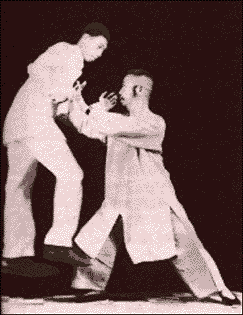
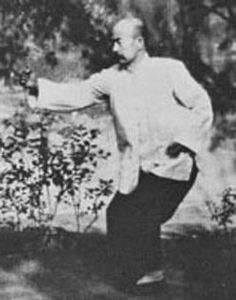
Cheng Man Ching doing Press
In the Tai Chi form Ji is usually done with the back of the hand in the typical Grasp Bird’s Tail sequence (presumably because it the easiest way to capitalise on a good position you’ve already achieved), but there’s nothing about the energy you’re using that means it has to be done with the back of the hand. It can be done with a fist or palm too.
And this is where the Tai Chi waters get a bit murky. There is the martial technique Press, which is to do with pressing further forward into an opponent you are already contacted with, and then there is the abstract concept of “jin in a forward direction”. Anytime you express jin (strength derived from the ground through a relaxed body) in a forward direction you could be said to be doing 挤, but when you put it into a Tai Chi context it takes on this quality of crowding in and pressing that attack.
My guest in this episode will need no introduction to anybody who trains in the Chinese styles of Xing Yi and Baguazhang, especially in the United States. Tim Cartmell is a lifelong martial artist who spent many years living in Asia learning the internal arts, before heading back to the US where he took up BJJ, becoming a black belt. Tim is now the head jiujitsu coach at Ace Jiujitsu Academy in Fountain Valley, California where he teaches classes and trains professional MMA fighters. https://www.acejiujitsu.com/
In this podcast I ask Tim about his training tips, especially for older martial artists, where he thinks martial arts is going in the future and his approach to combining all the arts he knows into a single principle-based, reality-driven approach.
You can find out more about Tim at his website www.shenwu.com and don’t forget to check out the Shen Wu Martial Arts group on Facebook.
I hadn’t talked to Tim before this interview, but many of the people I’ve had as guests on my podcast have rated him highly, and now I know why – for somebody with so much experience of martial arts Tim is a very humble and genuine guy, as I hope you’ll discover over the next hour or so.
You can support The Tai Chi Notebook Podcast by becoming a patron. Head over to www.patreon.com/taichinotebook and become a patron today! You’ll get a version of the podcast you can download, exclusive video clips and articles.
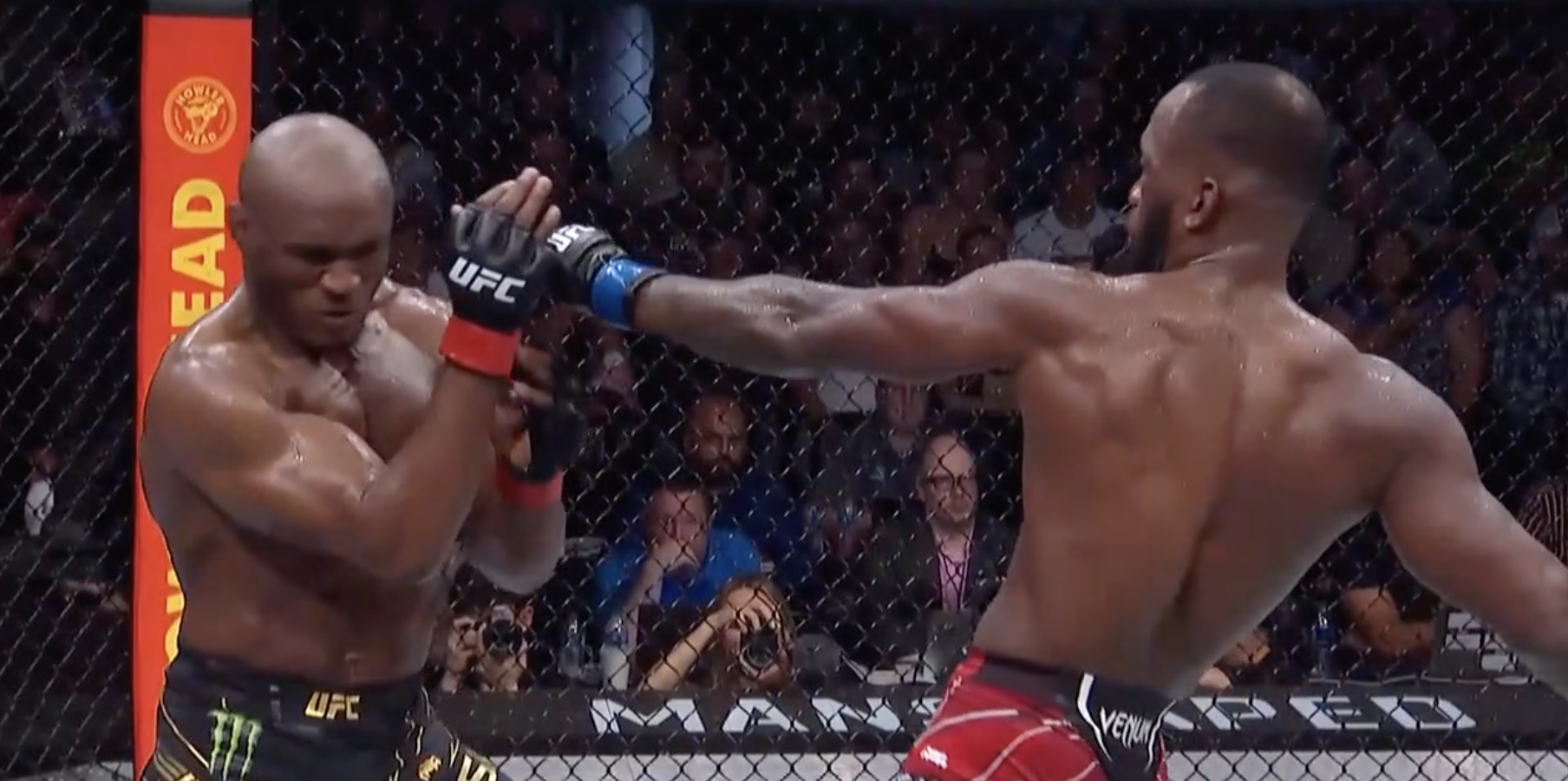
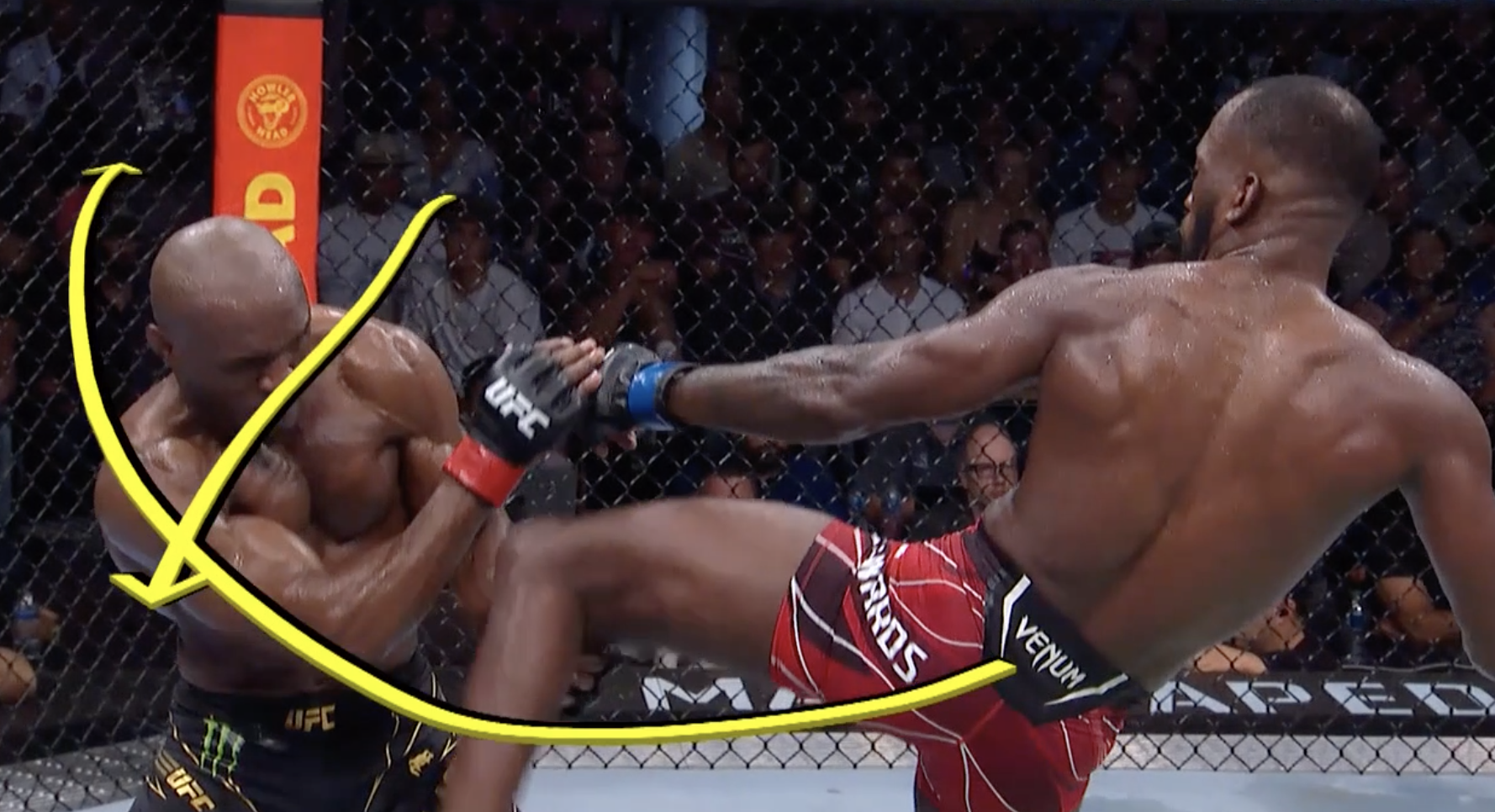
Congratulations to the UK’s Leon Edwards for becoming the new UFC Middleweight Champion of the world with his stunning head kick victory over Kamaru Usman. After a great first round Edwards was clearly losing on points having been dominated by the champion in each round since, but in the fifth and final he pulled off a near perfect head kick as you’re ever going to see, sending Usman crashing to the canvas and making him the new champion.
As the photos show, he set it up with a left that tells Usman to dip his head to the right, but that kick is already coming and it’s all over.
1. Feint the left.2. Usman dips his head.3. Kick connects!
Bagua and Xing Yi are two styles that have historically been trained together. The story you usually read is that martial artists living in Beijing in the 1900s rooming together found the two styles to be complimentary and therefore a long history of cross training naturally arose between them. I think this description of history is true, however, I often wonder if the real story is that earlier in time the two styles sprang from the same source, so this period was more of a reuniting of styles than two separate styles meeting?
Xing Yi Beng Quan
We speculated about the origins of Baguazhang before in the Heretics episode I did with my teacher. That one seemed to upset a lot of people, especially those were emotionally invested in Baguazhang, but hey it’s not called the Heretics Podcast for no reason! You’re going to get an heretical view of things there, and that will always upset people. Perhaps we should have put a big disclaimer on the front! If you’re going to listen to it, we’d suggest emptying your cup first. But anyway…
If we forget historical lineage questions for a moment and just look at the arts as presented today, it’s not hard to see a connection between the two. The stepping is very similar. Xing Yi normally steps in a straight line, but once you look at the turns at the end of each line you start to see what is clearly the same sort of stepping that is used in Baguazhang’s circle walking.
I think this is a very good video by a martial artist called Paul Rogers explaining how Bagua circle walking is basically two steps – an inward turning out step bai bu (inward placing step) and kou bu (hooking step).
Notice that his student is asking him questions about why they circle walk in Baguazhang and he keeps returning to the same answer, which is “you could do it in a straight line”. The problem with doing things on a straight line is that you need a lot of space, doing it in a circle helps you make more efficient use of whatever space you have. So, it’s the steps that are important, not the circle.
Here’s a short article about the two steps and their usage in Baguazhang. Plenty of styles of Baguazhang do have straight line drills too. And when you take the circle walking away, I think the connection between Xing Yi and Baguazhang starts to become clearer, at least to me.
In the Xing Yi lineage I’ve been taught the animal that most looks like Baguazhang is the monkey. These days Xing Yi is know for short little forms (or Lian Huan: “linking sequences” -as we prefer to call them) however I believe this is a result of years and years of politically-directed reformations being applied to the rich and varied martial systems that existed before the Boxer Rebellion. After the Boxer Rebellion and the religious secret societies that fueled it, there was an effort to strip martial arts away from any religious connections. Then came the Kuo Shu movement (we’re simplifying history here, but several authors have written about this – have a look on Amazon, and this video from Will at Monkey Steals Peach will help) and then the Communists arrived with the WuShu movement. The result was that the rich and varied lineages of Xing Yi became standardised, often into short sequences that could be easily taught to large groups. In any case, the idea of set sequences doesn’t have to be the be all and end all of martial arts. Some teacher encourage students to create their own, once they have a good enough understanding off the principles.
We have an extended linking sequence for Monkey, taught to me by my teacher. Here’s a video of me doing a fragment of it, being a Xing Yi Monkey in a forest grove. My natural home :). I’ll put the full video in my Patron’s area if you want to see more of it.
But look at the steps I’m doing – can you see the bai bu and the kou bu? I think that if I added circle walking into that it would be almost indistinguishable from Baguazhang.
This begs the question, which came first? Xing Yi is historically older than Baguazhang, but I think because of the mixing of the arts, they both influenced each other at this point, and possibly are the same art to begin with!
I like to think of the best answer to the terrible question that plagues martial arts lineages of “which is oldest?” is “right now, we are all historically equidistant to the founder”.
I’ve always liked the turtle position in BJJ. It’s supposed to be a position that you don’t go to voluntarily, however, I’m quite happy there and I find there are good opportunities for sweeping your opponent. This is one particular sweep I’ve always liked doing.
It’s off the opponent’s attempted toreando pass. They grab your gi pants at the knee, ready to toreando. You hold both sleeves, so you can adapt to whichever side they go to. Once they move a side is chosen, you turn away from them and stiff arm the sleeve that’s now your top arm. Your bottom arm starts building a base from elbow to hand and gets you into turtle right underneath them. You then wrap the stiff arm around your body and execute a shoulder throw from your hands and knees. In most cases it’s a pretty easy sweep and they go head over heels and land on their back. If the armbar is available then take it, otherwise side control is there for the taking.
A couple of months ago I put my Sacroiliac joint out doing Jiujitsu. Typical symptoms are pain walking, standing in one spot and generally everything involving being alive. I didn’t know it was out initially so carried on training for a couple of days, but the pain steadily increased until I sought help from a sports therapist who diagnosed me, followed by a painful massage which felt good afterwards, not during!
This video shows where the Sacroiliac joint (SI joint) is located (it’s the meeting of the sacrum and the iliac.) The pelvis is not one bone, it’s three bones and the SI joints are what connects them together. The presenters are a bit crazy, but I kind of like them:
As you can see, there’s not much movement in the joint at all, and when it gets jolted it can move out of alignment and that’s when you get all the problems I had. Naturally, your other muscles and tendons have to compensate for the joint being out, and they object, strongly! In my case my piriformis was particularly unhappy about the situation and wanted to let me know by inflaming. Ouch!
Now the video above shows various ways to pop your SI joint back in the right place, but I did it using the baduanjin exercise I was taught as part of Chinese Qigong, so I thought it was worth talking about here.
After a sports massage to relax the tendons I did the usual Baduajin routine I do regularly as part of my morning routine, and during one particular exercise I felt the SI joint pop back in place straight away.
Baduanjin 八段錦 (translates as ‘8 silk force’ or ‘8 pieces of brocade’) are a set of Chinese exercises that could be up to a thousand years old. Simon Cox has a great history of the baduanjin (including a video of them being done) on his website here.
The version of baduanjin I do is way simpler than Simon’s version from Wudang mountain. Here’s a video of my version done by Sifu Kerr of the Spinning Dragon Tao Youtube channel (whose videos are worth checking out as well):
At 6.48 he does “Stretch and Glare to the Horizon” which is the exercise that immediately popped my SI joint back in. I prefer to do that one with my hands in fists rather than the “sword fingers” Sifu Kerr is using, I don’t think it would make any difference to what’s happening to your SI joint either way.
In the Okanagan Valley Wading video that exercises is called “7. 攒拳怒目增力气 Make a fist and with glaring eyes increase your power and qi,”:
But they do it with the fist vertical and very much as a hard punch. The variation I prefer myself is doing it as a slower stretch and I keep my fists horizontal, and a bit bent downwards, so effectively out of alignment for a punch, but with an increased stretch across the yang channels on the outside of the forearm. With the slower stretch version you can really feel the counter rotation on the spine as one arm is stretching forward, the other is simultaneously stretching backwards and you are doing your best to not let your pelvis move – just keep it facing 100% forward and level in a horse stance… And that’s what did it – pop! I felt my SI pain immediately go and the joint felt normal again. Relief!
Clench the Fists and Glare Fiercely, circled in red, was the exercise that did it for me.
As you can see, there are many variations on the baduanjin, (just look at how many you can find on YouTube!). So, I’d suggest sticking with whatever version your teacher gives you. The important thing is these exercises put my SI joint back in place, and for that I’m very thankful, as is my piriformis, which took a couple of weeks to quieten down, but hasn’t bothered me since.
If you ever put your SI joint out, it’s good to know how to put it back, so try the above. I’d recommend a sports massage as well, to deal with the inflamed tendons caused by it being out of place.
Almost by accident I watched Onama vs Landwher from UFC: Marlon Vera vs Dominick Cruz this morning and heavens above, that was one hell of a fight! Possibly the fight of the year. I’ve no idea how you’d score it. Landwher won by decision, but it was possibly the MMA fight of the year. Wild exchanges throughout with both fighters being so tired they could hardly stand up, but somehow kept going. It looked like they both had almost beyond the levels of human endurance, going from looking so tired they could barley move to pulling off flashy 3 move combinations.
You could almost see their spirit rising within to propel them on. It reminded me of all the phrases about the internal harmonies (san nei he) that we use in the Internet arts. The Xin (heart) leads the Yi (intention/mind), the Yi leads the Qi (energy to work) and the Qi leads the Li (physical movement). Initially this seems rather simplistic, say if you want to do something like make a cup of tea then you first have a desire to do it (heart) that travels to the brain (yi) that decides and then it ends up in a physical movement (li) and you find your feet moving you towards the kettle.
But that process happens automatically in humans and all animals, so why do we need to make a big deal of it and describe all the parts that build up to making an automatic process happen?
It’s often explained as putting the intention and will (the brains and heart) behind the movement. You can do things with a sense of purpose, or you can do them absent mindedly. In the internal arts, like Xing Yi, Bagua and Tai Chi, your actions need to have a sense of purpose. Your mind needs to be on the job, not half engaged. That’s one reason, but I think there’s more to these internal harmonies than just this.
I remember in BJJ training sometimes being so exhausted it was like my mind left my body and I became somewhat detached from my surroundings. It’s at moments like that that you start to be able to feel your “spirit” or mind as an identifiable thing. Through a sheer act of will you can force your mind to not give up and get back to the job and it can give you the energy you need to carry on fighting. That’s what I saw happening in Obama vs Landwher. A sheer force of will was being used to make them continue – their internal was leading the external.
Frankly, most people training only internal arts without hard sparring pay a lot of lip service to the internal co-ordinations, but do they ever reach an intensity of training where they can actually feel these things as tangible elements?
I’m not saying that you need to get an an MMA cage to experience your internal state under extreme physical stress before you have any idea what it is, but you can experience it in a safer way through things like Jiujitsu. Maybe Systema, too. Just some food for thought, and another reason why I think all Tai Chi instructors who re physically able should try and get a blue belt in BJJ if they are teaching the art beyond the health aspects.
There’s a risk, when reading this that people might think that using your Yi, or Xin in Tai Chi technique simply means to furrow you brow, put on a mean face, stare hard at something, get really tense and act like you really mean it, man. Because that’s not it either. That’s not what using “martial intent” or Yi means in internal arts at all. If I see people practicing internal arts like that I think it’s just bad karate. Not that there’s anything wrong with karate, of course.
Your internal state can be serious, but come from a place of calm. It’s a strange contrast between being expansive, yet laser focused, like the eyes of an eagle who is high up in the sky looking for prey. He’s taking in all his surroundings, but can pinpoint down on a single point when required. That’s using the 3 internal harmonies properly.
I think this is a Kite, not an Eagle, but you get the idea. Photo by Flo Maderebner on Pexels.com
The Tai Chi classics say:
To fajin, sink, relax completely, and aim in one direction!
There it is – the (sung) relaxed body is the first requirements, once you have it you can ‘point your mind’ in the direction you want your power to go, so that the internal movement matches the external movement. When the inner and outer harmonise together, then you have internal power.
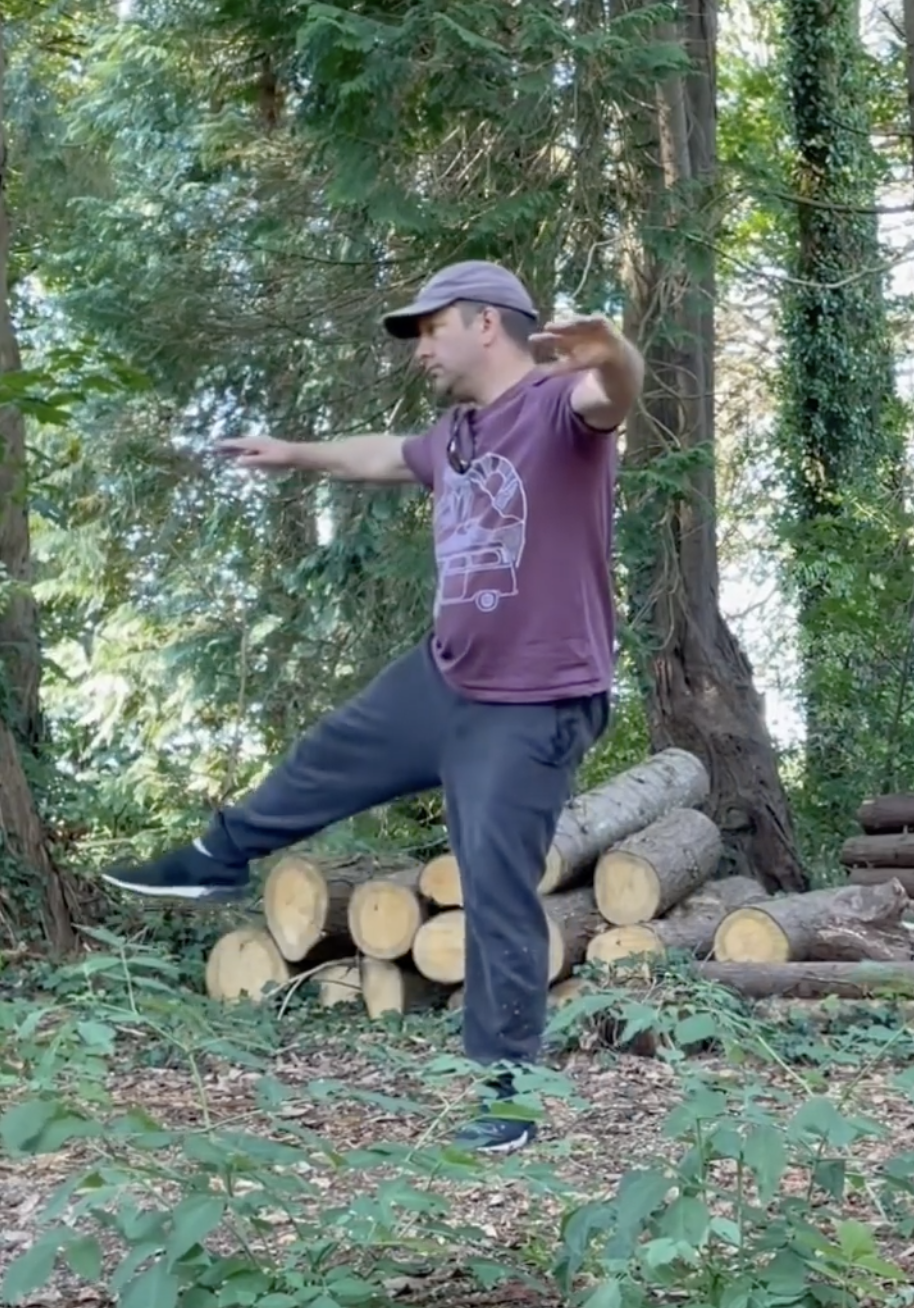
Tai Chi kicks are a great way of testing your balance. Due to the circular nature of Tai Chi technique the sections of the forms where you are kicking often involve turning the body to the left or right while you are standing on one leg. It’s more challenging than a simple one direction kick and is a great training for your balance.
I shot this during this morning’s Tai Chi practice. It’s the kicking section of the short form that we practice in the Yongquan Tai Chi Chuan Association:
You’ll notice that the kicks are done lower than you see in a lot of modern Tai Chi forms. That’s because we’re aiming at the knee. The classical technique for these moves is to block their knee with your foot and pull their arm in the opposite direction to get a takedown. Effectively using the foot as a kind of brace, not really as a kick.
But it’s the training these techniques offer in balance that is their real value I think – a lot of people end up very wobbly on the standing leg when performing these techniques. The key to making it silky smooth is not to think about sinking down into the ground as you raise the leg, but to ‘raise the back’ as you lift the leg. That upward ‘pull’ holds you in place securely so you can deliver a smooth kick.






 The Tai Chi Notebook